1
 →
→
Open-source local AI SDK - run AI on-device with no cloud, no API keys. Supports GGUF, RAG, image, music, and video generation, speech-to-text, P2P inference, and more.
tetherto/qvac is an open-source project on GitHub, mainly written in TypeScript. Open-source local AI SDK - run AI on-device with no cloud, no API keys. Supports GGUF, RAG, image, music, and video generation, speech-to-text, P2P inference It currently holds 621 stars and 112 forks with 0 open issues, and was last pushed on an unknown date (repository created unknown).
AI Homed tracks it on the Local & On-Device AI board.

Build mobile and desktop apps, or serve local models to your favorite AI tools.

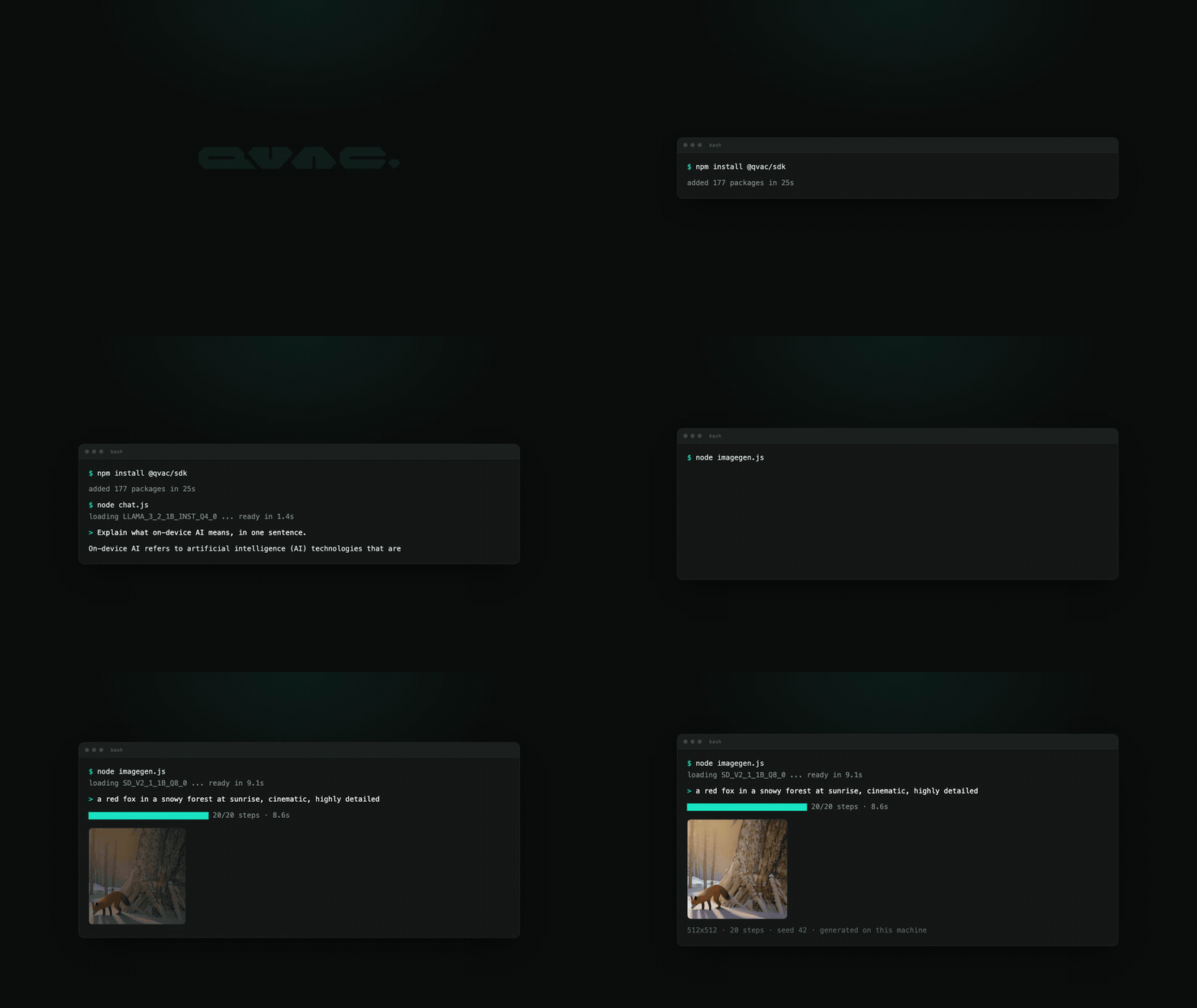
QVAC lets you run a comprehensive range of AI workloads locally using open models across Linux, macOS, Windows, Android, and iOS.
QVAC provides:
Load a model and run inference locally in a few steps. Pick your path.
Run your first example using the JS/TS SDK.
1. Create the examples workspace:
mkdir qvac-examples
cd qvac-examples
npm init -y && npm pkg set type=module
2. Install the SDK:
npm i @qvac/sdk
3. Create qvac.config.json to enable client and server logs during the run:
{
  "loggerConsoleOutput": true,
  "loggerLevel": "info"
}
4. Create the quickstart.js script:
import { loadModel, LLAMA_3_2_1B_INST_Q4_0, completion, unloadModel } from '@qvac/sdk';
try {
  const modelId = await loadModel({
    modelSrc: LLAMA_3_2_1B_INST_Q4_0,
    onProgress: (p) => {
      const mb = (n) => (n / 1e6).toFixed(1);
      const line = ▸ Downloading ${p.percentage.toFixed(0)}% (${mb(p.downloaded)}/${mb(p.total)} MB);
      process.stderr.write(process.stderr.isTTY ? \r${line} : ${line}\n);
      if (p.percentage >= 100) process.stderr.write('\n');
    },
  });
  const history = [{ role: 'user', content: 'Explain quantum computing in one sentence' }];
  const result = completion({ modelId, history, stream: true });
  for await (const token of result.tokenStream) {
    process.stdout.write(token);
  }
  await unloadModel({ modelId });
} catch (error) {
  console.error('✖', error);
  process.exit(1);
}
5. Run the quickstart script:
QVAC_CONFIG_PATH=./qvac.config.json node quickstart.js
You'll see the model download first. Then QVAC will stream the response tokens and print them to the terminal.
Run your first example using the Python SDK.
1. Create the examples workspace:
mkdir qvac-examples-py
cd qvac-examples-py
python -m venv .venv
source .venv/bin/activate
2. Install the package (self-contained — bundles the QVAC worker and Bare runtime, no Node.js required):
# Replace  with the release you want, e.g. sdk-v0.17.0:
pip install tetherto-qvac-sdk \
  -f https://github.com/tetherto/qvac/releases/expanded_assets/sdk-v
3. Create the quickstart.py script:
import asyncio
import sys
from tetherto.qvac_sdk import Client, completion, load_model, unload_model
from tetherto.qvac_sdk.models import LLAMA_3_2_1B_INST_Q4_0
def print_progress(p):
    line = f"▸ Downloading {p.percentage:.0f}% ({p.downloaded / 1e6:.1f}/{p.total / 1e6:.1f} MB)"
    print(line, end="\r" if sys.stderr.isatty() else "\n", file=sys.stderr)
    if p.percentage >= 100:
        print(file=sys.stderr)
async def main():
    async with Client() as client:
        t = client.transport
        try:
            model_id = await load_model(
                t, model_src=LLAMA_3_2_1B_INST_Q4_0, on_progress=print_progress
            )
            run = completion(
                t,
                model_id=model_id,
                history=[
                    {"role": "user", "content": "Explain quantum computing in one sentence"},
                ],
            )
            async for event in run.events:
                if event.type == "contentDelta":
                    sys.stdout.write(event.text)
                    sys.stdout.flush()
            print()
            await unload_model(t, model_id)
        except Exception as error:
            print(f"✖ {error}", file=sys.stderr)
            return 1
    return 0
if __name__ == "__main__":
    sys.exit(asyncio.run(main()))
4. Run the quickstart script:
python quickstart.py
You'll see the model download first. Then QVAC will stream the response tokens and print them to the terminal.
Launch the server with the CLI, then use QVAC as model provider for OpenAI-compatible tools like OpenCode and OpenClaw.
1. Install the CLI globally (this also installs @qvac/sdk as a transitive dependency):
npm install -g @qvac/cli
2. Create the examples workspace:
mkdir qvac-server
cd qvac-server
3. Create the qvac.config.json declaring one model to serve:
{
  "serve": {
    "models": {
      "my-llm": {
        "model": "QWEN3_600M_INST_Q4",
        "default": true,
        "config": { "ctx_size": 8192 }
      }
    }
  }
}
4. Start the server (bound to 127.0.0.1:11434 by default):
qvac serve openai
The model downloads on first start and is preloaded into memory. You'll see progress in the server output.
5. From another terminal, hit it with any OpenAI-compatible client. A minimal curl:
curl http://localhost:11434/v1/chat/completions \
  -H 'Content-Type: application/json' \
  -d '{
    "model": "my-llm",
    "messages": [{"role": "user", "content": "Explain quantum computing in one sentence"}]
  }'
The response comes back as a single JSON payload with the model's answer. Add "stream": true to the body to get an SSE stream instead.
6. Point your AI tool at the server: open its model provider settings and add a new OpenAI-compatible provider with base URL http://localhost:11434/v1, any string as the API key, and my-llm as the model name.
[!IMPORTANT]
Setup varies by tool, and we ship dedicated plugins for some of them (like OpenCode and OpenClaw) that run the server for you. See Connect AI tools to QVAC for details.
⭐ If QVAC saves you from shipping yet another cloud dependency, give it a star, it helps other developers find the project!
| Task | Description |
| --- | --- |
| Text generation | LLM inference for text generation and chat via Fabric LLM. |
| Text embeddings | Vector embedding generation for semantic search, clustering, and retrieval. |
| RAG | Out-of-the-box retrieval-augmented generation workflow. |
| Fine-tuning | Adapting LLMs to domain-specific tasks via LoRA. |
| Multimodal | LLM inference over text, images, and other media in one context. |
| Image generation | Text-to-image and image-to-image generation via a Diffusion backend. |
| Video generation | Text-to-video and image-to-video generation via a Diffusion backend. |
| Music generation | Generate music from text, lyrics, and musical controls via ACE-Step or MiniMax-Music3 (desktop). |
| Transcription | Speech-to-text via a Whisper backend or NVIDIA Parakeet. |
| Text-to-Speech | Speech synthesis via a GGML backend. |
| Translation | Neural machine translation, via Fabric LLM and Bergamot. |
| BCI | Brain–computer interface transcription via a Whisper backend. |
| VLA | Vision-language-action for robot control via a GGML backend. |
| OCR | Extract text from images via ONNX Runtime or GGML backends. See OCR GPU selection (main-gpu) to select a GGML GPU by registry index or device class. |
| Image classification | Classify images into labels with confidence scores via a GGML backend. |
QVAC's built-in P2P capabilities let you build unstoppable internet systems without depending on centralized infrastructure:
Explore and use QVAC:
| Resource | Description | | --- | --- | | Docs | Comprehensive QVAC documentation. | | Examples | Sample apps and PoCs built with QVAC SDK. | | Local model provider | Use QVAC as a local model provider connected to your favorite AI tools. | | QV.AC | Get to know our local AI assistant. | | Support and community | We gather on Discord and Keet. Ask for help, give feedback, and discuss QVAC. | | Blog | Tutorials, deep dives, engineering notes, and announcements. | | Ecosystem | Discover the broader QVAC ecosystem. | | Research | Papers, datasets, and models optimized for edge devices. | | Our vision | Learn why Tether built QVAC. |
We welcome contributions! Feel free to open a pull request, report bugs, or share ideas through issues.
See CONTRIBUTING for details.
Built something with QVAC? Add a badge to your README to show it and help others discover QVAC:


The full set of banners and light/dark and inline badge variants, with copy-paste snippets, lives in BADGES.md.
→ →
→ →
→ →
→ →
→ →
→ →
→ →
→