1
 →
→
Open-source Claude Design alternative. One-click import your Claude Code / Codex API key. Prompt → prototype / slides / PDF. Multi-model (Claude, GPT, Gemini, Kimi, GLM, Ollama).
OpenCoworkAI/open-codesign is an open-source project on GitHub, mainly written in TypeScript. Open-source Claude Design alternative. One-click import your Claude Code / Codex API key. Prompt → prototype / slides / PDF. It currently holds 7,951 stars and 831 forks with 0 open issues, and was last pushed on an unknown date (repository created unknown).
AI Homed tracks it on the Local & On-Device AI board.
简体中文: README.zh-CN.md
Your prompts. Your model. Your laptop.
> Turn prompts into polished artifacts — locally, openly, and with whichever model you already pay for.
Website · Quickstart · What's new · Changelog · Discussions · Docs · Contributing · Security
Open-source alternative to: Claude Design · v0 by Vercel · Lovable · Bolt.new · Figma AI
claude-code · claude-design-alternative · v0-alternative · bolt-alternative · lovable-alternative · figma-alternative · ai-design · design-to-code · prompt-to-design · ai-prototyping · desktop-design-tool · byok · local-first · multi-model · electron
---
feat/decompose-to-ui-kit (branch) — Image -> componentized ui_kits// bundle for coding-agent handoff · Boolean-per-dimension visual parity judge (12 standard checks) · Verify-and-iterate loop · Per-decompose cost row · See BENCHMARKS.md. Refs #225.DESIGN.md design systemsmodels/ prefix fix · OpenAI-compatible relay "instructions required" fix · third-party relay SSE-truncation hint---
Turn a prompt into a polished prototype, slide deck, or marketing asset, locally, with the model you already use.
Open CoDesign is the open-source Claude Design alternative — built for people who want the speed of AI-native design tools without subscription lock-in, cloud-only workflows, or being forced onto a single provider. An MIT-licensed desktop app, local-first from day one, with BYOK for any model (Claude, GPT, Gemini, DeepSeek, Kimi, GLM, Ollama, or any OpenAI-compatible endpoint) plus direct ChatGPT Plus / Pro / Team subscription sign-in for Codex models. One-click import of existing Claude Code or Codex provider configs, or one-click ChatGPT sign-in, gets you running in under 90 seconds.
---
The Examples gallery also includes three editable, asset-backed starting
points: Daymark (Todo brief, task/project JSON, original logo and design
tokens), Common Ground (workshop brief, schedule CSV and original artwork),
and Trailhead (an original low-fidelity SVG sketch, annotated brief and trip
data). Selecting a pack creates a fresh workspace and copies its reference
files before filling the composer; inspect or edit them in Files, then send
when ready. Nothing is submitted automatically and no existing workspace is
overwritten. These fictional MIT-licensed packs contain inputs, not prebuilt
final interfaces. Tags describe supplied references and requested prototype
behavior, not verified generation results. Bookings and other data are
simulated; the sketch includes text annotations for models without image input.
Preflight receives a bounded, non-exhaustive list of existing workspace file
paths and recognizes local DESIGN.md guidance. An absent App.jsx does not
mean reference inputs are missing; the agent can inspect them before building.
Local CSV references are included in the bounded agent text-file scan alongside
Markdown, JSX, JSON, and SVG inputs.
Preview and final verification resolve local assets relative to the source file
inside the bound workspace. Missing assets and paths outside that workspace
remain verification errors.
While a design is generating, Queue follow-up (Enter) adds a text request for when the agent would otherwise finish. Steer next step supplies it after the current assistant response and tool batch finish; it does not interrupt file writes, streaming tokens, permission decisions, or an unanswered agent question. The current run keeps its model, reasoning setting, and workspace. Queued requests are explicitly marked pending until the agent receives them. Stop, errors, or restarting the app leave undelivered requests recoverable, never automatically resent. Active-run messages are text-only: remove attached files, reference URLs, and queued comments before sending; those drafts are not silently included or discarded. Individual queue editing/removal is not supported. Delivery receipts use the existing local pi session JSONL, not a separate database. After sending, an empty composer stays compact; queue and steering actions appear only while composing another message. Delivery explanations are available on demand, not inserted into the draft. Long tool errors show a short reason with expandable, scrollable original diagnostics.
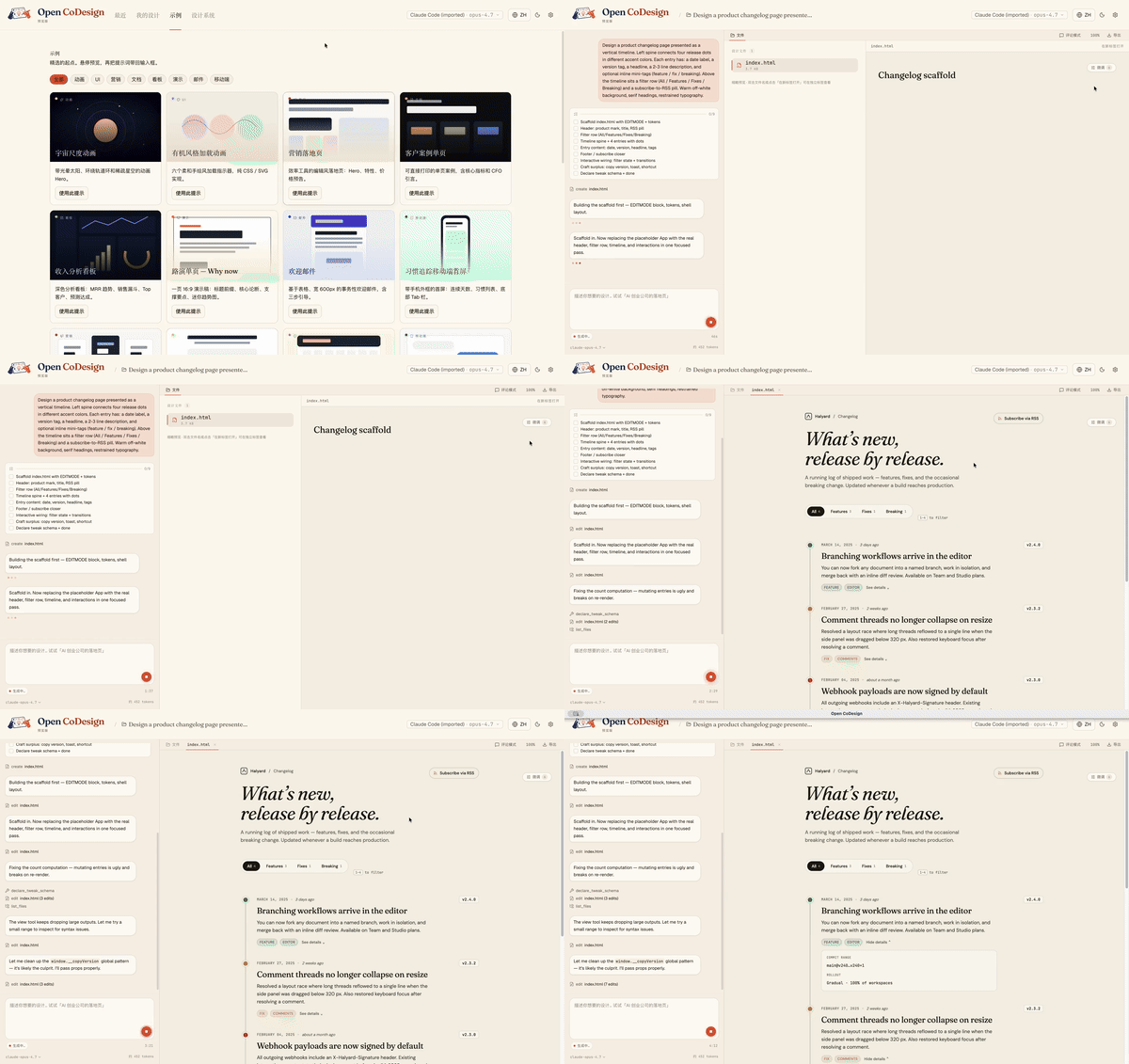
From a blank prompt to a finished artifact, the agent plans, writes, self-checks, and ships something with hover states, tabs, and empty states already wired up:
---
Open source, desktop-native, and built for people who do not want their design workflow locked to one model or one cloud.
| | Open CoDesign | Claude Design | v0 by Vercel | Lovable | |---|:---:|:---:|:---:|:---:| | Open source | ✅ MIT | ❌ Closed | ❌ Closed | ❌ Closed | | Desktop native | ✅ Electron | ❌ Web only | ❌ Web only | ❌ Web only | | Bring your own key | ✅ Any provider | ❌ Anthropic only | ❌ Vercel only | ⚠️ Limited | | Local / offline | ✅ Fully local app | ❌ Cloud | ❌ Cloud | ❌ Cloud | | Models | ✅ 20+ (Claude, GPT, Gemini, Ollama…) | Claude only | GPT-4o | Multi-LLM | | Version history | ✅ Local sessions + workspace files | ❌ | ❌ | ❌ | | Data privacy | ✅ On-device app state | ❌ Cloud-processed | ❌ Cloud | ❌ Cloud | | Editable export | ✅ HTML, PDF, PPTX, ZIP, Markdown | ⚠️ Limited | ⚠️ Limited | ⚠️ Limited | | Price | ✅ Free app, provider/subscription cost only | 💳 Subscription | 💳 Subscription | 💳 Subscription |
---
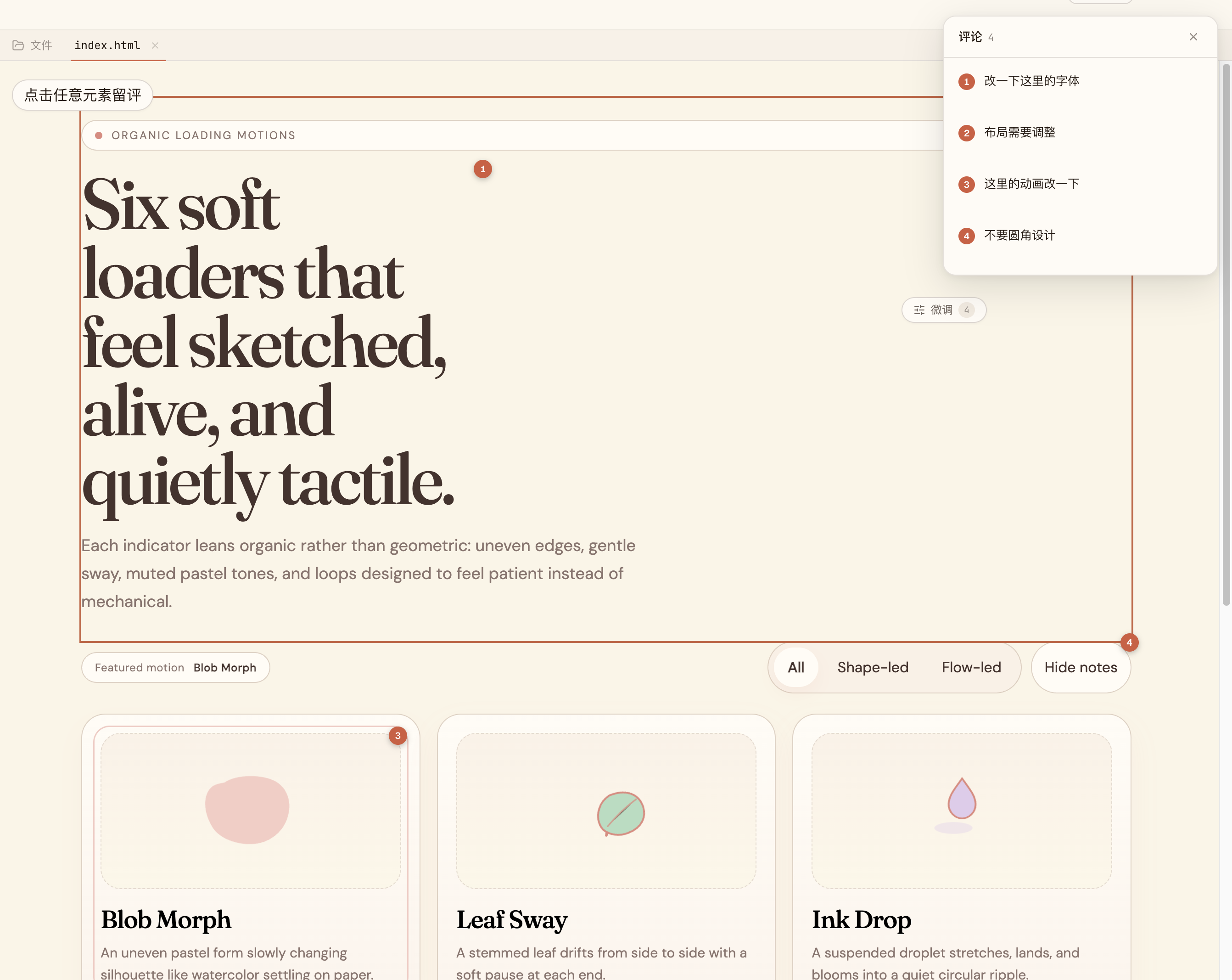
Comment, don’t retype. |
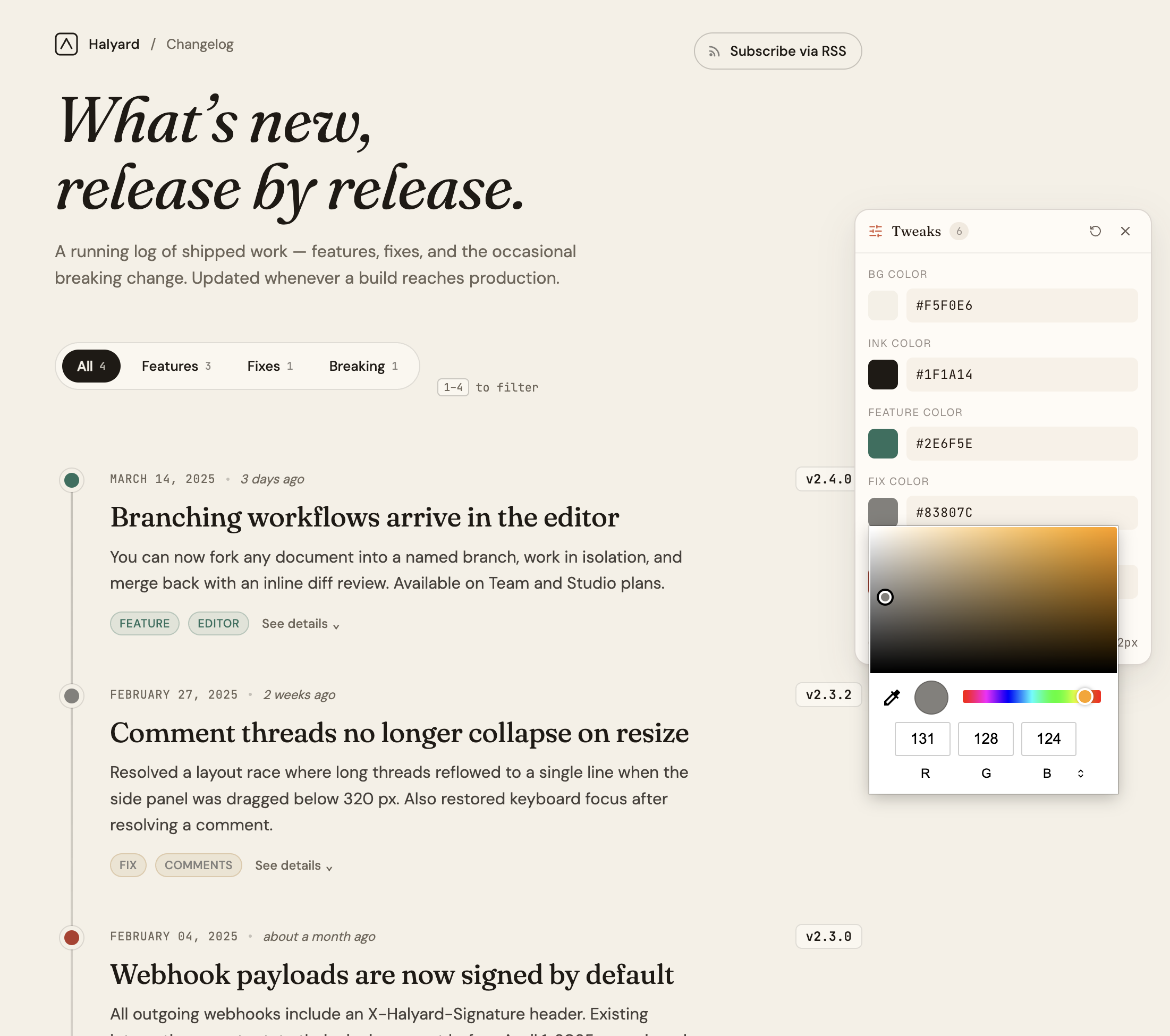
AI-tuned sliders. |
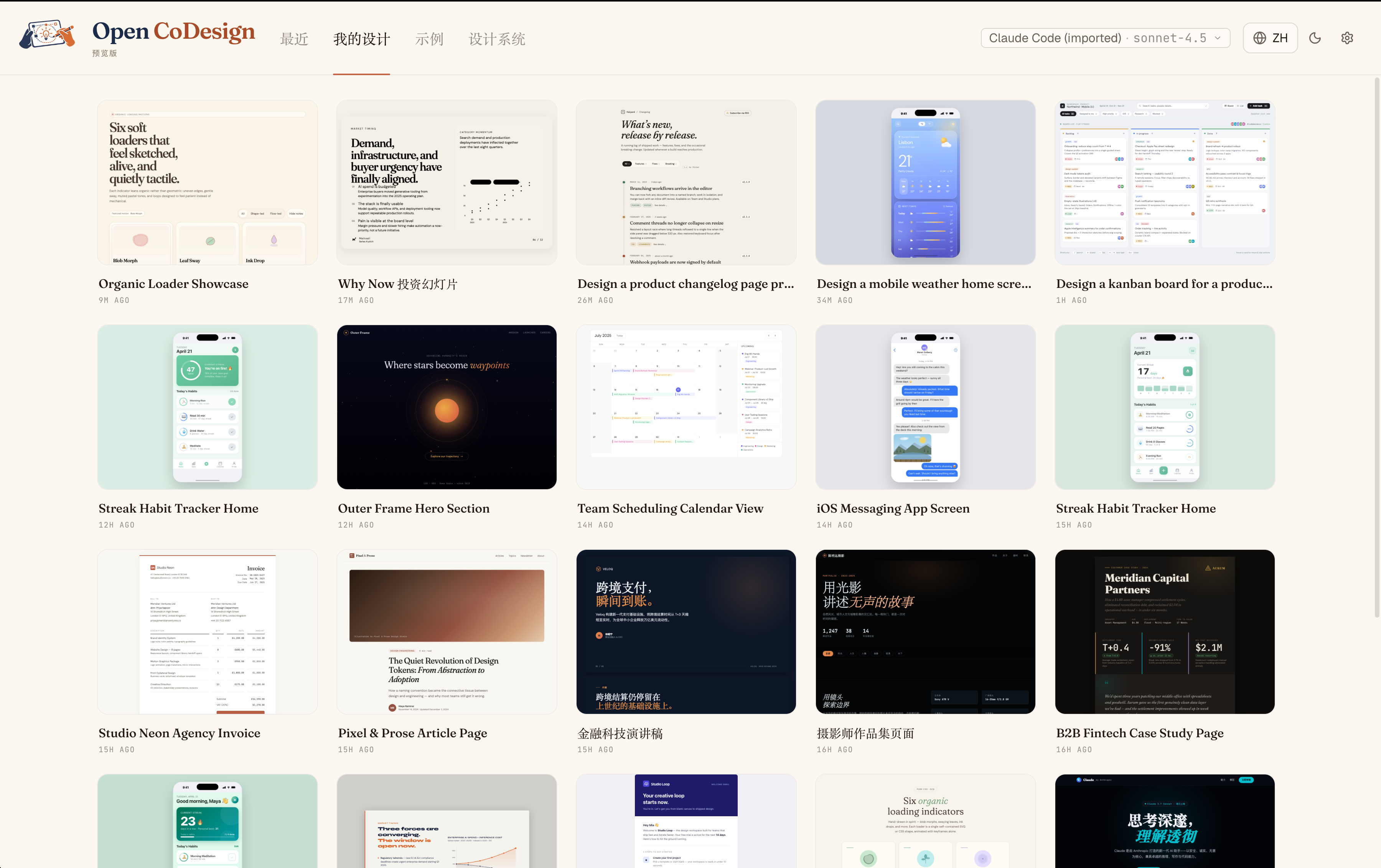
Every iteration, kept. |
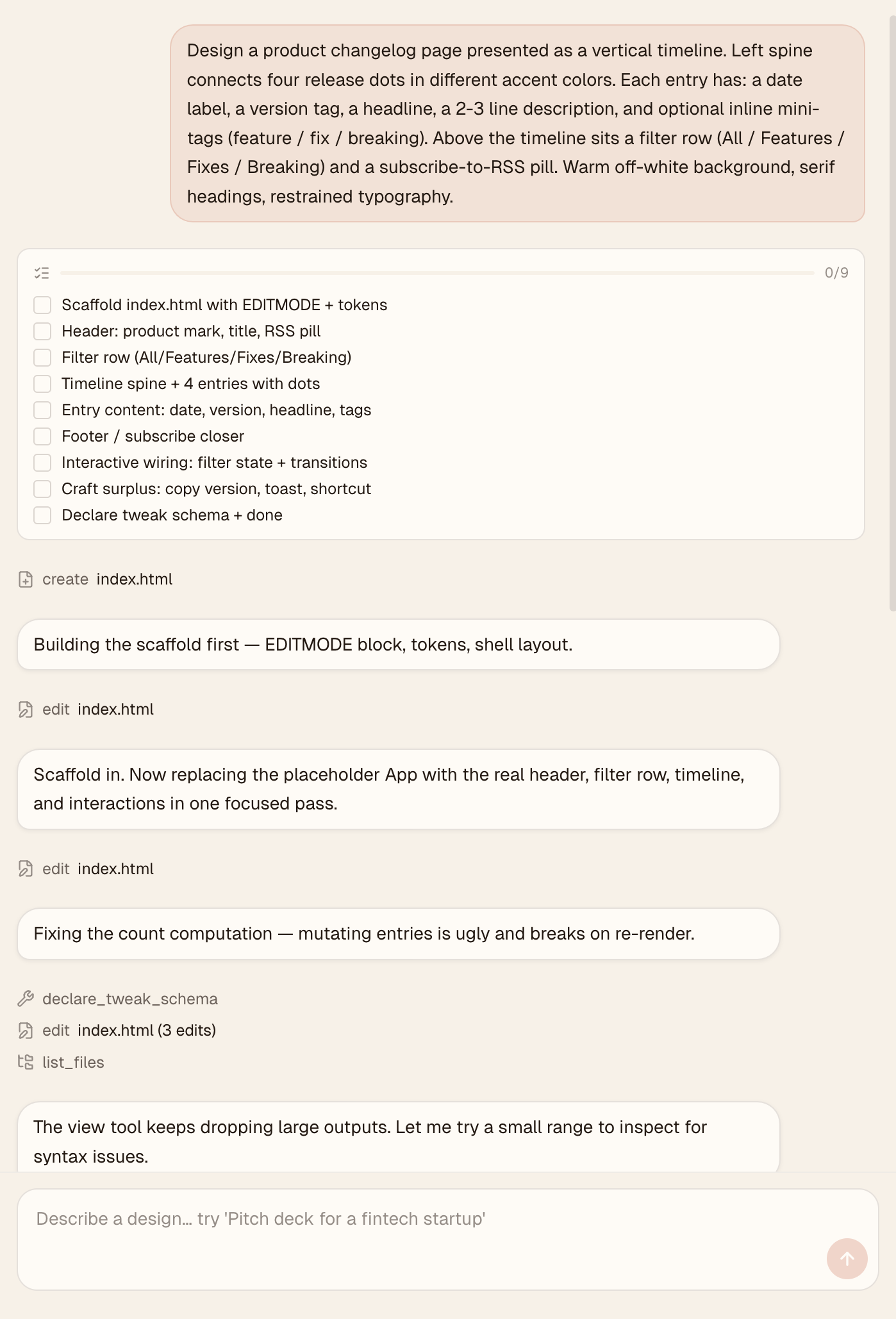
Watch the agent work. |
---
Time to first artifact: about 3 minutes
Requires: one API key, ChatGPT subscription sign-in, or local Ollama
Runs on: macOS 12+ (Monterey or later), Windows 10+, Linux (glibc ≥ 2.31)
Package manager (recommended):
# macOS
brew install --cask opencoworkai/tap/open-codesign
Windows — Scoop
scoop bucket add opencoworkai https://github.com/OpenCoworkAI/scoop-bucket
scoop install opencoworkai/open-codesign
Or direct download from the v0.2.0 GitHub Release:
| Platform | File |
|---|---|
| macOS (Apple Silicon) | open-codesign-*-arm64.dmg |
| macOS (Intel) | open-codesign-*-x64.dmg |
| Windows (x64) | open-codesign-*-x64-setup.exe |
| Windows (ARM64) | open-codesign-*-arm64-setup.exe |
| Linux (x64, AppImage) | open-codesign-*-x64.AppImage |
| Linux (x64, Debian/Ubuntu) | open-codesign-*-x64.deb |
| Linux (x64, Fedora/RHEL) | open-codesign-*-x64.rpm |
Each release ships with SHA256SUMS.txt and a CycloneDX SBOM (*-sbom.cdx.json) so you can verify what you downloaded.
| Manager | Command | Status |
|---|---|---|
| Homebrew Cask (macOS) | brew install --cask opencoworkai/tap/open-codesign | 🟢 Live |
| Scoop (Windows) | scoop bucket add opencoworkai https://github.com/OpenCoworkAI/scoop-bucket && scoop install opencoworkai/open-codesign | 🟢 Live |
| winget (Windows) | winget install OpenCoworkAI.OpenCoDesign | 🟡 PR submitted; waiting for Microsoft review |
| Flathub (Linux) | flatpak install flathub ai.opencowork.codesign | ⏸ Deferred; needs signed build + AppStream metadata |
| Snap (Linux) | snap install --dangerous open-codesign-*.snap | 🟡 Attached to releases best-effort; Snap Store publish not yet wired |
After each stable tag push, CI syncs SHAs back into packaging/ and publishes downstream Homebrew/Scoop updates when the repo secrets are configured. The first winget submission is in review; once Microsoft accepts the package, future winget bumps can be automated from the release workflow. Every packaging/*/README.md documents its own channel.
Unsigned installer note: installers are not notarized or Authenticode-signed yet. On macOS Sequoia 15+ right-click → Open no longer bypasses Gatekeeper, and "Open Anyway" in System Settings often fails. Reliable one-liner:
>> xattr -cr "/Applications/Open CoDesign.app"
> Then double-click normally. (Older 0.1.x builds are installed as /Applications/open-codesign.app.)
On Windows: SmartScreen → More info → Run anyway.
> Want a verified build? Compile from source — see CONTRIBUTING.md.
On first launch, Open CoDesign opens the Settings page. Pick the path that matches how you already use models:
sk-ant-...), OpenAI (sk-...), Google Gemini, OpenRouter, SiliconFlow, DeepSeek, or another supported provider key.JSX previews and standalone exports use system-ui by default without downloading fonts. The runtime loads a supported Google Fonts family (Fraunces, DM Serif Display, DM Sans, or JetBrains Mono) only when the artifact explicitly references it. Use local/system fonts for offline-only designs; explicit remote font choices still require network access.
Credentials stay in ~/.config/open-codesign/config.toml and the ChatGPT OAuth token store under the app config directory. Nothing leaves your machine unless your chosen model route requires it.
Pick one of fifteen built-in demos — landing page, dashboard, pitch slide, pricing, mobile app, chat UI, event calendar, blog article, receipt/invoice, portfolio, settings panel, and more — or describe your own. A sandboxed prototype appears in seconds.
For app requests, the agent is guided to build a bounded, connected local prototype, not a collection of isolated screens: a core journey, working navigation and back paths, shared records, and relevant validation, empty, and success states. For example: “Build Daymark, a polished mobile Todo app for planning a day.” Adding, editing, completing, and filtering tasks should update related views and counts together. Explicit single-screen requests, decks, documents, and narrow revisions keep their original scope.
Substantial fresh apps use a few runnable milestones: an early coherent frame with visual tokens and realistic initial content, connected journeys and shared-state actions, then integrated craft and responsive refinement. The agent edits complete, readable source at each checkpoint rather than holding back one giant file or showing generation placeholders. An early frame preview is progress, not completion; the final requested journeys still need to be implemented and checked. This is workflow guidance, not a guaranteed generation-speed improvement.
When useful or requested, tweak controls focus on consequential choices such as brand, density, type scale, and implemented layout variants, rather than every pixel. Defaults should match the source, choices should affect the relevant screens, and later agent edits should preserve your selections. Checking a source variant in preview does not verify the separate host tweak panel or guarantee automatic updates to unbound files.
These are interactive prototypes, not production services. Data and service actions are simulated; backend setup, real authentication, and payments are not implied. State is in memory by default and may reset on reload. The agent previews the result and, when supported by the preview tool, exercises a bounded journey at the target viewport, repairs concrete failures, and distinguishes runtime checks from interactions actually tested.
---
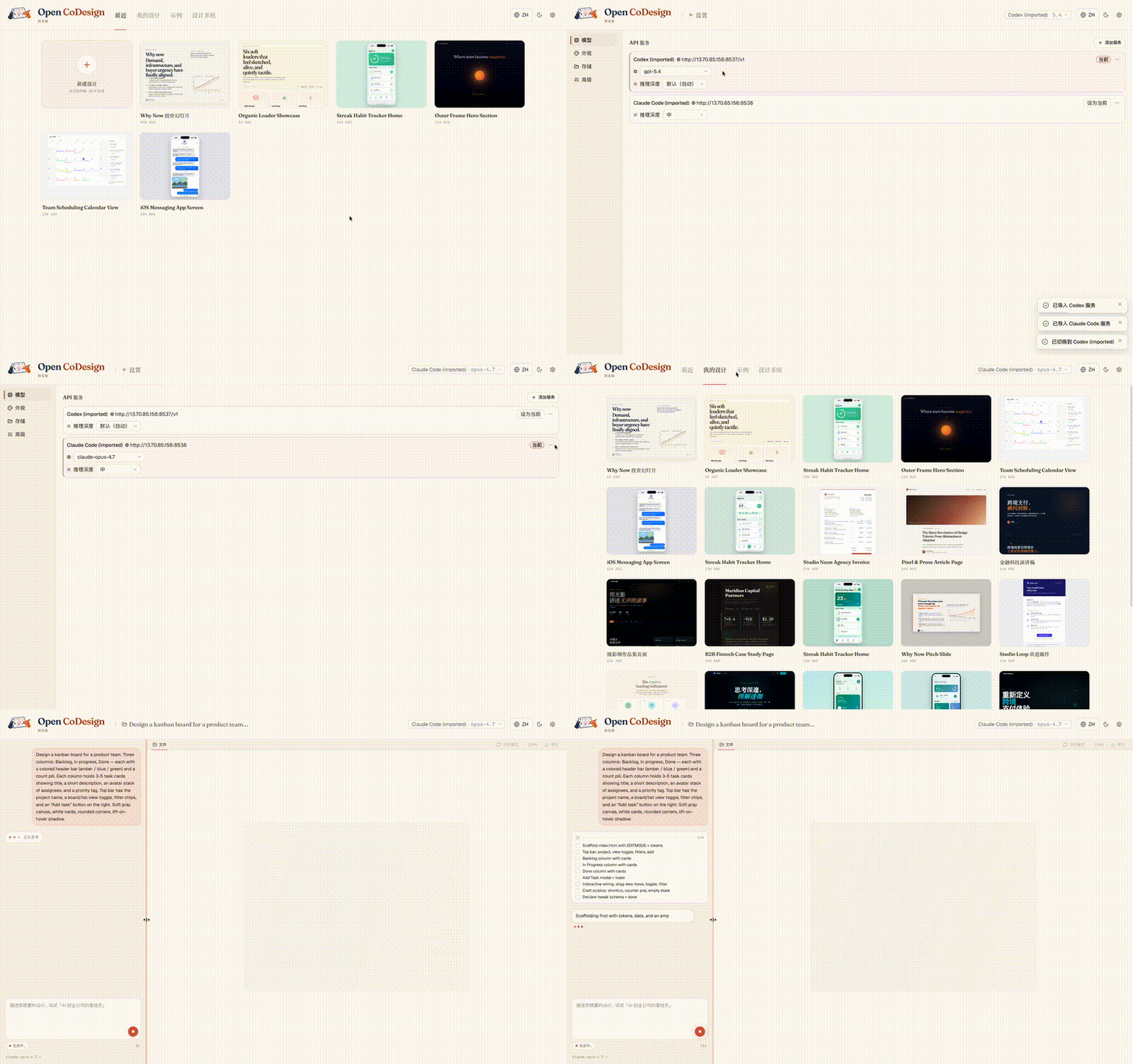
Already using Claude Code or Codex? API-key provider configs import in one click, with no copy-paste and no need to re-enter settings. If you use Codex through ChatGPT subscription login, sign in directly from Settings:
---
Build first, clarify blockers. Capability routing does not open a pre-generation questionnaire. The agent chooses reversible visual and layout details, notes material assumptions, and delivers a preview before optional refinement. It can still ask a compact batch for genuinely missing required facts or references, an output constraint that cannot be inferred, or your explicit request for a brief interview. Concept drafts may label nonessential event details as pending; official dates, sponsors, and legal claims must not be invented. Permission prompts remain separate and are not automatically approved.
Answered ask results already stored in the current design's session are reused as labelled data within the existing history budget, without displacing selected conversation or the design brief. Cancelled, empty, malformed, unmatched, or count-only results are not treated as answers or consent. Oversized answer groups are omitted intact rather than misleadingly truncated; facts that older preflight events never stored cannot be reconstructed.
Open CoDesign combines shared design guidance with on-demand method skills for composition, app navigation, mobile layouts, accessibility, charts, decks, and design-system handoff. Visual direction comes from the brief and references, not a fixed font or palette blacklist. Existing designs keep their language unless a redesign is requested.
The core prompt defines scope, workspace/runtime boundaries, and completion evidence. Selected skills provide focused techniques and examples, including source-backed tweak declarations and a DESIGN.md example checked against the app's validator. Resource indexes are available up front; full method bodies load only when requested by the agent.
DESIGN.md component extensions with string values (such as minHeight or borderRadius) are preserved with non-blocking warnings, following the pinned Google DESIGN.md consumer rules. Completion reports these metadata warnings separately; malformed token types and runtime failures still block completion. This targeted compatibility rule does not imply full conformance with every evolving upstream feature.
This approach synthesizes OpenAI's current prompting guidance, Claude prompting best practices, and skill-authoring guidance, reviewed on September 17, 2026. The dated official frontend-design reference informed an original rewrite; no external skill text is bundled. These are shared product rules, not assumptions that a private gateway model ID has a vendor's documented capabilities.
Contract tests check loaded instructions, supported source examples, preference consistency, and size limits. They do not establish faster generation, visual quality, or working journeys in every model output; those require separate rendered evaluation. Existing profiles load their local template copies, so rebuilding the app alone does not replace older or customized method text. Template upgrades must preserve user-owned content.
---
ui_kits// folder (index.html + components/*.tsx + tokens.css + manifest.json + README.md) shaped for coding-agent handoff. Built-in deterministic + vision verifiers self-check parity using a 12-question boolean rubric (no floating-point arbitrary scores) and re-iterate on gaps. Per-decompose cost surfaces inline as a toast. See BENCHMARKS.md.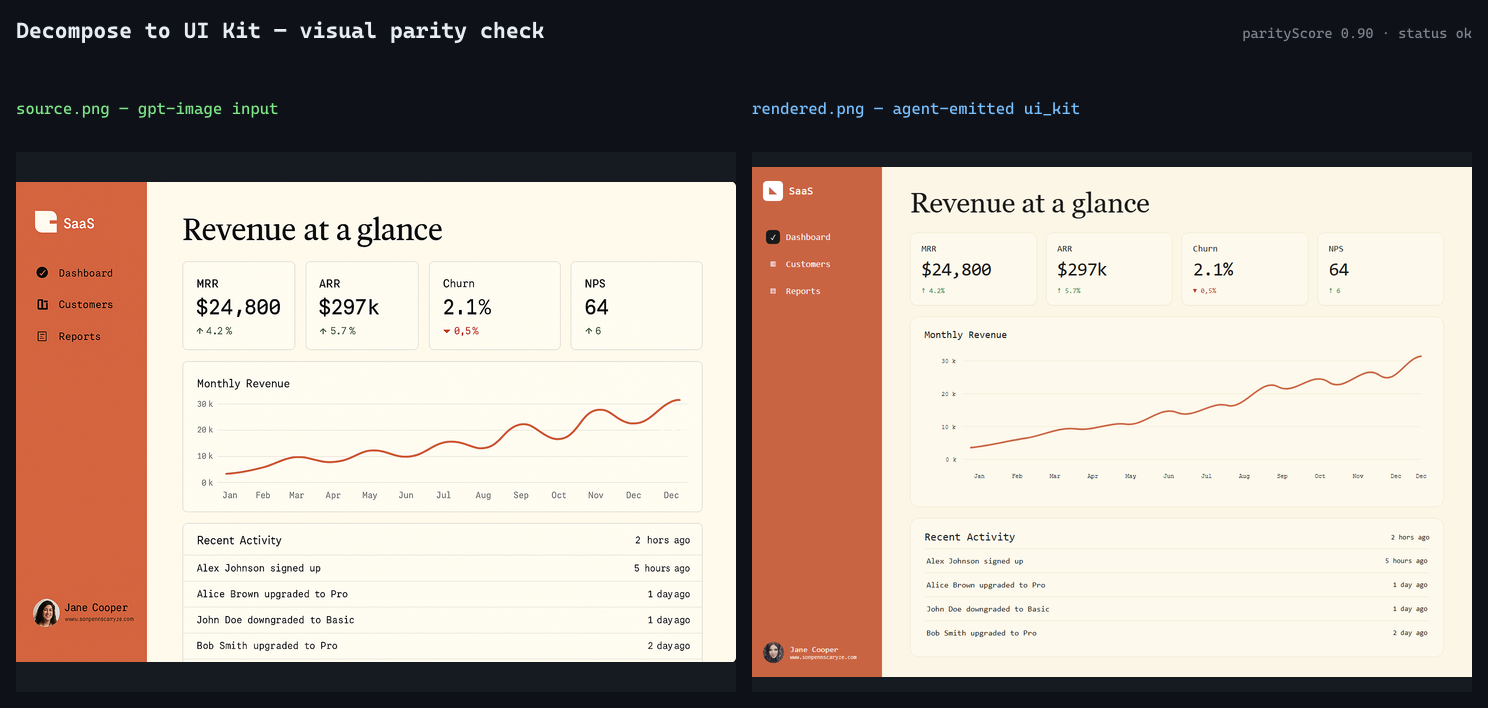 Source image (gpt-image input) on the left, agent-emitted→
 →
→ →
→ →
→ →
→ →
→ →
→ →
→