1
 →
→
VITS: Conditional Variational Autoencoder with Adversarial Learning for End-to-End Text-to-Speech
jaywalnut310/vits is an open-source project on GitHub, mainly written in Python. VITS: Conditional Variational Autoencoder with Adversarial Learning for End-to-End Text-to-Speech It currently holds 7,892 stars and 0 forks with 0 open issues, and was last pushed on an unknown date (repository created unknown).
AI Homed tracks it on the AI Audio Projects board and on the AI AI Audio Projects list.
In our recent paper, we propose VITS: Conditional Variational Autoencoder with Adversarial Learning for End-to-End Text-to-Speech.
Several recent end-to-end text-to-speech (TTS) models enabling single-stage training and parallel sampling have been proposed, but their sample quality does not match that of two-stage TTS systems. In this work, we present a parallel end-to-end TTS method that generates more natural sounding audio than current two-stage models. Our method adopts variational inference augmented with normalizing flows and an adversarial training process, which improves the expressive power of generative modeling. We also propose a stochastic duration predictor to synthesize speech with diverse rhythms from input text. With the uncertainty modeling over latent variables and the stochastic duration predictor, our method expresses the natural one-to-many relationship in which a text input can be spoken in multiple ways with different pitches and rhythms. A subjective human evaluation (mean opinion score, or MOS) on the LJ Speech, a single speaker dataset, shows that our method outperforms the best publicly available TTS systems and achieves a MOS comparable to ground truth.
Visit our demo for audio samples.
We also provide the pretrained models.
** Update note: Thanks to Rishikesh (ऋषिकेश), our interactive TTS demo is now available on Colab Notebook.
| VITS at training | VITS at inference |
|---|---|
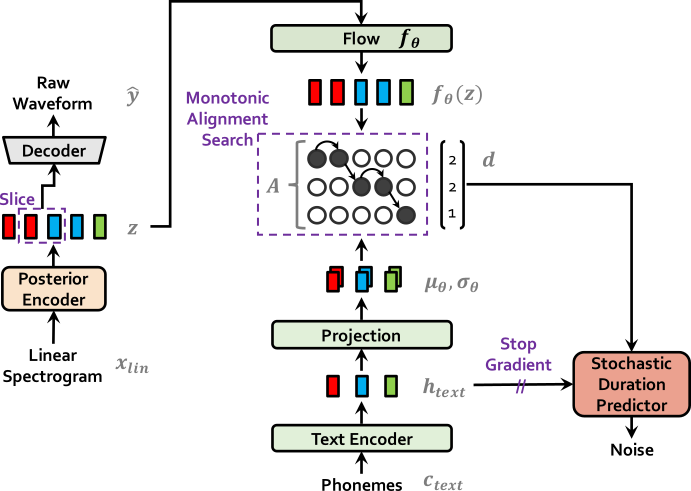 |
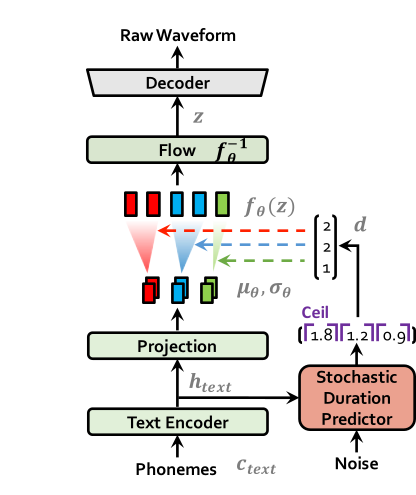 |
apt-get install espeak
0. Download datasets
1. Download and extract the LJ Speech dataset, then rename or create a link to the dataset folder: ln -s /path/to/LJSpeech-1.1/wavs DUMMY1
1. For mult-speaker setting, download and extract the VCTK dataset, and downsample wav files to 22050 Hz. Then rename or create a link to the dataset folder: ln -s /path/to/VCTK-Corpus/downsampled_wavs DUMMY2
0. Build Monotonic Alignment Search and run preprocessing if you use your own datasets.
# Cython-version Monotonoic Alignment Search
cd monotonic_align
python setup.py build_ext --inplace
Preprocessing (g2p) for your own datasets. Preprocessed phonemes for LJ Speech and VCTK have been already provided.
python preprocess.py --text_index 1 --filelists filelists/ljs_audio_text_train_filelist.txt filelists/ljs_audio_text_val_filelist.txt filelists/ljs_audio_text_test_filelist.txt
python preprocess.py --text_index 2 --filelists filelists/vctk_audio_sid_text_train_filelist.txt filelists/vctk_audio_sid_text_val_filelist.txt filelists/vctk_audio_sid_text_test_filelist.txt
# LJ Speech
python train.py -c configs/ljs_base.json -m ljs_base
VCTK
python train_ms.py -c configs/vctk_base.json -m vctk_base
 →
→ →
→ →
→ →
→ →
→ →
→ →
→