1
 →
→
VoxCPM2: Tokenizer-Free TTS for Multilingual Speech Generation, Creative Voice Design, and True-to-Life Cloning
OpenBMB/VoxCPM is an open-source project on GitHub, mainly written in Python. VoxCPM2: Tokenizer-Free TTS for Multilingual Speech Generation, Creative Voice Design, and True-to-Life Cloning It currently holds 37,599 stars and 0 forks with 0 open issues, and was last pushed on an unknown date (repository created unknown).
AI Homed tracks it on the AI Audio Projects board and on the AI AI Audio Projects list.
English | 中文

👋 Join our community for discussion and support!
 Feishu
|
Feishu
|
 Discord
|
📚 MiniCPM Wiki
Discord
|
📚 MiniCPM Wiki
VoxCPM is a tokenizer-free Text-to-Speech system that directly generates continuous speech representations via an end-to-end diffusion autoregressive architecture, bypassing discrete tokenization to achieve highly natural and expressive synthesis.
VoxCPM2 is the latest major release — a 2B parameter model trained on over 2 million hours of multilingual speech data, now supporting 30 languages, Voice Design, Controllable Voice Cloning, and 48kHz studio-quality audio output. Built on a MiniCPM-4 backbone.
Chinese Dialect: 四川话, 粤语, 吴语, 东北话, 河南话, 陕西话, 山东话, 天津话, 闽南话
pip install voxcpm
Requirements: Python ≥ 3.10 (<3.13), PyTorch ≥ 2.5.0, CUDA ≥ 12.0. See Quick Start Docs for details.
from voxcpm import VoxCPM
import soundfile as sf
model = VoxCPM.from_pretrained(
  "openbmb/VoxCPM2",
  load_denoiser=False,
)
wav = model.generate(
    text="VoxCPM2 is the current recommended release for realistic multilingual speech synthesis.",
    cfg_value=2.0,
    inference_timesteps=10,
    seed=42,
)
sf.write("demo.wav", wav, model.tts_model.sample_rate)
print("saved: demo.wav")
If you prefer downloading from ModelScope first, you can use:
pip install modelscope
from modelscope import snapshot_download
snapshot_download("OpenBMB/VoxCPM2", local_dir='./pretrained_models/VoxCPM2') # specify the local directory to save the model
from voxcpm import VoxCPM
import soundfile as sf
model = VoxCPM.from_pretrained("./pretrained_models/VoxCPM2", load_denoiser=False)
wav = model.generate(
    text="VoxCPM2 is the current recommended release for realistic multilingual speech synthesis.",
    cfg_value=2.0,
    inference_timesteps=10,
    seed=42,
)
sf.write("demo.wav", wav, model.tts_model.sample_rate)
Create a voice from a natural-language description — no reference audio needed. Format: put the description in parentheses at the start of text(e.g. "(your voice description)The text to synthesize."):
wav = model.generate(
    text="(A young woman, gentle and sweet voice)Hello, welcome to VoxCPM2!",
    cfg_value=2.0,
    inference_timesteps=10,
    seed=42,
)
sf.write("voice_design.wav", wav, model.tts_model.sample_rate)
Upload a reference audio. The model clones the timbre, and you can still use control instructions to adjust speed, emotion, or style.
wav = model.generate(
    text="This is a cloned voice generated by VoxCPM2.",
    reference_wav_path="path/to/voice.wav",
)
sf.write("clone.wav", wav, model.tts_model.sample_rate)
wav = model.generate(
    text="(slightly faster, cheerful tone)This is a cloned voice with style control.",
    reference_wav_path="path/to/voice.wav",
    cfg_value=2.0,
    inference_timesteps=10,
    seed=42,
)
sf.write("controllable_clone.wav", wav, model.tts_model.sample_rate)
Provide both the reference audio and its exact transcript for audio-continuation-based cloning with every vocal nuance reproduced. For maximum cloning similarity, pass the same reference clip to both reference_wav_path and prompt_wav_path as shown below:
wav = model.generate(
    text="This is an ultimate cloning demonstration using VoxCPM2.",
    prompt_wav_path="path/to/voice.wav",
    prompt_text="The transcript of the reference audio.",
    reference_wav_path="path/to/voice.wav", # optional, for better simliarity
)
sf.write("hifi_clone.wav", wav, model.tts_model.sample_rate)
🔄 Streaming API
import numpy as np
chunks = []
for chunk in model.generate_streaming(
    text="Streaming text to speech is easy with VoxCPM!",
):
    chunks.append(chunk)
wav = np.concatenate(chunks)
sf.write("streaming.wav", wav, model.tts_model.sample_rate)
# Voice design (no reference audio needed)
voxcpm design \
  --text "VoxCPM2 brings studio-quality multilingual speech synthesis." \
  --output out.wav
Controllable voice cloning with style control
voxcpm design \
  --text "VoxCPM2 brings studio-quality multilingual speech synthesis." \
  --control "Young female voice, warm and gentle, slightly smiling" \
  --seed 42 \
  --output out.wav
Voice cloning (reference audio)
voxcpm clone \
  --text "This is a voice cloning demo." \
  --reference-audio path/to/voice.wav \
  --output out.wav
Ultimate cloning (prompt audio + transcript)
voxcpm clone \
  --text "This is a voice cloning demo." \
  --prompt-audio path/to/voice.wav \
  --prompt-text "reference transcript" \
  --reference-audio path/to/voice.wav \ # optional, for better simliarity
  --output out.wav
Batch processing
voxcpm batch --input examples/input.txt --output-dir outs
Optional post-generation timestamps with stable-ts
pip install "voxcpm[timestamps]"
voxcpm design \
  --text "VoxCPM2 brings studio-quality multilingual speech synthesis." \
  --output out.wav \
  --timestamps \
  --timestamp-level word \
  --timestamp-language en
Character timestamps are best-effort and are derived from word alignment
voxcpm design \
  --text "欢迎使用 VoxCPM2。" \
  --output out.wav \
  --timestamps \
  --timestamp-level char \
  --timestamp-language zh
Help
voxcpm --help
python app.py --port 8808 # then open in browser: http://localhost:8808
Use --device to choose the runtime device:
python app.py --device auto
Supported values are auto, cpu, mps, cuda, and cuda:N. On Apple Silicon Macs, auto uses MPS when available.
For high-throughput serving, use Nano-vLLM-VoxCPM — a dedicated inference engine built on Nano-vLLM with concurrent request support and an async API.
pip install nano-vllm-voxcpm
from nanovllm_voxcpm import VoxCPM
import numpy as np, soundfile as sf
server = VoxCPM.from_pretrained(model="/path/to/VoxCPM", devices=[0])
chunks = list(server.generate(target_text="Hello from VoxCPM!"))
sf.write("out.wav", np.concatenate(chunks), 48000)
server.stop()
RTF as low as ~0.13 on NVIDIA RTX 4090 (vs ~0.3 with the standard PyTorch implementation), with support for batched concurrent requests and a FastAPI HTTP server. See the Nano-vLLM-VoxCPM repo for deployment details.
For production multi-tenant deployments, use vLLM-Omni — the official vLLM project's omni-modal extension with native VoxCPM2 support. PagedAttention KV cache, continuous batching, and a drop-in OpenAI-compatible /v1/audio/speech endpoint.
# Install from source (latest main — vllm-omni is rapidly evolving)
uv pip install vllm==0.19.0 --torch-backend=auto
git clone https://github.com/vllm-project/vllm-omni.git && cd vllm-omni
uv pip install -e .
See the vLLM-Omni installation guide for other platforms (ROCm, XPU, MUSA, NPU) and Docker images.
# Launch an OpenAI-compatible TTS server (--omni enables omni-modal serving)
vllm serve openbmb/VoxCPM2 --omni --port 8000
Call it from any OpenAI client
curl http://localhost:8000/v1/audio/speech \
  -H "Content-Type: application/json" \
  -d '{"model":"openbmb/VoxCPM2","input":"Hello from VoxCPM2 on vLLM-Omni!","voice":"default"}' \
  --output out.wav
Built on the upstream vLLM scheduler, with batched concurrent requests, streaming chunk delivery, and multi-GPU deployment out of the box. See the VoxCPM2 example for full deployment recipes.
For on-device / edge deployment without Python, use llama.cpp-omni — a high-performance C++ inference engine built on llama.cpp, with native VoxCPM2 GGUF support on CPU / Metal / CUDA / Vulkan.
1. Download GGUF weights from HuggingFace | ModelScope — you need one BaseLM (F16 or Q8_0) + the Acoustic file. Q8_0 halves the download with negligible quality loss.
2. Build
git clone https://github.com/tc-mb/llama.cpp-omni.git && cd llama.cpp-omni
cmake -B build -DCMAKE_BUILD_TYPE=Release
cmake --build build --target voxcpm2-cli -j
CMake auto-detects Metal (macOS) or CUDA (Linux with NVIDIA GPU).
3. Run
# Basic TTS
./build/bin/voxcpm2-cli \
    -t "Hello, this is VoxCPM2 running through llama.cpp-omni." \
    -o output.wav VoxCPM2-BaseLM-Q8_0.gguf VoxCPM2-Acoustic-F16.gguf
Voice cloning (reference audio)
./build/bin/voxcpm2-cli \
    -t "Cloned voice." -r speaker.wav -o clone.wav \
    VoxCPM2-BaseLM-Q8_0.gguf VoxCPM2-Acoustic-F16.gguf
Ultimate cloning (reference audio + transcript)
./build/bin/voxcpm2-cli \
    -t "Target text." --prompt-wav speaker.wav --prompt-text "transcript of speaker.wav" \
    -o clone.wav VoxCPM2-BaseLM-Q8_0.gguf VoxCPM2-Acoustic-F16.gguf
RTF ~1.76 (Q8_0) on Apple M4 Pro / Metal. Key flags:--cfg(guidance scale),--timesteps(CFM steps),--seed,--temperature,--stream. See the llama.cpp-omni repo and GGUF weights page for full details.
Full parameter reference, multi-scenario examples, and voice cloning tips → Quick Start Guide | Usage Guide | Cookbook
---
| | VoxCPM2 | VoxCPM1.5 | VoxCPM-0.5B | | ------------------------------- | ---------------------------------------------------------------------------------------------------- | -------------------------------------------------------------------------------------------------------- | ------------------------------------------------------------------------------------------------------------ | | Status | 🟢 Latest | Stable | Legacy | | Backbone Parameters | 2B | 0.6B | 0.5B | | Audio Sample Rate | 48kHz | 44.1kHz | 16kHz | | LM Token Rate | 6.25Hz | 6.25Hz | 12.5Hz | | Languages | 30 | 2 (zh, en) | 2 (zh, en) | | Cloning Mode | Isolated Reference & Continuation | Continuation only | Continuation only | | Voice Design | ✅ | — | — | | Controllable Voice Cloning | ✅ | — | — | | SFT / LoRA | ✅ | ✅ | ✅ | | RTF (RTX 4090) | ~0.30 | ~0.15 | ~0.17 | | RTF in Nano-VLLM (RTX 4090) | ~0.13 | ~0.08 | ~0.10 | | VRAM | ~8 GB | ~6 GB | ~5 GB | | Weights | 🤗 HF / MS | 🤗 HF / MS | 🤗 HF / MS | | Technical Report | arXiv | — | arXiv ICLR 2026 | | Demo Page | Audio Samples | — | Audio Samples |
VoxCPM2 is built on a tokenizer-free, diffusion autoregressive paradigm. The model operates entirely in the latent space of AudioVAE V2, following a four-stage pipeline: LocEnc → TSLM → RALM → LocDiT, enabling rich expressiveness and 48kHz native audio output.
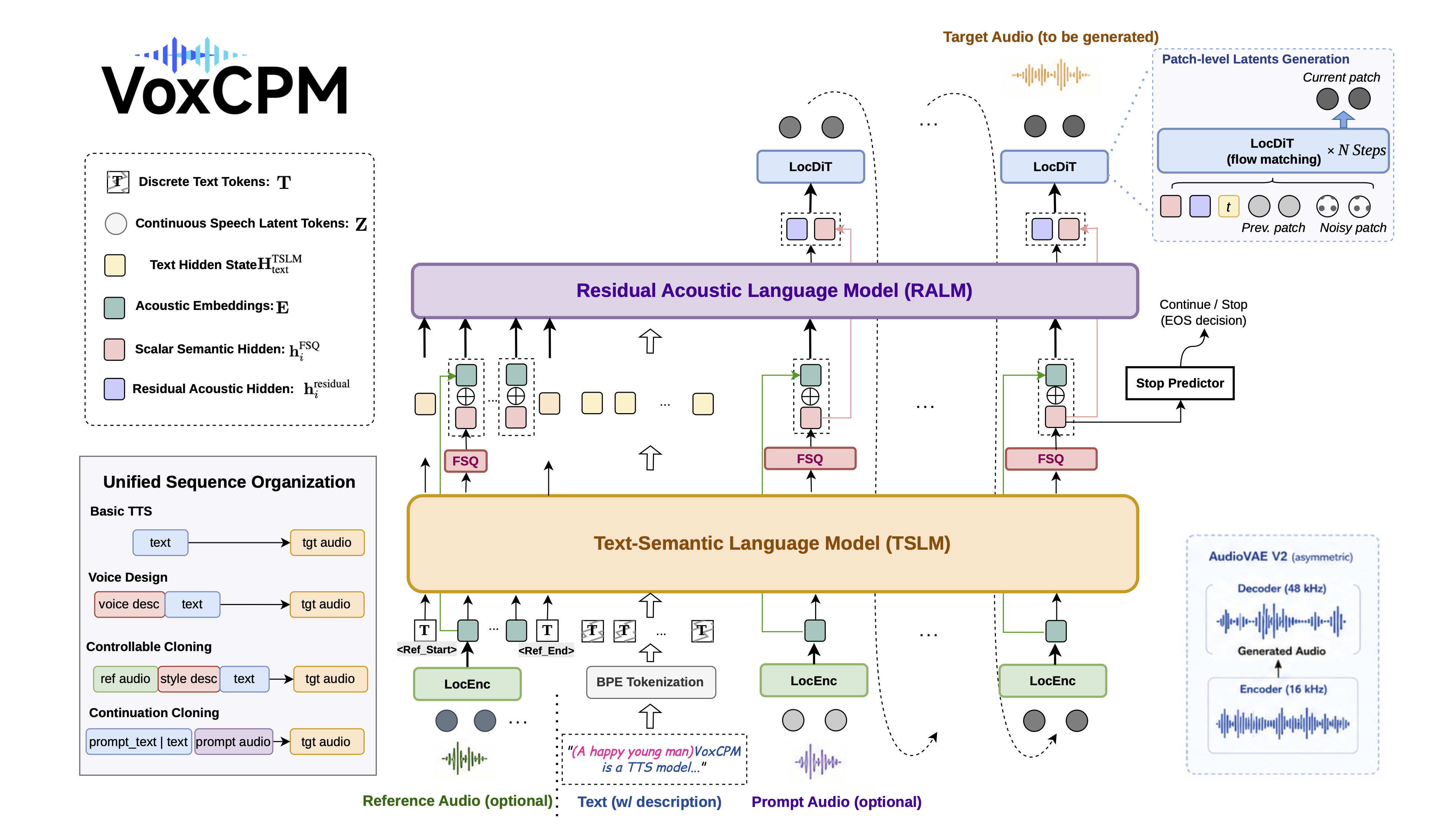
For full architectural details, VoxCPM2-specific upgrades, and a model comparison table, see the Architecture Design.
---
VoxCPM2 achieves state-of-the-art or comparable results on public zero-shot and controllable TTS benchmarks.
Seed-TTS-eval WER(⬇)&SIM(⬆) Results (click to expand)
| Model | Parameters | Open-Source | test-EN | | test-ZH | | test-Hard | | | ----------------- | ---------- | ----------- | ------- | ------ | ------- | ------ | --------- | ------ | | | | | WER/%⬇ | SIM/%⬆ | CER/%⬇ | SIM/%⬆ | CER/%⬇ | SIM/%⬆ | | MegaTTS3 | 0.5B | ❌ | 2.79 | 77.1 | 1.52 | 79.0 | - | - | | DiTAR | 0.6B | ❌ | 1.69 | 73.5 | 1.02 | 75.3 | - | - | | CosyVoice3 | 0.5B | ❌ | 2.02 | 71.8 | 1.16 | 78.0 | 6.08 | 75.8 | | CosyVoice3 | 1.5B | ❌ | 2.22 | 72.0 | 1.12 | 78.1 | 5.83 | 75.8 | | Seed-TTS | - | ❌ | 2.25 | 76.2 | 1.12 | 79.6 | 7.59 | 77.6 | | MiniMax-Speech | - | ❌ | 1.65 | 69.2 | 0.83 | 78.3 | - | - | | F5-TTS | 0.3B | ✅ | 2.00 | 67.0 | 1.53 | 76.0 | 8.67 | 71.3 | | MaskGCT | 1B | ✅ | 2.62 | 71.7 | 2.27 | 77.4 | - | - | | CosyVoice | 0.3B | ✅ | 4.29 | 60.9 | 3.63 | 72.3 | 11.75 | 70.9 | | CosyVoice2 | 0.5B | ✅ | 3.09 | 65.9 | 1.38 | 75.7 | 6.83 | 72.4 | | SparkTTS | 0.5B | ✅ | 3.14 | 57.3 | 1.54 | 66.0 | - | - | | FireRedTTS | 0.5B | ✅ | 3.82 | 46
→ →
→ →
→ →
→ →
→ →
→ →
→ →
→