1
 →
→
Debug, evaluate, and monitor your LLM applications, RAG systems, and agentic workflows with comprehensive tracing, automated evaluations, and production-ready dashboards.
comet-ml/opik is an open-source project on GitHub, mainly written in Python. Debug, evaluate, and monitor your LLM applications, RAG systems, and agentic workflows with comprehensive tracing, automated evaluations It currently holds 22,157 stars and 1,809 forks with 0 open issues, and was last pushed on an unknown date (repository created unknown).
AI Homed tracks it on the AI Prompt Engineering board.

Opik is the open-source LLM observability and evaluation platform for AI agent tracing, LLM evaluation, prompt management, and production monitoring. Built by Comet. Apache-2.0 licensed, free to self-host the full platform, with 20,000+ GitHub stars.

Website • Slack Community • Twitter • Changelog • Documentation
Last updated: 2026-07-17
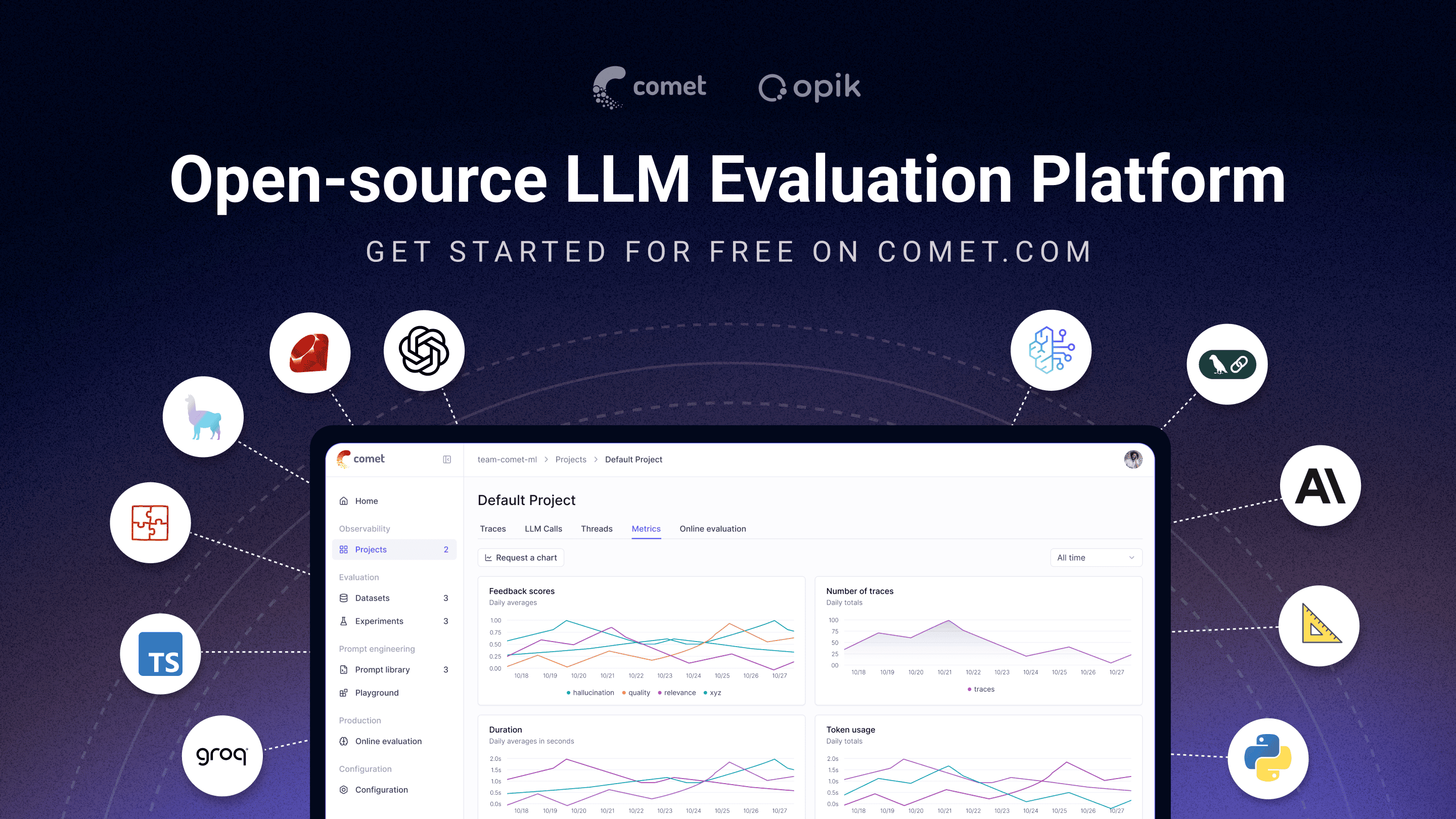
Opik covers the full LLM application lifecycle, from the first trace in development to production monitoring, for teams building LLM apps and AI agents. Key offerings include:
Key capabilities include:
Why open source matters here: Opik is Apache-2.0 licensed and free to self-host: the full platform, backend included, not just a client SDK. The repository includes the server backend, web application, tracing, datasets, experiments, evaluations, prompt management, online evaluation, and agent optimization components, all under Apache-2.0. You can run LLM observability inside your own infrastructure with no data leaving your environment and no Enterprise sales conversation required.
[!TIP]
If you are looking for features that Opik doesn't have today, please raise a new Feature request 🚀
Install the Python SDK and configure it:
pip install opik
opik configure
Wrap any function with the @track decorator to start logging traces:
from opik import track
@track
def my_function(input: str) -> str:
    return input
Every call to my_function is now logged to Opik, including nested calls, so this works for full agent and pipeline traces, not just single LLM calls. See the Quickstart guide for the TypeScript SDK and other setup options.
Let Claude Code, Cursor, VS Code Copilot, Codex or opencode read your traces, score outputs and run evaluations from chat. One command sets it up. It needs uv and no SDK:
uvx opik mcp configure

The badges and the add-mcp fallback below target Opik Cloud; the command above also handles self-hosted deployments. Other MCP clients on Opik Cloud: npx add-mcp https://www.comet.com/opik/api/v1/mcp --name opik-mcp. Details, troubleshooting and FAQ are in the MCP server guide.
Opik competes in the LLM observability / AI agent evaluation category alongside LangSmith, Arize (Phoenix and Arize AX), Weights & Biases (Weave), Langfuse, and Braintrust.
| Capability | Opik | LangSmith | Phoenix | Arize AX | Weights & Biases (Weave) | Langfuse | Braintrust | |---|---|---|---|---|---|---|---| | Open source | Yes, Apache-2.0 (full platform) | No | Source-available (Elastic License 2.0, not OSI-approved) | No | Open-source SDK/toolkit; self-managed platform requires a commercial license | MIT-licensed core platform; commercial enterprise modules | No | | Self-hosted deployment | Yes | Enterprise only | Yes | Enterprise only | Enterprise only for Weave itself | Yes, core | Enterprise only | | Free tier available (cloud or self-hosted) | Yes, both | Yes, cloud | Yes, self-hosted | Yes, cloud | Yes, cloud | Yes, both | Yes, cloud | | Agent / multi-step tracing | Yes | Yes | Yes | Yes | Yes | Yes | Yes | | LLM-as-a-judge evaluation | Yes | Yes | Yes | Yes | Yes | Yes | Yes | | Prompt management | Yes | Yes | Partly | Partly | Partly | Yes | Yes | | Framework-agnostic | Yes | Partly, built around LangChain | Yes | Yes | Yes | Yes | Yes |
When teams choose Opik: Opik's full observability, evaluation, and optimization platform is Apache-2.0 licensed and free to self-host. Unlike closed platforms whose self-hosted deployment requires an Enterprise plan, Opik can be deployed without a commercial license, and it's framework-agnostic so it won't lock you into a single agent ecosystem. See the table above for where self-hosting and licensing differ across alternatives.
Get your Opik server running in minutes. Choose the option that best suits your needs:
Access Opik instantly without any setup. Ideal for quick starts and hassle-free maintenance.
👉 Create your free Comet account
Deploy Opik in your own environment. Choose between Docker for local setups or Kubernetes for scalability.
This is the simplest way to get a local Opik instance running. Note the new ./opik.sh installation script:
On Linux or Mac Environment:
# Clone the Opik repository
git clone https://github.com/comet-ml/opik.git
Navigate to the repository
cd opik
Start the Opik platform
./opik.sh
On Windows Environment:
# Clone the Opik repository
git clone https://github.com/comet-ml/opik.git
Navigate to the repository
cd opik
Start the Opik platform
powershell -ExecutionPolicy ByPass -c ".\\opik.ps1"
Installation Script Options
The opik.sh and opik.ps1 scripts support the following options:
# Start full Opik suite (default behavior)
./opik.sh
Start only infrastructure services (databases, caches etc.)
./opik.sh --infra
Start infrastructure + backend services
./opik.sh --backend
Enable guardrails with any profile
./opik.sh --guardrails # Guardrails with full Opik suite
./opik.sh --backend --guardrails # Guardrails with infrastructure + backend
Build the containers from source before starting
./opik.sh --build
Check that all containers are healthy
./opik.sh --verify
Stop all containers
./opik.sh --stop
Stop all containers and remove all Opik data volumes
WARNING: ALL OPIK DATA WILL BE LOST
./opik.sh --clean
Show all available options
./opik.sh --help
Use the --help or --info options to troubleshoot issues. Dockerfiles now ensure containers run as non-root users for enhanced security. Once all is up and running, you can now visit localhost:5173 on your browser! For detailed instructions, see the Local Deployment Guide.
For production or larger-scale self-hosted deployments, Opik can be installed on a Kubernetes cluster using our Helm chart. Click the badge for the full Kubernetes Installation Guide using Helm.

Opik provides a suite of client libraries and a REST API to interact with the Opik server. This includes SDKs for Python and TypeScript, plus first-party OpenTelemetry support: any language with an OpenTelemetry SDK — including Java, Ruby, and .NET — can send traces to Opik. For detailed API and SDK references, see the Opik Client Reference Documentation.
To get started with the Python SDK:
Install the package:
# install using pip
pip install opik
or install with uv
uv pip install opik
Configure the python SDK by running the opik configure command, which will prompt you for your Opik server address (for self-hosted instances) or your API key and workspace (for Comet.com):
opik configure
[!TIP]
You can also call opik.configure(use_local=True) from your Python code to configure the SDK to run on a local self-hosted installation, or provide API key and workspace details directly for Comet.com. Refer to the Python SDK documentation for more configuration options.
You are now ready to start logging traces using the Python SDK.
The easiest way to log traces is to use one of our direct integrations. Opik supports a wide array of frameworks, including recent additions like Google ADK, Autogen, AG2, and Flowise AI:
| Integration | Description | Documentation | | --------------------- | ------------------------------------------------------- | ------------------------------------------------------------------------------------------------------------------------------------------------------------------------------ | | ADK | Log traces for Google Agent Development Kit (ADK) | Documentation | | AG2 | Log traces for AG2 LLM calls | Documentation | | Agent Spec | Log traces for Agent Spec calls | Documentation | | AIsuite | Log traces for aisuite LLM calls | Documentation | | Agno | Log traces for Agno agent orchestration framework calls | Documentation | | Anthropic | Log traces for Anthropic LLM calls | Documentation | | Autogen | Log traces for Autogen agentic workflows | Documentation | | Bedrock | Log traces for Amazon Bedrock LLM calls | Documentation | | BeeAI (Python) | Log traces for BeeAI Python agent framework calls | Documentation | | BeeAI (TypeScript) | Log traces for BeeAI TypeScript agent framework calls | Documentation | | BytePlus | Log traces for BytePlus LLM calls | Documentation | | Claude Code | Log traces for Claude Code sessions via the Opik plugin | GitHub | | Cloudflare Workers AI | Log traces for Cloudflare Workers AI calls | Documentation | | Cohere | Log traces for Cohere LLM calls | Documentation | | CrewAI | Log traces for CrewAI calls | Documentation | | Cursor | Log traces for Cursor conversations | Documentation | | DeepSeek | Log traces for DeepSeek LLM calls | Documentation | | Dify | Log traces for Dify agent runs
→ →
→ →
→ →
→ →
→ →
→ →
→ →
→