1
 →
→
Official Project Page for KL-Regularized Policy Optimization for Agentic Reinforcement Learning (KLPO)
yifanzhang-pro/KLPO is an open-source project on GitHub, mainly written in Python. Official Project Page for KL-Regularized Policy Optimization for Agentic Reinforcement Learning (KLPO) It currently holds 75 stars and 13 forks with 0 open issues, and was last pushed on an unknown date (repository created unknown).
AI Homed tracks it on the Today's Trending board, currently at rank #100 with 0 new stars today.
KL-Regularized Policy Optimization for Critic-Free Agentic Reinforcement Learning
KLPO is a critic-free, single-rollout method for off-policy agentic reinforcement learning. This repository implements KLPO token regression + Monte Carlo KL (MC-KL) by default: terminal rewards provide the feedback, and independent auxiliary token draws estimate the sampler-conditioned score correction. It needs no same-prompt response group or learned value/normalizer model.

Authors: Yifan Zhang et al.
Technical report: September 18, 2026 · Revised: September 20, 2026
[Project website] [Paper] [Algorithm reference] [Training guide] [Paper source]
R - beta * log(p_action / q_action) and an independently estimated score correction.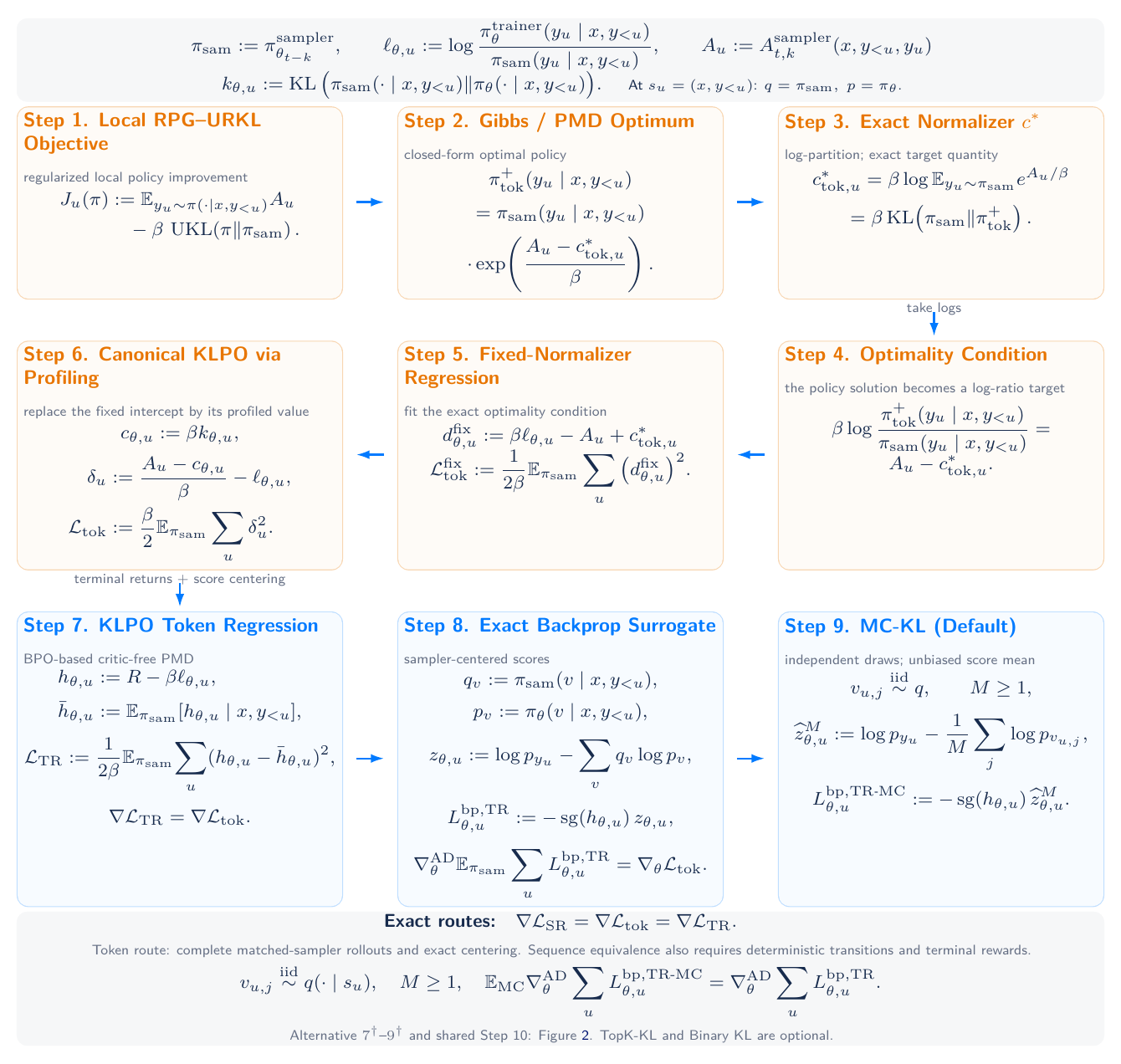
Figure 1 from the report. Step 7 builds on BPO’s critic-free PMD reformulation; Step 8 uses Score Centering. Independent MC-KL recovers the full-KL gradient in expectation under the stated sampling assumptions. TopK-KL and Binary KL are optional approximations.
Requires Python 3.10+ and PyTorch 2.2+. The toy example runs on CPU without a model or dataset download.
git clone https://github.com/yifanzhang-pro/KLPO.git
cd KLPO
python -m venv .venv
source .venv/bin/activate
pip install -e '.[test]'
python examples/train_toy.py  # Default: token regression + MC-KL, M=128
python examples/train_toy.py --mc-samples 1
python -m pytest -q
The example uses variable-length responses, a terminal verifier, historical sampler versions, and repeated learner updates. M counts independent auxiliary tokens per prefix; token regression supports M ≥ 1. The example is an implementation check, not a benchmark reproduction.
Let q be the actual collection sampler, p the current trainer, and R the terminal reward. At each visited prefix, draw v_j ~ q IID with replacement, independently of the complete rollout. The backward surrogate is:
ell_u = log p(a_u) - log q(a_u)
z_u   = log p(a_u) - mean_j log p(v_j)
loss  = -mean_responses sum_tokens stopgrad(R - beta  ell_u)  z_u
Sum over generated policy tokens and average over complete responses, without length normalization. Keep the recorded sampler probabilities and version fixed during reuse. See the loss API and sampling contracts for differentiable trainer inputs, masks, and adaptive replay requirements.
The regression route selects the feedback coefficient; the KL estimator selects the conditional score correction. All eight combinations are implemented. M is the number of random draws; K is the TopK-KL head size.
| Regression route | KL estimator | Toy example options |
| --- | --- | --- |
| Token (default) | MC-KL (default) | No flags; --mc-samples 128 by default, M ≥ 1 |
| Token | TopK-KL | --kl-estimator topk --top-k 2 |
| Token | Binary KL | --kl-estimator binary |
| Token | Full KL | --kl-estimator full |
| Sequence | MC-KL | --route sequence --mc-samples 8 (M ≥ 2) |
| Sequence | TopK-KL | --route sequence --kl-estimator topk --top-k 2 |
| Sequence | Binary KL | --route sequence --kl-estimator binary |
| Sequence | Full KL | --route sequence --kl-estimator full |
MC-KL averages independent sampler log-ratios. Top-K Aggregated KL (TopK-KL) keeps the sampler's K largest probabilities and combines all remaining tokens into one tail bucket. Binary KL groups the sampled action against its complement; Full KL uses the entire vocabulary. The toy vocabulary has four tokens, so --top-k 2 illustrates a nontrivial head/tail split; the training launcher defaults to K=128 when TopK-KL is selected.
Token regression uses per-token feedback; sequence regression uses trajectory feedback. Sequence MC-KL requires M ≥ 2 for leave-one-out residuals. Full-KL and independent-MC population equivalences require the report's assumptions; individual sample gradients can differ, and finite TopK-KL/Binary approximations need not preserve those equivalences. KLPO sequence regression is distinct from the SKLPO response-Gibbs comparison in the paper's appendix.
| Resource | Contents | | --- | --- | | Algorithm reference | Loss APIs, all eight combinations, numerical stabilization, sampling and replay contracts | | Training guide | Pinned native Molt installation, R1/Qwen-Math launchers, tensor contracts, supported execution | | CPU example | Small autoregressive policy with a terminal verifier and historical samplers | | Paper · LaTeX source | Derivations, proofs, assumptions, and SKLPO comparison | | Website maintenance | Local preview, GitHub Pages publication, and updating the paper snapshot |
The Molt launcher defaults to --route token --kl-estimator mc --mc-samples 128. GPU training requires a compatible Linux/CUDA environment; follow the pinned backend revision in the training guide. The optional predicted-KL budget is disabled in the Molt launcher.
CPU tests cover all eight combinations, independent MC gradient expectations, leave-one-out residuals, M=1 token updates, TopK-KL tail corrections, masked/extreme probabilities, and trajectory/microbatch normalization. To also check the native backend contract:
MOLT_SOURCE_PATH=/path/to/labs-molt python -m pytest -q
This release provides the theory, loss implementation, CPU verification, and native training integration. GPU training and paper-scale benchmark reproduction have not been validated. Example hyperparameters are starting values, not tuned benchmark settings. The training guide documents the current synchronous launcher restriction and fixed-record replay limitations.
@techreport{zhang2026klpo,
  title  = {{KL}-Regularized Policy Optimization for Critic-Free Agentic Reinforcement Learning},
  author = {Zhang, Yifan and others},
  year   = {2026},
  month  = sep,
  url    = {https://yifanzhang-pro.github.io/KLPO/}
}
Download BibTeX. The published PDF is a snapshot of paper-source commit 1658d8d.
Code is licensed under Apache 2.0. Training launcher scaffolding is adapted from FlashREINFORCE. The separately installed labs-molt backend retains its own licenses and notices; see NOTICE.
→ →
→ →
→ →
→ →
→ →
→ →
→ →
→