1
 →
→
Cognee is the open-source AI memory platform for agents. Give your AI agents persistent long-term memory across sessions with a self-hosted knowledge graph engine.
topoteretes/cognee is an open-source project on GitHub, mainly written in Python. Cognee is the open-source AI memory platform for agents. Give your AI agents persistent long-term memory across sessions with a self-hosted knowledge graph It currently holds 30,855 stars and 0 forks with 0 open issues, and was last pushed on an unknown date (repository created unknown).
AI Homed tracks it on the AI Agent Memory board.
Cognee - The Free Open-Source AI Memory Platform for Agents
Demo . Docs . Learn More · Join Discord · Join r/AIMemory . Community Plugins & Add-ons




Cognee is a free open-source AI memory platform that gives AI agents persistent long-term memory across sessions. Turn documents, code, and conversations into a self-hosted knowledge graph your agents can search and reuse.
Start locally for free without an OpenAI or Anthropic API key. Build memory from text with local extraction and embedding models. Add a local or hosted LLM when you want more functionality or reach out to us for a production-ready small model pipeline.
🌐 This README is also available in:
Deutsch |
Español |
Français |
日本語 |
한국어 |
Português |
Русский |
中文
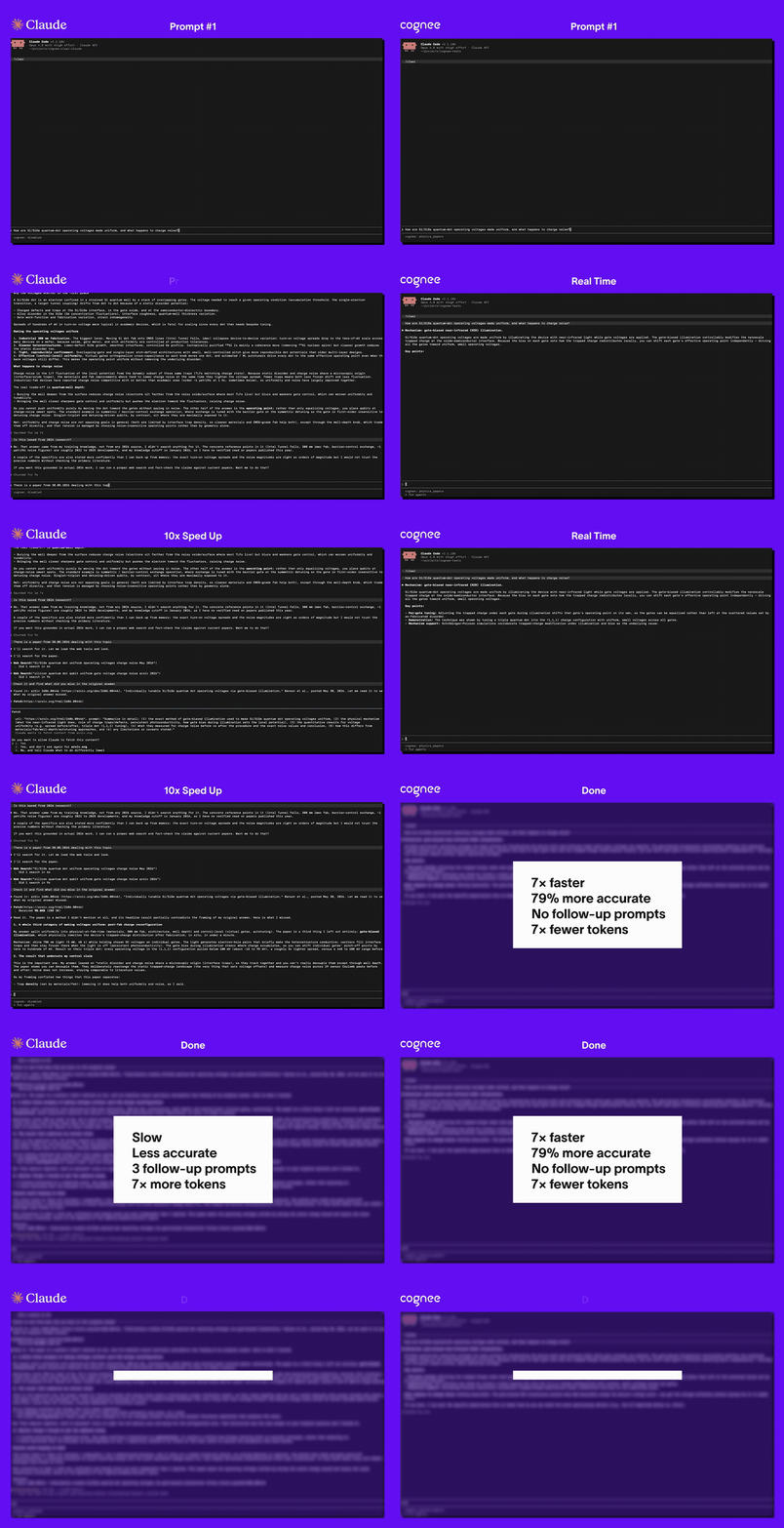
📄 Read the research paper: Optimizing the Interface Between Knowledge Graphs and LLMs for Complex Reasoning — Markovic et al., 2025
| I want to… | Start here | | --- | --- | | Build memory without an LLM | Local Python quickstart | | Explore a prebuilt graph without downloading models | Bundled demo | | Generate answers with a local or hosted LLM | Optional LLM setup | | Give an existing agent memory | Plugins and MCP | | Run Cognee on my infrastructure | Deployment options | | Use a managed service | Cognee Cloud |
Requires Python 3.10–3.14.
You can install Cognee with pip, uv, or your preferred Python package manager.
uv pip install "cognee[gliner]"
import os
os.environ["LLM_API_KEY"] = "YOUR OPENAI_API_KEY"
.env file using our template.
The default uses OpenAI for language models and embeddings. Processing and generated answers make provider calls. See installation, other providers, or local Ollama models for other setups.
In step 1, you did "cognee[gliner]" install.
Save this as quickstart.py and run python quickstart.py if you are feeling old school, or tell your LLM to do it:
import asyncio
import cognee
async def main():
    # Extract a knowledge graph and embed the text with local models.
    await cognee.remember(
        "Marie Curie was born in Warsaw and worked at the University of Paris.",
        dataset_name="local_quickstart",
    )
# Retrieve the matching source text; no LLM generates an answer.
    results = await cognee.recall(
        "Where was Marie Curie born?",
        datasets=["local_quickstart"],
    )
    for result in results:
        print(result)
if __name__ == "__main__":
    asyncio.run(main())
The same workflow is available from the CLI:
cognee-cli remember "Marie Curie was born in Warsaw." -d local_quickstart
cognee-cli recall "Where was Marie Curie born?" -d local_quickstart
Text ingestion, retrieval, and session storage work without an LLM. LLM-dependent improvement stages skip automatically.
Generated answers and media processing that requires a vision or transcription model need additional LLM configuration.
To explore a prebuilt graph without downloading extraction or embedding models:
cognee-cli demo
This command works with the base pip install cognee package. It loads bundled sample data and runs keyword search without an API key. Use the local quickstart above to build a graph from your own text.
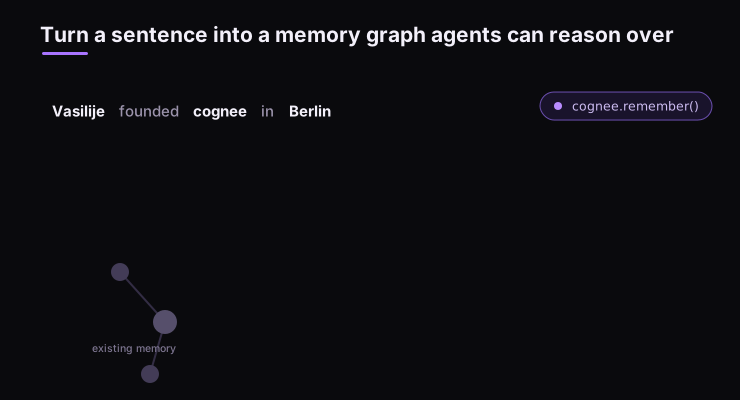
Cognee builds connected memory from different sources. Text becomes entities, relationships, and searchable chunks; code becomes a graph of symbols and dependencies. Session distillation curates accepted lessons into permanent memory.
At query time, retrieval selects relevant graph, vector, or code context. Your application can inspect the retrieved evidence and use it to answer a question or continue an agent task.
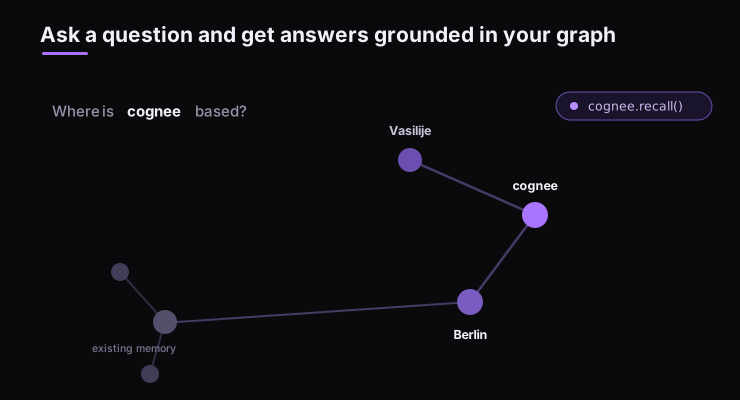
| Operation | What it does | Learn more |
| --- | --- | --- |
| remember | Store content or code in permanent memory, or in a session when a session ID is supplied. | Store memory |
| recall | Retrieve context and answers, using automatic routing or a chosen search strategy. | Query memory |
| improve | Enrich memory, apply feedback, and bridge session knowledge into the graph. | Improve memory |
| forget | Remove a specific item or dataset. | Delete memory |
Explore the architecture and session lifecycle.
Install the Claude Code plugin:
claude plugin marketplace add topoteretes/cognee-integrations
claude plugin install cognee-memory@cognee
or Codex plugin
Make sure to enable hooks:
# ~/.codex/config.toml
[features]
hooks = true
codex plugin marketplace add topoteretes/cognee-integrations --ref main
codex plugin add cognee@cognee
Follow the plugin setup guide to configure local or remote memory.
| Interface | Start here |
| --- | --- |
| Claude Code memory plugin | Install and configure the plugin |
| OpenClaw memory plugin | Install @cognee/cognee-openclaw |
| Cursor, Cline, and other MCP clients | Cognee MCP guide and server README |
| Python applications | Python API reference |
| TypeScript applications | TypeScript SDK |
| Rust applications | Cognee-RS |
| Applications using HTTP | REST API reference |
Browse the integrations repository for agent frameworks, plugins, and source connectors. Each guide describes its setup and memory capture behavior.
To inspect a local installation in the UI:
cognee-cli -ui
The UI launcher requires Node.js/npm; Docker is needed for its MCP service. See local UI setup.
For a local API demo using a prebuilt image, follow the minimal Docker Compose guide. It includes a persistent-volume configuration and explains the single-user demo settings.
To run the API, UI, and MCP server from a source checkout, clone this repository, enter its directory, copy .env.template to .env, and configure your providers. Then run:
docker compose --profile ui --profile mcp up
The default ports are API 8000, UI 3000, and MCP 8001. For deployment beyond a local demo, configure authentication, persistent storage, and compatible backends using the permissions guide and deployment templates. Cognee Cloud provides the managed option.
The default Docker image does not include GLiNER. To ingest text without an LLM in Docker, add the gliner extra to your image; the local quickstart installs it explicitly.
Graph memory traditionally means operating a stack — a graph database for relationships, a vector database for embeddings, Redis for sessions, and a relational database for metadata — all deployed, secured, and paid for before an agent remembers anything. In cognee 1.0 you can run the entire memory layer on a single Postgres instance.
⚠️ Warning: Using Postgres as a graph store is currently a released as a demo feature. The production ready feature is available as a licenced product. Use it to demo keeping relational metadata, PGVector, and graph working together
The BEAM evaluation measures conversational memory using synthetic long-context conversations and an LLM judge. The reported runs use Cognee's memory components with benchmark-specific data formatting, prompts, and retrieval configuration.
| BEAM context | Reported score (0–1) | Scope | | --- | --- | --- | | 100K tokens | 0.79 | Fixed hybrid retrieval; four evaluation rounds over 20 questions from one held-out conversation. | | 10M tokens | 0.67 | Exploratory result; question-type routing selected and scored on the same question set, averaged over five rounds. |
The two settings use different conversations, ingestion models, and retrieval-selection procedures. Read the methodology, models, limitations, and reproduction instructions before comparing these scores with other systems. The report also documents the remaining reproduction gap for the distributed 10M ingestion.
For the research behind Cognee's graph/LLM interface, see Optimizing the Interface Between Knowledge Graphs and LLMs for Complex Reasoning (Markovic et al., 2025).

CONTRIBUTING.md to get started.
We're committed to fostering an inclusive and respectful community. Read our Code of Conduct for guidelines.
We recently published a research paper on optimizing knowledge graphs for LLM reasoning:
@misc{markovic2025optimizinginterfaceknowledgegraphs,
      title={Optimizing the Interface Between Knowledge Graphs and LLMs for Complex Reasoning},
      author={Vasilije Markovic and Lazar Obradovic and Laszlo Hajdu and Jovan Pavlovic},
      year={2025},
      eprint={2505.24478},
      archivePrefix={arXiv},
      primaryClass={cs.AI},
      url={https://arxiv.org/abs/2505.24478},
}
 →
→ →
→ →
→ →
→ →
→ →
→ →
→