1
 →
→
Local-first code intelligence graph for MCP and CLI. Builds a persistent map of your codebase so AI coding tools read only what matters
tirth8205/code-review-graph is an open-source project on GitHub, mainly written in Python. Local-first code intelligence graph for MCP and CLI. Builds a persistent map of your codebase so AI coding tools read only what matters It currently holds 31,481 stars and 0 forks with 0 open issues, and was last pushed on an unknown date (repository created unknown).
AI Homed tracks it on the AI Models & LLM Tools board.
A local code knowledge graph that gives AI coding tools precise review context over MCP.
English | 简体中文 | 日本語 | 한국어 | हिन्दी



Usage · Commands · FAQ · Troubleshooting · GitHub Action · Reproducing the benchmarks · Roadmap
AI coding tools often re-read large parts of a codebase to review a change. code-review-graph builds a structural map of the code with Tree-sitter, keeps it updated incrementally, and serves compact context over MCP, so the assistant reads only the files a change touches.
---
pip install code-review-graph          # or: pipx install code-review-graph
code-review-graph install              # detect installed AI coding tools and configure each one
code-review-graph build                # parse the codebase
install detects which AI coding tools you have, writes an MCP server entry for each, installs hooks and skills where the platform supports them, and adds graph instructions to the platform's rules file. The MCP entry uses poetry run or uv run inside a Poetry or uv project environment, uvx code-review-graph serve when uvx is on PATH, and otherwise the current Python interpreter. Restart the editor or tool afterwards.
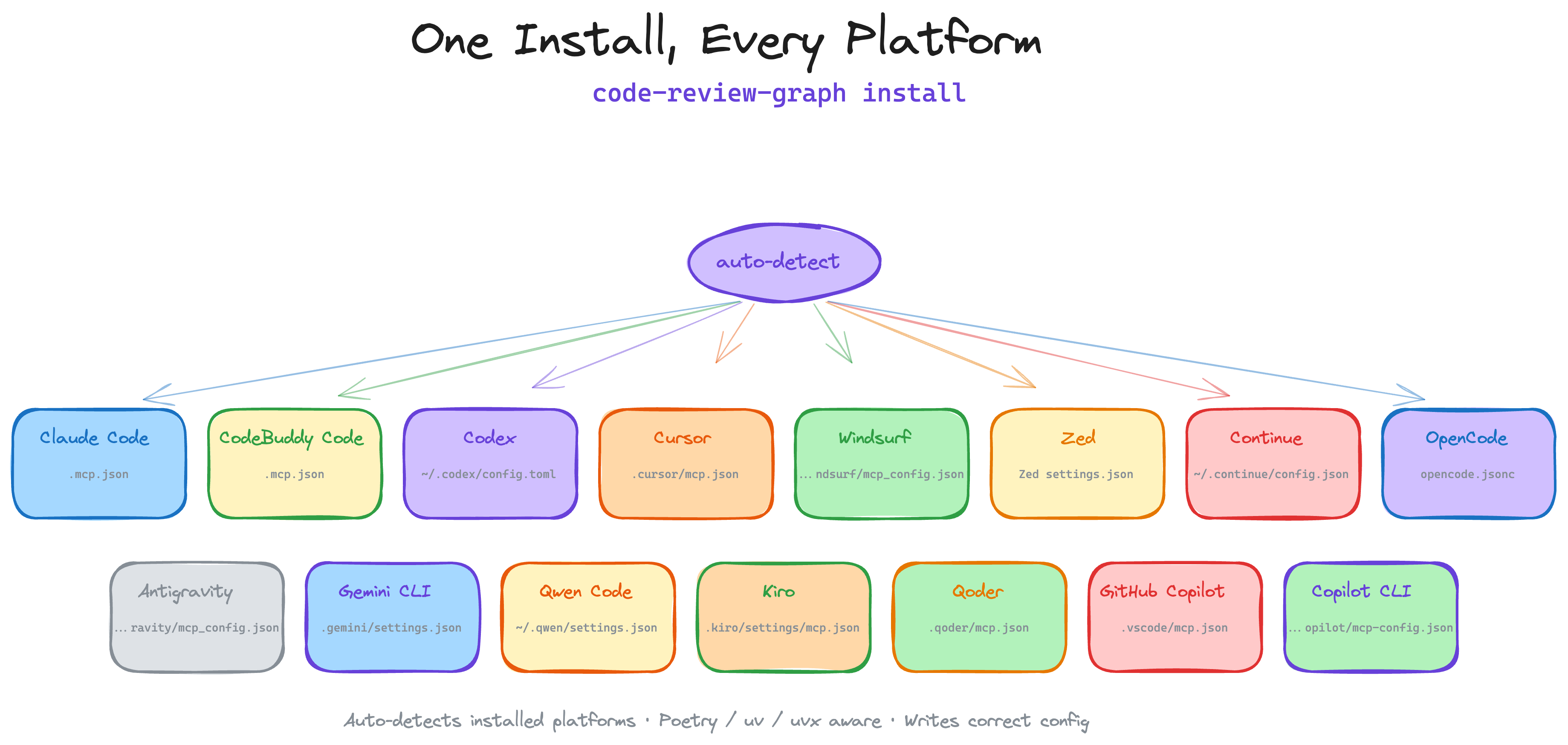
To configure one platform, pass --platform with one of codex, claude-code, cursor, windsurf, zed, continue, opencode, antigravity, gemini-cli, qwen, kiro, qoder, copilot, copilot-cli, codebuddy, or hermes:
code-review-graph install --platform cursor
code-review-graph install --platform codebuddy
Config file locations are listed in docs/USAGE.md. Requires Python 3.10+.
uninstall removes CRG-owned files and entries from a Git or SVN working tree and leaves other MCP servers, hooks, skills and JSONC comments alone. Run it from anywhere inside the tree. Shared config files are replaced atomically, so a failed write leaves the original intact.
code-review-graph uninstall --dry-run    # preview only
code-review-graph uninstall              # preview, confirm, apply
code-review-graph uninstall --yes        # apply without prompting
code-review-graph uninstall --all-repos  # also clean every registered repository
code-review-graph uninstall --keep-data  # remove integrations, keep graph databases
code-review-graph uninstall --keep-user-configs --repo .  # this project only
Then open the project and ask the assistant:
Build the code review graph for this project
Build time scales with repository size; a cold build of a ~3,000-file repository took about 40 seconds (measured). After that, hooks and watch mode keep the graph updated. If some files fail to parse, the result has status partial and names them in its summary; the CLI also prints a Warning: line on stderr, and those files keep their previous graph rows.
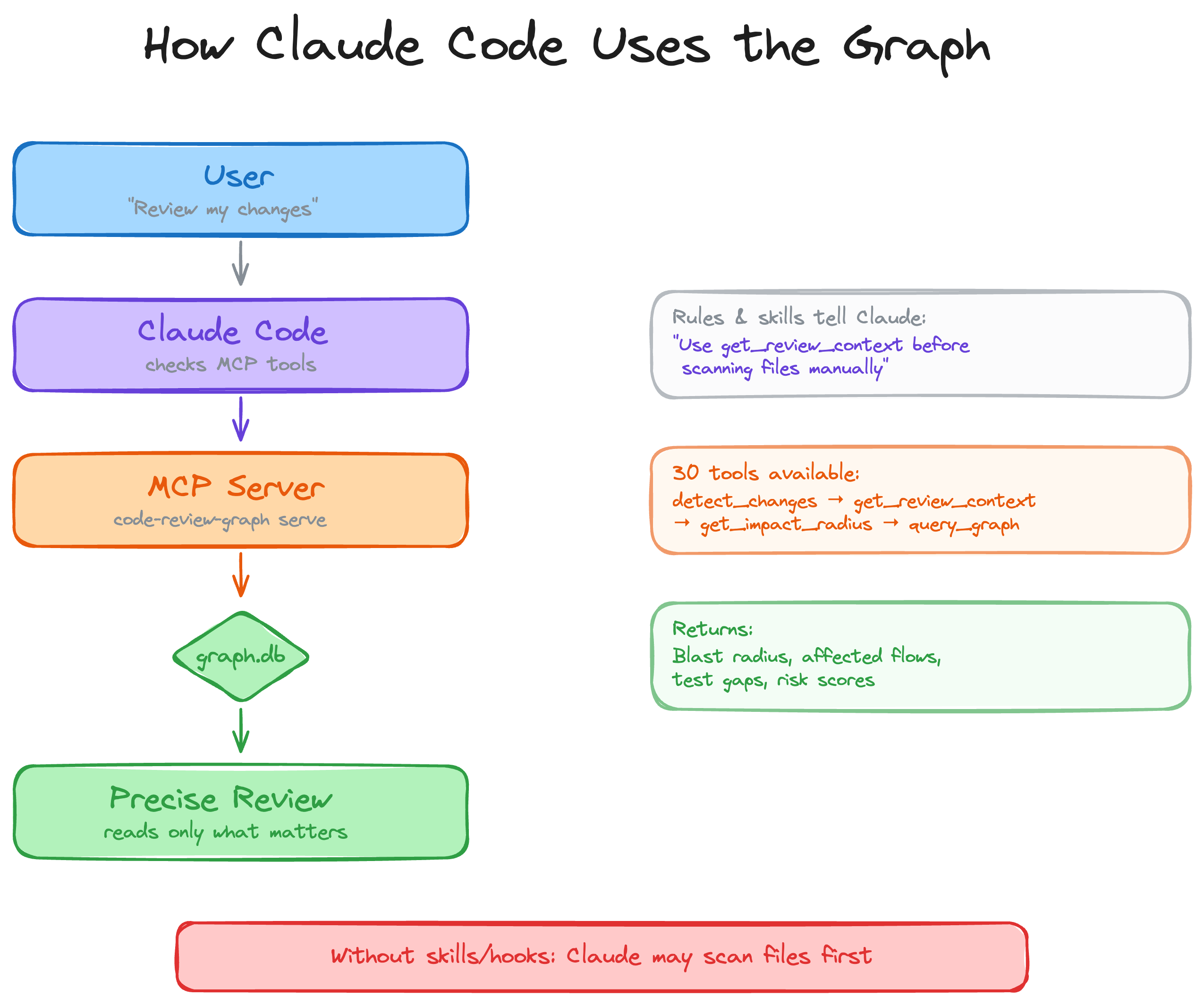
The repository is parsed into ASTs with Tree-sitter and stored as a graph of nodes (functions, classes, imports) and edges (calls, inheritance, test coverage). At review time the graph is queried for the smallest set of files the assistant needs to read.

When a file changes, the graph traces every caller, dependent and test that could be affected. The assistant reads those files instead of scanning the whole project.
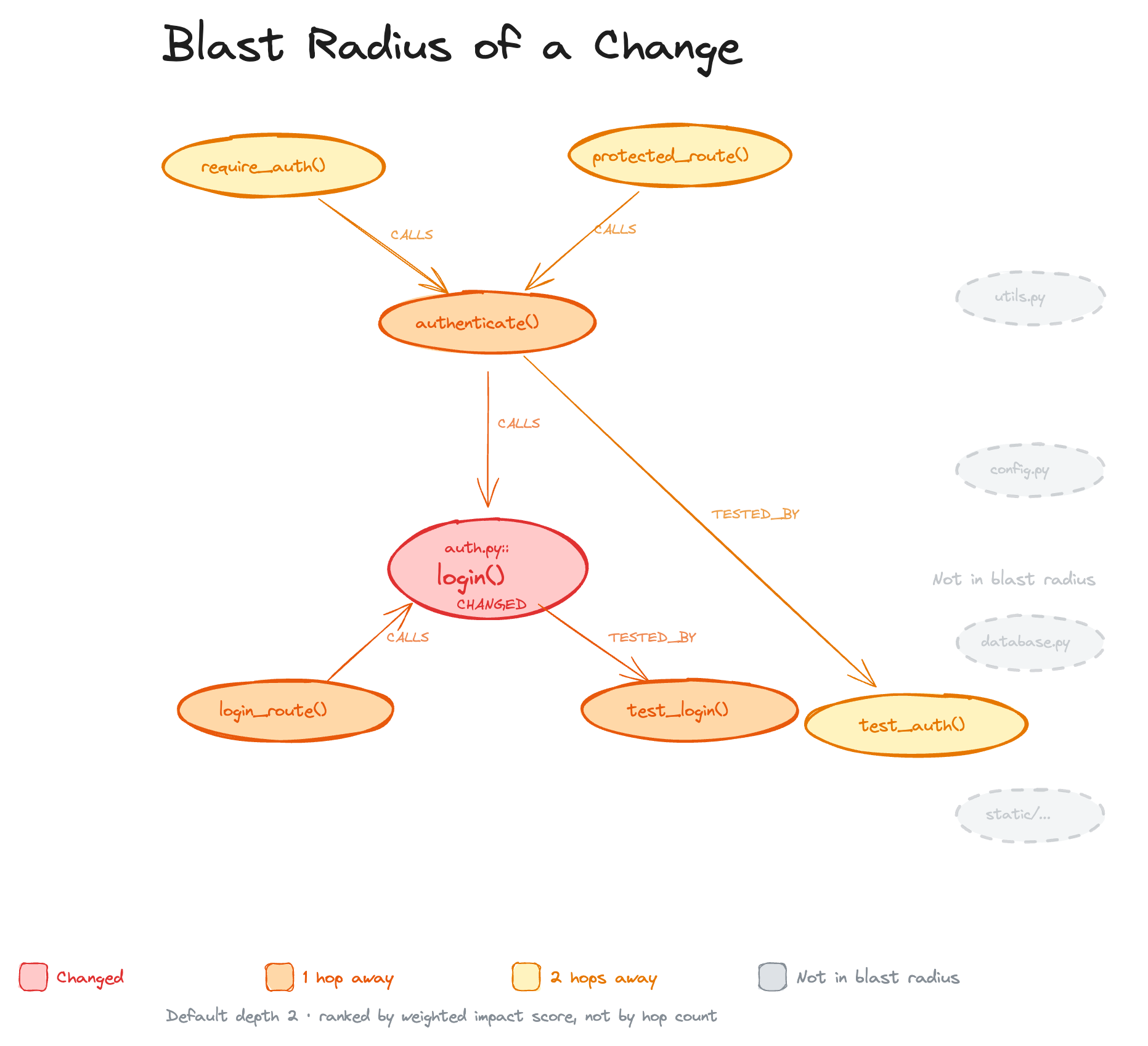
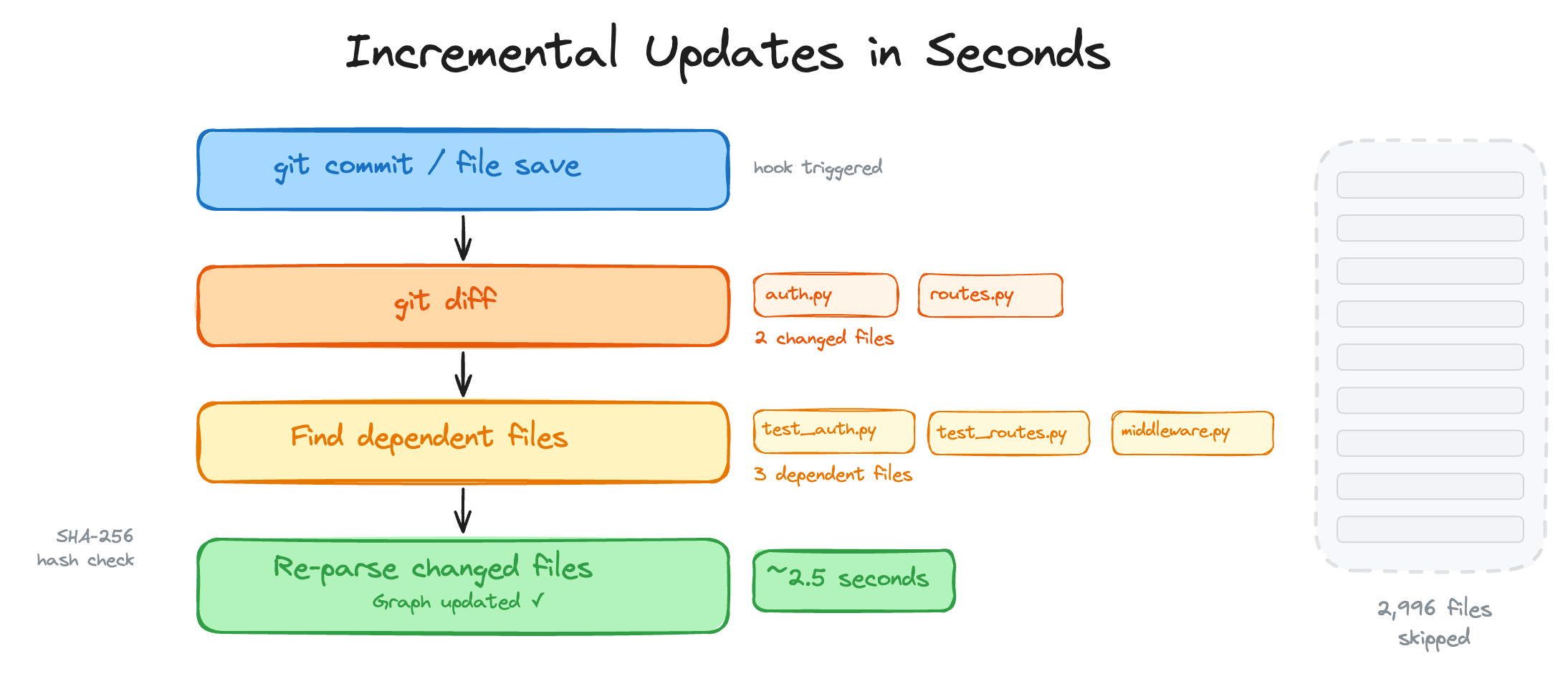
Hooks, the pre-commit hook and watch mode trigger incremental updates. The update diffs changed files, finds their dependents through the graph's import and call edges, and re-parses only the files whose SHA-256 hash changed. On a ~3,000-file project (django) a two-file edit re-indexes in about 2.5 seconds on the path the hooks use, of which ~1.4 s is process start-up; a no-op update costs only that start-up. See Incremental update latency.
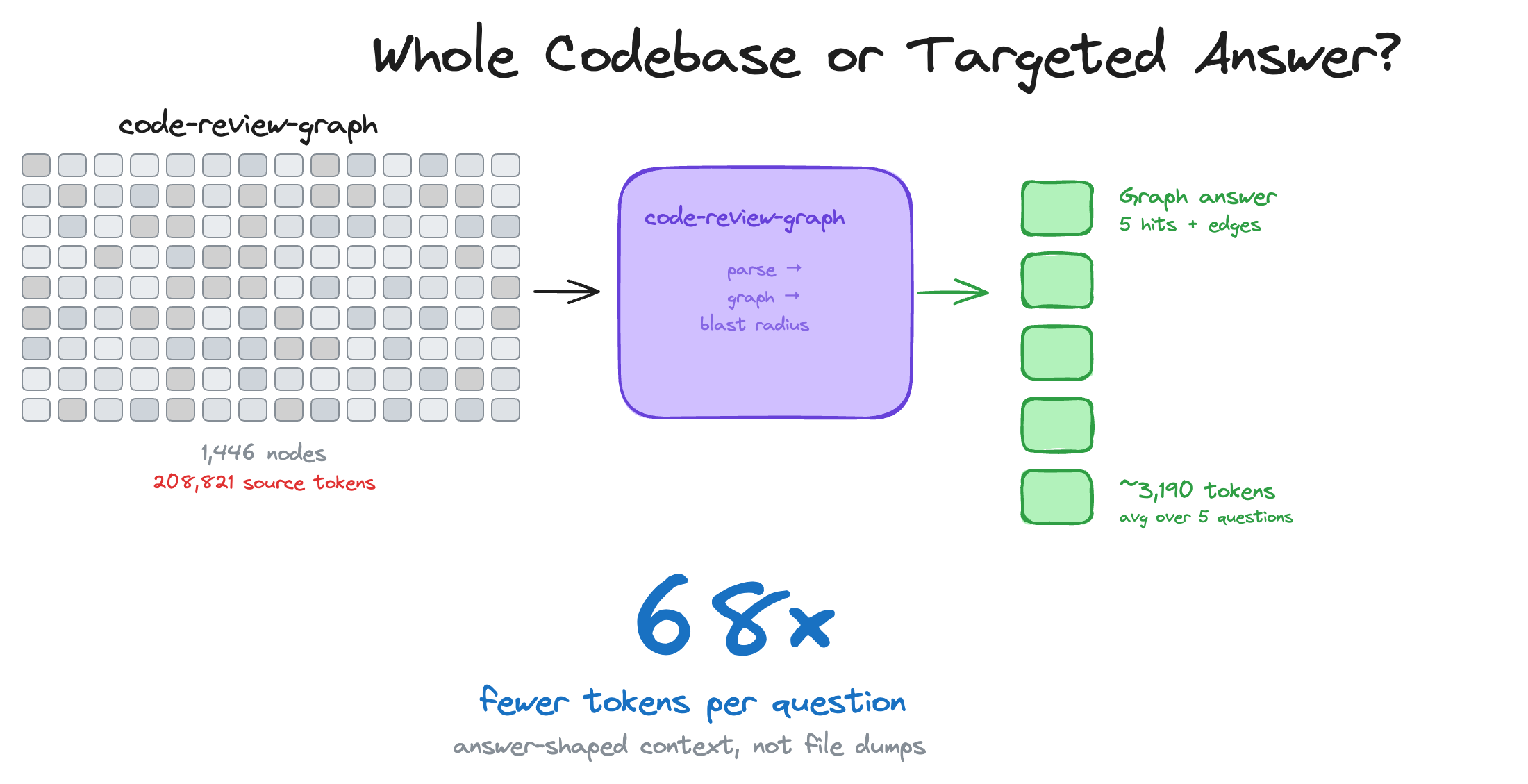
Instead of feeding a whole corpus to the model, the graph returns a slice shaped to the question. On this repository, 208,821 source tokens become ~3,190 tokens per question.
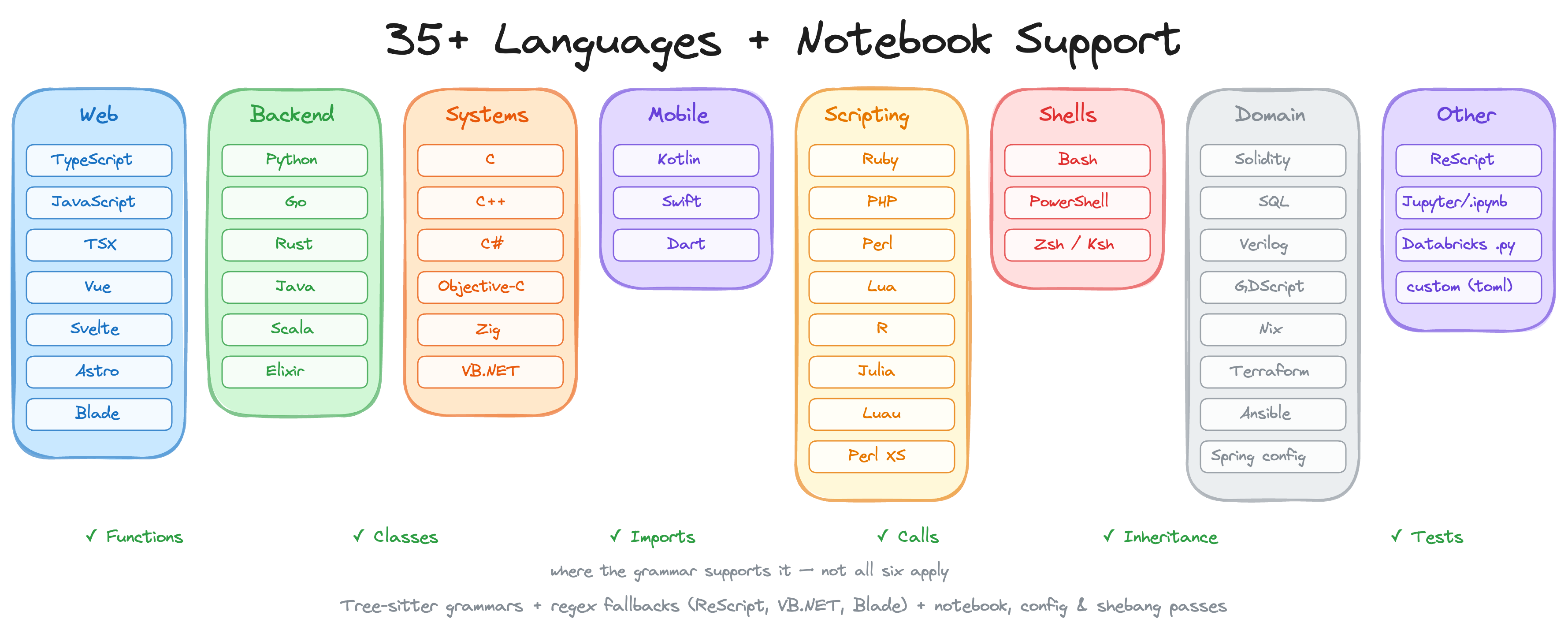
The parser extracts functions, classes, imports, call sites, inheritance and tests, using Tree-sitter where a grammar exists and targeted fallbacks elsewhere. Supported: Python, JavaScript/TypeScript/TSX, Go, Rust, Java, C/C++, C#, VB.NET, Ruby, Kotlin, Swift, PHP, Scala, Solidity, Dart, R, Perl, Lua/Luau, Objective-C, shell scripts, Elixir, Zig, PowerShell, Julia, ReScript, GDScript, Nix, Verilog/SystemVerilog, SQL, Terraform/OpenTofu (.tf; other .hcl files become file nodes only), Ansible YAML (playbooks, roles, tasks), Vue/Svelte SFCs, Astro files (parsed with the TypeScript grammar), Jupyter and Databricks notebooks (.ipynb), and Perl XS files (.xs). Other YAML is not treated as source code.
PHP projects also get repository-bounded Composer PSR-4 resolution, Blade template references, and Laravel Route and Eloquent edges when the source shows explicit framework imports, model inheritance and receiver evidence.
If your repository uses a language the parser does not cover, add a languages.toml to .code-review-graph/ that maps file extensions to any grammar bundled in tree_sitter_language_pack, plus the node types for functions, classes, imports and calls:
[languages.erlang]
extensions = [".erl"]
grammar = "erlang"
function_node_types = ["function_clause"]
class_node_types = ["record_decl"]
import_node_types = ["import_attribute"]
call_node_types = ["call"]
The generic tree-sitter walker does the extraction. Built-in languages cannot be overridden. See docs/CUSTOM_LANGUAGES.md for the schema, validation rules and a worked example.
The same analysis runs as a composite GitHub Action. The graph is built and queried on your CI runner; no source code is sent to an external service. On each pull request the action posts one sticky comment with risk-scored functions, affected execution flows and test gaps, updated in place on every push. The optional fail-on-risk input turns it into a merge gate.
# .github/workflows/code-review-graph.yml
on:
pull_request:
permissions:
contents: read
pull-requests: write
jobs:
review:
runs-on: ubuntu-latest
steps:
- uses: actions/checkout@v7
- uses: tirth8205/code-review-graph@v2.3.8
with:
github-token: ${{ secrets.GITHUB_TOKEN }}
See docs/GITHUB_ACTION.md for inputs, risk levels and caching, or the workflow this repository runs on itself in .github/workflows/pr-review.yml.
---
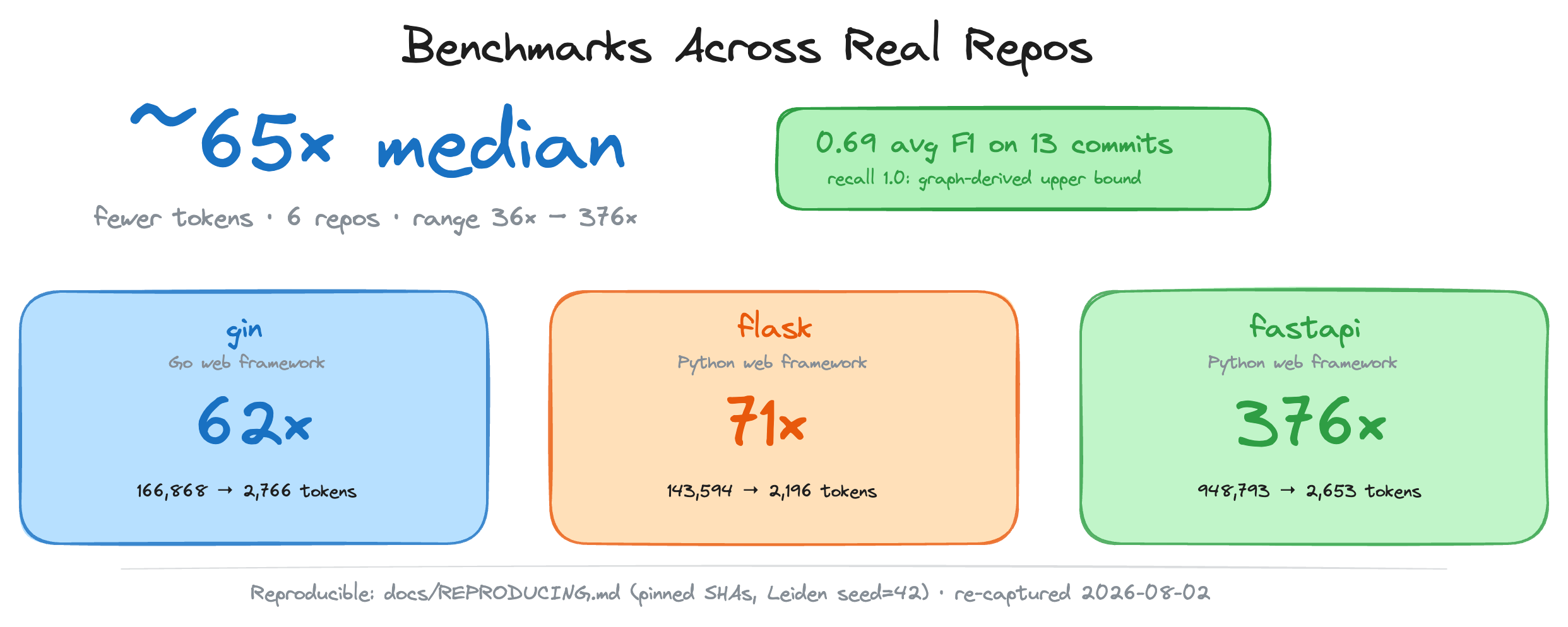
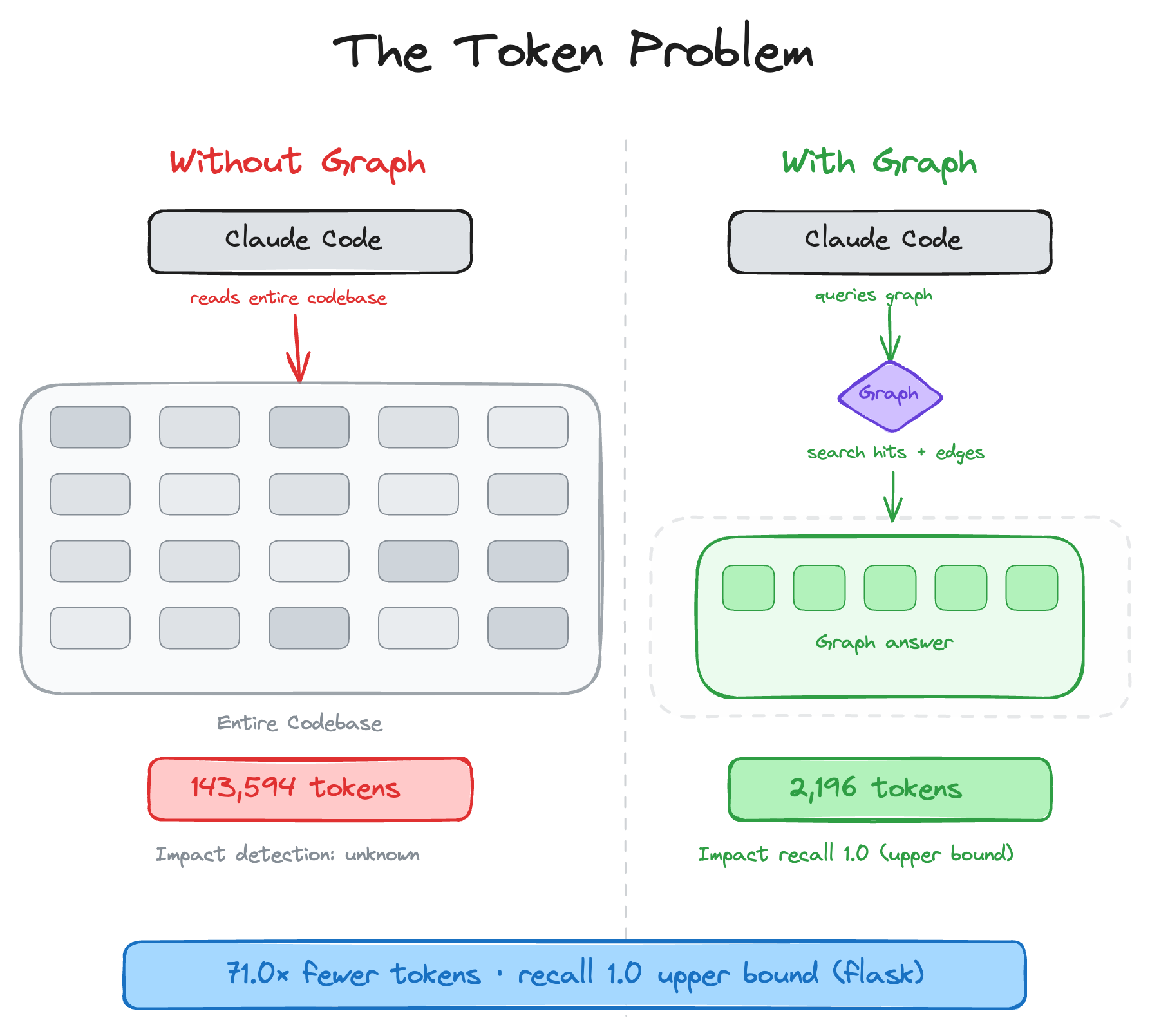
The median per-question token reduction across the 6 repositories is about 65x (whole-corpus baseline vs graph query). The 376x maximum is one repository (fastapi, the largest corpus), not the typical result.
All numbers come from the evaluation runner against 6 open-source repositories (13 commits). Every config pins an upstream SHA, Leiden runs with a fixed seed, and embeddings are deterministic on CPU, so two runs on different machines produce the same numbers. The reproduction recipe is in docs/REPRODUCING.md. A weekly report-only run on the two smallest configs lives in .github/workflows/eval.yml.
For a typical agent question ("how does authentication work", "what is the main entry point", and so on), the graph returns ~2,000 to 3,500 tokens of search hits plus neighbour edges instead of every source file. The table averages the 5 sample questions defined in code_review_graph/token_benchmark.py.
| Repo | Snapshot SHA | naive_corpus_tokens | avg graph_tokens | Reduction |
|------|---|-----------------:|----------------:|----------:|
| fastapi | 22381558 | 948,793 | 2,653 | 375.6x |
| flask | a29f88ce | 143,594 | 2,196 | 71.0x |
| code-review-graph | 84bde354 | 208,821 | 3,190 | 68.1x |
| gin | 5c00df8a | 166,868 | 2,766 | 61.9x |
| httpx | b55d4635 | 142,356 | 2,661 | 60.6x |
| express | b4ab7d65 | 136,052 | 3,936 | 36.0x |
Captured 2026-08-02 from clean clones at the pinned SHAs (crg 2.3.7, localall-MiniLM-L6-v2embeddings). These numbers are lower than the 2026-05-25 capture they replace: node embedding text became richer, soavg graph_tokensrose in every repo. fastapi is measured at its current pin22381558rather than the retired0227991a.
The whole-corpus baseline is an upper bound no real agent pays; an agent greps for identifiers and reads the best-matching files. The agent_baseline eval benchmark measures that case (a pure-Python grep over the corpus, top-3 files by match count, token-counted against the graph query cost). It writes evaluate/results/_agent_baseline_.csv; no canonical capture has been published yet.
The formal token_efficiency benchmark measures a different scenario, the full get_review_context() JSON against only the changed-file content of a commit, and reports ratios below 1 for small commits because the response carries impact-radius edges and source snippets. The two benchmarks answer different questions; see docs/REPRODUCING.md.
Review and impact tools attach a compact context_savings estimate to their responses. The CLI shows the same figures in the Token Savings panel (see Usage below) and --verify compares them with OpenAI's cl100k_base tokenizer. Calibration across 222 sample files puts the estimate within about 1% of real tokens in aggregate (data).
Blast-radius analysis recovers every file in the ground truth on all 13 evaluation commits. Read that as an upper bound, not as "100% recall": the ground truth (changed files plus files with call or import edges into them) comes from the same graph the predictor traverses. The lower precision is deliberate; flagging an extra file costs less than missing a broken dependency.
| Repo | Commits | Avg F1 | Avg Precision | Recall (graph-derived upper bound) | |------|--------:|-------:|--------------:|-------:| | httpx | 2 | 0.863 | 0.785 | 1.0 | | code-review-graph | 2 | 0.734 | 0.584 | 1.0 | | fastapi | 2 | 0.697 | 0.539 | 1.0 | | express | 2 | 0.667 | 0.500 | 1.0 | | flask | 2 | 0.633 | 0.485 | 1.0 | | gin | 3 | 0.609 | 0.439 | 1.0 | | Average | 13 | 0.693 | 0.546 | 1.000 |
The benchmark also runs a co-change mode: the predictor is seeded with one changed file and graded against the other files the author touched in the same commit, which is evidence from git history rather than from the graph. Both modes appear in the result CSVs (ground_truth_mode column). In the 2026-08-02 capture co-change mode returned predicted_files = 0 on every graded commit, so it is not yet a usable measurement and no co-change number is quoted.
From the same 2026-08-02 clean-room build. Embedding counts are lower than node counts because File nodes are not embedded.
| Repo | Nodes | Edges | Embeddings | |------|------:|------:|-----------:| | fastapi | 6,287 | 32,036 | 5,159 | | express | 1,990 | 19,492 | 1,849 | | gin | 1,589 | 17,237 | 1,491 | | code-review-graph | 1,446 | 9,094 | 1,354 | | flask | 1,415 | 8,259 | 1,329 | | httpx | 1,263 | 8,236 | 1,193 |
| Feature | Details |
|---------|---------|
| Incremental updates | Re-parses only files whose hash changed. On a ~3,000-file repo a two-file edit takes ~2.5 s on the hook path (measured). |
| Language and notebook support | See Language coverage above. |
| Framework-aware PHP parsing | Repository-bounded Composer PSR-4 imports, Blade template references, evidence-gated Laravel Route-to-controller and Eloquent relationship edges |
| Blast-radius analysis | Which functions, classes and files are likely affected by a change |
| Auto-update hooks | Editor hooks, a git pre-commit hook and watch mode update the graph as you work |
| Semantic search | Optional vector embeddings via sentence-transformers, Google Gemini, MiniMax, Voyage AI, or any OpenAI-compatible endpoint (OpenAI, Azure, new-api, LiteLLM, vLLM, LocalAI) |
| Interactive visualisation | D3.js force-directed graph with search, community legend toggles and degree-scaled nodes |
| Hub and bridge detection | Most-connected nodes and chokepoints (betweenness centrality) |
| Surprise scoring | Unexpected coupling: cross-community, cross-language, peripheral-to-hub edges |
| Knowledge gap analysis | Isolated nodes, untested hotspots, thin communities |
| Suggested questions | Review questions generated from bridges, hubs and surprises |
| Edge confidence | Three-tier confidence (EXTRACTED/INFERRED/AMBIGUOUS) with float scores on edges |
| Graph traversal | BFS/DFS from any node with configurable depth and token budget |
| Export formats | GraphML (Gephi/yEd), Neo4j Cypher, Obsidian vault, SVG, JSON |
| Token benchmarking | code_review_graph/token_benchmark.py measures whole-corpus tokens against graph query tokens per question |
| Estimated context savings | context_savings metadata (estimated, saved_tokens, saved_percent) on review, impact, detect-changes and architecture responses |
| Community auto-split | Communities above 25% of the graph are split recursively with Leiden |
| Execution flows | Call chains from entry points, sorted by weighted criticality |
| Community detection | Leiden clustering with resolution scaled to graph size |
| Architecture overview | Community-based architecture map with coupling warnings |
| Risk-scored reviews | detect_changes maps diffs to affected functions, flows and test gaps |
| Custom languages | New languages via .code-review-graph/languages.toml, no fork needed |
| GitHub Action | Sticky risk-scored PR review comments in CI, with an optional fail-on-risk merge gate |
| Refactoring tools | Rename preview, framework-aware dead code detection, community-driven suggestions |
| Wiki generation | Markdown wiki from community structure |
| Multi-repo registry | Register several repos and search across them |
| Multi-repo daemon | crg-daemon watches several repos as child processes, with health checks and restart |
| MCP prompts | 5 workflow templates: review, architecture, debug, onboard, pre-merge |
| Full-text search | FTS5 hybrid search combining keyword and vector similarity |
| Local storage | One SQLite file in .code-review-graph/; no external database or cloud service |
---
| Command | Description |
|---------|-------------|
| /code-review-graph:build-graph | Build or rebuild the code graph |
| /code-review-graph:review-delta | Review changes since last commit |
| /code-review-graph:review-pr | Full PR review with blast-radius analysis |
code-review-graph install          # Detect and configure all platforms
code-review-graph install --platform   # One platform
code-review-graph uninstall --dry-run  # Preview removal of installed artifacts
code-review-graph build            # Parse the whole codebase
code-review-graph update           # Incremental update (changed files only)
code-review-graph status           # Graph statistics
code-review-graph watch            # Update on file changes
code-review-graph visualize        # Interactive HTML graph
code-review-graph visualize --format json      # Export graph data as JSON
code-review-graph visualize --format graphml   # Export as GraphML
code-review-graph visualize --format svg       # Export as SVG
code-review-graph visualize --format obsidian  # Export as Obsidian vault
code-review-graph visualize --format cypher    # Export as Neo4j Cypher
code-review-graph wiki             # Markdown wiki from communities
code-review-graph detect-changes --brief         # Risk panel + token savings (read-only)
code-review-graph detect-changes --brief --base main  # Against the merge base of main and HEAD
code-review-graph update --brief                 # Refresh graph + same panel
code-review-graph detect-changes --brief --verify  # Cross-check against tiktoken
code-review-graph register   # Register repo in the multi-repo registry
code-review-graph unregister   # Remove repo from the registry
code-review-graph repos            # List registered repositories
code-review-graph daemon start     # Start the multi-repo watch daemon
code-review-graph daemon stop      # Stop the daemon
code-review-graph daemon status    # Daemon status and repos
code-review-graph eval             # Run evaluation benchmarks
code-review-graph serve            # Start the MCP server (stdio)
code-review-graph serve --http     # MCP over Streamable HTTP on localhost:5555
When detect-changes --base names a branch, the diff runs against the merge base of that branch and HEAD. Commit hashes and other revisions are used as given.
JSON exports are written inside the local graph data directory, which Git ignores by default. They can contain absolute paths and code-structure metadata, so inspect an export before publishing it.
detect-changes --brief vs update --briefBoth commands print the same panel showing how many tokens the graph saved compared with handing the changed files to an agent raw. They differ in one thing: whether the graph is refreshed first.
```text ┌─────────────────────── Token Savings ────────────────────────┐ │ Full context would be: 12,921 tokens │ │ Graph context used: 762 tokens │ │ Save
→ →
→ →
→ →
→ →
→ →
→ →
→ →
→