tile-ai/tilelang
Domain-specific language designed to streamline the development of high-performance GPU/CPU/Accelerators kernels
About tile-ai/tilelang
tile-ai/tilelang is an open-source project on GitHub, mainly written in Python. Domain-specific language designed to streamline the development of high-performance GPU/CPU/Accelerators kernels It currently holds 8,055 stars and 812 forks with 0 open issues, and was last pushed on an unknown date (repository created unknown).
Project Overview
AI Homed tracks it on the Today's Trending board, currently at rank #27 with 157 new stars today.

GitHub Repository Details
README
Tile Language
Documentation · Installation · Examples · Releases · Contributing · TileLang (Ascend 950)
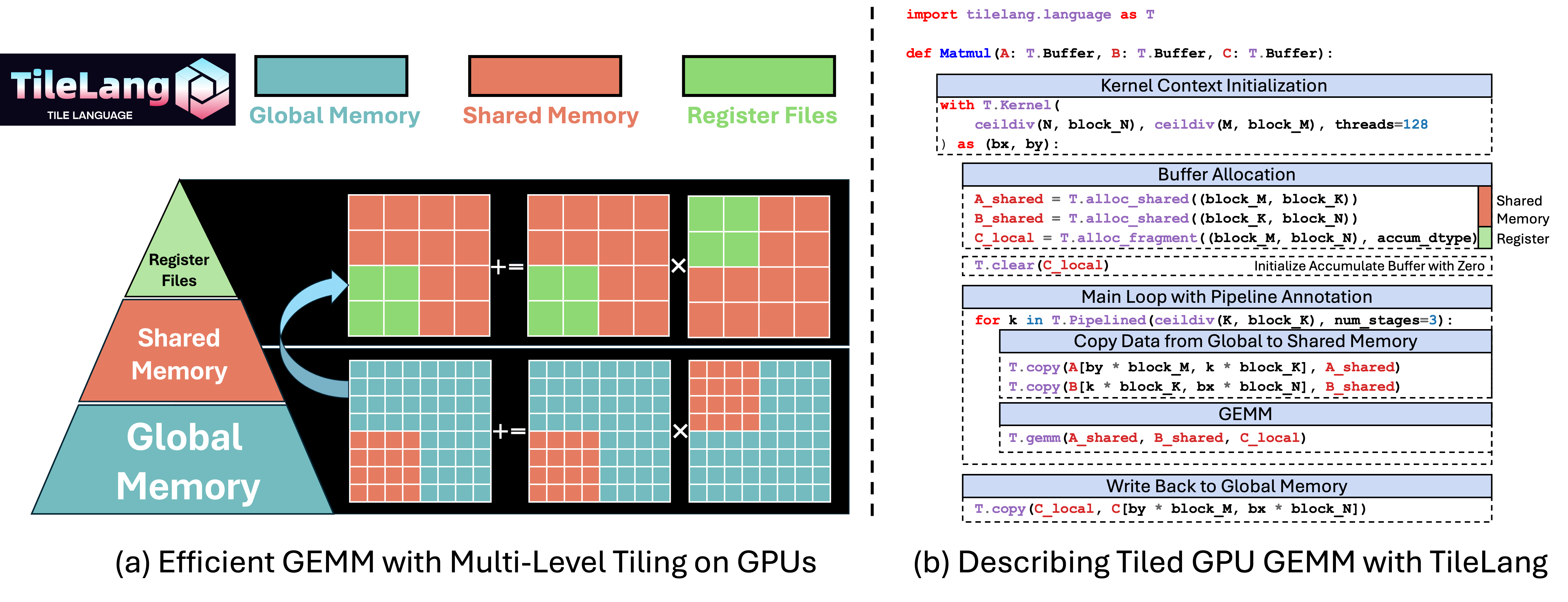
Tile Language (tile-lang) is a concise domain-specific language designed to streamline the development of high-performance GPU/CPU/NPU kernels (e.g., GEMM, Dequant GEMM, FlashAttention, LinearAttention). By employing a Pythonic syntax with an underlying compiler infrastructure on top of TVM, tile-lang allows developers to focus on productivity without sacrificing the low-level optimizations necessary for state-of-the-art performance.
Latest News
- 2026-09-30 — Ascend 950 backend: TileLang now officially supports Huawei Ascend 950 NPUs with native code generation, automatic scheduling and synchronization, SIMD/SIMT vector programming, etc. Explore the Ascend examples for GEMM, FlashAttention, and more.
- 2026-08-04 — TileLang LSP open sourced: published a Language Server Protocol implementation for TileLang with inlay hints for buffer shapes, dtypes, scopes, and inferred layouts, plus hover details and precise diagnostics.
- 2026-08-03 — TileLang v0.1.13: shipped the multi-backend language dialect, source locations in compiler diagnostics, new CUDA and Metal hardware paths, and a broad set of correctness fixes. This release removes several legacy APIs; read the compatibility notes before upgrading.
- 2026-07-30 — SM120 NVF4 block-scaled MMA: added an optimized Blackwell path for
T.mma_gemm_blockscaledand a corresponding SM120 example. - 2026-07-28 — Metal 4 cooperative-tensor GEMM: added cooperative-tensor
T.gemmsupport for Apple M5, while retaining the simdgroup fallback for unsupported shapes and systems.
Earlier news (2025–2026)
2026
- 2026-07-28 — Source-aware compiler diagnostics: carried Python source locations into TIRX and surfaced them in compiler errors.
- 2026-07-24 — Multi-backend language dialect: reorganized the language layer around shared semantics with static CUDA, ROCm, and Metal dialects.
- 2026-07-23 — Block-causal attention for dLLM: added fixed-length and variable-length block-causal attention examples for diffusion language models.
- 2026-07-22 — IR Lower Trace: introduced a debugging tool for inspecting IR changes across every compiler pass and the final code-generation step.
- 2026-07-22 — DeepSeek V3.2 sparse MLA backward: selected the launch width adaptively from the head-block size.
- 2026-07-21 — DeepSeek V3.2 top-k optimization: improved the sparse-attention top-k selector's memory access pattern, delivering approximately 1.9× higher performance in the reported benchmark.
- 2026-07-16 — Compiler pass timing: added profiling for compiler passes with a configurable reporting threshold.
- 2026-07-12 — IKET profiler integration: added CUDA timeline instrumentation and profiling support.
- 2026-07-08 — TileLang v0.1.12: added the LLVM backend, tile scheduler, backend registry, pass visualizer, and expanded Blackwell support.
- 2026-07-06 — Pass Visualizer: introduced a structure-tree browser for inspecting compiler transformations.
- 2026-06-26 — Cross-host CUDA binary cache: enabled compiled CUDA binaries to be reused across compatible hosts.
- 2026-06-24 — Tile scheduler: introduced persistent tile-scheduling primitives for kernel authors.
- 2026-06-24 — Backend CodeGen registry: moved device and host CodeGen dispatch behind a backend registry.
- 2026-06-18 — LLVM backend: added CPU lowering and execution through LLVM.
- 2026-06-18 — Arbitrary-layout TMA lowering: enabled TMA transfers for swizzled shared-memory layouts.
- 2026-06-16 — Pass Diff: added compiler-pass IR comparison for debugging lowering changes.
- 2026-06-08 — TileLang v0.1.11: expanded scan, pipeline, backend, CUDA, ROCm, and Metal functionality.
- 2026-05-25 — Scan operators: introduced tile-level scan primitives.
- 2026-05-25 — TileLang v0.1.10: broadened AMD and Blackwell support, added initial Metal GEMM, improved Windows packaging, and expanded autotuning.
- 2026-05-24 — CDNA4 MXFP4: added FP4 E2M1 matrix-core support for AMD gfx950.
- 2026-05-22 — Metal simdgroup GEMM: added the first Metal
T.gemmpath usingsimdgroup_matrixMMA. - 2026-05-20 — Cluster copies: introduced
T.copy_clusterfor TMA multicast and SM-to-SM cluster transfers. - 2026-05-20 — TMA gather/scatter: added
tile::gather4andtile::scatter4support. - 2026-05-20 — Native SM75 MMA GEMM: added FP16, INT8, and INT4 tensor-core paths for Turing GPUs.
- 2026-05-20 — TIRX migration: moved TileLang IR usage to TVM's TIRX representation.
- 2026-05-11 — Parallel autotuning: added pipelined compilation, grouped compilation, and multi-GPU benchmarking.
- 2026-05-07 — DeepSeek V4 operators: added TileLang examples for DeepSeek V4 workloads.
- 2026-05-06 — Windows support: added complete Windows build and runtime support with cross-platform fixes.
- 2026-04-28 — MXFP8 grouped GEMM: added block-scaled grouped GEMM examples with transposed-B support on Blackwell.
- 2026-04-25 — HISA sparse-attention indexer: added hierarchical sparse-attention indexing examples.
- 2026-04-24 — Blackwell MXFP8 block-scaled GEMM: added MXFP8 block-scaled matrix multiplication on SM100.
- 2026-04-22 — TileLang v0.1.9: delivered CuTe DSL GEMM V2, Metal code generation improvements, and build-without-host-toolchain support.
- 2026-04-22 — RDNA3/RDNA3.5 WMMA: added WMMA lowering for AMD gfx11 GPUs.
- 2026-04-20 — INT4
T.gemm: added INT4 matrix multiplication to the CUDA GEMM path. - 2026-04-17 — CUDA source kernels: introduced
T.CUDASourceCodeKernelfor embedding custom CUDA source. - 2026-04-15 — AutoDD frozen regions: added
__freeze__annotations to preserve selected code during automatic delta debugging. - 2026-03-27 — TMA stores: added store support to
T.tma_copy. - 2026-03-24 — Two-SM Blackwell kernels: added two-SM TMA, TMEM, and TCGEN5 MMA support.
- 2026-03-23 — AMD RDNA4: upgraded the ROCm path and added RDNA4 GPU support.
- 2026-03-22 — FlashAttention on SM100: added Blackwell FlashAttention examples.
- 2026-03-18 — Producer-consumer warp specialization: added automatic warp-specialized pipelines and the
T.tma_copyAPI. - 2026-03-12 — Eager-mode autotuning: enabled the autotuner with eager JIT kernels.
- 2026-03-10 — CPU
T.gemm: added matrix multiplication support for the CPU target. - 2026-03-05 — IR dump configuration: added a TileLang pass configuration for dumping intermediate IR.
- 2026-02-28 — CUDA cluster primitives: added cluster launch, query, synchronization, and barrier operations.
- 2026-02-28 — TCGEN5 MMA tensor-shared path: added the tensor-memory/shared-memory Blackwell GEMM path.
- 2026-02-24 — Host-toolchain-free builds: enabled installation without a host C/C++ toolchain when supported artifacts are available.
- 2026-02-23 — CuTe DSL GEMM V2: added SM90 and SM100 GEMM V2 support to the CuTe DSL backend.
- 2026-02-16 — TileLang v0.1.8: shipped dynamic pipeline improvements, logging documentation, richer layout representations, and AMD fixes.
- 2026-02-14 — Cross-CUDA release wheels: unified multiple CUDA versions behind a single wheel.
- 2026-02-14 — Hierarchical reductions: added hierarchical and warp-level reduction intrinsics.
- 2026-02-09 — CUDA runtime stubs: added lazy-loading CUDART and NVRTC stubs for CUDA 11, 12, and 13 compatible wheels.
- 2026-02-08 — Layout visualization improvements: improved rendering and inspection of TileLang layouts.
- 2026-02-02 — TileLang Puzzles: published ten progressively harder exercises for learning TileLang interactively.
2025
- 2025-12-18 — CuTe DSL backend: added compilation through NVIDIA CUTLASS CuTe DSL; follow ongoing work in issue #1454.
- 2025-12-17 — Z3 integration: integrated SMT-based symbolic reasoning into the TVM arithmetic analyzer.
- 2025-10-31 — Apache TVM FFI migration: moved the runtime interface to
apache-tvm-ffito reduce host-side overhead. - 2025-10-30 — TileLang v0.1.6.post2: published the final TileLang release compatible with Python 3.8.
- 2025-10-07 — Apple Metal backend: introduced Metal device support for Apple silicon.
- 2025-09-29 — Huawei Ascend adapters: published AscendC and Ascend NPU IR backend work in the external TileLang Ascend project.
- 2025-07-04 — 2:4 sparse tensor cores: introduced
T.gemm_spfor structured-sparse matrix multiplication. - 2025-06-05 — NVRTC execution backend: added an NVRTC path to reduce compilation time for generated CUDA templates.
- 2025-04-14 — FlashMLA on AMD MI300X: published the optimized AMD implementation and accompanying documentation.
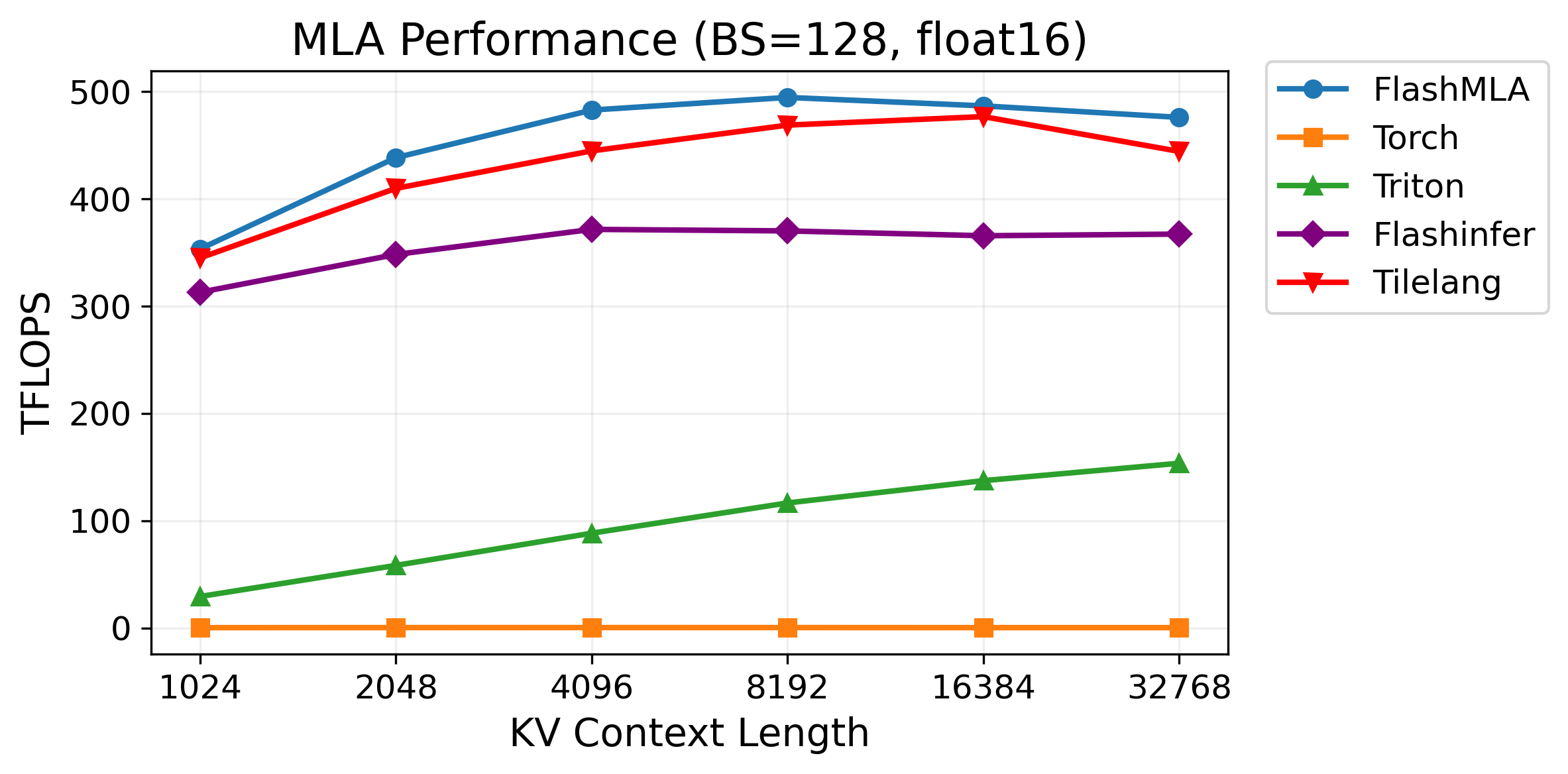
- 2025-03-03 — MLA decoding on H100: published the compact TileLang implementation, benchmarks, and optimization walkthrough.
- 2025-02-15 — WebGPU code generation: added the initial WebGPU backend.
- 2025-02-12 — TileLang v0.1.0: published the first v0.1 public release.
- 2025-02-10 — Debugging and layout tools: added
T.printand fragment-layout visualization workflows. - 2025-01-20 — TileLang open sourced: made the project publicly available.
See all releases for complete changelogs and compatibility notes.
Platform and Backend Support
TileLang is evolving into a multi-backend compiler (TileLang-X) built around a modular backend abstraction. See the backend architecture for the design, or ask a coding agent to use the backend integration skill when porting TileLang to a new backend.
The currently supported backends are listed below. Primary identifies TileLang's core backend, while Supported and Experimental backends are implemented in the main repository. Ecosystem adapters live in separate repositories, are not included in TileLang release wheels, and may follow independent compatibility schedules. Prebuilt wheels are available for Linux x86-64/AArch64, Windows x86-64, and macOS arm64.
TileLang uses Target objects to represent compilation targets. The default auto target detects CUDA, HIP, Metal, and Ascend devices; select an explicit target when compiling for another backend or architecture. See the target guide for target syntax, architecture options, and backend-specific notes, or the corresponding adapter repository for installation and tested-device details.
| Backend | Target | Platforms and hardware | Support level | Notes |
| --- | --- | --- | --- | --- |
| NVIDIA CUDA | cuda | Linux x86-64/AArch64, Windows x86-64; code paths from SM70 through SM120 | Primary | Release wheels and CI coverage; TMA, WGMMA, and TMEM features require the corresponding GPU architecture. |
| AMD ROCm/HIP | hip | Linux; CDNA and RDNA GPUs, including gfx942/gfx950 paths | Supported | Included in Linux wheels; a ROCm runtime is required. CI runs on a self-hosted gfx942 (MI300X) runner; gfx950 is not yet covered. |
| Huawei Ascend 950 | ascend | Linux; Ascend 950 NPUs | Supported | Build from source with USE_ASCEND=ON; requires CANN and torch_npu. See the Ascend guide. |
| Apple Metal | metal | macOS on Apple silicon | Supported | Release wheels and CI coverage; Metal 4 cooperative tensors are available on supported M5 systems. |
| LLVM CPU | llvm | Host CPUs | Experimental | Build from source with USE_LLVM=ON; LLVM 15 or newer is required. |
| NVIDIA CuTe DSL | cutedsl | NVIDIA GPUs | Experimental | Requires nvidia-cutlass-dsl. |
| WebGPU | webgpu | WebGPU runtimes | Experimental | Code generation and runtime integration are still evolving. |
| Huawei Ascend A2/A3 | ascendc / pto / npuir | Ascend A2 and A3 | Ecosystem | Developed in tilelang-ascend and the MLIR-based tilelang-mlir-ascend. |
| MetaX MACA | maca | MetaX C500 and C600 | Ecosystem | Developed in tilelang-metax; requires the MACA software stack. |
| Moore Threads MUSA | musa | S5000, S4000, and M1000 | Ecosystem | Developed in tilelang-musa and released independently. |
| HYGON | hcu | Linux; BW1000, BW1100, BW150 and K100_AI | Ecosystem | Developed in tilelang-hygon; requires the DTK software stack. |
| Sunrise-AI TANG | tang | Sunrise S2 and S3 | Ecosystem | Developed in tilelang-sunrise. The TANG software stack is required. |
Installation
Install the latest stable release from PyPI:
pip install tilelang
Verify the installation:
python -c "import tilelang; print(tilelang.__version__)"
Nightly wheels provide recent features and fixes before the next stable release:
pip install tilelang --find-links https://tile-ai.github.io/whl/nightly
On AMD GPUs the same Linux wheels work out of the box: install a ROCm build of PyTorch first (e.g. pip install torch --index-url https://download.pytorch.org/whl/rocm7.0), then pip install tilelang. A host ROCm installation is required at runtime; see the ROCm notes in the installation guide.
Nightly builds may be less stable than official releases. For source builds, editable installs, Docker, ROCm setup, pip-provided CUDA toolchains, or a custom TVM checkout, follow the complete installation guide.
Quick Start
The following example defines, compiles, runs, and verifies an FP16 GEMM kernel with FP32 accumulation and a fused ReLU epilogue. It uses PyTorch CUDA tensors; PyTorch uses the same cuda device name on ROCm systems. TileLang selects the target automatically from the current environment.
import torch
import tilelang
import tilelang.language as T
@tilelang.jit
def matmul_relu(A, B, block_M: int = 128, block_N: int = 128, block_K: int = 32):
M, N, K = T.const("M, N, K")
A: T.Tensor((M, K), T.float16)
B: T.Tensor((K, N), T.float16)
C = T.empty((M, N), T.float16)
with T.Kernel(T.ceildiv(N, block_N), T.ceildiv(M, block_M), threads=128) as (bx, by):
A_shared = T.alloc_shared((block_M, block_K), T.float16)
B_shared = T.alloc_shared((block_K, block_N), T.float16)
C_local = T.alloc_fragment((block_M, block_N), T.float32)
T.clear(C_local)
for k in T.Pipelined(T.ceildiv(K, block_K), num_stages=3):
T.copy(A[by block_M, k block_K], A_shared)
T.copy(B[k block_K, bx block_N], B_shared)
T.gemm(A_shared, B_shared, C_local)
for i, j in T.Parallel(block_M, block_N):
C_local[i, j] = T.max(C_local[i, j], 0)
T.copy(C_local, C[by block_M, bx block_N])
return C
M = N = K = 1024
a = torch.randn((M, K), device="cuda", dtype=torch.float16)
b = torch.randn((K, N), device="cuda", dtype=torch.float16)
c = matmul_relu(a, b)
torch.testing.assert_close(c, torch.relu(a @ b), rtol=1e-2, atol=1e-2)
print("GEMM + ReLU passed.")
@tilelang.jit specializes the kernel for the input shape and compile-time arguments on first use. T.Pipelined stages global-to-shared transfers, T.gemm maps the tile operation to the target backend, and T.Parallel expresses the elementwise ReLU epilogue. Continue with the language basics, then explore the GEMM examples for layouts, autotuning, and architecture-specific optimizations.
Examples
- Start here: quickstart and elementwise kernels
- GEMM and quantization: GEMM, grouped GEMM, FP8 GEMM, dequantization GEMM, and block-scaled GEMM
- Attention and sequence models: FlashAttention, Flash Decoding, block-sparse attention, linear attention, and GDN
- Model workloads: DeepSeek MLA, DeepSeek V3.2, DeepSeek V4, and DeepSeek mHC
- Architecture-specific kernels: AMD, TCGEN05, and SM120
- Compiler and debugging tools: analyzer, layout visualization, AutoDD, and IKET
Benchmark Summary
TileLang achieves exceptional performance across a variety of computational patterns. Comprehensive benchmark scripts and settings are available at tilelang-benchmark. Below are selected results showcasing its capabilities:
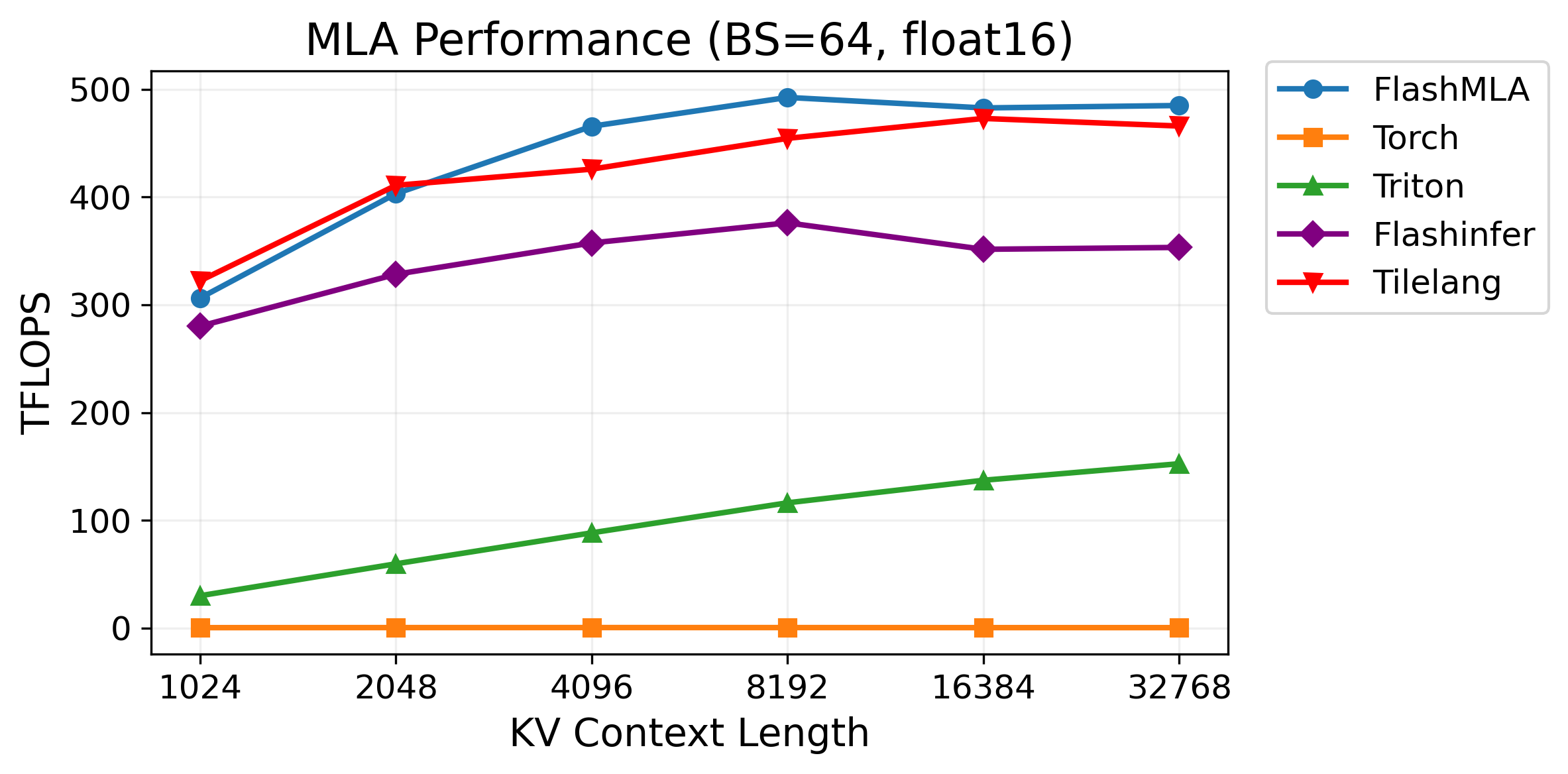
- MLA Decoding Performance on H100
- Flash Attention Performance on H100