1
 →
→
An optimized deep prompt tuning strategy comparable to fine-tuning across scales and tasks
THUDM/P-tuning-v2 is an open-source project on GitHub, mainly written in Python. An optimized deep prompt tuning strategy comparable to fine-tuning across scales and tasks It currently holds 2,077 stars and 212 forks with 0 open issues, and was last pushed on an unknown date (repository created unknown).
AI Homed tracks it on the AI Prompt Engineering board.
Source codes and data for
Find our previous version P-tuning v1 for knowledge probing and few-shot SuperGLUE. Your kindly starring our repo can greatly encourage us to work harder :)
You may be also interested in our recent work GLM-130B: An Open Bilingual Pre-trained Model (2022-10-06). It is an open-sourced LLM outperforming GPT-3 175B over various benchmarks. Get model weights, do inference and P-Tuning v2 with only **4 RTX 3090 or 8 RTX 2080 Ti FOR FREE!
P-tuning v2 leverages deep prompt tuning, which is to apply continuous prompts for every layer input of the pretrained transformer. Deep prompt tuning increases the capacity of continuous prompts and closes the gap to fine-tuning across various settings, especially for small models and hard tasks.
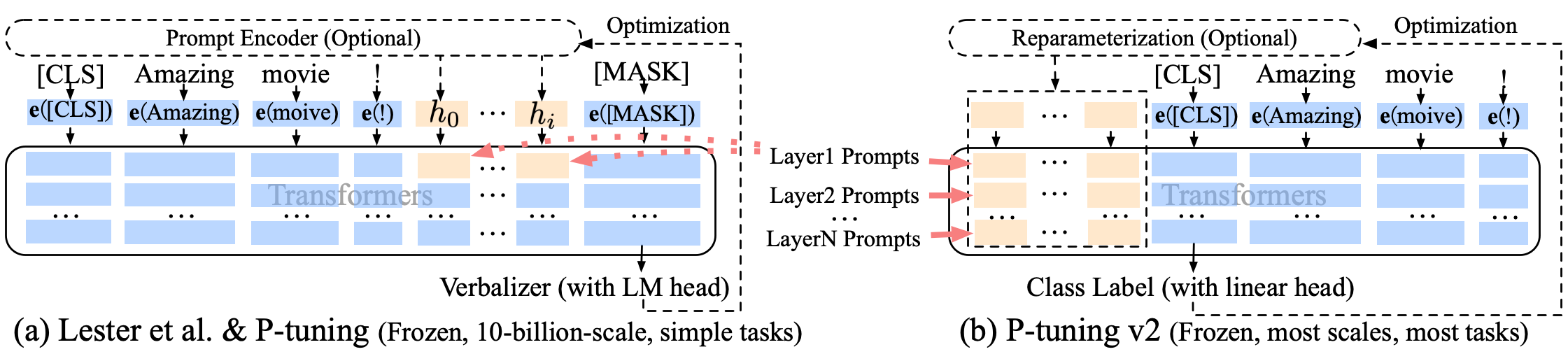
Thanks @rainatam's joint effort in re-organizing codes for publishing!
conda create -n pt2 python=3.8.5
conda activate pt2
After we setup basic conda environment, install pytorch related packages via:
conda install -n pt2 pytorch==1.7.1 torchvision==0.8.2 torchaudio==0.7.2 cudatoolkit=11.0 -c pytorch
Finally, install other python packages we need:
pip install -r requirements.txt
For sequence tagging (NER, SRL) datasets, we prepare a non-official packup here. After downloading, unzip the packup to the project root. Please use at your own risk.
bash run_script/run_rte_roberta.sh
Released results on BERT-large
| | BoolQ | COPA | RTE | WiC | WSC | CoNLL04 | OntoNotes 5.0 | CoNLL12 | |--------------|-------|------|------|------|------|---------|---------------|---------| | Result | 74.3 | 77.0 | 80.1 | 75.1 | 68.3 | 84.5 | 86.4 | 85.3 | | Total Epochs | 100 | 80 | 60 | 80 | 80 | 40 | 30 | 45 | | Best Epoch | 58 | 12 | 30 | 56 | 17 | 33 | 24 | 43 |
Released results on RoBERTa-large
| | BoolQ | COPA | RTE | WiC | WSC | CoNLL03 | CoNLL04 | OntoNotes 5.0 | CoNLL12 | CoNLL05 WSJ | CoNLL05 Brown | SQuAD 1.1 | SQuAD 2.0 | |--------------|-------|------|------|------|------|---------|---------|---------------|---------|-------------|---------------|-----------|-----------| | Results | 84.0 | 92.0 | 86.6 | 73.7 | 64.4 | 91.8 | 88.4 | 90.1 | 84.7 | 89.4 | 83.9 | 88.1/94.2 | 81.3/84.7 | | Total Epochs | 100 | 120 | 100 | 50 | 10 | 30 | 80 | 60 | 45 | 15 | - | 30 | 10 | | Best Epoch | 86 | 78 | 65 | 31 | 3 | 28 | 45 | 59 | 37 | 13 | - | 24 | 9 |
For other hyper-parameters, please refer to the training scripts. If you can not achieve the reported results at the best epoch, there is probably an environmental mismatch and hyper-parameter search is needed.
If you find our work useful, please kindly cite our paper:
@article{DBLP:journals/corr/abs-2110-07602,
  author    = {Xiao Liu and
               Kaixuan Ji and
               Yicheng Fu and
               Zhengxiao Du and
               Zhilin Yang and
               Jie Tang},
  title     = {P-Tuning v2: Prompt Tuning Can Be Comparable to Fine-tuning Universally
               Across Scales and Tasks},
  journal   = {CoRR},
  volume    = {abs/2110.07602},
  year      = {2021},
  url       = {https://arxiv.org/abs/2110.07602},
  eprinttype = {arXiv},
  eprint    = {2110.07602},
  timestamp = {Fri, 22 Oct 2021 13:33:09 +0200},
  biburl    = {https://dblp.org/rec/journals/corr/abs-2110-07602.bib},
  bibsource = {dblp computer science bibliography, https://dblp.org}
}
 →
→ →
→ →
→ →
→ →
→ →
→ →
→