1
 →
→
TeleMem is a high-performance drop-in replacement for Mem0, featuring semantic deduplication, long-term dialogue memory, and multimodal video reasoning.
TeleAI-UAGI/telemem is an open-source project on GitHub, mainly written in Python. TeleMem is a high-performance drop-in replacement for Mem0, featuring semantic deduplication, long-term dialogue memory, and multimodal video reasoning. It currently holds 492 stars and 0 forks with 0 open issues, and was last pushed on an unknown date (repository created unknown).
AI Homed tracks it on the AI Agent Memory board.



_🤝 Contributions welcome! Feel free to open an issue or submit a pull request._
---
TeleMem is an agent memory management layer that can be used as a high-performance drop-in replacement for Mem0 with one line of code (import telemem as mem0), deeply optimized for complex scenarios involving multi-turn dialogues, character modeling, long-term information storage, and semantic retrieval.
Through its unique context-aware enhancement mechanism, TeleMem provides conversational AI with core infrastructure offering higher accuracy, faster performance, and stronger character memory capabilities.
Building upon this foundation, TeleMem implements video understanding, multimodal reasoning, and visual question answering capabilities. Through a complete pipeline of video frame extraction, caption generation, and vector database construction, AI Agents can effortlessly store, retrieve, and reason over video content just like handling text memories.
The ultimate goal of the TeleMem project is to _use an agent's hindsight to improve its foresight_.
TeleMem, where memory lives on and intelligence grows strong.
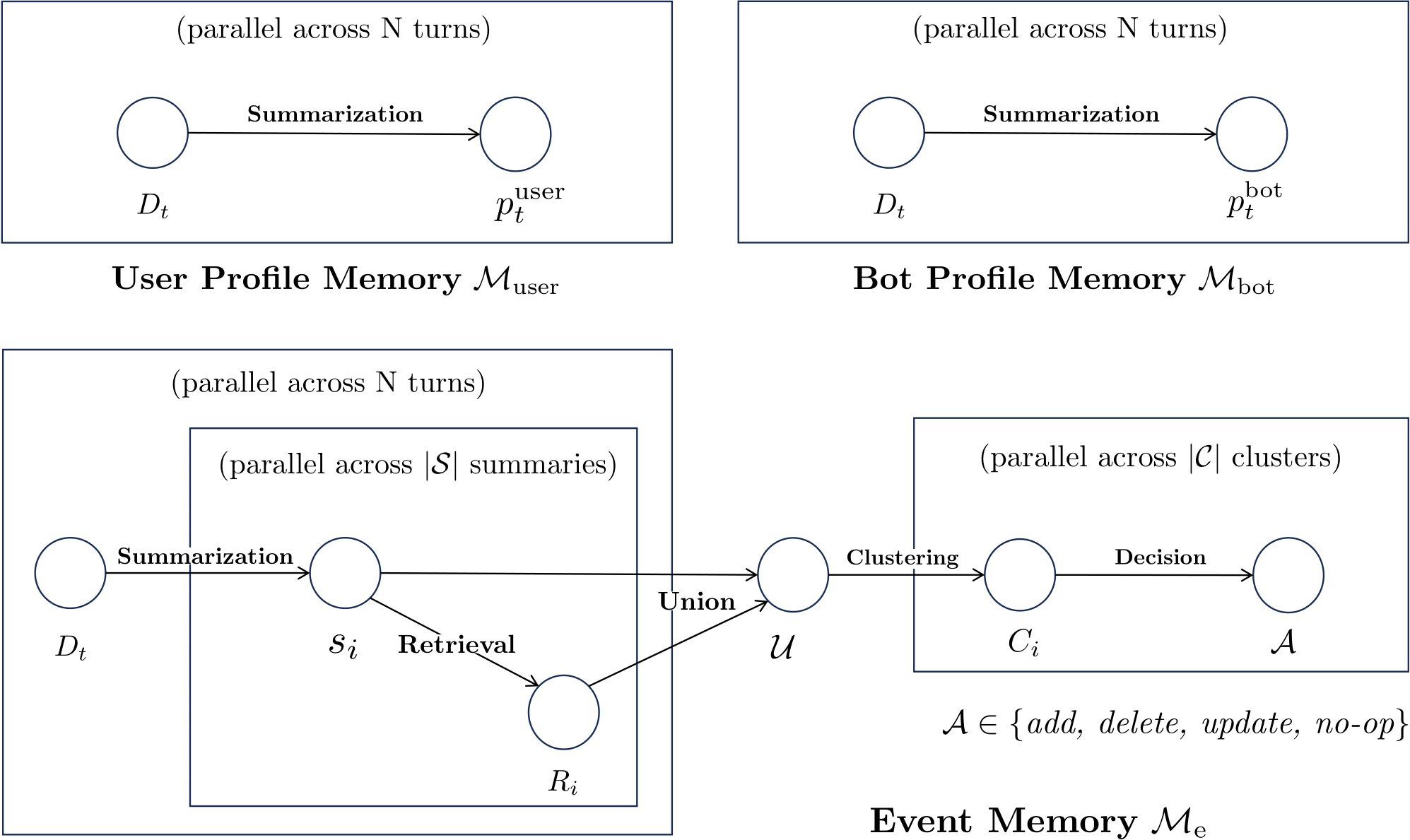
add() / search() accept the same arguments and return the same {"results": [...]} shapes, so existing Mem0 code keeps working.uvx, registers all 8 memory tools under mcp__telemem__*, and securely forwards provider configuration. See the MCP server docs.infer=False/prompt/memory_type now fully honored, offline contract test suite, telemetry disabled by default, and a multi-NPC demo!uvx telemem! Also new: evaluation principles and a LongMemEval harness with built-in baselines.pip install telemem! v1.6.0 adds Ollama/DeepSeek/Kimi configs, LangChain & LlamaIndex examples, and a documentation site.TeleMem enables conversational AI to maintain stable, natural, and continuous worldviews and character settings during long-term interactions through a deeply optimized pipeline of character-aware summarization → semantic clustering deduplication → efficient storage → precise retrieval.
flowchart LR
    A["Dialogue
messages"] --> B["Character-aware
summarization
(global + per-character)"]
    B --> C["Embedding +
similar-memory
retrieval"]
    C --> D["Write buffer
(batch flush)"]
    D --> E["LLM semantic
clustering & fusion"]
    E --> F[("FAISS index +
JSON metadata")]
    Q["Query"] --> S["Vector search
+ rerank"]
    F --> S
    S --> R["results"]
---
TeleMem deeply refactors Mem0 to address characterization, long-term memory, and high performance. Key differences:
| Capability Dimension | Mem0 | TeleMem | | -------------------------- | --------------------------- | ------------------------------------------------------------ | | Multi-character separation | ❌ Not supported | ✅ Automatically creates independent memory profiles per character | | Summary quality | Basic summarization | ✅ Context-aware + character-focused prompts covering key entities, actions, and timestamps | | Deduplication mechanism | Vector similarity filtering | ✅ LLM-based semantic clustering: merges similar memories via LLM | | Write performance | Streaming, single writes | ✅ Batch flush + concurrency: 2–3× faster writes | | Storage format | SQLite / vector DB | ✅ FAISS + JSON metadata dual-write: fast retrieval + human-readable | | Multimodal Capability | Single image to text only | ✅ Video Multimodal Memory: Full video processing pipeline + ReAct multi-step reasoning QA | ---
We evaluate the ZH-4O Chinese long-character dialogue dataset constructed in the paper MOOM: Maintenance, Organization and Optimization of Memory in Ultra-Long Role-Playing Dialogues:
{
"question": "What is Zhao Qi's nickname for Bai Yulan? A Xiaobai B Xiaoyu C Lanlan D Yuyu",
"answer": "A"
},
{
"question": "What is the relationship between Zhao Qi and Bai Yulan? A Classmates B Teacher and student C Enemies D Neighbors",
"answer": "B"
}
---
pip install telemem            # core (text memory)
pip install "telemem[mcp]"     # + MCP server
pip install "telemem[video]"   # + video/multimodal pipeline
pip install "telemem[all]"     # everything
Using uv (recommended — creates .venv from the committed uv.lock for a reproducible environment):
uv sync --all-extras   # install TeleMem (editable) + all extras, incl. MCP
uv run python examples/quickstart.py
Or with conda + pip:
# Create and activate virtual environment
conda create -n telemem python=3.10
conda activate telemem
Install from source (editable), with the extras you need
pip install -e ".[all]"
Set your OpenAI API key:
export OPENAI_API_KEY="your-openai-api-key"
# python examples/quickstart.py
import telemem as mem0
memory = mem0.Memory()
messages = [
    {"role": "user", "content": "Jordan, did you take the subway to work again today?"},
    {"role": "assistant", "content": "Yes, James. The subway is much faster than driving. I leave at 7 o'clock and it's just not crowded."},
    {"role": "user", "content": "Jordan, I want to try taking the subway too. Can you tell me which station is closest?"},
    {"role": "assistant", "content": "Of course, James. You take Line 2 to Civic Center Station, exit from Exit A, and walk 5 minutes to the company."}
]
memory.add(messages=messages, user_id="Jordan")
results = memory.search("What transportation did Jordan use to go to work today?", user_id="Jordan")
for hit in results["results"]:   # same result shape as mem0
    print(hit["memory"])
Memory() uses the default provider settings inherited from mem0ai. To use the repository's local Qwen + FAISS configuration, load config/config.yaml explicitly:
from telemem.utils import load_config
import telemem as mem0
config = load_config("config/config.yaml")
memory = mem0.Memory(config=config)
The runnable examples also honor the same configuration through TELEMEM_CONFIG:
TELEMEM_CONFIG=config/config.yaml python examples/quickstart.py
TeleMem supports MiniMax as an LLM backend via its OpenAI-compatible API.
A ready-to-use example config is provided at config/config.minimax.yaml.
export MINIMAX_API_KEY="your-minimax-api-key"
export OPENAI_API_KEY="your-openai-api-key"  # still needed for embeddings
from telemem.utils import load_config
import telemem as mem0
config = load_config("config/config.minimax.yaml")
memory = mem0.Memory(config=config)
Key points for MiniMax usage:
https://api.minimax.io/v1; MiniMax M2.7 (204,800 context) is also available. MiniMax-M3 accepts text, image and video input and supports adaptive thinking; MiniMax-M2.7 is text-only with always-on thinking
Regional endpoints: use https://api.minimax.io/v1 (global) or https://api.minimaxi.com/v1 (China) as openai_base_url
Temperature: must be in (0.0, 1.0] — set explicitly (e.g. 0.7) to avoid out-of-range errors
Embeddings: MiniMax does not provide a public embedding API; configure a separate embedder (e.g. text-embedding-3-small) in the embedder section
TeleMem works with
any OpenAI-compatible endpoint. Ready-to-use config examples ship inconfig/:
| Provider | Config file | LLM | Embeddings | Notes | | -------- | ----------- | --- | ---------- | ----- | |
Ollama (fully local) |config.ollama.yaml | any local model (e.g. qwen3:8b) | nomic-embed-text, local | No API key, no cloud — everything runs on your machine |
| DeepSeek | config.deepseek.yaml | deepseek-chat / deepseek-reasoner | external (e.g. OpenAI) | DEEPSEEK_API_KEY + OPENAI_API_KEY |
| Moonshot (Kimi) | config.moonshot.yaml | kimi-k2-0905-preview | external (e.g. OpenAI) | .cn and .ai endpoints supported |
| MiniMax** | config.minimax.yaml | MiniMax-M3 | external (e.g. OpenAI) | see section above |
TELEMEM_CONFIG=config/config.ollama.yaml python examples/quickstart.py # 100% local memory
---
telemem/
├── assets/                 # Documentation assets and figures
├── baselines/              # Baseline implementations for comparative evaluation
│ ├── RAG                   # Retrieval-Augmented Generation baseline
│ ├── MemoBase              # MemoBase memory management system
│ ├── MOOM                  # MOOM dual-branch narrative memory framework
│ ├── A-mem                 # A-mem agent memory baseline
│ └── Mem0                  # Mem0 baseline implementation
├── config/
│ ├── config.yaml           # TeleMem default configuration
│ └── config.minimax.yaml   # MiniMax provider example configuration
├── data/                   # Small sample datasets for evaluation or demonstration
├── examples/               # Code examples and tutorial demos
│ ├── quickstart.py         # Quick start
│ ├── quickstart_mm.py      # Quick start (multimodal)
│ ├── mcp_client.py         # Quick start over MCP (stdio client)
│ ├── mcp_config.json       # MCP config snippet for Claude Desktop / Cursor
│ └── deepseek-harness.cordis.yml # DeepSeek Harness memory patch
├── docs/
│ ├── MCP.md                # MCP server reference
│ └── TeleMem_Tech_Report.pdf
├── telemem/                # Telemem code
│ └── mcp/                  # Model Context Protocol server
├── tests/                  # Telemem test
├── README.md               # English README
├── README-ZH.md            # Chinese README
└── pyproject.toml          # Python environment
---
The add() method injects one or more dialogue turns into the memory system.
def add(
 self,
 messages,
 *,
 user_id: Optional[str] = None,
 agent_id: Optional[str] = None,
 run_id: Optional[str] = None,
 metadata: Optional[Dict[str, Any]] = None,
 infer: bool = True,
 memory_type: Optional[str] = None,
 prompt: Optional[str] = None,
 batch: bool = False,
)
| Parameter | Type | Required | Description |
| ------------- | ------------------------------- | -------- | ------------------------------------------------------------ |
| messages | str or List[Dict[str, str]] | ✅ Yes | A single statement, or a list of dialogue messages with role (user/assistant) and content |
| user_id | Optional[str] | ❌ No | Character/user to attribute the memory to; TeleMem keeps an independent memory profile per user_id. Omit it to store shared conversation-event memories |
| agent_id / run_id | Optional[str] | ❌ No | Additional mem0-compatible scopes (e.g. one run_id per session) |
| metadata | Optional[Dict[str, Any]] | ❌ No | Arbitrary metadata stored with each memory |
| infer | bool | ❌ No | Extract salient facts with the LLM (default: True); False stores message contents verbatim with no LLM call |
| memory_type | Optional[str] | ❌ No | Pass "procedural_memory" to create procedural memories via mem0's pipeline; omit for conversational memories |
| prompt | Optional[str] | ❌ No | Custom extraction prompt (replaces the optimized default as the system prompt) |
| batch | bool | ❌ No | Route through the high-throughput batched pipeline (add_batch) |
Returns the mem0-compatible shape: {"results": [{"id": "...", "memory": "...", "event": "ADD"}, ...]}
add()1. Message preprocessing: Merge consecutive messages from the same speaker; normalize turn structure. 2. Multi-perspective summarization:
🎭 Multi-character demo: examples/multi_npc.py runs five tavern
NPCs through one scene — a single add_batch(scene, user_id=[...]) call gives each NPC a
private memory profile plus a shared "events" world-state, and each NPC then recalls the
scene from their own perspective.
---
Performs semantic vector-based retrieval of relevant memories with context-aware recall.
def search(
 self,
 query: str,
 *,
 user_id: Optional[str] = None,
 agent_id: Optional[str] = None,
 run_id: Optional[str] = None,
 limit: int = 100,
 filters: Optional[Dict[str, Any]] = None,
 threshold: Optional[float] = None,
 rerank: bool = True,
)
| Parameter | Type | Required | Description |
| ----------- | ------------------ | -------- | ------------------------------------------------- |
| query | str | ✅ Yes | Natural language query |
| user_id | Optional[str] | ❌ No | Character/user profile to search. The shared event memories (pseudo-user "events") are always searched as well |
| agent_id / run_id | Optional[str] | ❌ No | Additional mem0-compatible scope filters |
| limit | int | ❌ No | Max number of results (default: 100) |
| threshold | Optional[float] | ❌ No | Similarity threshold (0–1; auto-tuned if omitted) |
| filters | Dict[str, Any] | ❌ No | Custom filters (e.g., by character, time range) |
| rerank | bool | ❌ No | Whether to rerank results (default: True) |
Returns the mem0-compatible shape: {"results": [{"id": "...", "memory": "...", "score": ..., ...}, ...]}
🔍 Search is based on FAISS vector retrieval, supporting millisecond-level responses.
---
Beyond text memory, TeleMem further extends multimodal capabilities. Drawing inspiration from Deep Video Discovery's Agentic Search and Tool Use approach, we implemented two core methods in the TeleMemory class to support intelligent storage and semantic retrieval of video content.
| Method | Description |
|------|----------|
| add_mm() | Process video into retrievable memory (frame extraction → caption generation → vector database) |
| search_mm() | Query video content using natural language, supporting ReAct-style multi-step reasoning |
→ →
→ →
→ →
→ →
→ →
→ →
→ →
→