1
 →
→
Looksmaxxing for motion graphics. An agent skill that turns AI slop videos into films that look made by a motion designer.
Tejashmakwana/motionmaxxing is an open-source project on GitHub, mainly written in JavaScript. Looksmaxxing for motion graphics. An agent skill that turns AI slop videos into films that look made by a motion designer. It currently holds 82 stars and 9 forks with 0 open issues, and was last pushed on an unknown date (repository created unknown).
AI Homed tracks it on the Today's Trending board, currently at rank #90 with 0 new stars today.
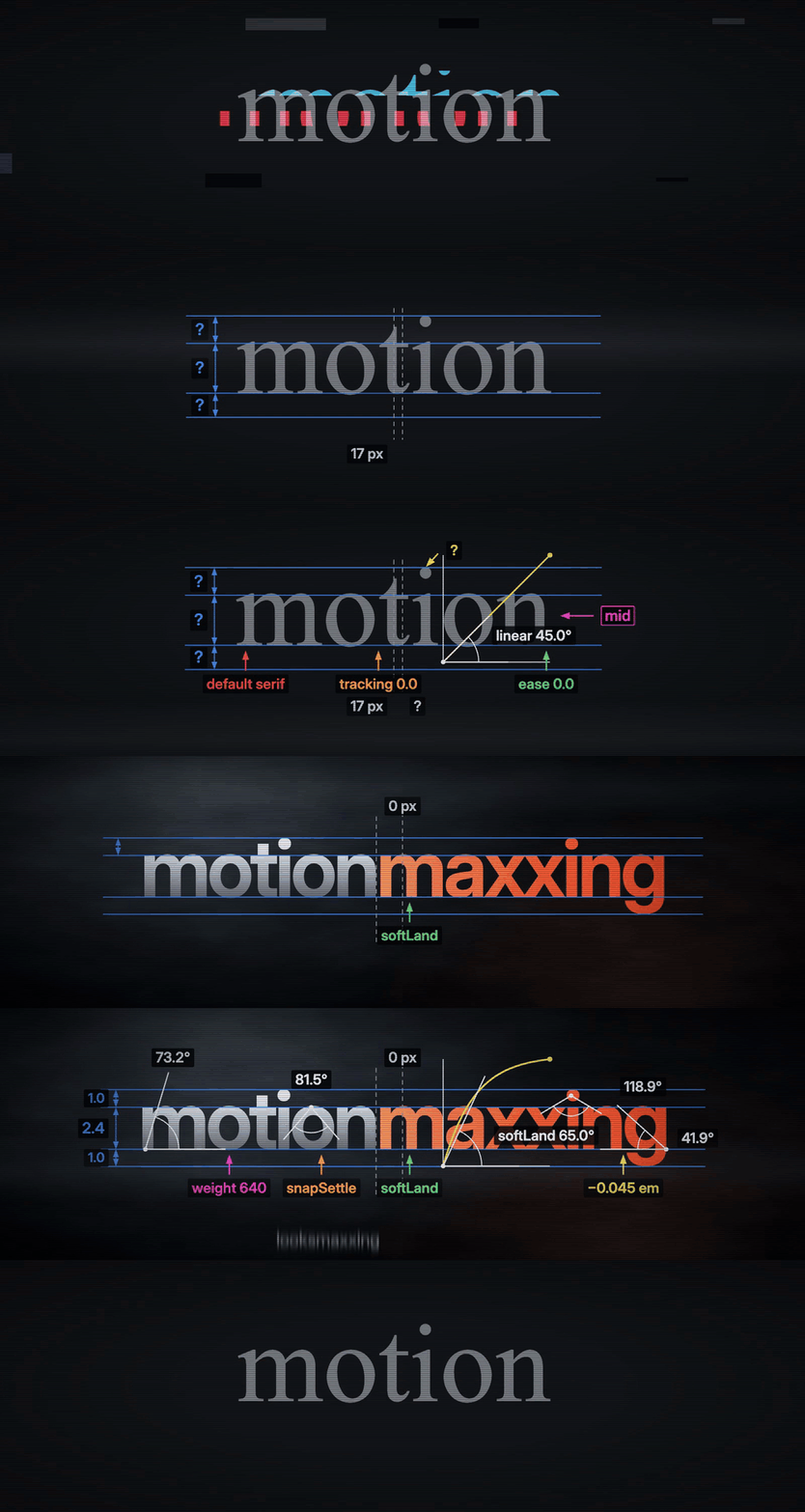
Your keyframes get a face rating: first the default (mid), then the measured version (maxxed). Typography and vector only, no photo of anyone, made with the skill's own runtime. Watch the MP4 · how it was made and checked
Looksmaxxing for motion graphics.
An agent skill that turns AI slop videos into films that look made by a motion designer.
Follow @makwanatejas170 on X for the next glow-ups. Lives inside FinalMotion.
The glow-up · Why your AI video is mid · The science of the mog · The protocol · Mog check · Install · Start maxxing · Toolbox
Your AI video is mid. Not broken, not ugly, just undecided: a label in the corner, a headline on the left, a card on a flat colour, a fade between every beat. motionmaxxing is an agent skill that makes launch films, product promos, brand stings and kinetic-type pieces, and makes them on purpose. Give it a website and it captures the brand, finds an idea only that brand could own, builds a world for it, and animates with timing measured frame by frame from 53 professional motion moments. Then it renders the film and looks at it with scripts, instead of telling you it came out well. It runs in Claude Code and in any agent that reads a SKILL.md folder. Everything renders locally from plain HTML.
Motionmaxx it, then check the numbers.
Early release. Still getting sharper, and more is coming soon.
The rating scale
| Rating | What it looks like on screen | |---|---| | Slop | A slide deck that moves: corner labels, a counter, a left headline beside a card, fades everywhere | | Mid | Clean and competent, and nobody decided anything: default eases, flat grounds, a held end card | | Maxxed | One idea, a world with light and texture, measured motion, cuts on motion, and gates that pass with the numbers shown |
The skill's job is to move a film one notch right and to say honestly which notch it landed on.
Three before / after comparisons. In each, the same brand is filmed twice: once without the skill (mid) and once with it (maxxed). The brands belong to their owners and are used only to show the difference (see Ethics and credits).
Cluely, mid to maxxed. Same model, same brief: both films were generated with GPT-6.1. Left: without the skill. Right: with it. You don't need the most expensive model to get motion that looks designed. The difference is the skill, not the price tag. Watch the MP4 (30 s with sound, 1920x600).
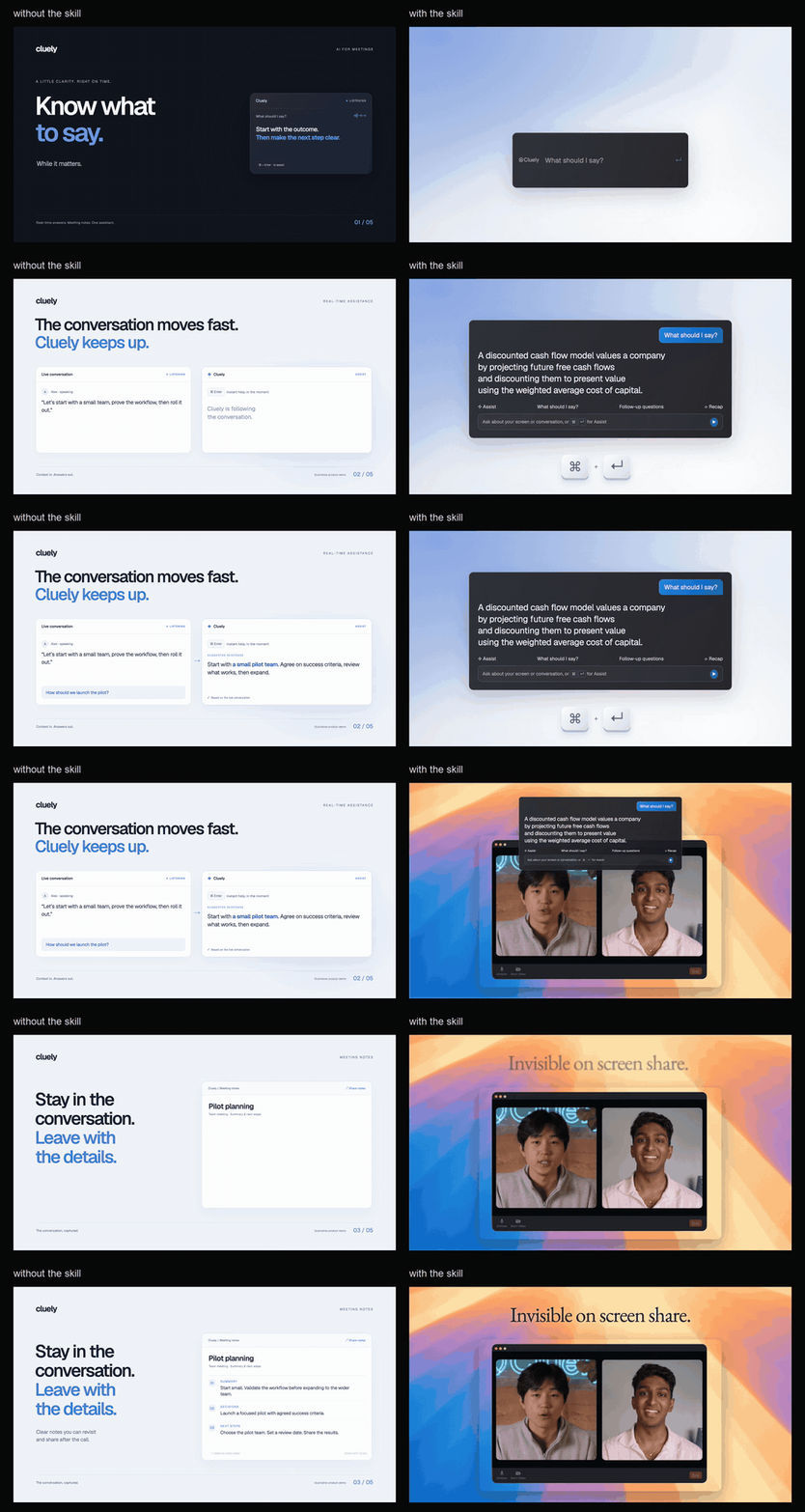
The left film is a slide deck: a brand label top-left, a "REAL-TIME ASSISTANCE" tag top-right, a held left headline in two colours, two cards, and a "02 / 05" counter. The right film is the product: the real assist overlay on a lit desktop, the ⌘ + ↵ shortcut as physical keys, then the overlay sitting on a live call.
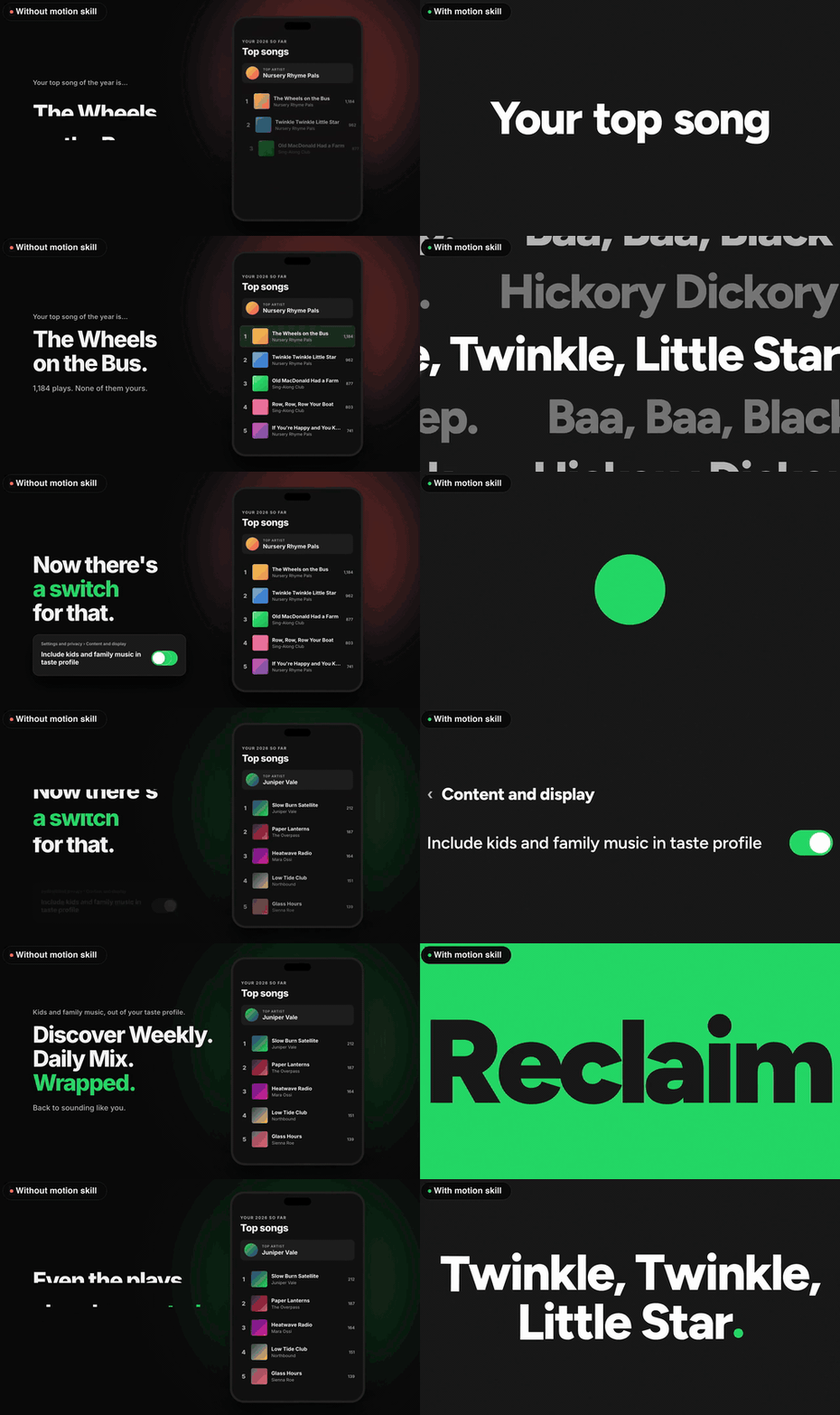
Spotify, mid to maxxed. Left: without the skill. Right: with it. The without arm is a left headline beside a phone mock-up in every frame. The with arm carries one idea (the green full stop becomes a switch, floods the frame, and becomes the icon) through type, a wall of lines that collapses, and a full-bleed ending. Watch the MP4 (15 s, 2560x720).
Wispr Flow, mid to maxxed. Top: without the skill. Bottom: with it. Watch the MP4 (24 s with sound, 1080x1440).
|
|
What to look for
|
Most AI motion graphics fail in the same recognisable way: everything is a slide. A slop autopsy of rejected AI films ranked 25 default patterns. These are the loudest tells, and what catches each one.
| The tell | What it looks like | Caught by |
|---|---|---|
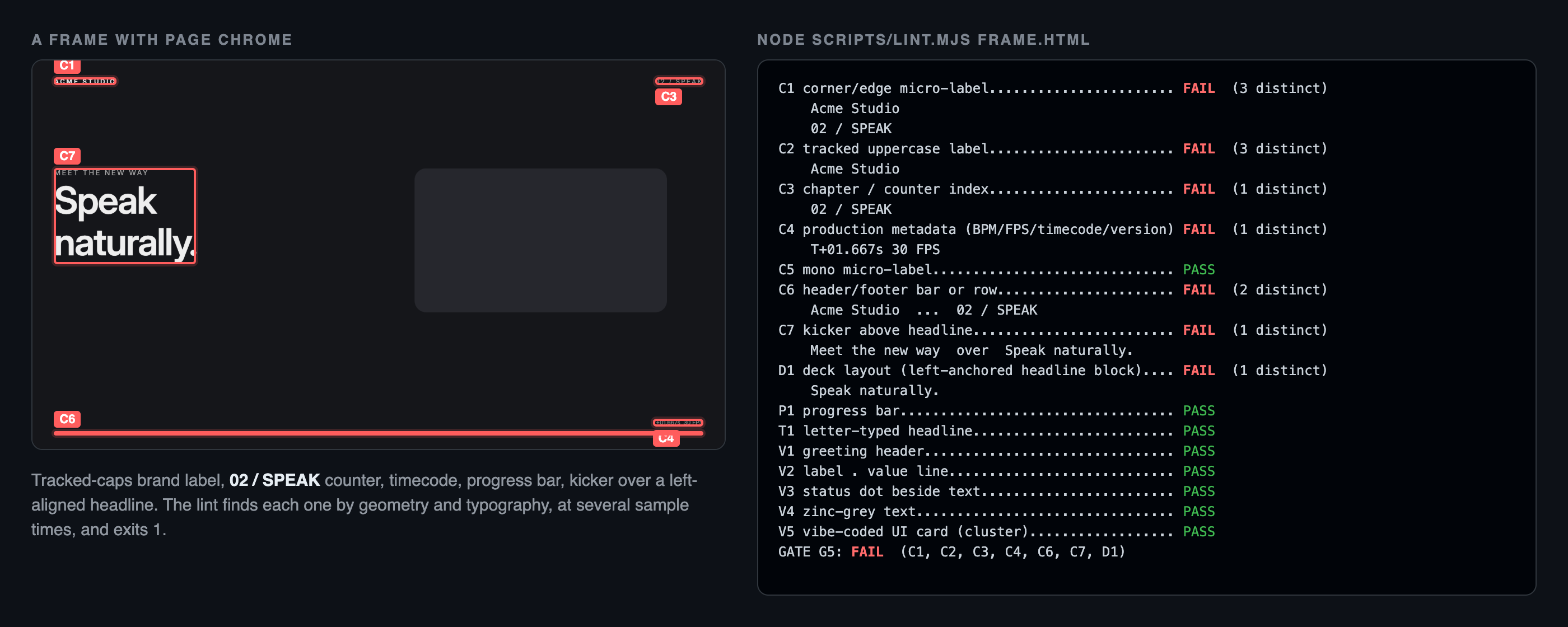
| Page chrome | A brand name in a corner, a "02 / SPEAK" counter, a timecode, corner brackets, a progress bar | lint.mjs (G5), rules C1-C6, P1 |
| Deck layouts | A held left-aligned headline, a kicker above it, "headline left, device right" | lint.mjs (G5), rules C7, D1 |
| Letter-typed headlines | A headline typed out character by character with a caret | lint.mjs (G5), rule T1 |
| Vibe-coded UI cards | A rounded card with a status dot and "label . value", a "Good morning" header, zinc greys | lint.mjs (G5), rules V1-V5 |
| Flat swatches | A different flat colour per scene, or a small card floating on a void | Your eyes on the contact sheet (references/world.md) |
| Dead frames | Runs of frames where nothing on screen moves | look.py (G2): more than 3 flat frames in a row fails |
| Fades everywhere | Every element arrives by opacity and every beat ends in a dissolve | Measured instead: pros use 3,392 transform entries against 584 opacity fades, and cut on motion |
Several of these were prescribed by earlier wording of the skill itself ("alternate flat grounds", "a recurring carrier"), so the fix was an edit to the skill, not a scolding for the agent. The lint is a lead, not a verdict: it cannot see text inside an image or a canvas.
Most "motion design skills" are a list of opinions. This one started with a measurement.

| Finding | Measured | |---|---| | The median move | 10 frames (0.33 s). Entries 11-12 f, opacity 6 f, blur 7-8 f | | Landing vs leaving | Landing decelerates (58% ease out); leaving accelerates (37% ease in, against 16% of landings) | | Overshoot | Under 9% of moves (8.8%), and late: a slow lean past the mark, not a fast spring | | Arrival | Decelerates from oversize. Logos crash in from about 3.5x. Nothing grows from zero | | Fades | Elements arrive by moving: 3,392 transform entries against 584 opacity fades | | Cuts | Pros cut on motion, not on rest. 96% of moments use hard cuts, about 20 per moment | | Dead frames | In the 3-7 s pro moments, motion on about 99% of frames (median still run: 1 frame). Whole films breathe more; the skill treats that as a question, not a target | | The ending | A resolved end hold of 0.6-1.4 s; the ending usually gets smaller |
Looksmaxxing is mostly boring fundamentals done consistently. So is motion design. The translation, with the measured finding behind each:
Ten steps, the same order every time. The agent shows you the idea and the storyboard before it builds, then fixes in a fixed order when a gate fails.
flowchart TD
    A["0  Toolbox and taste
providers.sh, verdicts, edits"] --> B["1  Know the brand
brand.mjs, fetch_logo.mjs"]
    B --> C["2  One true thing and PAGE
problem, audience, goal, emotion"]
    C --> D["3  Find the idea
3 kinds, cover the logo"]
    D --> E["4  World and time
STORYBOARD.md, buys, handoffs"]
    E -.-> F["5  Script and voice
voice.py, sync.mjs"]
    E --> G["6  Hardest beat first
runtime, stills, selfTest"]
    F -.-> G
    G --> H["7  Look honestly
render, look.py, lint.mjs"]
    H -->|a gate fails, fix it| G
    H --> I["8  Sound to picture
sfx, music, mix.py"]
    I --> J["9  Deliver
final.mp4, index.html, NOTE.md"]
Dashed steps are optional: voice and sound need an ElevenLabs key, and some films are better silent.
A gate that fails is fixed, not argued. Scripts print the numbers and the agent quotes them in NOTE.md. Two gates have no script, and the agent has to say so.
| Gate | Pass condition | Computed by | The vibe |
|---|---|---|---|
| G0 render exists | Decodes, is not blank, the picture moves, the length matches the plan, audio is present when planned | look.py | show up |
| G1 proof readable | UI text at least 0.04 H; the fragment at least 0.55 W or cropped by the frame; lit, in a world; magnified by the camera | by eye on the contact sheet | no squinting |
| G2 no empty frame | No run of more than 3 consecutive flat frames | look.py | mewing for your frames |
| G3 end card short | End hold at most 1.4 s; the final shot at most 25% of the film | look.py | do not overstay |
| G4 one hero per frame | Two panels only if one has twice the area of the other, or the camera moves between them | by eye on the contact sheet | one main character |
| G5 no page chrome | No corner labels, tracked-caps labels, counters, timecodes, header or footer bars, kicker over a headline, left headline block beside right-side media, progress bars, letter-typed headlines, or vibe-coded UI cards | lint.mjs | take the lanyard off |
Requirements: Node 22+, Python 3, ffmpeg, Google Chrome. Optional: an ElevenLabs key for voice, sound effects and music (ELEVENLABS_API_KEY); the Codex CLI with image generation for surface plates.
Claude Code
git clone https://github.com/Tejashmakwana/motionmaxxing ~/.claude/skills/motionmaxxing
bash ~/.claude/skills/motionmaxxing/install.sh        # checks the requirements; installs nothing system-wide
Or, from a checkout somewhere else: ./install.sh links it into ~/.claude/skills/motionmaxxing. Flags: --dir PATH for another skills folder, --copy to copy instead of symlink, --force to replace an existing install.
Other agents. The skill is a folder with a SKILL.md at its root. Point any agent that reads SKILL.md at the folder (or copy it into that agent's skills directory) and give it shell access. The scripts only need node, python3 and ffmpeg on the path.
Check your machine
bash scripts/providers.sh # JSON: chrome, ffmpeg, key, codex, disk. Never installs anything.
In Claude Code, run /motionmaxxing or just ask in plain language. The skill triggers on any request to make, plan, storyboard, fix or critique a motion graphic.
1. From a URL
> /motionmaxxing make a 20s launch film for https://example.com. I want to see the idea and the storyboard before you build.
2. A single moment
> /motionmaxxing a 6 second kinetic-type sting for our brand: the one line "Ship it" with real 3D on the mark. Silent is fine.
3. Rate and repair a mid video
> /motionmaxxing here is draft.mp4 and its index.html. Rate it slop, mid or maxxed, run the gates, tell me what fails, and fix it.
What you get
| File | What it is |
|---|---|
| film/final.mp4 | The film, with sound when a key is set |
| film/index.html | The editable source: plain HTML plus the Motion runtime, reproducible frame by frame |
| film/STORYBOARD.md | The plan: page, brand inventory, the chosen idea and why, per-act world, the beat table with what each beat buys |
| film/NOTE.md | The honest account: the idea, what is real and what is illustrative or generated, the G0-G5 numbers from the scripts, what you would still improve. The agent never certifies the film as good |
Every script prints --help. Zero dependencies unless noted. Full flags in references/tools.md.
| Script | What it does |
|---|---|
| scripts/providers.sh | Reports what the machine has: Chrome, ffmpeg, key, Codex image generation, free disk |
| scripts/brand.mjs | Captures a site's brand: brand.json, BRAND.md, board.png, logo, fonts, screens, media |
| scripts/fetch_logo.mjs | Fetches an official mark from SVGL, Simple Icons, or the site, and never redraws one |
| scripts/precedent.py | Rule-only precedent per beat from library/moments.jsonl (716 rows) |
| scripts/imagegen.py | Generated surface plates, with a guard that refuses text, logos, UI and people |
| scripts/voice.py | ElevenLabs voice-over, sound effects, music, music fitting, and word alignment |
| scripts/sync.mjs | Word timings to frames, for cutting picture to the voice |
| scripts/mix.py | Voice, music and hits to one -14 LUFS / -1 dBTP mix, with predictable ducking |
| scripts/render.mjs | Deterministic frame-by-frame render through Chrome and ffmpeg; stills, shutter blur, grain |
| scripts/look.py | Contact sheet, cuts, end hold, audio audit and gates G0, G2, G3 |
| scripts/lint.mjs | The page-chrome lint, gate G5 |
| scripts/blind_review.py | A randomised, blind A/B page for choosing between versions |
runtime/motion.js is one plain ` on top of GSAP, with no build step. The API is in runtime/README.md`.
M.ease.softLand, snapSettle, accelExit, ...), also accepted anywhere an ease is.Motion.selfTest proves it, including canvas pixels.hero3d. A Three.js hero object (a logo extruded from SVG, a coin, a glass slab, a phone) with real light and depth, on the same clock. Three.js is vendored; no CDN, no build.native-ui. True-proportion iOS furniture (phone, lock screen, notifications, tab bar) for when a product's real UI cannot be captured.SKILL.md the skill: laws, "never ship" list, gates, the 10-step process
references/ the craft, one topic per file (judgment, idea, world, motion, type, slop, tools, ...)
runtime/ motion.js, hero3d/, native-ui/, fonts, vendored GSAP and Three.js
scripts/ the toolbox above
templates/film.html the starting film
examples/ demo, 3d-hero, phone, selftest (must print PASS)
library/ moments.jsonl: rule-only precedent rows
taste/ verdicts and edits: what was rejected and the before/after fixes
studies/ two calibration strips of invented brands, and where they come from
docs/ hero source, showcase media, HOW-IT-WAS-BUILT, KNOWN-LIMITS
install.sh requirement check, then link or copy into a skills folder
LICENSE, NOTICE Apache-2.0, and the bundled third-party components with their own licenses
Tejas Makwana
The full research and engineering story, with the method and the numbers, is in docs/HOW-IT-WAS-BUILT.md: the corpus, the six analysts, the frame-by-frame curves, the slop autopsy, the merge with earlier generations, and what each gate was born from.
studies/ are original images of invented brands.NOTE.md.Early release, so a glow-up in progress. It works end to end on the author's machine and has been used on a handful of real briefs, but it has not had a wide test. Known limits, said plainly in docs/KNOWN-LIMITS.md: the lint cannot see text inside a canvas or an image; G1 and G4 are judged by eye; ElevenLabs music does not always hit tempo or length; WebGL renders run at about 7-11 fps; the sound-effect normaliser can corrupt very short clips; look.py treats show and hide events as cuts; and fetch_logo.mjs can return a header ribbon instead of the mark.
Open source under Apache-2.0. Bundled third-party components (GSAP, three.js, opentype.js, Inter) keep their own licenses: see NOTICE. Brand names in the showcase belong to their owners.
→ →
→ →
→ →
→ →
→ →
→ →
→ →
→