1
 →
→
Open-source memory runtime for AI agents — reproducible, provenance-tagged context bundles instead of query-time retrieval. Apache-2.0, self-hosted on Postgres + pgvector, Python + TypeScript SDKs.
smaramwbc/statewave is an open-source project on GitHub, mainly written in Python. Open-source memory runtime for AI agents — reproducible, provenance-tagged context bundles instead of query-time retrieval. It currently holds 343 stars and 0 forks with 0 open issues, and was last pushed on an unknown date (repository created unknown).
AI Homed tracks it on the AI Agent Memory board.
🚀 Statewave is live on Product Hunt today. If you're already running it, we'd love your honest take — join the discussion



Statewave is the open-source memory runtime that gives AI agents reproducible, provenance-tagged context — without sampling-noise from query-time retrieval.
_If Statewave is useful to you, a ⭐ on the repo helps others discover it._
v1.5.0 — actively developed. Changelog · Roadmap · Limitations
The interactive comparison demo is embedded directly in the website at statewave.ai — open the chat widget to see two identical AI agents answer the same question, one stateless and one backed by Statewave.
Most AI applications have no memory. Every conversation starts from scratch. Context is lost between sessions, decisions aren't remembered, and user history disappears the moment a session ends. Bolting on a vector database or dumping chat logs into a prompt doesn't solve this — it creates fragile, unstructured context that degrades as it scales.
Statewave gives your AI system durable, structured memory with a clear data lifecycle:
1. Ingest — record raw events (episodes) as they happen, append-only 2. Compile — extract typed, summarised memories with confidence scores and provenance 3. Retrieve — assemble ranked, token-bounded context bundles ready for your prompts 4. Govern — inspect subject timelines, trace every memory to its source, delete by subject
Everything is organised around subjects — a user, account, agent, repo, or any entity you track.
Statewave is not a chatbot framework, a vector database, a RAG pipeline, or a hosted service. It is infrastructure you run alongside your application.
Statewave reads raw events, compiles them once per subject change into typed memories, and assembles a token-bounded context bundle on demand. Each bundle carries provenance back to its source episodes — the same query against the same subject at the same point in time always produces the same bytes. That determinism is what separates compile-then-use from query-time retrieval, where sampling noise leaks into every answer.
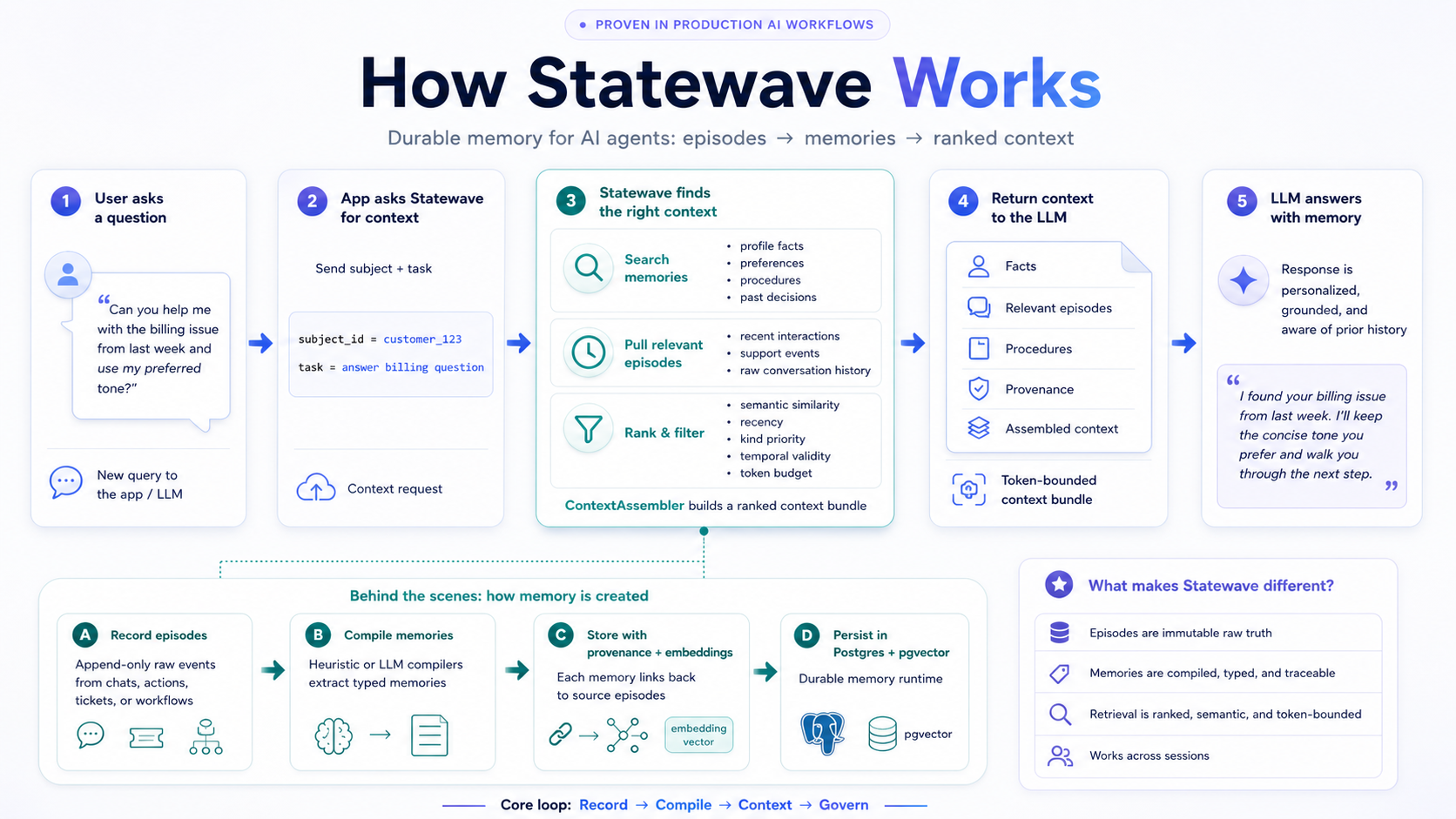
Idempotent at every step — recompiling a subject produces no duplicates; reassembling a bundle for the same task at the same point in time returns the same bytes.
The runtime essentials. Full capability inventory →
user:, repo:, account:, or any entity prefix you choosePOST /v1/receipts/{id}/replay for "what would today's code say with the original rules?"deny / redact) over per-memory tags (pii, financial, secret, …) with log_only and enforce modes. v0.9 adds advisory suggested_labels from heuristic detectors (pii.email/phone, financial.card, secret.token) with operator review + explicit promotion via the admin appX-Tenant-ID header, per-tenant config and policies. v0.9 adds per-tenant region pinning for residency: requests for a tenant pinned to eu are 403'd at any process running in another regionfrom statewave import StatewaveClient
with StatewaveClient("http://localhost:8100") as sw:
sw.create_episode(subject_id="user-42", source="chat", type="message",
payload={"text": "Alice asked about pricing tiers"})
sw.compile_memories("user-42")
print(sw.get_context("user-42", task="answer pricing", max_tokens=1000).assembled_context)
That's the loop: ingest → compile → use — ranked, token-bounded context with provenance. Run the server below, or self-host with Docker / Helm. Full SDK docs: statewave-py (Python) · statewave-ts (TypeScript).
Three runnable examples in statewave-examples:
Fastest — one line to a running server:
# macOS / Linux
npx @statewavedev/statewave
or
curl -fsSL https://www.statewave.ai/install | sh
# Windows (PowerShell)
irm https://www.statewave.ai/install.ps1 | iex
Prefer to run it yourself?
git clone https://github.com/smaramwbc/statewave && cd statewave
docker compose up -d
Brings up Postgres (pgvector) + the API; migrations run automatically on container start. The API is available at http://localhost:8100.
By default the server boots in demo mode — stub hash-based embeddings + the heuristic compiler, no real semantic search. For LLM-backed behaviour, add a .env next to docker-compose.yml and re-run docker compose up -d to pick it up:
STATEWAVE_EMBEDDING_PROVIDER=litellm
STATEWAVE_LITELLM_API_KEY=sk-...            # any LiteLLM provider
STATEWAVE_LITELLM_MODEL=gpt-4o-mini
STATEWAVE_LITELLM_EMBEDDING_MODEL=text-embedding-3-small
| Endpoint | Purpose |
|----------|---------|
| http://localhost:8100/docs | OpenAPI (Swagger) |
| http://localhost:8100/redoc | ReDoc |
| GET /healthz or GET /health | Liveness check |
| GET /readyz or GET /ready | Readiness check |
Check GET /readyz to confirm your LLM key was picked up — if the llm check shows "detail":"STATEWAVE_LITELLM_API_KEY is not set", the key isn't being read (re-check that .env sits next to docker-compose.yml and re-run docker compose up -d).
See the full getting started guide for step-by-step setup including environment configuration.
| Method | Path | Description |
|--------|------|-------------|
| POST | /v1/episodes | Ingest a single episode (append-only) |
| POST | /v1/episodes/batch | Ingest up to 100 episodes at once |
| POST | /v1/memories/compile | Compile memories from episodes (idempotent) |
| GET | /v1/memories/search | Search by kind, text, or semantic similarity |
| POST | /v1/context | Assemble ranked, token-bounded context bundle |
| GET | /v1/timeline | Chronological subject timeline (newest_first for recent history) |
| GET | /v1/subjects | List known subjects with episode/memory counts |
| DELETE | /v1/subjects/{id} | Permanently delete all data for a subject |
| POST | /v1/resolutions | Track issue resolution state per session |
| GET | /v1/resolutions | List resolutions for a subject |
| POST | /v1/handoff | Generate compact handoff context pack |
| GET | /v1/subjects/{id}/health | Customer health score with explainable factors |
| GET | /v1/subjects/{id}/sla | SLA metrics — response time, resolution time, breaches |
Full reference: API v1 contract.
| Surface | Supported |
|---|---|
| Python | 3.11+ (CI runs 3.11, 3.12, and 3.13) |
| OS — server | Linux verified in CI; macOS + Windows usually fine for local dev but not CI-tested |
| Docker image | linux/amd64 and linux/arm64 |
| Database | PostgreSQL 14+ with pgvector ≥ 0.4.2 |
| LLM provider (compiler) | Any of 100+ LiteLLM-supported providers — OpenAI, Anthropic, Azure, Bedrock, Ollama, Cohere, Gemini, Mistral, Groq, … |
| Embedding provider | Any LiteLLM-supported, plus stub (local heuristic, no API key) |
| SDKs | Python (pip install statewave) · TypeScript (npm install @statewavedev/sdk) |
How is this different from other memory systems? Most memory layers store isolated facts and retrieve them per query; some extract a graph whose retrieval surface can return the same summary regardless of the question. Statewave compiles the context once per subject change, with provenance — which is what buys the higher multi-hop accuracy in our benchmarks.
Does it work with my model provider?
Yes — Statewave uses LiteLLM so any of 100+ providers work (OpenAI, Anthropic, Azure, Bedrock, Ollama, Groq, Cohere, Gemini, Mistral, …). Set STATEWAVE_LITELLM_MODEL to any LiteLLM identifier.
What's the license — can I use this commercially? Yes. Statewave (server + SDKs) is Apache-2.0 — a permissive license with an explicit patent grant. Use it freely in proprietary, hosted, or commercial products with no source-disclosure obligations. See LICENSING.md.
Can I self-host? Yes — that's the default. Docker Compose, Helm chart, or bare-metal. See Deployment guide.
Why does it cost more tokens per answer than a plain fact store? Compiled context bundles are denser than fact-store retrieval — that's what buys the higher multi-hop accuracy. If your queries are mostly single-hop and you're cost-sensitive, a lighter fact store may be the right call.
Statewave is not limited to live chat transcripts. Connectors feed real-world events into Statewave as episodes, so your agents can build memory from repos, communities, docs, support tools, email, and workflows — without you hand-writing an ingest path for each source.
| Source | Memory shape | Status | |---|---|---| | MCP server | Copilot / Claude / Cursor / agent memory | ✅ shipped | | GitHub | Issues, pull requests, reviews, releases → repo memory | ✅ shipped | | Markdown | Local docs, ADRs, RFCs → decision memory | ✅ shipped | | Slack | Channel + thread history (pull) + Events-API webhook (push, with opt-in DMs and group DMs) → team memory | ✅ shipped | | n8n | Workflow runs, failures, per-node errors → workflow memory | ✅ shipped | | Zapier | "Webhooks by Zapier" → push-mode helper for any zap | ✅ shipped | | Discord | Server channel + thread history → community memory | ✅ shipped | | Notion | Pages + opt-in body content + database scoping → decision memory | ✅ shipped | | Zendesk / Intercom / Freshdesk | Tickets + replies + notes (pull) and real-time webhook receivers (push) → customer memory | ✅ shipped | | Gmail | Query-scoped messages (pull, with History-API delta sync) and Cloud Pub/Sub push receiver → relationship memory | ✅ shipped |
Connectors live in their own repository so this core stays focused on the runtime. They are modular — install only what you need:
# Pick what you need — every package is independent
npm install @statewavedev/connectors-github
npm install @statewavedev/connectors-jira          # preview
npm install @statewavedev/connectors-database      # preview — postgres/mysql/mariadb/mssql
npm install @statewavedev/connectors-markdown
npm install @statewavedev/connectors-slack
npm install @statewavedev/connectors-n8n
npm install @statewavedev/connectors-zapier
npm install @statewavedev/mcp-server
A convenience meta-package @statewavedev/connectors re-exports the official connectors for the rare case where you want them all at once. It is not required for normal usage.
Quick examples (dry-run-first — nothing is ingested without your say-so):
statewave-connectors sync github \
  --repo smaramwbc/statewave \
  --subject repo:smaramwbc/statewave \
  --dry-run
statewave-connectors sync markdown \
  --path ./docs \
  --subject repo:smaramwbc/statewave \
  --dry-run
statewave-connectors mcp start
Where to go next:
@statewavedev/connectors-* (incl. preview Jira + database source connectors)No connector code lives in this repo. Connectors talk to Statewave through the same public HTTP API documented above. If you don't need any of them, you don't install any of them.
All settings use the STATEWAVE_ env prefix. Copy .env.example to .env to get started.
For best results: SetSTATEWAVE_COMPILER_TYPE=llmandSTATEWAVE_EMBEDDING_PROVIDER=litellmwith anSTATEWAVE_LITELLM_API_KEY. Statewave uses LiteLLM as its single provider abstraction, so you can use any supported provider — OpenAI, Anthropic, Azure, Ollama, Cohere, Gemini, Bedrock, Mistral, Groq, and 100+ others — by settingSTATEWAVE_LITELLM_MODELto any LiteLLM model identifier (e.g.gpt-4o-mini,claude-3-haiku-20240307,ollama/llama3,azure/gpt-4). The heuristic compiler still works without any LLM API key.
| Variable | Default | Description |
|----------|---------|-------------|
| STATEWAVE_DATABASE_URL | postgresql+asyncpg://statewave:statewave@localhost:5432/statewave | Postgres connection string |
| STATEWAVE_DEBUG | false | Enable debug logging |
| STATEWAVE_COMPILER_TYPE | heuristic | heuristic or llm |
| STATEWAVE_EMBEDDING_PROVIDER | stub | stub, litellm, or none |
| STATEWAVE_LITELLM_API_KEY | — | Provider-neutral API key (e.g. OpenAI sk-..., Anthropic sk-ant-...) — passed through to the provider chosen by STATEWAVE_LITELLM_MODEL |
| STATEWAVE_LITELLM_MODEL | gpt-4o-mini | Chat-completion model — any LiteLLM identifier (claude-3-haiku-20240307, ollama/llama3, azure/gpt-4, etc.) |
| STATEWAVE_LITELLM_EMBEDDING_MODEL | text-embedding-3-small | Embedding model — any LiteLLM-supported (cohere/embed-english-v3.0, voyage/voyage-large-2, …) |
| STATEWAVE_LITELLM_API_BASE | — | Custom base URL (e.g. http://localhost:11434 for Ollama, or a self-hosted OpenAI-compatible gateway) |
| STATEWAVE_LITELLM_TIMEOUT_SECONDS | 60 | Request timeout |
| STATEWAVE_LITELLM_MAX_RETRIES | 2 | Retries on transient errors |
| STATEWAVE_EMBEDDING_DIMENSIONS | 1536 | Embedding vector dimensions |
| STATEWAVE_API_KEY | — | API key for auth (empty = open access) |
| STATEWAVE_RATE_LIMIT_RPM | 0 | Requests/min/IP (0 = disabled) |
| STATEWAVE_RATE_LIMIT_STRATEGY | distributed | distributed (Postgres) or memory (in-process) |
| STATEWAVE_WEBHOOK_URL | — | Webhook callback URL (empty = disabled) |
| STATEWAVE_WEBHOOK_TIMEOUT | 5.0 | Webhook HTTP timeout in seconds |
| STATEWAVE_WEBHOOK_EVENTS | — | Comma-separated event-type allowlist (empty = deliver every event) |
| STATEWAVE_RECEIPT_SIGNING_KEYS | — | JSON {"<key_id>": ""} map of HMAC keys for receipt signing (≥32 bytes each). Never persisted to the DB; per-tenant active key id set via tenant_configs.config.receipt_signing_key_id. |
| STATEWAVE_AUTO_LABELING_ENABLED | false | Run heuristic detectors at compile time and stamp advisory suggested_labels on memories (v0.9). See docs/auto-labeling.md. |
| STATEWAVE_AUTO_LABELING_PROVIDER | heuristic | Detector provider. Only heuristic is currently supported (since v0.9); the switch is reserved for future LLM-based classifiers. |
| STATEWAVE_REGION | — | Region this server process is running in. When set, requests for tenants pinned to a different region are refused with HTTP 403 residency.mismatch (v0.9). Empty = single-region mode, residency disabled. See docs/residency.md. |
| STATEWAVE_TENANT_HEADER | X-Tenant-ID | Header for multi-tenant isolation |
| STATEWAVE_REQUIRE_TENANT | false | Reject requests without tenant header |
| STATEWAVE_DEFAULT_MAX_CONTEXT_TOKENS | 4000 | Default token budget for context assembly |
| STATEWAVE_CORS_ORIGINS | ["*"] | Allowed CORS origins |
# Unit tests (no DB required)
pytest tests/test_*.py -v
Integration tests (requires Postgres)
PGPASSWORD=statewave createdb -h localhost -U statewave statewave_test
pytest tests/integration/ -v
All tests
pytest tests/ -v
Statewave is in active development (v1.5.0). Honest status:
promoted_at + labels on every promotion, but promoted_by is null until an admin-identity layer shipsHorizontal scaling. Statewave runs multi-replica in production (Fly multi-machine + Helm HPA both verified). The policy bundle cache that previously assumed single-process was dropped in v0.8 (#77) precisely so multi-replica deploys behave correctly under enforce mode. Heavy load is bottlenecked by Postgres + your embedding provider, not the API.
| | | |---|---| | Getting started | Clone, run, ingest your first episode | | What is Statewave? | Product overview, use cases, limitations | | Why Statewave? | Technical comparison for support-agent workflows | | API v1 contract | Full endpoint reference | | Architecture overview | System design and data flow | | Compiler modes | Heuristic vs LLM — when to use which | | Privacy & data flow | What stays local, what leaves your network | | Hardware & scaling | GPU is never required; scaling characteristics | | Deployment sizing guide | Hardware profiles by tier (local → enterprise) and topology patterns | | Capacity planning checklist | Diagnostic flow + tuning order when load grows | | Deployment guide | Pr
→ →
→ →
→ →
→ →
→ →
→ →
→ →
→