1
 →
→
An open-source, privacy-first, self-hosted knowledge workspace where humans and AI agents work together 开源、隐私优先、自托管的知识工作空间,让人与智能体在此协作
siyuan-note/siyuan is an open-source project on GitHub, mainly written in TypeScript. An open-source, privacy-first, self-hosted knowledge workspace where humans and AI agents work together 开源、隐私优先、自托管的知识工作空间,让人与智能体在此协作 It currently holds 46,384 stars and 0 forks with 0 open issues, and was last pushed on an unknown date (repository created unknown).
AI Homed tracks it on the AI Agent Skills board and on the AI AI Agent Skills list.

From thought to insight, with agents







---
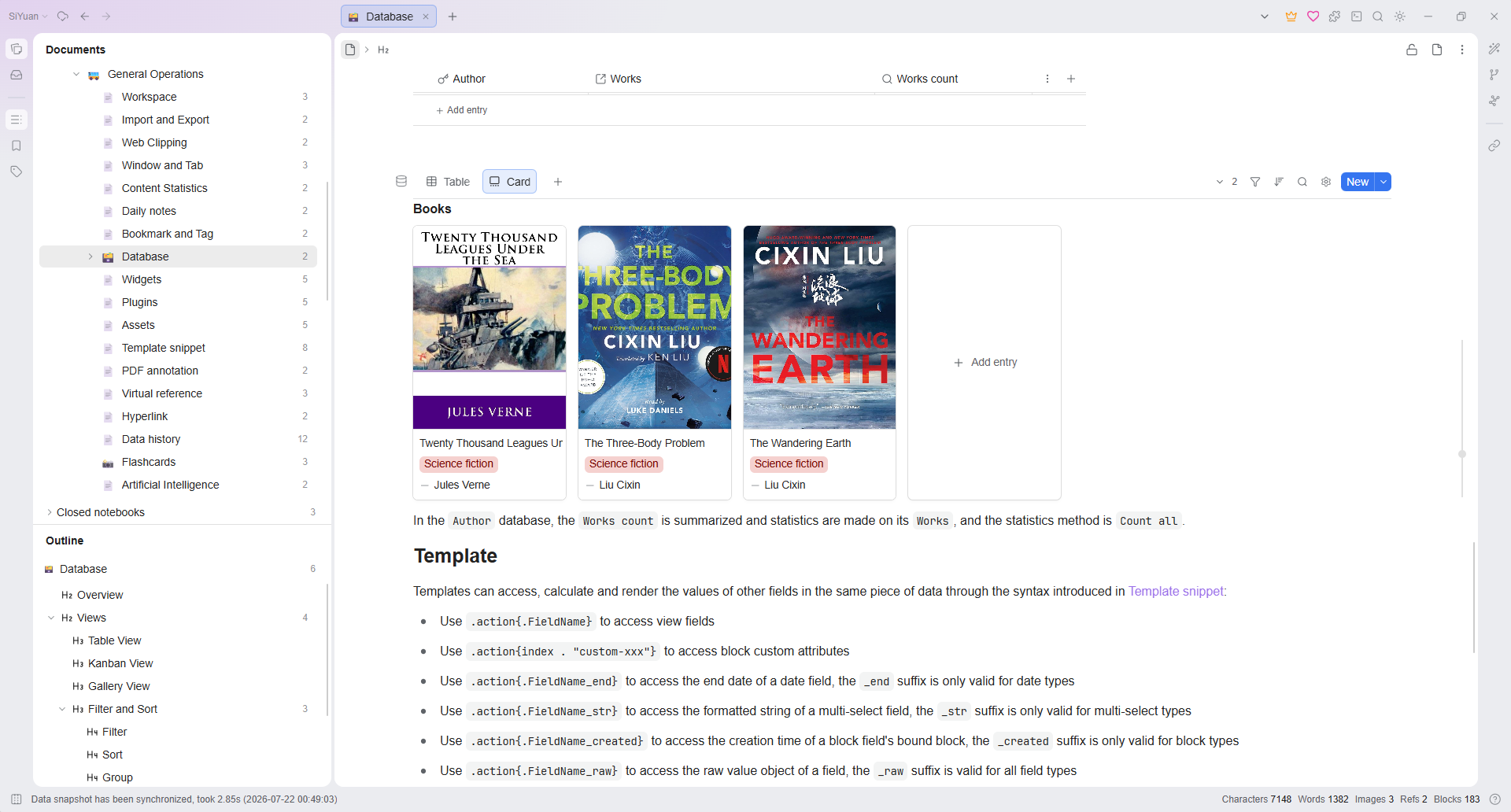
SiYuan is a privacy-first personal knowledge management system, supporting fine-grained block-level reference and Markdown WYSIWYG.
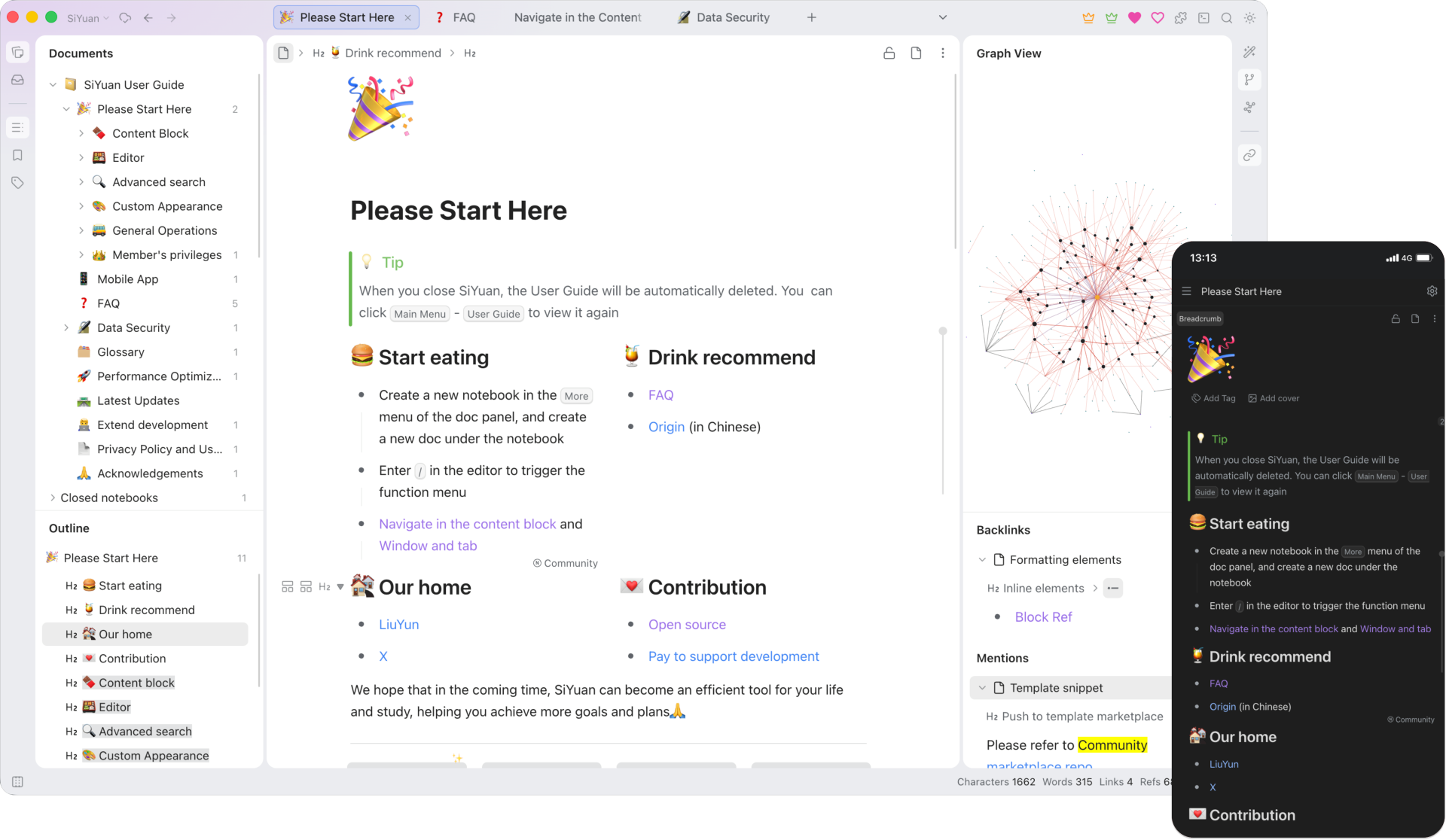
To learn more, read the online user guide or join the SiYuan English Discussion Forum.
Most features are free, even for commercial use.
siyuan://
| Project | Description | Forks | Stars |
|----------------------------------------------------------|-----------------------|---------------------------------------------------------------------------------|--------------------------------------------------------------------------------------|
| lute | Editor engine | |
|
| chrome | Chrome/Edge extension |
|
|
| bazaar | Community marketplace |
|
|
| dejavu | Data repo |
|
|
| petal | Plugin API |
|
|
| android | Android App |
|
|
| ios | iOS App |
|
|
| harmony | HarmonyOS App |
|
|
| riff | Spaced repetition |
|
|
It is recommended to give priority to installing through the application market on desktop and mobile, so that you can upgrade the version with one click in the future.
Mobile:
Desktop:siyuan
siyuan-note
The easiest way to serve SiYuan on a server is to deploy it through Docker.
b3log/siyuanThe overall program is located under /opt/siyuan/, which is basically the structure under the resources folder of the Electron installation package:
The entry point is set when building the Docker image: ENTRYPOINT ["/opt/siyuan/entrypoint.sh"]. This script allows changing the PUID and PGID of the user that will run inside the container. This is especially relevant to solve permission issues when mounting directories from the host. The PUID (User ID) and PGID (Group ID) can be passed as environment variables, making it easier to ensure correct permissions when accessing host-mounted directories.
Use the following parameters when running the container with docker run b3log/siyuan:
Note: Since v3.7.0, theservesubcommand must be passed explicitly (e.g.docker run b3log/siyuan serve --workspace=...). Rundocker run --rm b3log/siyuan serve --helpto see all serving options.
--workspace: Specifies the workspace folder path, mounted to the container via -v on the host--accessAuthCode: Specifies the lock screen password--help. Here’s an example of a startup command with the new environment variables:
docker run -d \
  -v workspace_dir_host:workspace_dir_container \
  -p 6806:6806 \
  -e PUID=1001 -e PGID=1002 \
  b3log/siyuan \
  serve \
  --workspace=workspace_dir_container \
  --accessAuthCode=xxx
PUID: Custom user ID (optional, defaults to 1000 if not provided)PGID: Custom group ID (optional, defaults to 1000 if not provided)workspace_dir_host: The workspace folder path on the hostworkspace_dir_container: The path of the workspace folder in the container, as specified in --workspaceSIYUAN_WORKSPACE_PATH env variable. The commandline will always have the priority, if both are setaccessAuthCode: Lock screen password (please be sure to modify, otherwise anyone can access your data)SIYUAN_ACCESS_AUTH_CODE env variable. The commandline will always have the priority, if both are setSIYUAN_ACCESS_AUTH_CODE_BYPASS=trueSIYUAN_OIDC_ENABLED=true, SIYUAN_OIDC_PROVIDER (custom, google, microsoft, or github), SIYUAN_OIDC_CLIENT_ID, and the provider-specific values below. GitHub uses its OAuth 2.0 user API adapter; the other providers use OpenID Connect discovery and ID Token validation. An invalid enabled configuration stops Docker startup when no lock screen password is availableSIYUAN_OIDC_ISSUER_URL: Issuer URL required by the custom and microsoft providers; Microsoft must use a tenant-specific issuer such as https://login.microsoftonline.com//v2.0SIYUAN_OIDC_CLIENT_SECRET: Optional client secret for OpenID Connect providers; required by the GitHub OAuth adapter. Every authorization-code flow also uses PKCESIYUAN_OIDC_SCOPES: Comma- or space-separated scopes; openid is always includedSIYUAN_OIDC_REDIRECT_URL: Public HTTPS callback URL ending in /api/system/oidc/callback, required for remote browser accessSIYUAN_OIDC_ALLOW_ALL: Explicitly grant SiYuan administrator access to every identity authenticated by the providerSIYUAN_OIDC_CLAIM_RULES: JSON array of claim rules used when allow-all is disabled, for example [{"claim":"email","operator":"equals","values":["user@example.com"]},{"claim":"email_verified","operator":"equals","values":["true"]}]; values within a rule use OR, while rules use ANDsiyuan:/oidc-callback; register it exactly as written. Mobile configuration verification uses this callback before saving. Custom providers, Microsoft, and GitHub can be used only when their application registration accepts this callback URI. Google does not accept this private-use URI for its Android client type, so Google login is limited to browser and desktop flowsSIYUAN_LANG: Interface language (optional, defaults to en if unset in Docker). Accepts BCP 47 tags like zh-CN/zh-TW/en/ja/pt-BR; legacy underscore values like zh_CN/en_US are also accepted for backward compatibility. Omit it if you want the language chosen in Settings to persist across restarts; if set, it is applied on every startup and overrides the saved setting--lang command-line parameter. If both are set, the command-line takes priorityworkspace_dir_host and workspace_dir_container configured as /siyuan/workspace. The corresponding startup command would be:
docker run -d \
  -v /siyuan/workspace:/siyuan/workspace \
  -p 6806:6806 \
  -e PUID=1001 -e PGID=1002 \
  b3log/siyuan \
  serve \
  --workspace=/siyuan/workspace/ \
  --accessAuthCode=xxx
For users running SiYuan with Docker Compose, the environment variables PUID and PGID can be passed to customize the user and group IDs. Here's an example of a Docker Compose configuration:
version: "3.9"
services:
main:
image: b3log/siyuan
command: ['serve', '--workspace=/siyuan/workspace/', '--accessAuthCode=${AuthCode}']
ports:
- 6806:6806
volumes:
- /siyuan/workspace:/siyuan/workspace
restart: unless-stopped
environment:
- TZ=${YOUR_TIME_ZONE} # A list of time zone identifiers can be found at https://en.wikipedia.org/wiki/List_of_tz_database_time_zones
- PUID=${YOUR_USER_PUID} # Customize user ID
- PGID=${YOUR_USER_PGID} # Customize group ID
In this setup:
PUID and PGID are set dynamically and passed to the container1000 will be usedPUID and PGID in the environment, you avoid the need to explicitly set the user directive (user: '1000:1000') in the compose file. The container will dynamically adjust the user and group based on these environment variables at startup.
In the image, the entrypoint.sh script ensures the creation of the siyuan user and group with the specified PUID and PGID. Therefore, when the host creates a workspace folder, pay attention to setting the user and group ownership of the folder to match the PUID and PGID you plan to use. For example:
chown -R 1001:1002 /siyuan/workspace
If you use custom PUID and PGID values, the entrypoint script will ensure that the correct user and group are created inside the container, and ownership of mounted volumes will be adjusted accordingly. There’s no need to manually pass -u in docker run or docker-compose as the environment variables will handle the customization.
Use an NGINX reverse proxy to hide port 6806. Please note:
/wsPUID and PGID environment variables match the ownership of the mounted directories on your host systemNote: First run chown -R 1000:1000 /mnt/user/appdata/siyuan in the terminal
Template reference:
Web UI: 6806
Container Port: 6806
Container Path: /home/siyuan
Host path: /mnt/user/appdata/siyuan
PUID: 1000
PGID: 1000
Publish parameters: serve --accessAuthCode=****(Lock screen password)
Note: First, run the commands below in the TrueNAS Shell. Please update Pool_1/Apps_Data/siyuan to match your dataset path.
zfs create Pool_1/Apps_Data/siyuan
chown -R 1001:1002 /mnt/Pool_1/Apps_Data/siyuan
chmod 755 /mnt/Pool_1/Apps_Data/siyuan
Navigate to Apps - DiscoverApps - More Options (on top right, besides Custom App) - Install via YAML
Template reference:
services:
siyuan:
image: b3log/siyuan
container_name: siyuan
command: ['serve', '--workspace=/siyuan/workspace/', '--accessAuthCode=2222']
ports:
- 6806:6806
volumes:
- /mnt/Pool_1/Apps_Data/siyuan:/siyuan/workspace # Adjust to your dataset path
restart: unless-stopped
environment:
- TZ=America/New_York # Replace with your timezone if needed
- PUID=1001
- PGID=1002
Select Beta or Alpha in Settings - About - Update channel to receive prereleases. Beta includes stable, RC, and Beta releases; Alpha includes all releases. Test channels require access to GitHub.
The built-in CLI provides direct access to workspace data — no running server required.
# List all notebooks
siyuan notebook list -w ~/SiYuan
Full-text search with JSON output
siyuan search "keyword" -w ~/SiYuan -f json
Search inside asset files (PDF/Word/Excel/txt etc.)
siyuan search "phrase" --asset -w ~/SiYuan
siyuan search "phrase" --asset --ext pdf --ext docx -w ~/SiYuan
Export a document as Markdown
siyuan export md --id  -w ~/SiYuan
| Category | Commands |
|----------|----------|
| Notebooks & Documents | notebook, document, dailynote — CRUD and daily notes |
| Content | block, attr, outline — block read/write, attributes, outline |
| Metadata | tag, bookmark, template — tags, bookmarks, template snippets |
| Queries | search, sql — full-text, semantic, asset-content, and SQL queries |
| References | ref — backlinks and mentions |
| Import/Export | export, import, inbox — Markdown, HTML, preview, Word, .sy.zip, Data, cloud inbox |
| Data Management | repo, history, sync — snapshots, versions, cloud sync |
| Utilities | asset, file — resources and file system |
| Database | database — attribute view management |
| Server | serve — start the kernel HTTP server |
| Workspace & System | workspace, system — list, inspect, system info |
Run siyuan --help for the full command tree. Use -f json (default is -f table) for script-friendly output. Most mutating commands also support --dry-run to preview changes without applying them.
The CLI binary is /resources/kernel/SiYuan-Kernel, invoked via the siyuan command.
PATH, so siyuan works out of the box. The Microsoft Store edition runs in an MSIX sandbox and cannot modify PATH; deploy a siyuan.cmd shim once (survives Store updates): # Microsoft Store edition only — run once in PowerShell
$shimDir = "$env:LOCALAPPDATA\Microsoft\WindowsApps" # already in PATH by default
@(
'@echo off'
'setlocal'
'set "ROOT="'
'for /f "delims=" %%i in (''powershell -NoProfile -Command "(Get-AppxPackage SiYuan).InstallLocation"'') do set "ROOT=%%i"'
'if not defined ROOT goto :noshim'
'"%ROOT%\app\resources\kernel\SiYuan-Kernel.exe" %*'
'exit /b %ERRORLEVEL%'
':noshim'
'1>&2 echo siyuan: Microsoft Store edition not found'
'exit /b 1'
) | Set-Content "$shimDir\siyuan.cmd"
Remove-Item "$env:LOCALAPPDATA\Microsoft\WindowsApps\siyuan.cmd".
ln -s /Applications/SiYuan.app/Contents/Resources/kernel/SiYuan-Kernel /usr/local/bin/siyuan
ln -s /resources/kernel/SiYuan-Kernel /usr/local/bin/siyuan
See Development Guide.
The data is saved in the workspace data folder:
assets is used to save all inserted assetsemojis is used to save emoji imagessnippets is used to save code snippetsstorage is used to save query conditions, layouts and flashcards, etc.templates is used to save template snippetswidgets is used to save widgetsplugins is used to save pluginspublic is used to save public data.sy in the notebook folder are used to save the document data, and the data format is JSONData synchronization through third-party synchronization disks is not supported, otherwise data may be corrupted.
Although it does not support third-party sync disks, it supports connecting with third-party cloud storage (Members' privileges).
SiYuan is completely open source, and contributions are welcome:
→ →
→ →
→ →
→ →
→ →
→ →
→ →
→