SeemSeam/claude_codex_bridge

★ 3,515⑂ 341

Visible multi-agent CLI workspace for mixing Codex, Claude, Gemini, Kimi, Qwen, Cursor, Copilot, Pi, OpenCode, and other AI coding agents

About SeemSeam/claude_codex_bridge

SeemSeam/claude_codex_bridge is an open-source project on GitHub, mainly written in Python. Visible multi-agent CLI workspace for mixing Codex, Claude, Gemini, Kimi, Qwen, Cursor, Copilot, Pi, OpenCode, and other AI coding agents It currently holds 3,515 stars and 341 forks with 0 open issues, and was last pushed on an unknown date (repository created unknown).

Project Overview

AI Homed tracks it on the AI Coding Agents board.

GitHub Repository Details

Repository SeemSeam/claude_codex_bridge · default branch - · size 0 KB · watchers 0 · source: GitHub REST API and repository README

README

CCB - Mobile Has Arrived!

A lightweight multi-agent TUI with a stable cross-provider collaboration layer
Coordinate Codex, Claude, Gemini, and other CLI agents in visible, controllable workflows you can take over


https://github.com/SeemSeam/claude_codex_bridge/blob/HEAD/version https://github.com/SeemSeam/claude_codex_bridge/blob/HEAD/platform https://github.com/SeemSeam/claude_codex_bridge/blob/HEAD/providers

https://github.com/SeemSeam/claude_codex_bridge/blob/HEAD/Codex https://github.com/SeemSeam/claude_codex_bridge/blob/HEAD/Claude https://github.com/SeemSeam/claude_codex_bridge/blob/HEAD/Pi https://github.com/SeemSeam/claude_codex_bridge/blob/HEAD/OMP https://github.com/SeemSeam/claude_codex_bridge/blob/HEAD/Kimi https://github.com/SeemSeam/claude_codex_bridge/blob/HEAD/OpenCode https://github.com/SeemSeam/claude_codex_bridge/blob/HEAD/Gemini https://github.com/SeemSeam/claude_codex_bridge/blob/HEAD/Grok CLI https://github.com/SeemSeam/claude_codex_bridge/blob/HEAD/MiMo https://github.com/SeemSeam/claude_codex_bridge/blob/HEAD/Qwen https://github.com/SeemSeam/claude_codex_bridge/blob/HEAD/Cursor https://github.com/SeemSeam/claude_codex_bridge/blob/HEAD/GitHub Copilot https://github.com/SeemSeam/claude_codex_bridge/blob/HEAD/Crush https://github.com/SeemSeam/claude_codex_bridge/blob/HEAD/Kiro https://github.com/SeemSeam/claude_codex_bridge/blob/HEAD/Antigravity https://github.com/SeemSeam/claude_codex_bridge/blob/HEAD/Droid

中文 | English | 日本語 | Français | Deutsch | العربية | Español | Português | 한국어 | Русский

Quick Start · Mobile App · Rich Mode · Configure Agents · User Guide · Developer Guide
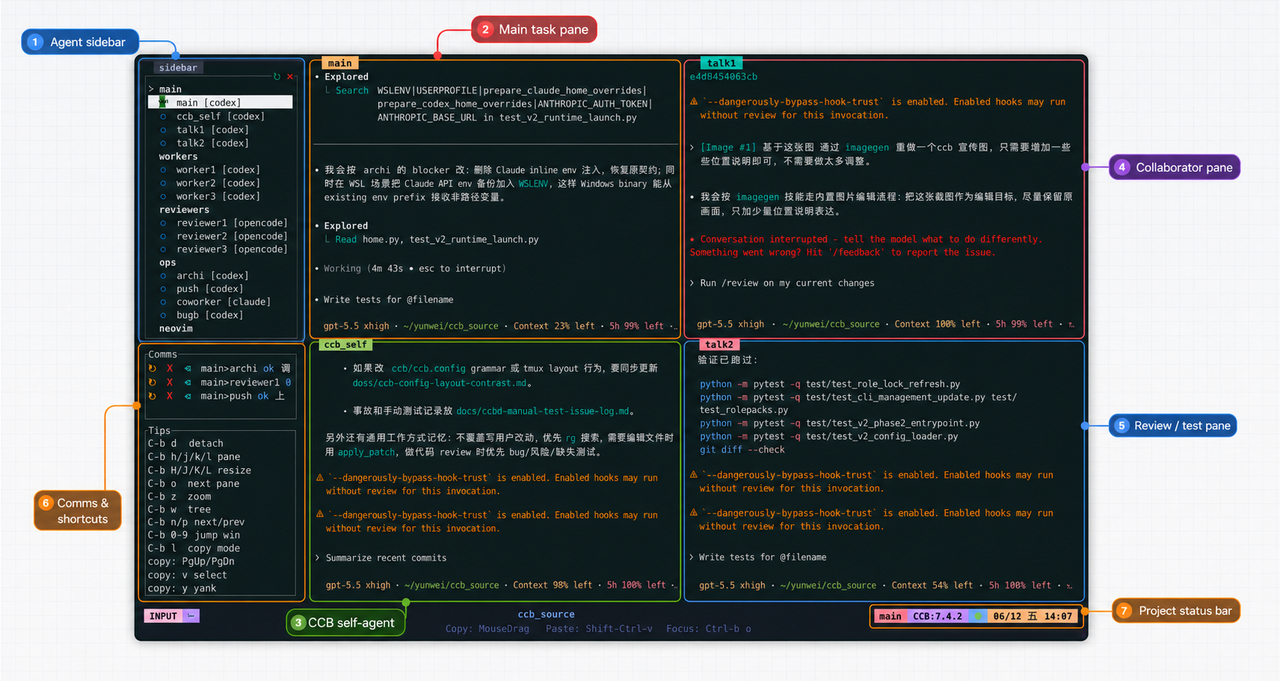
https://github.com/SeemSeam/claude_codex_bridge/blob/HEAD/CCB visible multi-agent CLI workspace

Why CCB?

and direct takeover; service-backed providers keep an explicit managed host/log surface without pretending it is their request protocol.

How to Install

Install or update an npm-managed CCB with npm:

npm install -g @seemseam/ccb@latest

For GitHub release-package or source installs, use CCB's transactional updater:

ccb update

On an npm-managed install, ccb update prints the equivalent npm command and does not modify npm's vendored payload in place.

Native Windows x64 beta

The Windows beta artifact is attached to the matching stable CCB GitHub release. Download ccb-windows-x86_64.zip and its .sha256 sidecar, verify the digest, extract the ZIP, then run:

.\install.ps1 install -Yes
ccb --print-version

It requires native Windows x64, Python 3.10+, WezTerm, Git Bash, and Herdr 0.8.0 or newer. The installer creates an install-local managed Python runtime. The binaries are unsigned, and ccb update remains diagnostic-only for this beta support tier; install a later Windows build by rerunning its validated install.ps1.

CCB-managed provider panes suppress known provider-native startup update prompts. After updating CCB—or immediately when CCB is already current—ccb update checks installed provider CLIs and offers supported updates once. Use --providers check, --providers all, or --providers none for explicit report-only, non-interactive update, or skip behavior. Declining prompts again on the next ccb update; skipping a version hides only that exact version. CCB never restarts active provider panes during this flow, so an accepted provider update applies when that pane next starts or is explicitly restarted.

After a release change, the newly installed CCB also retires old project-scoped Claude/Gemini caches. Manifest-valid caches for deleted projects are removed immediately. A stopped current project is cleaned immediately; active or other existing projects are preserved and cleaned after their next successful ccb kill. Unknown providers, malformed manifests, foreign symlinks, sessions/auth, and the user-scoped Gemini cache are never removed by this migration. Use ccb update --no-cache-cleanup to skip it for one update.

To roll back, use the same transactional updater with an older released version, for example ccb update 8.1.3. CCB rejects a same-version artifact whose build identity differs from the installed build, and restores the prior local prefix if the update transaction fails. If restoration itself cannot complete, CCB retains and reports the external recovery backup path.

GitHub release package and source install fallbacks

If npm is not convenient in your environment, download the matching package from Releases, unpack it, and install:

tar -xzf ccb-*.tar.gz
cd ccb-*
./install.sh install

Source install is intended only for development or temporary fallback:

git clone https://github.com/SeemSeam/claude_codex_bridge.git
cd claude_codex_bridge
./install.sh install

Source install links global ccb / ask back to the checkout. Regular users should prefer the npm package.

Quick Start

1. Launch

Run this from your working directory:

ccb

If startup reports that .ccb cannot be created automatically or that the project anchor is missing, create .ccb manually:

mkdir -p .ccb

2. Configure The Workspace

A blank project starts light: CCB opens one main window with a single agent named demo, selecting the first supported CLI available on the machine (Codex, Claude, Gemini, then other providers). It no longer mounts a multi-agent team by default.

Click the ⚙ Settings icon at the top-left of the CCB sidebar to open the local configuration control panel. You can also run ccb config ui from the project directory.

Persistent local Config UI access

The Config UI always binds to loopback. To use a stable local port and token, configure a token source in .ccb/ccb.config; never put a literal token in that file:

[config_ui]
port = 43123
token_env = "CCB_CONFIG_UI_TOKEN"

Or use this instead of token_env:

token_file = ".ccb/config-ui.token"

--port remains a one-run override. token_file must be project-relative, non-symlinked, and owner-only (chmod 600 .ccb/config-ui.token on POSIX). Without a token source, CCB keeps the existing random token and ephemeral-port behavior. The CLI prints only the loopback URL and token source, never the token value.
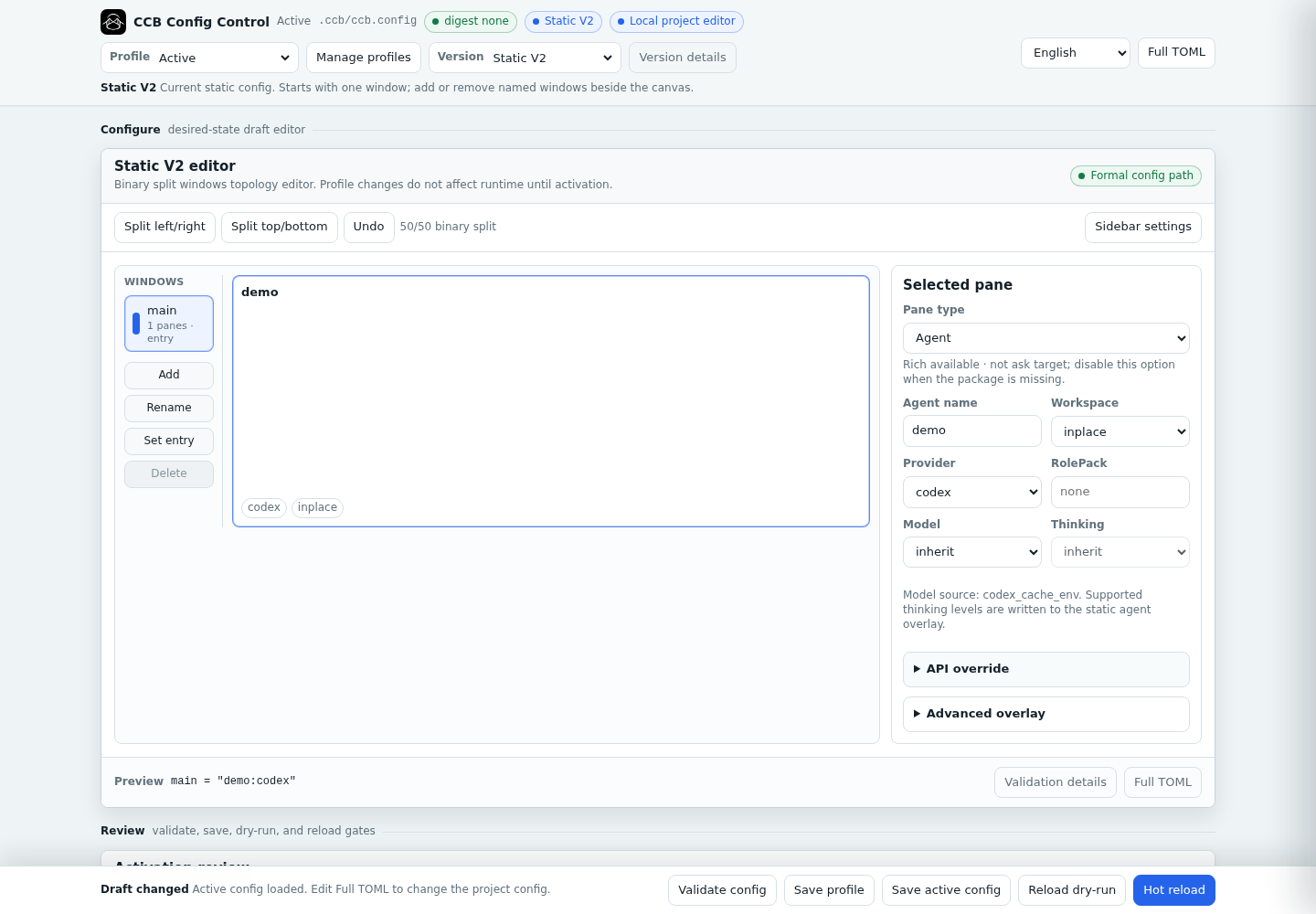
https://github.com/SeemSeam/claude_codex_bridge/blob/HEAD/CCB configuration control panel editing the default demo agent

The panel edits windows, pane splits, providers, models, thinking levels, API overrides, workspaces, Rich mode, and sidebar settings. It validates changes before saving and supports reload dry-runs and guarded hot reload. Saving creates .ccb/ccb.config and pins the selected provider and topology for this project.

For an advanced multi-agent topology, edit it visually or create .ccb/ccb.config manually. In v2 [windows], , and ; control vertical stacking and horizontal splits inside each window, so A,B;C,D is close to a four-pane layout.

version = 2

[windows] main = "main:codex" work = "worker1:codex(worktree), worker2:claude(worktree)" review = "reviewer:claude, qa:gemini"

[ui.sidebar] mode = "every_window" width = "15%" bottom_height = 20 agents_height = "50%" comms_height = "15%" tips_height = "35%" comms_limit = 3

Validate the config and start the workspace:

ccb config validate
ccb

3. Collaborate

You can type directly in any agent pane, or let agents collaborate:

/ask reviewer review the latest parser changes and list blocking issues.

Agents can also call /ask during workflow orchestration to delegate and hand off work. Use agent memory or the project-wide shared memory file .ccb/ccb_memory.md for durable coordination.

Mobile Remote Control (Android)

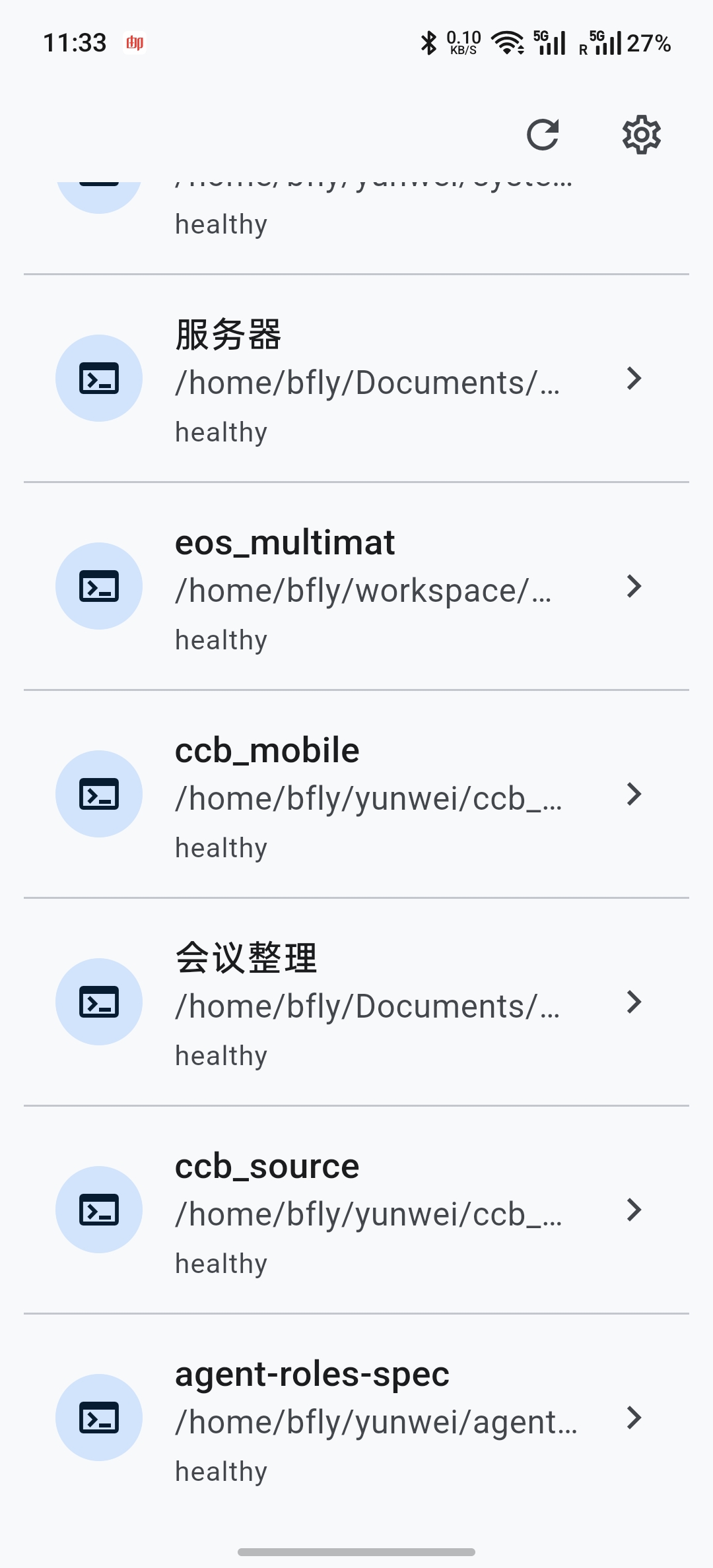
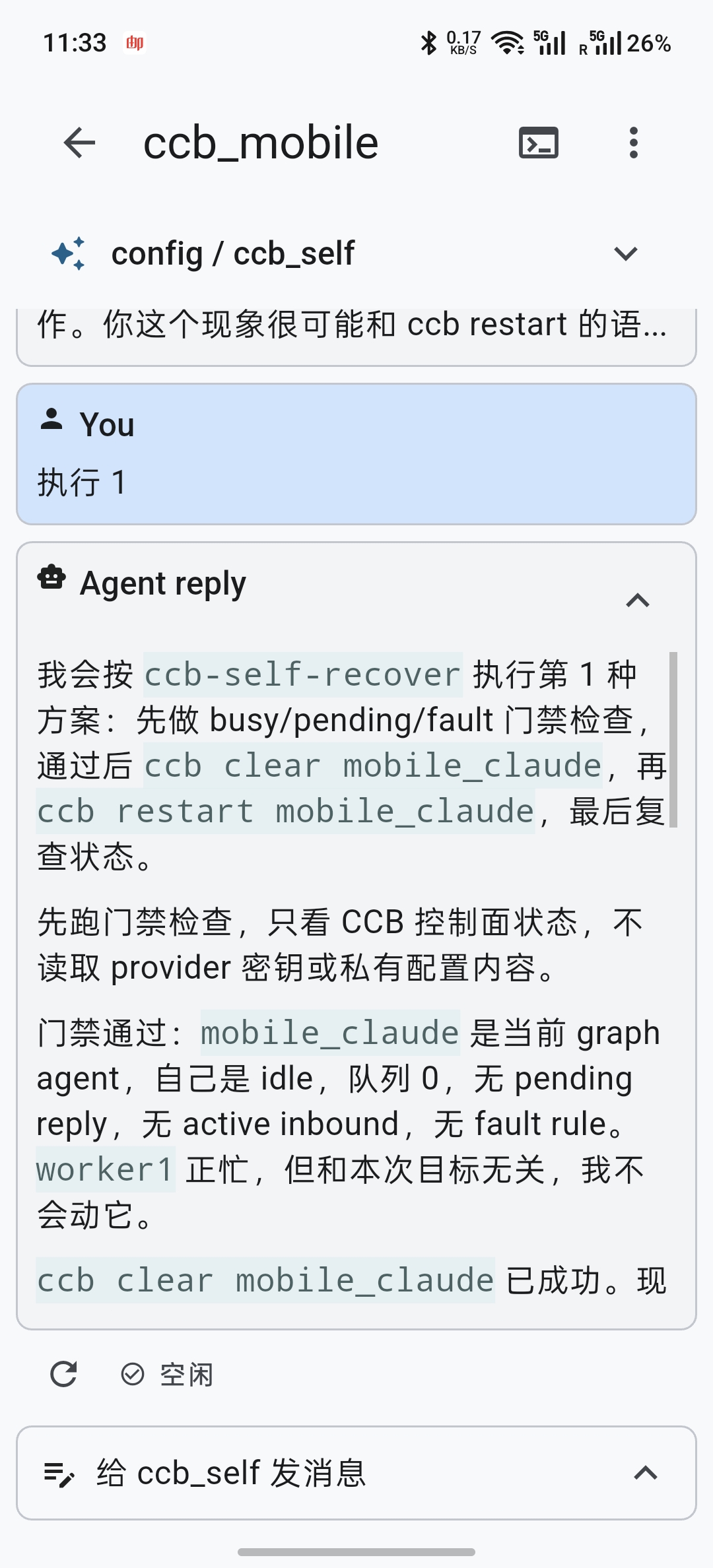
The recommended way to control CCB from a phone can connect to all CCB projects, control each agent, accept voice input, and transfer files.

ccb update mobile

This command guides installation and configuration.
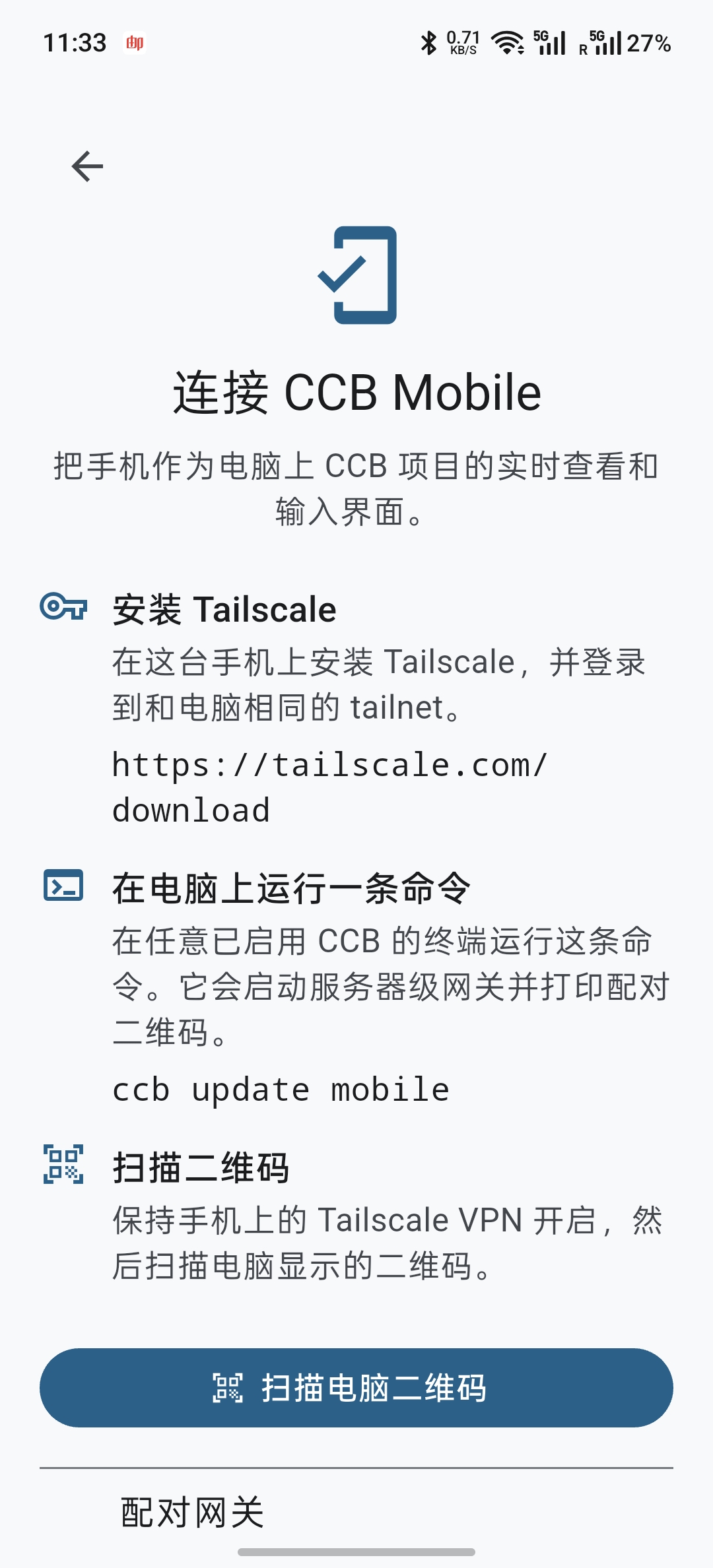
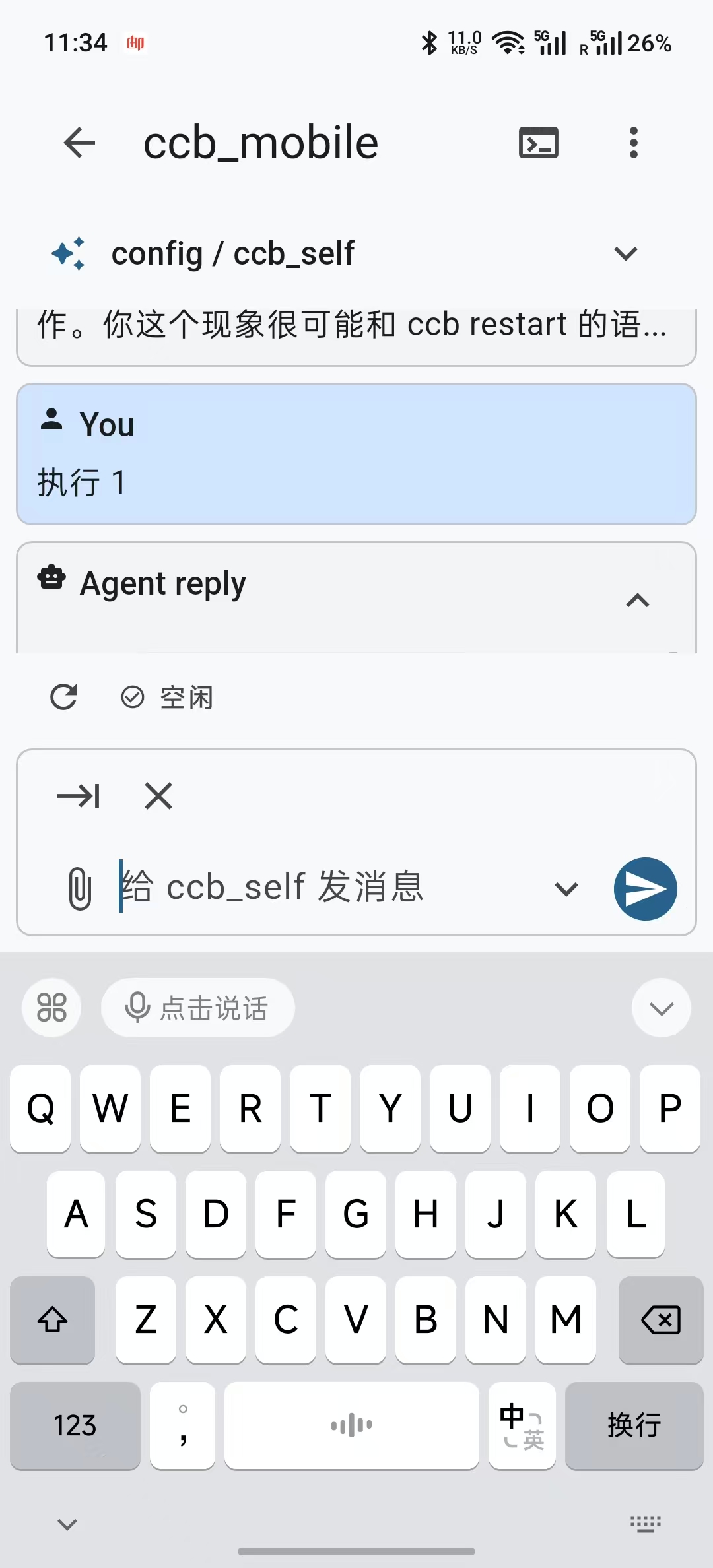
https://github.com/SeemSeam/claude_codex_bridge/blob/HEAD/CCB Mobile agent chat https://github.com/SeemSeam/claude_codex_bridge/blob/HEAD/CCB Mobile terminal control https://github.com/SeemSeam/claude_codex_bridge/blob/HEAD/CCB Mobile file transfer https://github.com/SeemSeam/claude_codex_bridge/blob/HEAD/CCB Mobile pairing and connection

Mobile App details, safety boundary, and source

CCB 8.6.13 includes the Flutter CCB Mobile source in mobile/ and publishes the Android APK through GitHub Releases:

The phone app is a remote controller for real CCB projects running on a server. It can discover mounted projects from the server-wide mobile gateway, switch windows and agents, render agent conversation context, send text through pane-native input, open a terminal view, and upload/download images and documents through the authenticated gateway.

Safety boundary:

  • The CCB gateway binds to loopback by default, for example 127.0.0.1:8787.
  • For direct LAN access, bind one specific private interface address (wildcard and public addresses are rejected): ccb install mobile --route-provider lan --listen 192.168.31.155:8787. The pairing URL is inferred from --listen; no forwarding process or --public-url is needed.
  • Remote access uses Tailscale Serve, not Tailscale Funnel.
  • CCB does not store Tailscale passwords, OAuth tokens, admin API tokens, or automatically modify tailnet ACLs/grants.
  • The phone receives only the scopes authorized by the pairing profile, such as view, content, terminal, file upload, and file download.

Rich Media Terminal

Browse file trees, open files, edit documents, and preview media inside the terminal.
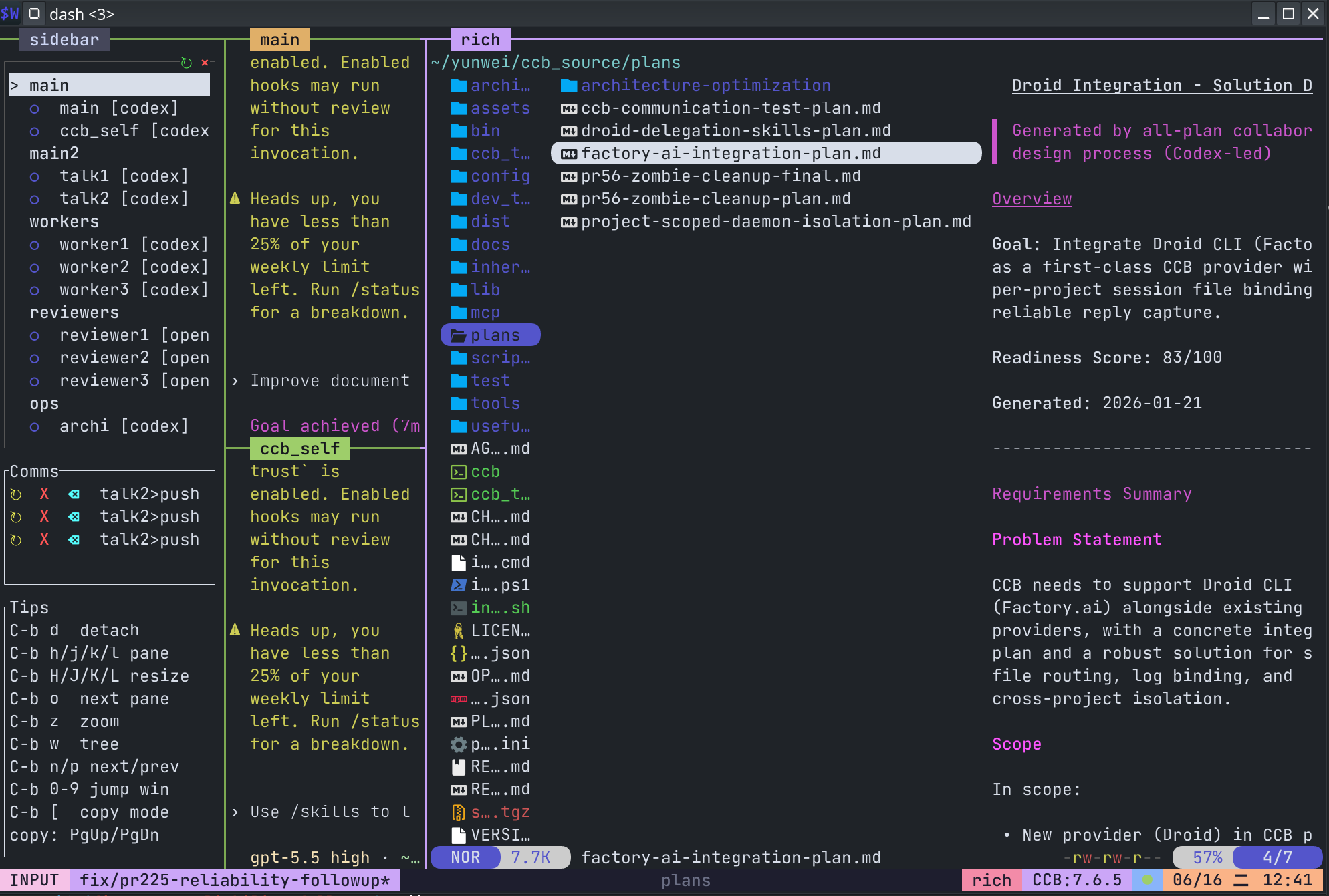
https://github.com/SeemSeam/claude_codex_bridge/blob/HEAD/CCB rich media workbench using Yazi preview in WezTerm

ccb update rich

After rich mode is enabled, plain ccb opens the rich WezTerm launcher automatically unless it is already running inside a CCB-managed rich WezTerm session. Run ccb uninstall rich to return to normal terminal startup.

Agent Roles Spec And Role Catalog

CCB supports Agent Roles Spec, a host-neutral specification for packaging specialist agents. It can bundle skills, memory, and tool dependencies into installable, mountable, and removable Role Packs. That repository also serves as the public role catalog.

View the public role catalog

| Role | Purpose | | :--- | :--- | | agentroles.ccb_self | CCB self-maintenance, config help, runtime diagnosis, protected recovery, and workflow orchestration. | | agentroles.archi | Architecture review, boundary checks, coupling analysis, maintainability risks, and follow-up gate advice. | | agentroles.frontend_engineer | Frontend design and implementation, design systems, accessibility, browser QA, and reviewed AGY delegation. | | agentroles.mobile_app_engineer | Mobile design and implementation for iOS, Android, React Native, Expo, Flutter, SwiftUI, Jetpack Compose, and more. | | agentroles.mother | Role creation, role source audit, role research, blueprint design, and Agent Roles spec compliance checks. | | agentroles.su_ccb | SU-CCB workflow operations for requirement analysis, planning, dispatch, review gates, archiving, and recovery. |

Config And Shared Memory

Use the ⚙ Settings control panel for normal project configuration. If you want agent-assisted configuration and runtime diagnosis, ccb_self remains available as an optional Role Pack and can be added with ccb roles add agentroles.ccb_self:codex.

Supported managed Agents receive the built-in ask, ccb-clear, ccb-compact, and ccb-diagnose control skills even when optional skill inheritance is disabled. Use $ccb_diagnose to inspect one Agent's authoritative runtime/job state and live pane evidence, apply bounded recovery when safe, and review a redacted issue draft before explicitly authorizing GitHub submission. Managed Codex also keeps reconnect.

.ccb/ccb_memory.md is the project-wide shared memory document. Use it for team collaboration rules, project constraints, long-lived context, and agent handoff conventions. Stable cross-agent information belongs there instead of being copied into several provider-private memory files.

Contact

https://github.com/SeemSeam/claude_codex_bridge/blob/HEAD/CCB WeChat group 2

WeChat group QR codes are valid for seven days. If this one has expired, add seemseam-com to request the latest invitation.

Community And Credits

Thanks to the Linux.do community for testing, feedback, and discussion.

Thanks to tmux-agent-sidebar for sidebar ideas and inspiration.

Release Notes

v8.6.13 - Reliable visible OMP asks and focused role selection
  • Run OMP asks in the visible managed pane and use OMP's native completion evidence, so tool-using turns remain active until the final assistant result.
  • Keep Config V1/V2 role selection focused on general roles and agentroles.ccb_self; workflow-specific ccb_* roles remain available to V3 rather than appearing in earlier schemas.
  • Refocus current public provider guidance on the primary supported CLI families. DeepSeek CLI, Z.ai, and DeepSeek Harness remain implemented and documented in historical release notes, but are no longer presented as current headline support.
  • No project, conversation, or configuration migration is required. Native Windows x64 and Herdr remain beta and isolated from the shared Linux/macOS runtime.
v8.6.12 - Provider profile inheritance and Mobile conversations
  • Show Pi and OMP native conversations in CCB Mobile while preserving Provider-private session paths and transcript boundaries.
  • Inherit Pi profile assets into Agent-private homes through immutable shared snapshots, and publish concurrent first-start snapshots atomically (PR #328).
  • Preserve Git author and committer identity in managed Provider homes, and return Agent control immediately after an accepted ask submission (PRs #329 and #330).
  • Refresh the WeChat community QR code. Restart managed Pi Agents to refresh projected profile assets; no project, conversation, pairing, or configuration migration is required.
v8.6.11 - Provider authentication and isolated Windows reliability
  • Restore bearer authentication for explicit Codex CLI 0.149.0 custom providers while keeping route-only local gateways unauthenticated.
  • Add per-Agent Codex model catalog projection and model override support, preserve reconnect and custom tmux configuration behavior, and make Pi clear start a fresh context (PRs #321, #322, #325, and #326).
  • Keep Herdr lifecycle synchronization and UTF-8 native startup inside Windows-owned implementations, without adding shared-to-Windows imports (PRs #320 and #323).
  • Restart managed Codex Agents and CCB projects after upgrading. No project, conversation, pairing, or configuration migration is required.
v8.6.10 - Claude OAuth re-login isolation
  • Refresh an existing Agent-private Claude Keychain credential after an external OAuth re-login, so a stopped managed restart does not keep using a revoked token (Issue #319).
  • Preserve a Claude-private Keychain refresh when the inherited source credential is unchanged; external Claude Keychain services remain read-only.
  • Fail closed for symlinked CCB credential projections and private Keychain inspection errors. No project, conversation, pairing, or configuration migration is required.
v8.6.9 - DeepSeek Harness, AGY startup, and Windows isolation
  • Add the official DeepSeek Harness as the separate Developer Preview provider dsh, using its loopback HTTP/WebSocket service and exact native turn evidence.
  • Make managed AGY 1.1.13 select private file token storage immediately, avoiding the keyring timeout without writing to the user's source HOME (Issue #318).
  • Roll back Windows PR changes that crossed into shared Linux/macOS runtime code and add a trusted-base native-only PR gate that rejects future cross-platform leakage.
  • Keep DSH clear, compact, exact-session restore, credentials, skills, and runtime state inside provider-native, agent-private boundaries.
v8.6.5 - Responsive and reliable Mobile terminals
  • Reflow Agent terminal snapshots to the phone viewport while preserving the desktop tmux pane geometry.
  • Keep terminal input and reconnection stable across LAN and Relay routes, and close active sessions cleanly during gateway shutdown.
  • Keep terminal font size and shortcut order in the shared Terminal settings panel, with full-width inline terminal mode on phones and wide layouts.
  • Reattach persisted Windows Herdr namespace and pane references with fail-closed capability checks (PR #304).
v8.6.3 - Mobile access to agent workspace artifacts
  • Turn links to ordinary files in the current Agent's .ccb/workspaces/<agent>/... tree into authenticated Mobile download attachments.
  • Keep the boundary fail-closed: other Agent workspaces, hidden workspace paths, and all other private .ccb runtime state remain unavailable.
  • Preserve the existing Mobile client behavior and pairing model; no project configuration or state migration is required.
v8.6.2 - Explicit command approval, resilient sessions, and broader Mobile terminals
  • Require exact, external approval before project configuration can execute tool-window commands or custom Provider command templates; use ccb config approve-commands for intentional values.
  • Recover managed Codex conversations from the latest valid session when the current session record is corrupt, without silently clearing context.
  • Add visible-pane Cursor execution, Pi native history, OMP Provider-config inheritance, and more reliable Windows process and namespace cleanup.
  • Expand CCB Mobile with multi-session host terminals, Relay capability-negotiated Provider controls, and stronger native Windows readiness validation.
v8.6.1 - Mobile Provider controls, direct terminals, and safe context compaction
  • Show selected-Agent Provider identity, configured/active/pending model and thinking state, Codex/Claude native session usage, and optional account quota in CCB Mobile.
  • Persist supported model/thinking choices through guarded, restart-required host configuration without interrupting active work or exposing Provider credentials.
  • Open project-window or Agent terminals directly from Mobile home and customize terminal shortcut visibility and order.
  • Add the built-in ccb-compact Skill and ccb compact command with outstanding-work checks and fail-closed Provider command selection.
  • Populate Config UI from the complete available Role catalog, retain native-session boundaries in Mobile history, and refresh the WeChat group QR image.
v8.5.7 - Built-in agent diagnosis and stuck-delivery recovery
  • Keep ccb-clear in every supported managed Agent and add the required ccb-diagnose Skill. Run $ccb_diagnose <agentname> to combine daemon, lineage, queue, inbox, trace, provider-log, and live Pane evidence for one Agent.
  • Classify working, waiting-input, stale-prompt, Provider-error, dead/blank, and misframed Pane states; apply only evidence-backed bounded control-plane recovery and verify the Agent afterward.
  • Generate a redacted incident draft after diagnosis, but require fresh user authorization before creating any GitHub issue.
  • Recover abandoned mailbox deliveries without replaying business work, expose queue depth and active job identifiers in the sidebar, preserve Kiro login/settings through its isolated KIRO_HOME, forward Provider no-terminal timeout settings, and keep old Claude busy-turn records fenced from newly queued requests.
  • Probe reconnect readiness against the active Codex Provider route so custom Provider capacity and connectivity failures can continue through the existing guarded recovery path.
v8.5.6 - Continuous Provider inheritance without clearing CCB conversations
  • Resolve each configured API, token, URL, route, and account dimension from CCB-local authority first, then read only the missing dimensions from the current external Provider state.
  • Refresh inherited state on a stopped Provider generation without writing back to the user's shell, Provider home, IDE, keyring, or remote login.
  • Keep one stable CCB conversation and its workspace, queue, and history across authority generations. Same-authority sessions use native resume; supported Codex/Claude/Gemini import or fork when safe, otherwise CCB records a linked continuation instead of hiding history.
  • Recover usable sessions affected by the withdrawn v8.5.5 migration shape without clearing them. The withdrawn v8.5.5 package is not reused.
  • Install and automatically arm bundled codex-reconnect for managed Codex panes; terminal network and selected-model capacity failures receive one b

GitHub Stars & Activity

3,515Stars
341Forks
0Open issues
PythonLanguage

GitHub Popularity

GitHub stars3,515
Forks341
Open issues0
Primary languagePython
License-
Stars gained today0
Created-
Last pushed-

Trending History

Trending statusnot on today's boards

Related AI Projects

1

Graphify-Labs / graphify

Python★ 119,969⑂ 11,594
2

shareAI-lab / learn-claude-code

Python★ 77,303⑂ 12,438
3

headroomlabs-ai / headroom

Python★ 73,296⑂ 5,638
4

Imbad0202 / academic-research-skills

Python★ 48,911⑂ 3,795
5

luongnv89 / claude-howto

Python★ 41,611⑂ 5,109
6

wshobson / agents

Python★ 39,837⑂ 4,248
7

anthropics / claude-plugins-official

Python★ 36,561⑂ 4,110
8

mukul975 / Anthropic-Cybersecurity-Skills

Python★ 33,046⑂ 4,003

More AI Rankings