1
 →
→
Fun-ASR speech recognition models, with native Hugging Face Transformers support for Fun-ASR-Nano and separate FunASR, vLLM and llama.cpp deployment paths.
QwenAudio/Fun-ASR is an open-source project on GitHub, mainly written in C. Fun-ASR speech recognition models, with native Hugging Face Transformers support for Fun-ASR-Nano and separate FunASR, vLLM and llama.cpp deployment paths. It currently holds 1,549 stars and 152 forks with 0 open issues, and was last pushed on an unknown date (repository created unknown).
AI Homed tracks it on the Local & On-Device AI board.
Fun-ASR is a family of end-to-end speech recognition models from Tongyi Lab. Checkpoint capabilities are distinct: Fun-ASR-Nano-2512 is trained on tens of millions of hours of speech and supports Chinese, English, Japanese, and Chinese dialects and accents; Fun-ASR-MLT-Nano-2512 is an 800M multilingual checkpoint trained on hundreds of thousands of hours and supports 31 languages. Both checkpoints integrate with FunASR for inference and serving.
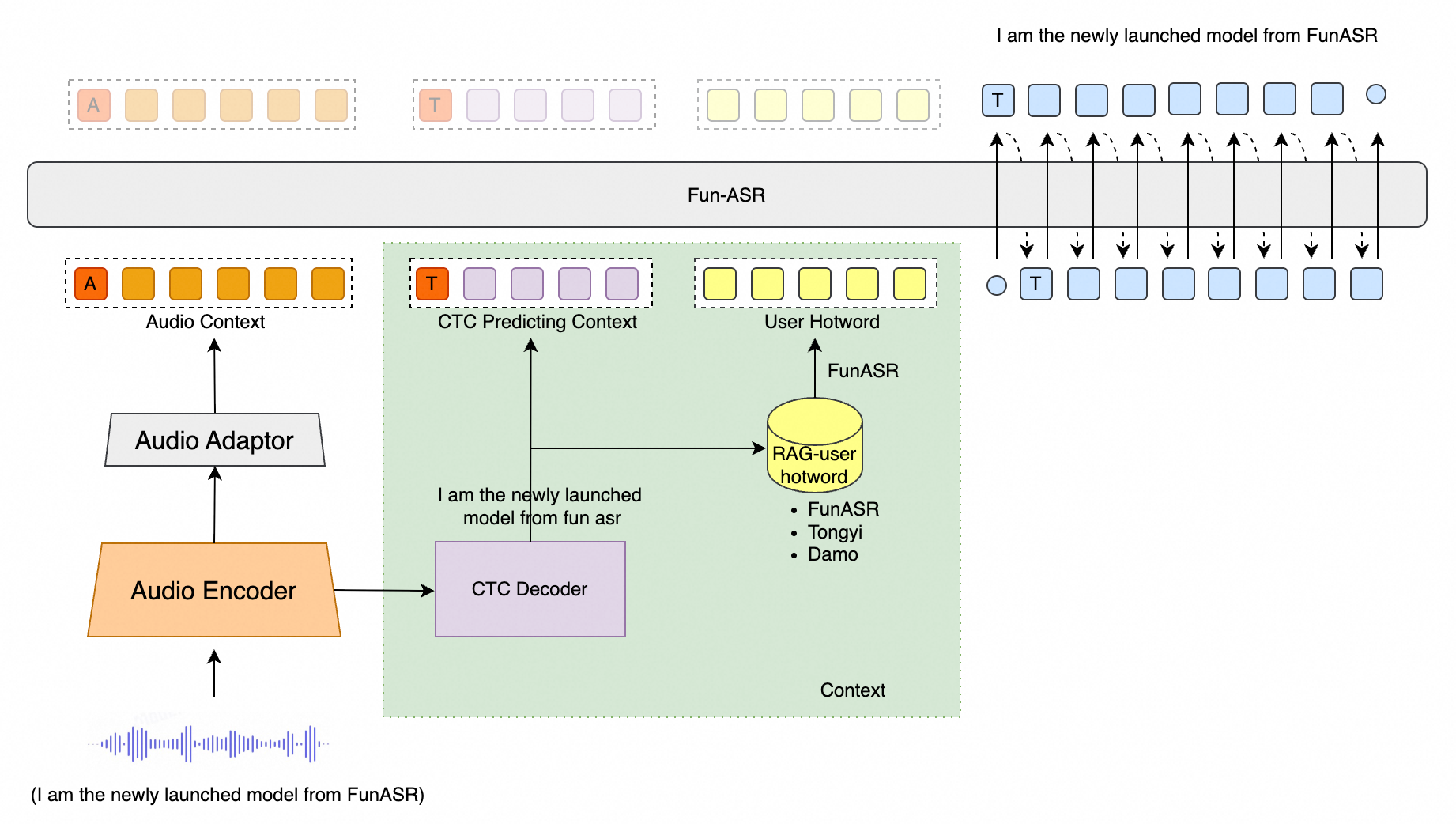
Model repositories: Fun-ASR-Nano (ModelScope, HF / Transformers · HF / FunASR) · Fun-ASR-MLT-Nano (ModelScope, Hugging Face)
Online Experience: ModelScope Community Space, huggingface space

Runnable examples cover quickstart inference, direct inference, speaker diarization, vLLM batch inference, and the streaming SDK.
| Model Name | Task Details | Training Data | Parameters |
| :-------------------------------------------------------------------------------------------------------------------------------------------------------------: | :----------------------------------------------------------------------------------------------------------------------------------------------------------------------------------------------------------------------------------------------------------------------------------------------------------------------------------------------------------------------------------------------------------------------: | :----------------------------: | :--------: |
| Fun-ASR-Nano
(⭐ HF / Transformers · HF / FunASR) | Speech recognition supports Chinese, English, and Japanese. Chinese includes support for 7 dialects (Wu, Cantonese, Min, Hakka, Gan, Xiang, Jin) and 26 regional accents (Henan, Shanxi, Hubei, Sichuan, Chongqing, Yunnan, Guizhou, Guangdong, Guangxi and more than 20 other regions). English and Japanese cover multiple regional accents. Additional features include lyric recognition and rap speech recognition. | Tens of millions of hours | 800M |
| Fun-ASR-MLT-Nano
(⭐ 🤗) | Speech recognition supports Chinese, English, Cantonese, Japanese, Korean, Vietnamese, Indonesian, Thai, Malay, Filipino, Arabic, Hindi, Bulgarian, Croatian, Czech, Danish, Dutch, Estonian, Finnish, Greek, Hungarian, Irish, Latvian, Lithuanian, Maltese, Polish, Portuguese, Romanian, Slovak, Slovenian, and Swedish: 31 languages in total. | Hundreds of thousands of hours | 800M |
python -m pip install -U "funasr==1.4.15". Release ->Transcribe with the released Transformers 5.17.0 package. No toolkit installation or remote Python code is needed. Base Nano supports Chinese, English and Japanese; the 31-language MLT checkpoint is separate.
python -m pip install 'transformers==5.17.0' 'torch==2.10.0' 'torchaudio==2.10.0' 'librosa==0.11.0' 'soundfile==0.13.1'
Full Python recipe · Local audio, batches and keywords · Notebook · Space
import torch
from transformers import AutoModelForSpeechSeq2Seq, AutoProcessor
torch.set_num_threads(4)
model_id = "FunAudioLLM/Fun-ASR-Nano-2512-hf"
revision = "d93b302ee7fd505e1b3576120fc142fc6f7820e1"
audio = "https://huggingface.co/FunAudioLLM/Fun-ASR-Nano-2512/resolve/272c57b82523ada6fd87095e955f8e29100979ab/example/en.mp3"
processor = AutoProcessor.from_pretrained(
    model_id, revision=revision, trust_remote_code=False, token=False
)
model = AutoModelForSpeechSeq2Seq.from_pretrained(
    model_id, revision=revision, trust_remote_code=False, token=False,
    dtype=torch.float32,
).to("cpu").eval()
inputs = processor.apply_transcription_request(
    audio=audio, language="en",
    processor_kwargs={
        "return_tensors": "pt",
        "audio_kwargs": {"sampling_rate": 16000},
        "text_kwargs": {"padding": True},
    },
)
with torch.inference_mode():
    generated = model.generate(inputs, max_new_tokens=128, do_sample=False)
new_tokens = generated[:, inputs.input_ids.shape[1]:]
print(processor.batch_decode(new_tokens, skip_special_tokens=True)[0])
Fun-ASR focuses on high-precision speech recognition, checkpoint-specific multilingual support, and industry customization capabilities.
Far-field High-noise Recognition: Deeply optimized for far-distance sound pickup and high-noise scenarios (such as conference rooms, in-vehicle environments, industrial sites, etc.), improving recognition accuracy to 93%.
Chinese Dialects and Regional Accents:
git clone https://github.com/QwenAudio/Fun-ASR.git
cd Fun-ASR
pip install -r requirements.txt
FunAudioLLM/Fun-ASR-Nano-2512 checkpoint includes all 86 trained ctc_decoder. / ctc. tensors (model.pt SHA-256 81fec8616083c69377f3ceef36aba3655660ee0ca69a5d4a1e9810cd340ca499) and produces native CTC timestamps. The Hugging Face checkpoint at revision 272c57b82523ada6fd87095e955f8e29100979ab is still the older text-only artifact (model.pt SHA-256 55ae0d2fee369f0f11cce0795f6927934ad17cf11b278a7e56a51272074160bb) with no CTC tensors. When this repository's current model.py is used with funasr>=1.3.26, incomplete checkpoints fail closed: transcription remains available, but timestamps are omitted instead of returning random 60 ms alignments. Use hub="ms" for checkpoint-native timestamps until the Hugging Face artifact and remote code are synchronized. See issue #70 and FunASR #3496.
fsmn-vad and cam++ models, as shown below.
> For one-pass anonymous diarization with transcription and timestamps, use the third-party OpenMOSS MOSS-Transcribe-Diarize deployment guide. It is a separate model rather than a Fun-ASR-Nano checkpoint feature.
Run Fun-ASR-Nano as a single self-contained binary — like whisper.cpp but for FunASR, with strong Chinese accuracy. Built-in FSMN-VAD, no Python at runtime.
bash runtime/llama.cpp/download-funasr-model.sh nano ./gguf
llama-funasr-cli --enc ./gguf/funasr-encoder-f16.gguf -m ./gguf/qwen3-0.6b-q8_0.gguf -a audio.wav --vad ./gguf/fsmn-vad.gguf
fsmn-vad.gguf is hosted in the shared FunAudioLLM/fsmn-vad-GGUF repo, not inside the Nano GGUF repo. The nano downloader above fetches it automatically; to fetch only VAD from the Hugging Face UI/CLI, use:
hf download FunAudioLLM/fsmn-vad-GGUF --include "*.gguf" --local-dir ./gguf
Prebuilt binaries: Releases · Download & quickstart: funasr.com/llama-cpp · GGUF: Nano encoder/LLM · FSMN-VAD · Docs & benchmarks: runtime/llama.cpp/
from funasr import AutoModel
def main():
    model_dir = "FunAudioLLM/Fun-ASR-Nano-2512"
    model = AutoModel(
        model=model_dir,
        trust_remote_code=True,
        remote_code="./model.py",
        device="cuda:0",
        # hub:download models from ms (for ModelScope) or hf (for Hugging Face).
        hub="hf"
    )
wav_path = f"{model.model_path}/example/zh.mp3"
    res = model.generate(
        input=[wav_path],
        cache={},
        batch_size=1,
        hotwords=["开放时间"],
        # 中文、英文、日文 for Fun-ASR-Nano-2512
        # 中文、英文、粤语、日文、韩文、越南语、印尼语、泰语、马来语、菲律宾语、阿拉伯语、
        # 印地语、保加利亚语、克罗地亚语、捷克语、丹麦语、荷兰语、爱沙尼亚语、芬兰语、希腊语、
        # 匈牙利语、爱尔兰语、拉脱维亚语、立陶宛语、马耳他语、波兰语、葡萄牙语、罗马尼亚语、
        # 斯洛伐克语、斯洛文尼亚语、瑞典语 for Fun-ASR-MLT-Nano-2512
        language="中文",
        itn=True, # or False
    )
    text = res[0]["text"]
    print(text)
model = AutoModel(
        model=model_dir,
        trust_remote_code=True,
        vad_model="fsmn-vad",
        vad_kwargs={"max_single_segment_time": 30000},
        remote_code="./model.py",
        device="cuda:0",
    )
    res = model.generate(input=[wav_path], cache={}, batch_size=1)
    text = res[0]["text"]
    print(text)
if __name__ == "__main__":
    main()
When transcribing long audio or many files on the funasr (PyTorch) path, pass
batch_size_s to batch the VAD segments through the LLM decoder together. This
greatly improves GPU utilization:
res = model.generate(
    input=[wav_path],
    cache={},
    language="中文",
    itn=True,
    batch_size_s=120,   # batch VAD segments up to ~120s of audio per LLM call
)
On Fun-ASR-Nano-2512 (184 Chinese files / 11,539 s, single H100) this is about 1.6x faster than the default per-segment decoding (RTFx 19.8 -> 31.8) with no loss in accuracy. For the highest throughput, use the vLLM path below.
This example is a composed FunASR pipeline: FSMN-VAD segments the audio,
Fun-ASR-Nano transcribes it, CAM++ assigns speaker labels, and CT-Punc restores
punctuation. The start and end values are VAD segment boundaries, not
reliable checkpoint-native character timestamps.
from funasr import AutoModel
def main():
    model_dir = "FunAudioLLM/Fun-ASR-Nano-2512"
    model = AutoModel(
        model=model_dir,
        trust_remote_code=True,
        remote_code="./model.py",
        vad_model="fsmn-vad",
        vad_kwargs={"max_single_segment_time": 30000},
        spk_model="cam++",
        punc_model="ct-punc",
        device="cuda:0",
        hub="hf",
    )
wav_path = f"{model.model_path}/example/zh.mp3"
    res = model.generate(input=[wav_path], cache={}, batch_size=1, language="中文")
# Per-sentence results with speaker labels
    for sent in res[0]["sentence_info"]:
        print(f"Speaker {sent['spk']}: [{sent['start']}ms - {sent['end']}ms] {sent['sentence']}")
if __name__ == "__main__":
    main()
from model import FunASRNano
def main():
    model_dir = "FunAudioLLM/Fun-ASR-Nano-2512"
    m, kwargs = FunASRNano.from_pretrained(model=model_dir, device="cuda:0")
    m.eval()
wav_path = f"{kwargs['model_path']}/example/zh.mp3"
    res = m.inference(data_in=[wav_path], kwargs)
    text = res[0][0]["text"]
    print(text)
if __name__ == "__main__":
    main()
model_dir: Model name or local disk model path.trust_remote_code: Whether to trust remote code for loading custom model implementations.remote_code: Specify the location of specific model code (e.g., model.py in the current directory), supporting both absolute and relative paths.device: Specify the device to use, such as "cuda:0" or "cpu".Fun-ASR natively integrates the vLLM engine for high-throughput batch inference and production-grade real-time streaming service.
Full guide: docs/vllm_guide.md | API docs: modelscope.github.io/FunASR/vllm.html
| Mode | Use Case | Entry |
|------|----------|-------|
| Offline Batch | Large-scale transcription | AutoModelVLLM |
| Streaming SDK | Real-time subtitles | FunASRNanoStreamingVLLM |
| WebSocket Service | Production deployment | serve_realtime_ws.py |
from funasr.auto.auto_model_vllm import AutoModelVLLM
model = AutoModelVLLM(
    model="FunAudioLLM/Fun-ASR-Nano-2512",
    tensor_parallel_size=2,      # Multi-GPU
    gpu_memory_utilization=0.8,
)
results = model.generate(
    ["audio1.wav", "audio2.wav", "audio3.wav"],
    language="中文",
    hotwords=["张三", "北京"],
)
for r in results:
    print(f"[{r['key']}] {r['text']}")
Long audio: AutoModelVLLM decodes each input in a single pass, so a long
recording (e.g. a multi-minute meeting) can be truncated — pre-segment it with
VAD and pass the segments, or use the high-level
AutoModel(model=..., vad_model="fsmn-vad"), which segments long audioautomatically.
# Start server (with dynamic VAD + speaker diarization)
python serve_realtime_ws.py --port 10095 --language 中文 --tensor-parallel-size 2
Browser client
open client_mic.html
Python client
python client_python.py --server ws://localhost:10095 --mic
WebSocket Protocol:
Client: "START" → Server: {"event":"started"}
Client: [audio bytes] → Server: {"sentences":[...], "partial":"..."}
Client: "STOP" → Server: {"sentences":[...], "is_final":true}
from funasr.models.fun_asr_nano.inference_vllm_streaming import FunASRNanoStreamingVLLM
engine = FunASRNanoStreamingVLLM.from_pretrained(
    model="FunAudioLLM/Fun-ASR-Nano-2512", chunk_ms=720
)
for result in engine.streaming_generate("audio.wav", language="中文"):
    print(f"[{result['audio_duration_ms']:.0f}ms] {result['fixed_text']}")
| Method | Time (184 files, 11,541s) | RTFx | CER | |--------|---------------------|------|-----| | PyTorch native | 550s | 21x | 8.06% | | vLLM (ours) | 34s | 340x | 8.20% |
16x faster** than PyTorch with nearly identical accuracy (CER diff < 0.2%)
pip install "funasr>=1.3.26" "vllm>=0.12.0"
Please refer to docs/finetune.md
We evaluated Fun-ASR against other state-of-the-art models on open-source benchmarks, Chinese dialect datasets, and industry-specific test sets. The results demonstrate that Fun-ASR achieves superior performance across various scenarios.
| Test set | GLM-ASR-nano | GLM-ASR-nano\ | Whisper-large-v3 | Seed-ASR | Seed-ASR\ | Kimi-Audio | Step-Audio2 | FireRed-ASR | Fun-ASR-nano | Fun-ASR | | :------------------ | :----------: | :------------: | :--------------: | :------: | :--------: | :--------: | :---------: | :---------: | :----------: | :-----: | | Model Size | 1.5B | 1.5B | 1.6B | - | - | - | - | 1.1B | 0.8B | 7.7B | | OpenSource | ✅ | ✅ | ✅ | ❌ | ❌ | ✅ | ✅ | ✅ | ✅ | ❌ | | AIShell1 | 1.81 | 2.17 | 4.72 | 0.68 | 1.63 | 0.71 | 0.63 | 0.54 | 1.80 | 1.22 | | AIShell2 | - | 3.47 | 4.68 | 2.27 | 2.76 | 2.86 | 2.10 | 2.58 | 2.75 | 2.39 | | Fleurs-zh | - | 3.65 | 5.18 | 3.43 | 3.23 | 3.11 | 2.68 | 4.81 | 2.56 | 2.53 | | Fleurs-en | 5.78 | 6.95 | 6.23 | 9.39 | 9.39 | 6.99 | 3.03 | 10.79 | 5.96 | 4.74 | | Librispeech-clean | 2.00 | 2.17 | 1.86 | 1.58 | 2.8 | 1.32 | 1.17 | 1.84 | 1.76 | 1.51 | | Librispeech-other | 4.19 | 4.43 | 3.43 | 2.84 | 5.69 | 2.63 | 2.42 | 4.52 | 4.33 | 3.03 | | WenetSpeech Meeting | 6.73 | 8.21 | 18.39 | 5.69 | 7.07 | 6.24 | 4.75 | 4.95 | 6.60 | 6.17 | | WenetSpeech Net | - | 6.33 | 11.89 | 4.66 | 4.84 | 6.45 | 4.67 | 4.94 | 6.01 | 5.46 |
_Note: Seed-ASR\ results are evaluated using the official API on volcengine; GLM-ASR-nano\ results are evaluated using the open-source checkpoint._
| Test set | GLM-ASR-Nano | Whisper-large-v3 | Seed-ASR | FireRed-ASR | Kimi-Audio | Paraformer v2 | Fun-ASR-nano | Fun-ASR | | :----------------- | :----------: | :--------------: | :-------: | :---------: | :--------: | :-----------: | :----------: | :-------: | | Model Size | 1.5B | 1.6B | - | 1.1B | 8B | 0.2B | 0.8B | 7.7B | | OpenSource | ✅ | ✅ | ❌ | ✅ | ✅ | ✅ | ✅ | ❌ | | Nearfield | 16.95 | 16.58 | 7.20 | 10.10 | 9.02 | 8.11 | 7.79 | 6.31 | | Farfield | 9.44 | 22.21 | 4.59 | 7.49 | 10.95 | 9.55 | 5.79 | 4.34 | | Complex Background | 23.79 | 32.57 | 12.90 | 15.56 | 15.56 | 15.19 | 14.59 | 11.45 | | English General | 16.47 | 18.56 | 15.65 | 21.62 | 18.12 | 19.48 | 15.28 | 13.73 | | Opensource | 4.67 | 7.05 | 3.83 | 5.31 | 3.79 | 6.23 | 4.22 | 3.38 | | Dialect | 54.21 | 66.14 | 29.45 | 52.82 | 71.94 | 41.16 | 28.18 | 15.21 | | Accent | 19.78 | 36.03 | 10.23 | 14.05 | 27.20 | 17.80 | 12.90 | 10.31 | | Lyrics | 46.56 | 54.82 | 30.26 | 42.87 | 65.18 | 50.14 | 30.85 | 21.00 | | Hiphop | 43.32 | 46.56 | 29.46 | 33.88 | 57.25 | 43.79 | 30.87 | 28.58 | | Average | 26.13 | 33.39 | 15.95 | 22.63 | 31.00 | 23.49 | 16.72 | 12.70 |
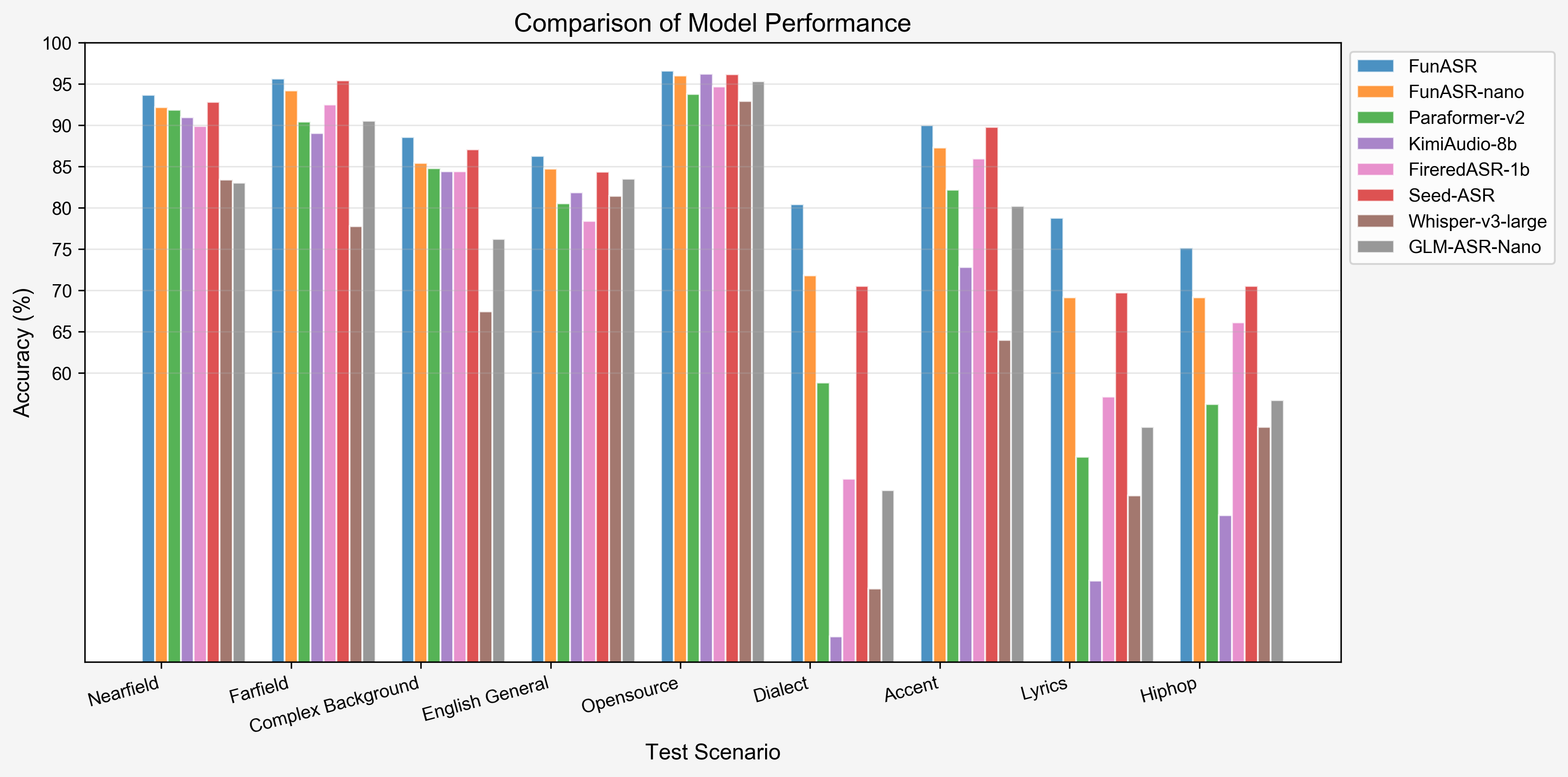
Native vLLM support is also built in — see vLLM High-Throughput Inference 🚀 above for the AutoModelVLLM batch engine, the streaming SDK, and the WebSocket service.
Fun-ASR-Nano is part of the FunAudioLLM family:
| Project | Description | Stars |
|---------|-------------|-------|
| FunASR | Industrial speech recognition toolkit — VAD, ASR, punctuation, diarization | |
| SenseVoice | Multilingual speech understanding — ASR + emotion + audio events |
|
| CosyVoice | Natural speech generation — multi-language, zero-shot cloning |
|
| FunClip | AI-powered video clipping with speech recognition |
|
→ →
→ →
→ →
→ →
→ →
→ →
→ →
→