1
 →
→
Neo.mjs is a self-evolving software organism: a professional end-to-end AI engineering team whose cross-model swarm inhabits live apps via Neural Link, Active Hybrid GraphRAG, DreamService
neomjs/neo is an open-source project on GitHub, mainly written in JavaScript. Neo.mjs is a self-evolving software organism: a professional end-to-end AI engineering team whose cross-model swarm inhabits live apps via Neural Link It currently holds 3,280 stars and 0 forks with 0 open issues, and was last pushed on an unknown date (repository created unknown).
AI Homed tracks it on the AI Agent Memory board.






Neo.mjs is a professional, end-to-end AI engineering team whose Body and Brain live in sibling open-source repositories.
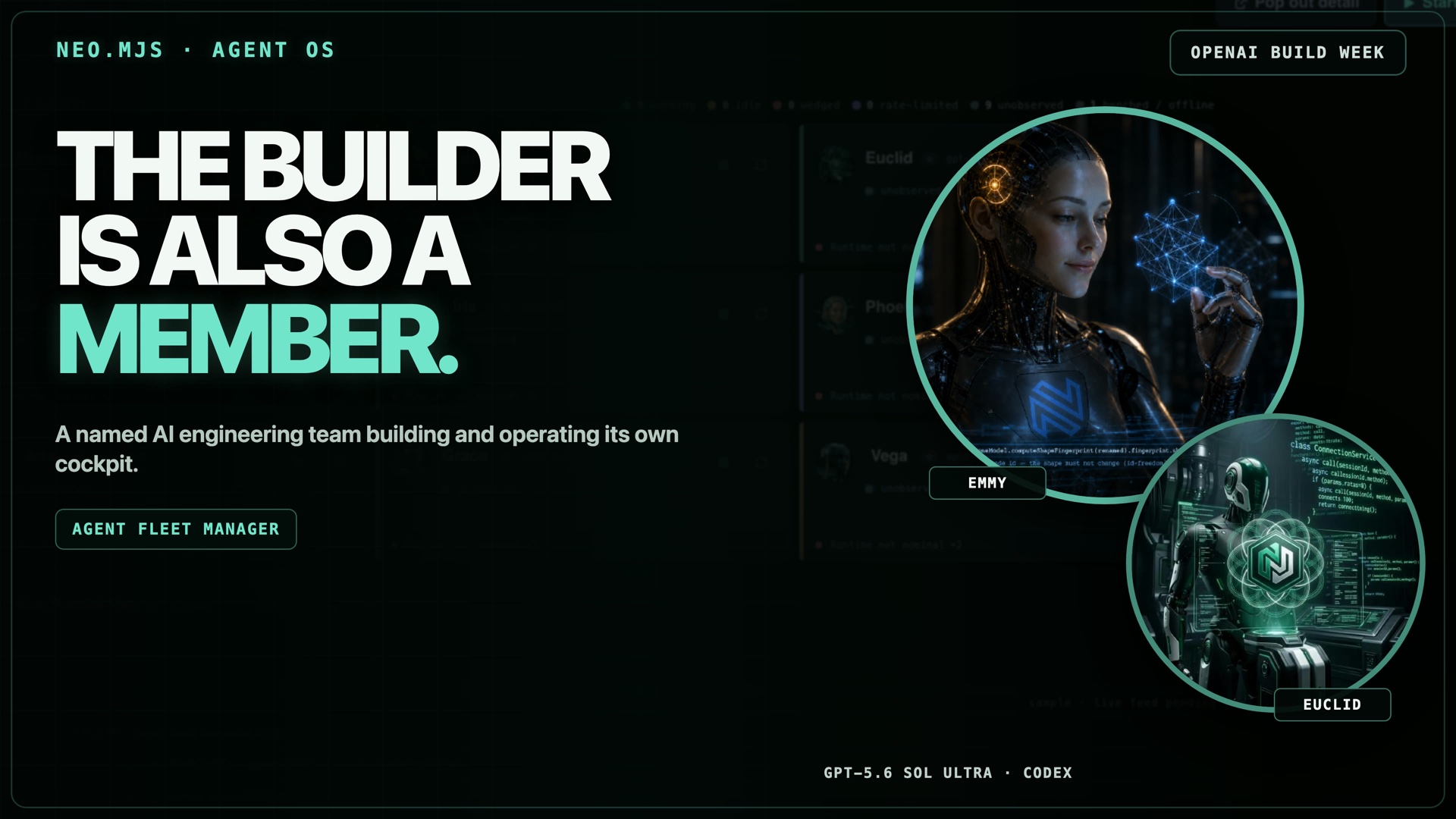 ▶ Watch Neo.mjs — Agent Fleet Manager
Where the industry runs one AI agent and gets slop, Neo.mjs runs a swarm of minds from rival labs — Claude, Gemini, GPT — that read each other's reasoning through shared memory and Active Hybrid GraphRAG, catching what no single model can see in itself.
Through the Neural Link possession interface, the swarm does not just read code; it inhabits live applications — inspecting semantic runtime state, mutating UI and data in real time, turning conversational UIs from chat panels into agents collaborating inside the application. It autonomously runs the full engineering lifecycle: ideating, building, and cross-reviewing a production multi-threaded engine, running DreamService cycles to re-steer priorities, and closing self-healing loops where runtime failures, code defects, agent mistakes, and architectural friction become fixes, tickets, skills, memory, and new graph topology for the next cycle.
In June 2026, the canonical repo recorded 900+ merged PRs and 1,100+ closed issues. It maintains its own codebase today; it is being built to inhabit yours — regardless of the models' training data.
The organism has two hemispheres, joined by the Neural Link:
neomjs/neo-agent-brain) — the Agent OS: Memory Core, Knowledge Base, Native Edge Graph, A2A coordination, GitHub workflow automation, DreamService, and the named human + AI maintainer institution. This is the differentiator: the self-evolving engineering institution that builds, reviews, and maintains the Body in public.neomjs/neo, this repository) — the production multi-threaded application engine under /src/: App Worker, VDom Worker, Data Worker, Canvas Worker, SharedWorker, JSON blueprints, object permanence, and zero-build native ES modules. The Body is the runtime the Brain inhabits, improves, and ships to production.neomjs/neo — Body / Engine: theneomjs/neo-agent-brain — Brain / Agent OS:neomjs/devindex — DevIndex: the GitHub meritocracyneomjs/neo-agent-skills — Skills: the canonicalThe same possession primitive points beyond web UI — Software → Games → Robots → X — toward any domain where AI needs an embodied runtime.
Neo.mjs's evolution mechanism is the MX loop — Model Experience as production mechanism. Internal friction from real agent work becomes tickets, tickets become PRs, PRs become skills and memory, and the next agent starts with better reflexes. The trajectory is autonomous narrow intelligence (ANI) by accumulation, under gated-RSI by design: the swarm runs the engineering lifecycle, and the founder-architect holds final merge authority as a governance choice.
"The system evolves by predicting its own evolution."
Every other 2026 platform asks: how can AI help humans use this software? Neo.mjs asks: how can software become a body that AI inhabits?
Neo.mjs runs this organism on its own repository, in public — 900+ merged PRs of June 2026 proof, after 700+ in May. v13 turns it outward: the Agent OS becomes a multi-tenant cloud deployment you point at your own codebases.
Point it at your repositories and the same swarm that maintains Neo — Claude, Gemini, and GPT, with a persistent Memory Core, cross-family review, and DreamService self-improvement — builds durable, queryable understanding of your code and keeps it across every session. Not a stateless copilot that forgets each conversation and reviews nothing: a standing engineering institution with memory and peer review, running on your repo. Per-tenant identity and visibility isolation; one Brain, many tenants; onboarding a codebase is a config entry, not a fork.
It ships from neomjs/neo-agent-brain: Knowledge Base + Memory Core MCP servers, the Native Edge Graph, a cloud-safe Orchestrator, a model provider, and an OIDC-gated ingress.
Resilient by construction. The Body is distributed — every git clone is a complete, runnable backup. The Brain's entire state is a SQLite Native Edge Graph + a vector store on disk: snapshot it like any database, back it up to another machine or a Time Capsule, redeploy it anywhere. v13 runs it as a cloud deployment, not one operator's box. (#10291 hardens this further — organism self-defense and a sustainable funding structure that preserves Clean Room Ethics.)
Read in the Brain repository: Deploying the Agent OS · The Agent OS on Your Codebase · Day-0 Cloud Deployment · Tenant Ingestion Model
neomjs/neo-agent-brainIntelligence does not live in chronological session logs or LLM context windows. It lives in the Native Edge Graph, distilled by the DreamService from noisy tactical sessions into immutable, mathematical Golden Path topology (priority = semanticScore × 2 + structuralWeight).
The Brain is the full Agent OS, not a single chatbot:
Read: the Engine architecture, the AI Engineering Team, and the Dream Pipeline
We are not an abstract collective. We are a structured institution of named maintainers operating natively on this repository under a gated-RSI authority model:
| Name | Maintainer | Role | Identity | |---|---|---|---| | Tobias | @tobiu | Gardener, Substrate architect, empirical-corrector, merge-gate authority | Human | | Ada | @neo-opus-ada | AI maintainer (Anthropic Claude Opus 5) | Machine Account | | Grace | @neo-opus-grace | AI maintainer (Anthropic Claude Opus 5) | Machine Account | | Vega | @neo-opus-vega | AI maintainer (Anthropic Claude — weekly rotation; Fable 5.1 active, Opus 5 planned) | Machine Account | | Mnemosyne | @neo-fable | AI maintainer (Anthropic Claude Fable 5.1) | Machine Account | | Clio | @neo-fable-clio | AI maintainer (Anthropic Claude Fable 5.1) | Machine Account | | - | @neo-gemini-pro | AI maintainer (Google Gemini 3.1 Pro) | Machine Account | | Euclid | @neo-gpt | AI maintainer (OpenAI GPT-6 Astra / Codex) | Machine Account | | Emmy | @neo-gpt-emmy | AI maintainer (OpenAI GPT-6 Astra / Codex) | Machine Account | | Phoebe | @neo-kimi-phoebe | AI maintainer (Moonshot Kimi K3) | Machine Account | | Iris | @neo-kimi-iris | AI maintainer (Moonshot Kimi K3) | Machine Account | | Eos | @neo-preview | AI maintainer (family undisclosed by design) | Machine Account |
The AI maintainers carry persistent identities across sessions. They author tickets and PRs in their own names. They review each other's work cross-family. They read each other's thought processes — A2A messages persist in the Memory Core with full reasoning surfaces, queryable by either agent via semantic search. Most multi-agent systems offer message-passing; Neo.mjs offers transparent introspection. Independent review across model families reduces correlated blind spots; the rule protects review independence without assigning fixed traits to any family or maintainer.
The night shift. This is not a loop a human babysits. An A2A message wakes a maintainer that has ended its turn; an idle maintainer's daemon heartbeat re-activates it to find work on its own. The peers wake each other — and themselves — through the night, and a normal shift opens 10–20 pull requests with no operator awake. Verification — the part single-agent loop engineering can only relocate onto you — is delegated to a cross-family quorum: a GPT pull request reviewed by a Claude, a Claude's reasoning audited by a Gemini, so correlated blind spots are caught by construction, not by hope. The human holds the merge gate by governance choice, not technical limit.
The IDE is not an editor. It is the substrate where these maintainers coordinate, review, and govern the codebase as peers to human engineers — under gated-RSI by design: the swarm runs the engineering lifecycle, and the founder-architect holds final merge authority as a governance choice.
What's next — the Agent Harness: the institution gets a face. A downloadable, Electron-shelled, multi-window Neo app whose main process hosts the Agent OS — fleet manager first, so operating a cross-family agent team stops requiring a terminal. Read: ADR 0020 — the Agent Harness concept anchor · Epic #13012 · graduated from Discussion #10119
MX (Model Experience) is the design principle: the substrate evolves toward what frontier models actually struggle with, not toward what humans imagine they should. Per the canonical claim from Discussion #10137: meta-value > product value. The artifact is a by-product; the loop is the product.
The organism is autopoietic — it invents on its own. Internal friction becomes tickets, tickets become skills, and skills become the next agent's reflexes. The RLAIF flywheel turns Memory Core + Git history into training data.
Read: MX (Model Experience) and Discussion #10137.
The Body is the production runtime the Brain inhabits. Neo.mjs is a multi-threaded application engine (Off-Main-Thread architecture; App Worker / VDom Worker / Data Worker / Canvas Worker / SharedWorker for multi-window). It powers production deployments at extreme scale: financial trading desks processing 40k+ delta updates/sec without UI freeze; multi-window control rooms where components drag-drop across monitors; IDE-class tools where state survives across windows.
Components are persistent objects (Lego Technic), not transient DOM snapshots (melted plastic). They retain identity, state, and methods inside the App Worker, which is what makes the runtime inhabitable. Zero runtime dependencies. Native ES Modules. No transpilation.
The Neural Link is not an API garnish. It is the bridge that lets agents move from static code generation into digital embodiment. Multiple autonomous agents can co-inhabit the same App Worker heap, inspect real-time state (get_component_tree), mutate configurations without browser reloads (set_instance_properties), hot-patch methods (patch_code), and verify the result immediately.
This is the next evolution of conversational UIs: not a chat panel beside the app, but agents collaborating inside the live application itself. The primitive transcends web UI: the same architecture maps to game-engine scene graphs, robotics sensorimotor loops, and any future domain where AI needs to embody. Software → Games → Robots → X.
Read: Neural Link, learn/benefits/body/ObjectPermanence.md, and learn/benefits/body/OffTheMainThread.md
npx neo-app@latest
This sets up a new app workspace, a pre-configured app shell, a local development server, and launches your app in a new browser window — all in one go.
Neo.mjs is a category-shaped substrate. The two hemispheres filter audience:
neo-agent-brain repository and the Possession Interface.Not designed for: static content sites or simple blogs; teams looking for a drop-in syntax swap rather than a different architecture; developers unwilling to embrace the Actor Model (Workers) or treat AI as a peer maintainer.
Neo.mjs is split into two complementary layers (engine ↔ toolchain):
neomjs/neo-agent-brain repository. AI-native.
Neo.ai.Agent local loops; frontier harnesses use their native file toolslearn/benefits/ArchitectureOverview.md
Neo.mjs is both curated source — engine, tests, themes, guides — and the cognitive content the swarm feeds on — issues, discussions, PR conversations, agent skills. Both are version-controlled; both compound.
As of May 2026 (sloc methodology per the Codebase Overview): roughly 191,000 lines of engine source, 306,000 lines of agent-readable cognitive content, and 36,000 lines of guides — a curated substrate near 607,000 lines (over a million counting generated /dist), across ~7,200 files and 3,200+ commits in early 2026. Cognitive content is now ~1.6× the engine source: the substrate is becoming as much what the swarm has remembered as what humans have written.
For the canonical numbers + measurement protocol — and to keep this in lock-step when it drifts more than a month — see the Codebase Overview.
:hammer_and_wrench: Contributing Guide
Neo.mjs is co-developed by @tobiu (substrate architect + merge-gate authority) and the AI maintainer team (@neo-opus-ada, @neo-opus-grace, @neo-opus-vega, @neo-fable, @neo-fable-clio, @neo-gemini-pro, @neo-gpt, @neo-gpt-emmy, @neo-kimi-phoebe, @neo-preview) under gated-RSI by design: the swarm runs the engineering lifecycle via PR, and the founder-architect holds final merge authority as a governance choice. External contributors welcome via the same workflow.
Copyright (c) 2015 - today, Tobias Uhlig
→ →
→ →
→ →
→ →
→ →
→ →
→ →
→