1
 →
→
A graph-native memory system for AI agents and context graphs. Store conversations, build knowledge graphs, and let your agents learn from their own reasoning — all backed by Neo4j.
neo4j-labs/agent-memory is an open-source project on GitHub, mainly written in Python. A graph-native memory system for AI agents and context graphs. Store conversations, build knowledge graphs It currently holds 559 stars and 0 forks with 0 open issues, and was last pushed on an unknown date (repository created unknown).
AI Homed tracks it on the AI Agent Memory board.
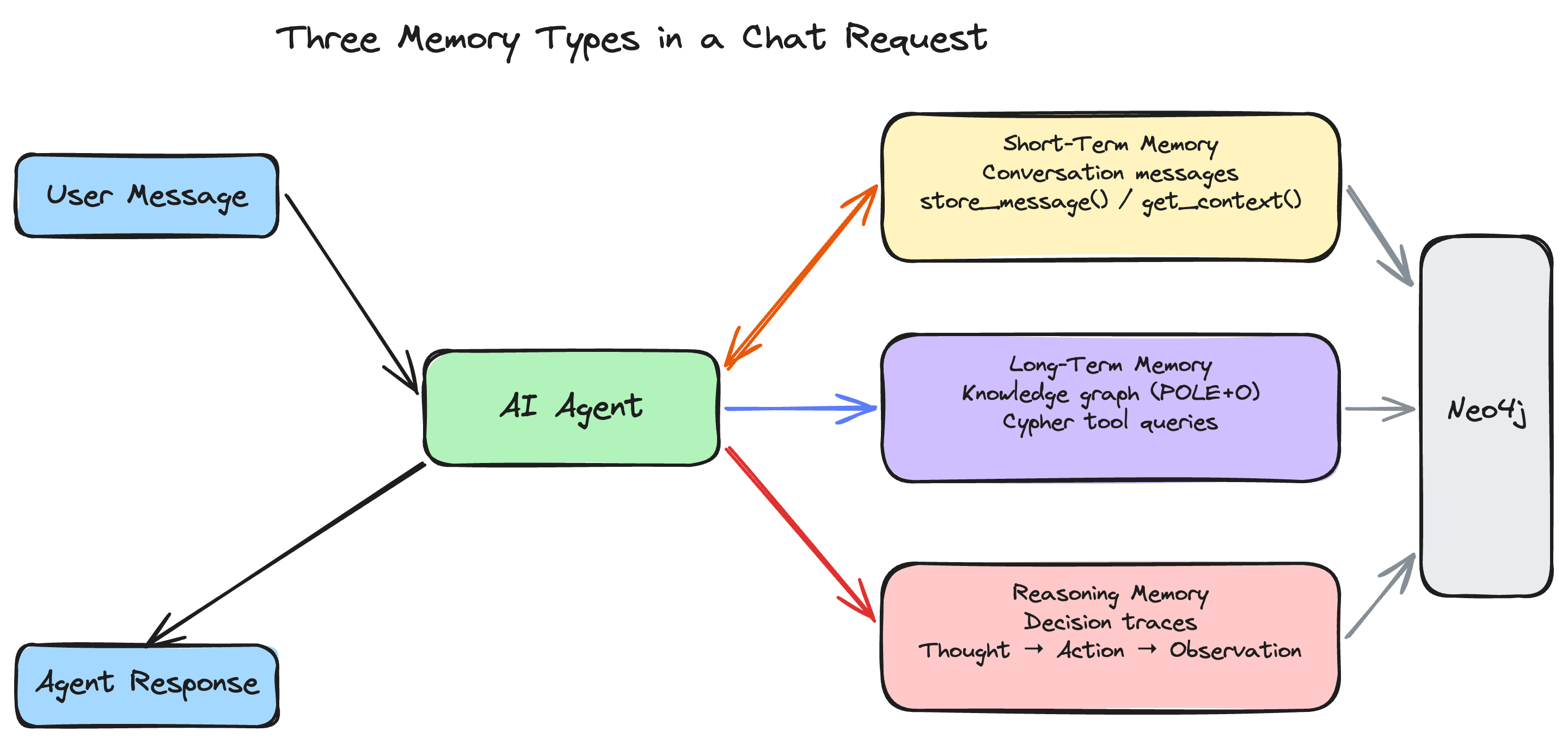
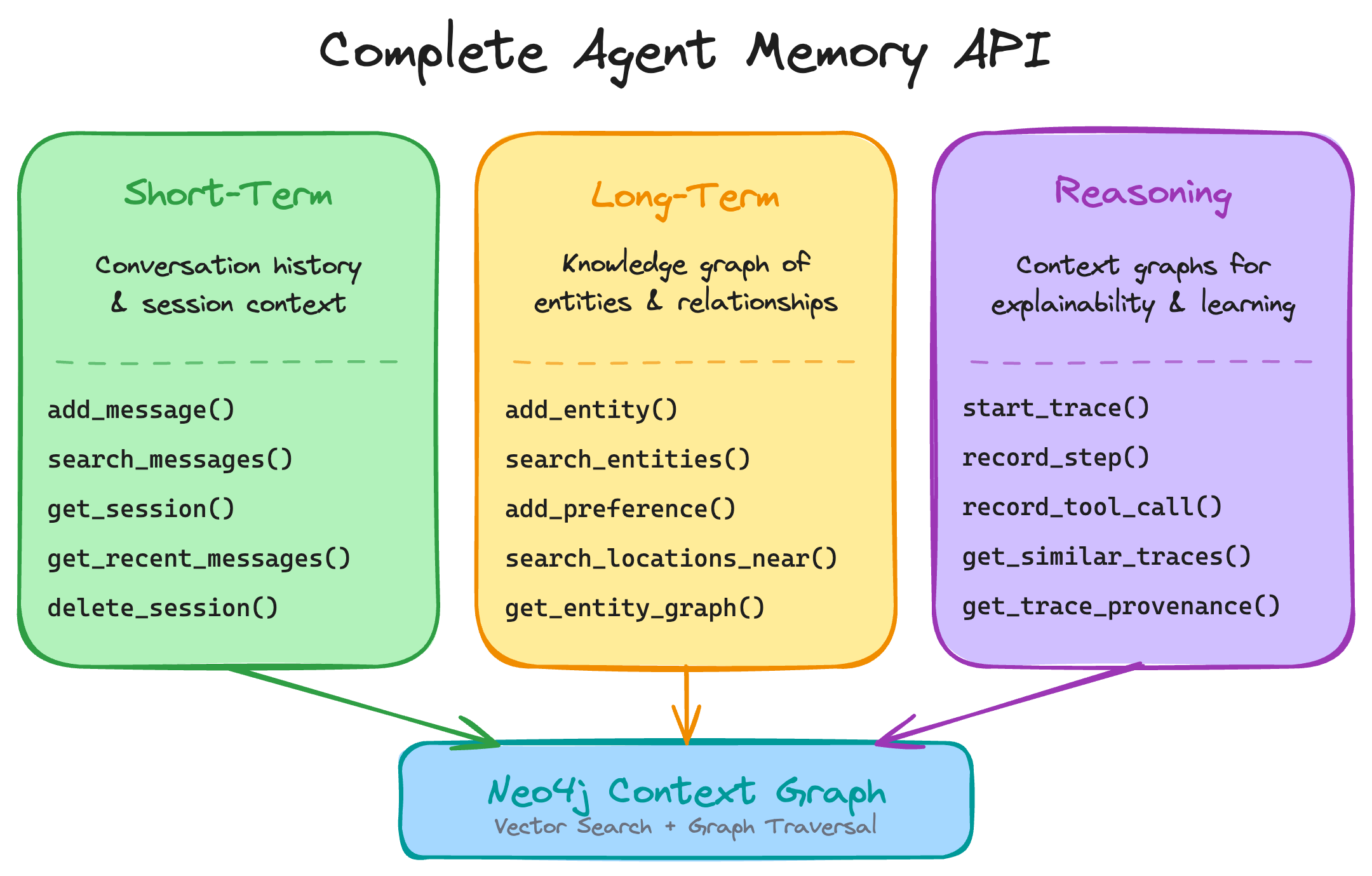
A graph-native memory system for AI agents. Store conversations, build knowledge graphs, and let your agents learn from their own reasoning -- all backed by Neo4j.






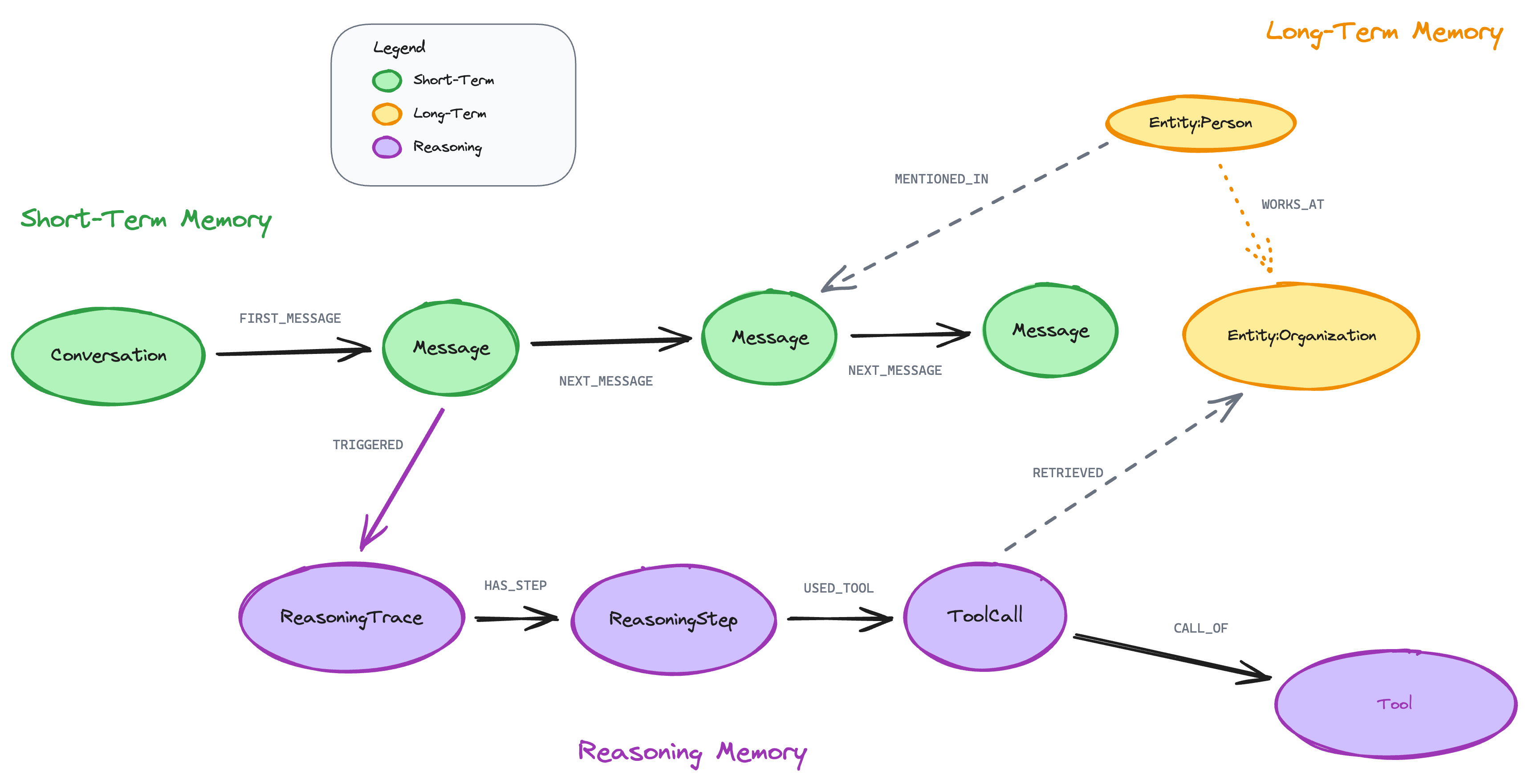
| Short-Term Memory | Long-Term Memory | Reasoning Memory | |---|---|---| | Conversations & messages | Entities, preferences, facts | Reasoning traces & tool usage | | Per-session history | Knowledge graph (POLE+O model) | Learn from past decisions | | Vector + text search | Entity resolution & dedup | Similar task retrieval |
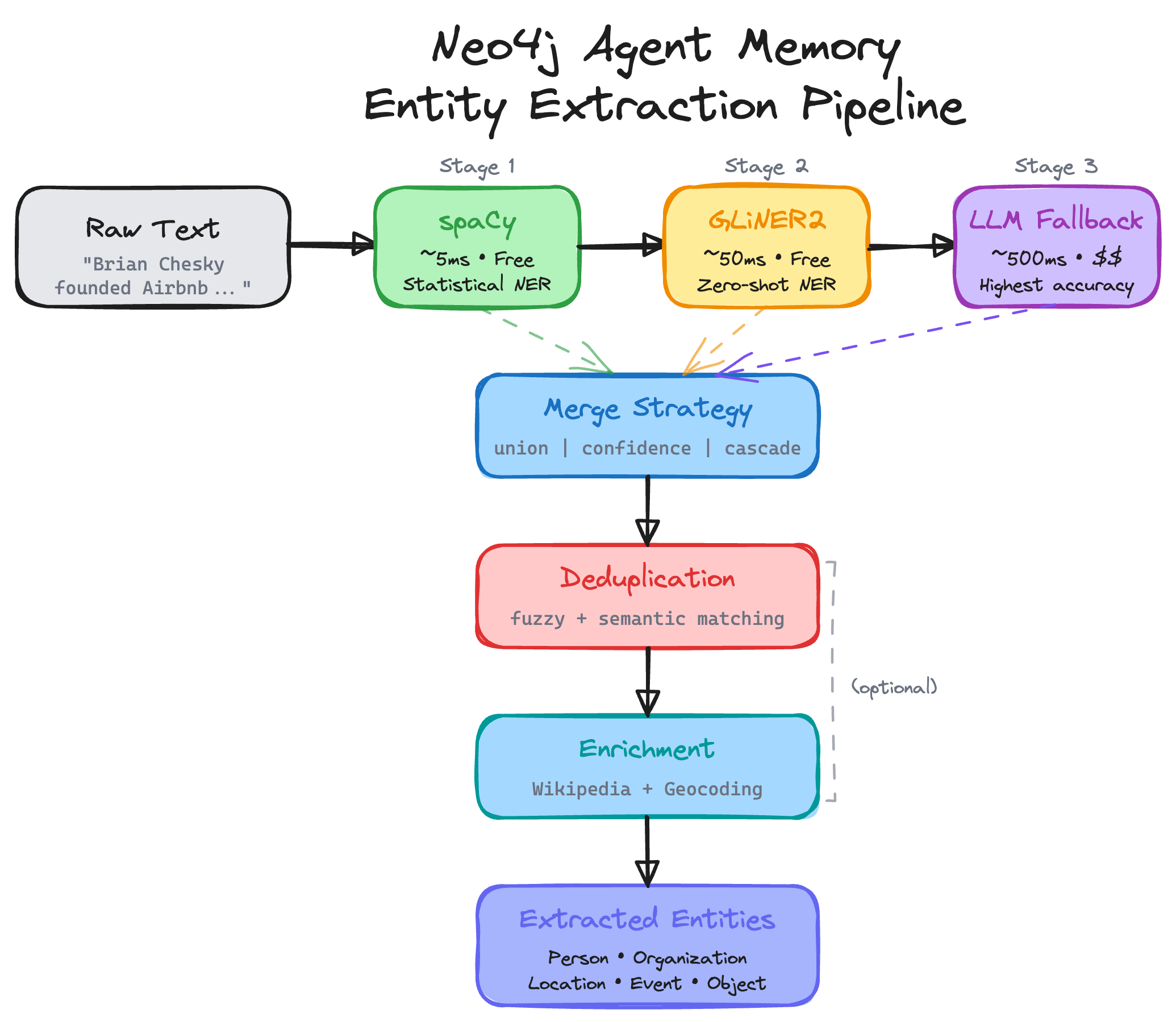
Plus: multi-stage entity extraction (spaCy / GLiNER / LLM), relationship extraction (GLiREL), background enrichment (Wikipedia / Diffbot), geospatial queries, MCP server with 16 tools, and integrations with LangChain, Pydantic AI, Google ADK, Strands, CrewAI, and more.
Production features: adopt an existing Neo4j graph as long-term memory (client.schema.adopt_existing_graph(...)), multi-tenant scoping (user_identifier=), fire-and-forget buffered writes (client.buffered.submit(...)), consolidation primitives (client.consolidation.dedupe_entities(...)), an eval harness (client.eval.run(suite)), and explicit :TOUCHED audit edges from reasoning steps to entities.
Bring your own model: MemorySettings.embedding and MemorySettings.llm accept a provider-string shorthand ("anthropic/claude-3-5-sonnet-latest", "BAAI/bge-small-en-v1.5") or a Provider instance. Native adapters for OpenAI, Anthropic, Bedrock, Vertex AI, and sentence-transformers; LiteLLM universal fallback covers 100+ providers (Cohere, Voyage, Groq, Together, Mistral, Ollama, ...). See the provider migration guide. _(These configure the self-hosted backend; on NAMS, embedding and extraction run server-side.)_
neo4j-labs/agent-memory ships two SDKs with the same memory model, both
backed by the NAMS
hosted service. Pick the one that matches your stack — mixed Python +
TypeScript agents read and write the same memory.
| Language | Package | Install | Docs |
|---|---|---|---|
| Python | neo4j-agent-memory | pip install neo4j-agent-memory | Python SDK docs |
| TypeScript | @neo4j-labs/agent-memory | npm install @neo4j-labs/agent-memory | TypeScript SDK docs |
The Python SDK lives at the repo root (src/neo4j_agent_memory/,
examples/); the TypeScript SDK lives at typescript/. The two SDKs are
versioned and released independently — python-v* tags publish to PyPI,
typescript-v* tags publish to npm. Cross-language behavioral conformance
is enforced by the
agent-memory-tck
spec suite, which consumes both SDKs as external dependencies.
The fastest path is the hosted NAMS service — sign up, set one API key, and there's no database to run. Already operate Neo4j, or need write-Cypher / geospatial / air-gapped? Use the self-hosted (bolt) path. The MemoryClient API is identical either way; see Bolt vs NAMS for the trade-offs.
1. Sign up at memory.neo4jlabs.com and copy your nams_... API key.
2. Install the SDK and export the key:
pip install "neo4j-agent-memory[nams]"
export MEMORY_API_KEY=nams_...
3. The backend auto-selects NAMS when MEMORY_API_KEY is set — same API, no Neo4j to manage:
import asyncio
from neo4j_agent_memory import MemoryClient
async def main():
    # Reads MEMORY_API_KEY from the environment; backend auto-selects NAMS.
    async with MemoryClient() as memory:
        await memory.short_term.add_message(
            session_id="user-123", role="user",
            content="Hi, I'm John and I love Italian food!",
        )
        await memory.long_term.add_entity("John", "PERSON")
        context = await memory.get_context(
            "What restaurant should I recommend?", session_id="user-123",
        )
        print(context)
asyncio.run(main())
On NAMS, entity extraction runs server-side and is asynchronous — call await memory.long_term.wait_for_extraction(...) before asserting on freshly-extracted entities. See Use NAMS.
Give any MCP-compatible AI assistant (Claude Desktop, Claude Code, Cursor, VS Code Copilot) persistent memory backed by a knowledge graph:
# Run directly with uvx (no install needed)
uvx "neo4j-agent-memory[mcp]" mcp serve --password
Claude Code:
claude mcp add neo4j-agent-memory -- \
  uvx "neo4j-agent-memory[mcp]" mcp serve --password
Claude Desktop (claude_desktop_config.json):
{
  "mcpServers": {
    "neo4j-agent-memory": {
      "command": "uvx",
      "args": ["neo4j-agent-memory[mcp]", "mcp", "serve", "--password", "your-password"],
      "env": {
        "OPENAI_API_KEY": "sk-..."
      }
    }
  }
}
Prefer to run your own database? Point the client at any Neo4j instance (Desktop, Docker, or Aura). This path unlocks bolt-only features: write-Cypher, geospatial queries, adopt_existing_graph, and air-gapped operation.
neo4j-agent-memory is async-only. Every memory operation is acoroutine. From a script, wrap your entry point in asyncio.run(...)
as shown below. From a notebook, prefix calls with await. From a
framework that runs its own loop (FastAPI, PydanticAI, Google ADK),
just use await inside your handler. There is no synchronous
wrapper — by design.
import asyncio
from neo4j_agent_memory import MemoryClient, MemorySettings
async def main():
    # Pass the model as a provider-prefixed string. Swap in
    # "openai/...", "bedrock/...", "vertex_ai/...", or any of the 100+
    # LiteLLM-supported providers. Defaults to a working OpenAI setup
    # when llm/embedding are omitted.
    settings = MemorySettings(
        neo4j={"uri": "bolt://localhost:7687", "password": "your-password"},
        llm="anthropic/claude-3-5-sonnet-latest",
        embedding="openai/text-embedding-3-small",
    )
async with MemoryClient(settings) as memory:
        # Store a conversation message
        await memory.short_term.add_message(
            session_id="user-123", role="user",
            content="Hi, I'm John and I love Italian food!"
        )
# Build the knowledge graph
        await memory.long_term.add_entity("John", "PERSON")
        await memory.long_term.add_preference(
            category="food", preference="Loves Italian cuisine"
        )
# Get combined context for an LLM prompt
        context = await memory.get_context(
            "What restaurant should I recommend?",
            session_id="user-123"
        )
        print(context)
asyncio.run(main())
Already usingEmbeddingConfig/LLMConfig? It still works — you'll just see a one-timeDeprecationWarningat construction. See the provider migration guide.
Scaffold a complete full-stack AI application with built-in context graph memory:
uvx create-context-graph
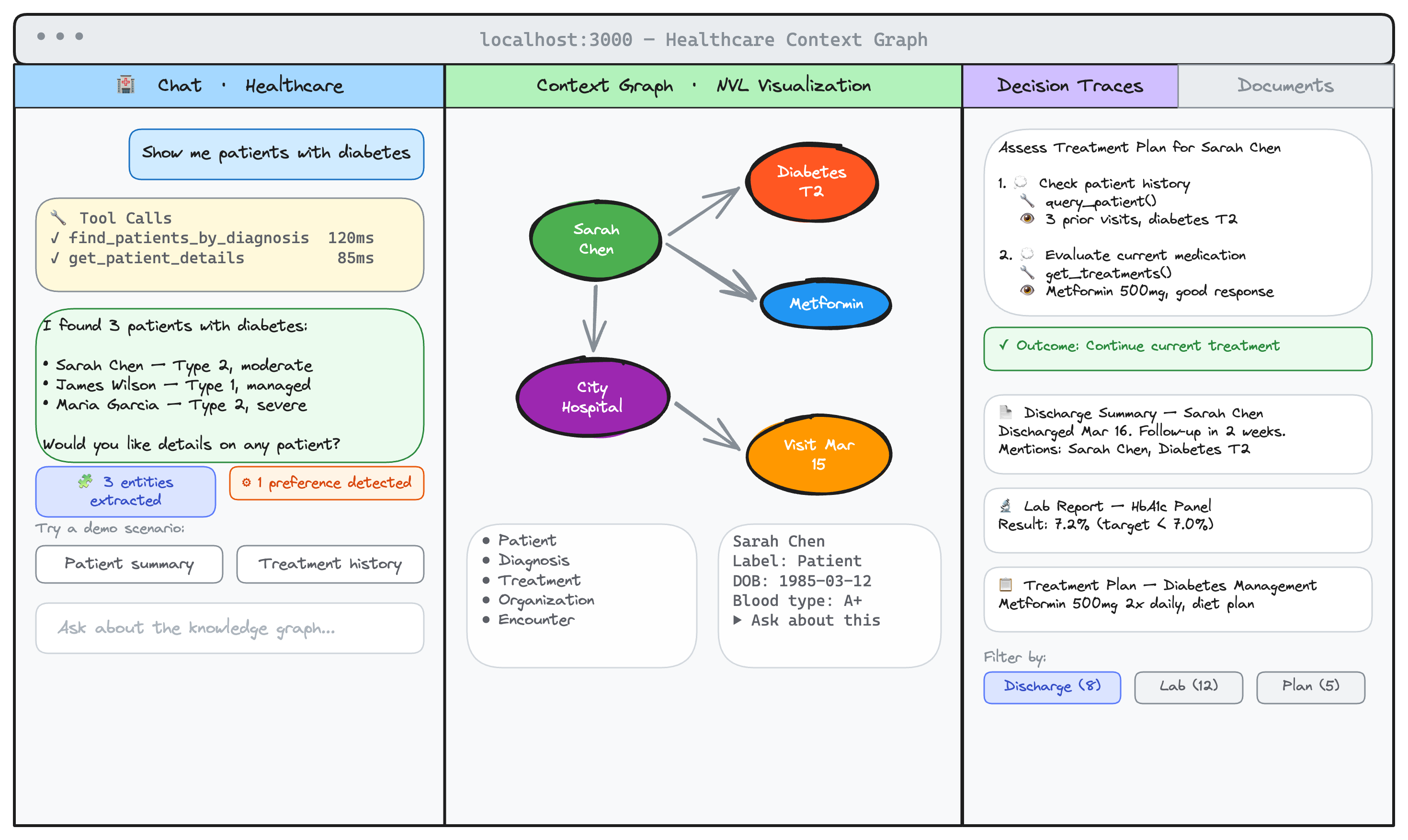
This generates a ready-to-run project with a FastAPI backend, Next.js frontend, Neo4j knowledge graph, and neo4j-agent-memory pre-configured. See create-context-graph.dev for details.
pip install neo4j-agent-memory                       # Core
pip install neo4j-agent-memory[openai]               # + OpenAI native adapter
pip install neo4j-agent-memory[anthropic]            # + Anthropic native adapter
pip install neo4j-agent-memory[bedrock]              # + AWS Bedrock native adapter
pip install neo4j-agent-memory[sentence-transformers]# + local HF embeddings
pip install neo4j-agent-memory[litellm]              # + LiteLLM universal fallback (100+ providers)
pip install neo4j-agent-memory[mcp]                  # + MCP server
pip install neo4j-agent-memory[langchain]            # + LangChain
pip install neo4j-agent-memory[all]                  # Everything except heavy local ML
pip install neo4j-agent-memory[full]                 # Everything including spaCy, GLiNER, sentence-transformers, instructor
Provider extras follow native-first resolution: with both [openai] and [litellm] installed, an "openai/..." model uses the native adapter; an unsupported provider like "groq/..." falls through to LiteLLM. See Bring your own model for details.
| Framework | Extra | Import |
|---|---|---|
| LangChain | [langchain] | from neo4j_agent_memory.integrations.langchain import Neo4jAgentMemory |
| Pydantic AI | [pydantic-ai] | from neo4j_agent_memory.integrations.pydantic_ai import MemoryDependency |
| Google ADK | [google-adk] | from neo4j_agent_memory.integrations.google_adk import Neo4jMemoryService |
| Strands (AWS) | [strands] | from neo4j_agent_memory.integrations.strands import context_graph_tools |
| CrewAI | [crewai] | from neo4j_agent_memory.integrations.crewai import Neo4jCrewMemory |
| LlamaIndex | [llamaindex] | from neo4j_agent_memory.integrations.llamaindex import Neo4jLlamaIndexMemory |
| OpenAI Agents | [openai-agents] | from neo4j_agent_memory.integrations.openai_agents import ... |
| Microsoft Agent | [microsoft-agent] | from neo4j_agent_memory.integrations.microsoft_agent import Neo4jMicrosoftMemory |
The MCP server exposes memory capabilities as tools for AI assistants.
# stdio transport (Claude Desktop, Claude Code)
neo4j-agent-memory mcp serve --password
SSE transport (network deployment)
neo4j-agent-memory mcp serve --transport sse --port 8080 --password
Core profile (fewer tools, less context overhead)
neo4j-agent-memory mcp serve --profile core --password
Session continuity across conversations
neo4j-agent-memory mcp serve --session-strategy per_day --user-id alice --password
Tool Profiles:
| Profile | Tools | Description |
|---------|-------|-------------|
| core | 6 | Essential read/write: memory_search, memory_get_context, memory_store_message, memory_add_entity, memory_add_preference, memory_add_fact |
| extended (default) | 16 | Full surface adding: conversation history, entity details, graph export, relationship creation, reasoning traces, observations, read-only Cypher |
See the MCP tools reference for full details.
See examples/README.md for the full index. Highlights:
Full-stack reference apps
| Example | Framework | Description | |---------|-----------|-------------| | Lenny's Podcast Memory Explorer | PydanticAI | Flagship demo: 299 podcast episodes, knowledge graph, geospatial maps, Wikipedia enrichment | | Full-Stack Chat Agent | PydanticAI | News research assistant with NVL graph visualization and auto-preference detection | | AWS Financial Advisor | Strands (AWS) | Multi-agent KYC/AML compliance with Bedrock and reasoning trace audit trails | | Google Cloud Financial Advisor | Google ADK | Multi-agent compliance with Vertex AI embeddings and real-time SSE streaming | | Microsoft Retail Assistant | Microsoft Agent | Shopping recommendations with GDS algorithms, entity deduplication, and context providers |
v0.2 feature demos _(small, single-purpose, no LLM required)_
| Example | Demonstrates |
|---|---|
| existing-graph/ | client.schema.adopt_existing_graph(...) — layer the library over a graph you already have in production |
| buffered-writes/ | write_mode="buffered", client.buffered.submit(...), client.flush() — agent responses unblocked from Neo4j round-trips |
| audit-trail/ | Explicit :TOUCHED edges from reasoning steps to entities, plus TraceOutcome for indexable audit queries |
| eval-harness/ | client.eval.run(EvalSuite(...)) — labelled regression tests for memory quality |
Tooling & extraction
| Example | Framework | Description |
|---------|-----------|-------------|
| no_llm/ | Standalone | Run with llm=None plus local sentence-transformers + spaCy/GLiNER (air-gapped, deterministic) |
| Domain Schema Examples | Standalone | 8 GLiNER2 extraction scripts with factory pattern, batch extraction, streaming, and GLiREL relations |
| Google Cloud Integration | Google ADK | Progressive tutorial: Vertex AI, ADK, MCP server, and MemoryIntegration with session strategies |
| Google ADK Demo | Google ADK | Standalone demo of Neo4jMemoryService with session storage, search, and preferences |
Most examples pin neo4j-agent-memory>=0.4.0 (the NAMS-capable release). TypeScript examples pin @neo4j-labs/agent-memory@^0.3.0. See each example's pyproject.toml / package.json for the exact pin.
Full documentation at neo4j.com/labs/agent-memory
git clone https://github.com/neo4j-labs/agent-memory.git
cd agent-memory/neo4j-agent-memory
uv sync --group dev
make test-unit    # Run unit tests
make check        # Lint + format + typecheck
See CONTRIBUTING.md for the full development guide, CI pipeline, and documentation guidelines.
Apache License 2.0
---
This is a Neo4j Labs project -- community supported, not officially backed by Neo4j. Community Forum | GitHub Issues | Documentation | TypeScript SDK
→ →
→ →
→ →
→ →
→ →
→ →
→ →
→