
1
 →
MUSE-AI-Lab/Concept-Brittleness is an open-source project on GitHub, mainly written in Python. Concept Brittleness It currently holds 262 stars and 0 forks with 0 open issues, and was last pushed on an unknown date (repository created unknown).
AI Homed tracks it on the Today's Trending board, currently at rank #100 with 0 new stars today.
Yifan Yuan1* · Xiangyu Liu2* · Hongming Shan3 · Yu Han4 · Yu Jiang5 · Hao Tan1 · Junping Zhang6 · Linlin Shen1†
1School of Artificial Intelligence, Shenzhen University 2School of Mathematical Sciences, Shenzhen University
3Institute of Science and Technology for Brain-inspired Intelligence, Fudan University 4College of Computer Science and Software Engineering, Shenzhen University
5Department of Statistics and Data Science, National University of Singapore 6College of Computer Science and Artificial Intelligence, Fudan University
*Equal contribution †Corresponding author
ACM MM 2026
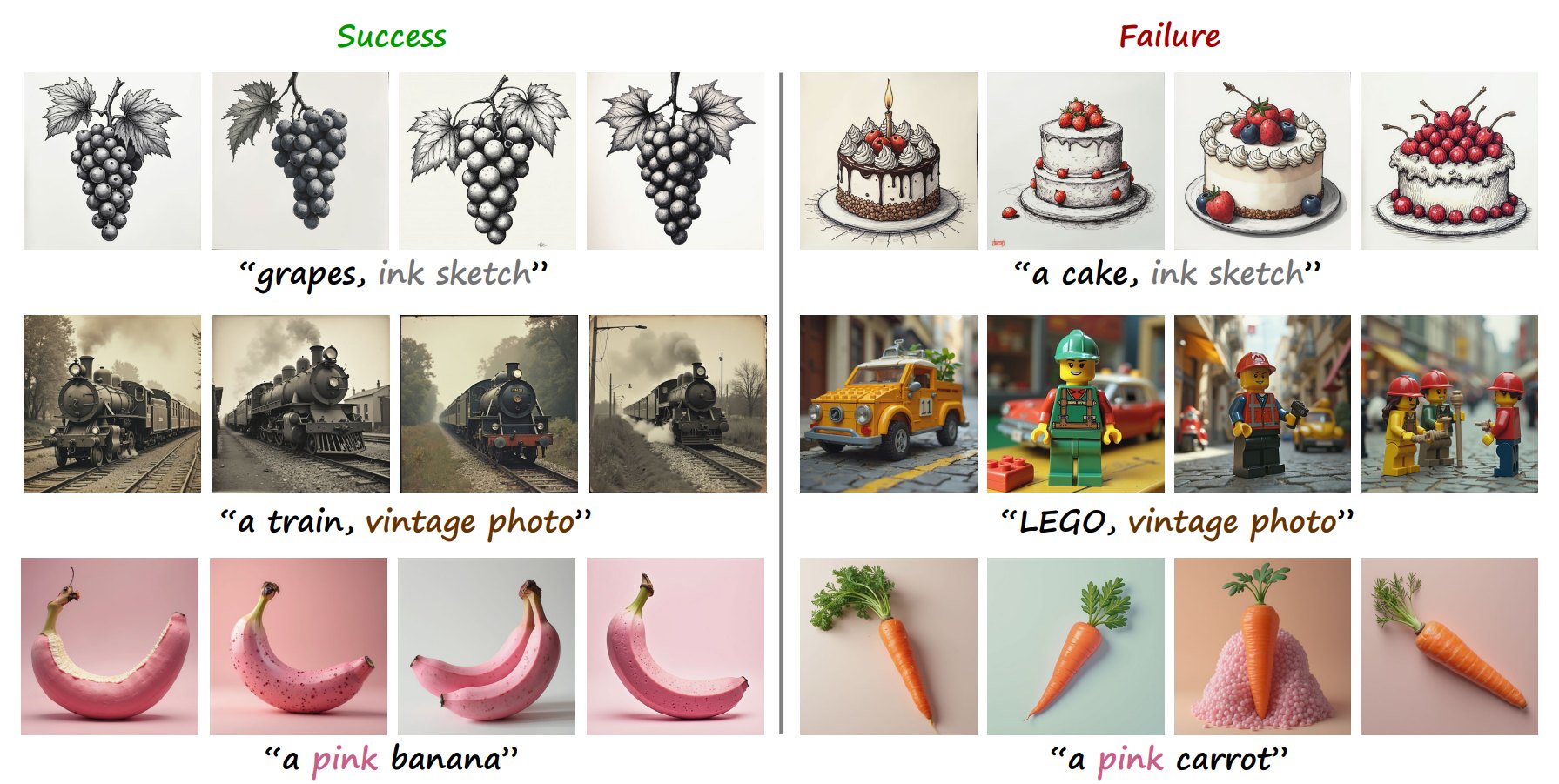
Object-dependent concept brittleness: for a fixed concept, FLUX.1-dev succeeds on most objects but repeatedly fails on a few (four random seeds each).
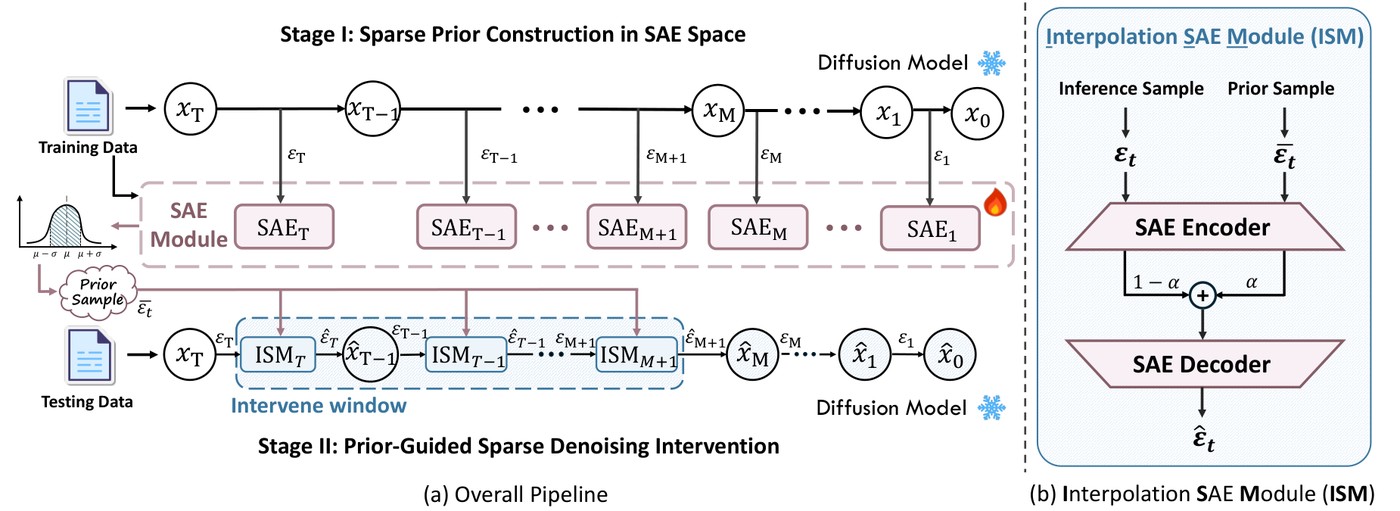
TL;DR: Text-to-image diffusion models follow most prompts, yet a fixed concept such as ink sketch can fail again and again on a few objects — grapes become an ink sketch, a cake stays in full colour, whatever the seed. We call this object-dependent concept brittleness and show that it reflects systematic blind spots rather than sampling noise. Training a sparse autoencoder (SAE) at every denoising step makes abstract style and attribute concepts separable, so successful and failed generations can be compared, the missing, weakened or delayed concept dimensions located, and the failures repaired at inference time by nudging features toward a class-level concept prototype — no retraining.
git clone https://github.com/MUSE-AI-Lab/Concept-Brittleness.git
cd Concept-Brittleness
conda create -n brittleness python=3.10 -y && conda activate brittleness
pip install -r requirements.txt      # PyTorch with CUDA is recommended; experiments used one A800 80GB GPU
Weights are not distributed with the code. Put trusted local copies under models/ (layout in models/README.md) or pass explicit paths (python generate.py --help).
| --model | Backbone | Weights |
|:-|:-|:-|
| flux | FLUX.1-dev | black-forest-labs/FLUX.1-dev |
| sd3.5 | Stable Diffusion 3.5 Large | stabilityai/stable-diffusion-3.5-large |
| sdxl | Stable Diffusion XL | stabilityai/stable-diffusion-xl-base-1.0 |
| pixart | PixArt-α (XL-2, 256px) | PixArt-alpha/PixArt-alpha |
| sd1.5 | Stable Diffusion 1.5 | stable-diffusion-v1-5/stable-diffusion-v1-5 |
The full pipeline (SDXL shown; replace --model for other backbones):
# 1. extract classifier-free-guided denoising step updates on the training prompts
python generate.py --model sdxl --mode save_feature
2. train one SAE per denoising timestep
python train_sae.py --data feature/step_updates_style_2026.pt \
    --d_model 16 --n_dirs 64 --checkpoint_dir checkpoints/sdxl
3. select reliable reference samples in SAE space
python select_reference_samples.py --data feature/step_updates_style_2026.pt \
    --checkpoint_dir checkpoints/sdxl --steps 0 1 2 \
    --remove_far --filtered_output feature/step_updates_style_filtered.pt
4. build class-level concept prototypes
python build_concept_prototypes.py --checkpoint_dir checkpoints/sdxl \
    --output_path feature/sdxl_style_prototypes.pt
5. prototype-guided correction in the early denoising window
python generate.py --model sdxl --mode sae_style_guide --ablation_steps 1,2,3,4,5,6,7,8,9,10
generate.py also supports --mode normal (plain sampling) and --mode mean_ablation; --sae_alpha sets the intervention strength $\alpha$ and --prompt / --prompt_file the prompts.
Held-out prompts, 256×256, official sampler settings of each backbone, seed 2026 (Table 1 of the paper):
| Model | CLIP-I ↑ | CLIP-T ↑ | Style Align. ↑ | Color ↑ | Texture ↑ | Shape ↑ | CLIPSim ↑ | Time (s) | |:-|:-:|:-:|:-:|:-:|:-:|:-:|:-:|:-:| | SD 1.5 | 0.644 | 0.327 | 0.237 | 0.204 | 0.195 | 0.236 | 0.217 | 1.23 | | SD 1.5 + Ours | 0.659 | 0.333 | 0.239 | 0.336 | 0.328 | 0.330 | 0.231 | 1.26 | | SD 3.5 | 0.725 | 0.261 | 0.220 | 0.341 | 0.302 | 0.451 | 0.245 | 15.41 | | SD 3.5 + Ours | 0.797 | 0.297 | 0.221 | 0.461 | 0.437 | 0.475 | 0.250 | 15.70 | | SDXL | 0.630 | 0.341 | 0.238 | 0.353 | 0.276 | 0.300 | 0.235 | 6.39 | | SDXL + Ours | 0.653 | 0.359 | 0.243 | 0.415 | 0.361 | 0.318 | 0.237 | 6.39 | | PixArt-α | 0.627 | 0.336 | 0.232 | 0.349 | 0.356 | 0.315 | 0.222 | 0.59 | | PixArt-α + Ours | 0.629 | 0.338 | 0.239 | 0.368 | 0.366 | 0.358 | 0.247 | 0.61 | | FLUX.1-dev | 0.598 | 0.273 | 0.220 | 0.379 | 0.326 | 0.240 | 0.229 | 4.10 | | FLUX.1-dev + Ours | 0.623 | 0.288 | 0.230 | 0.394 | 0.346 | 0.379 | 0.233 | 4.15 |
Style generation is measured with CLIP-I / CLIP-T / Style Alignment, attribute control with BLIP-VQA (Color, Texture, Shape) and CLIPSim; the correction adds almost no inference time.
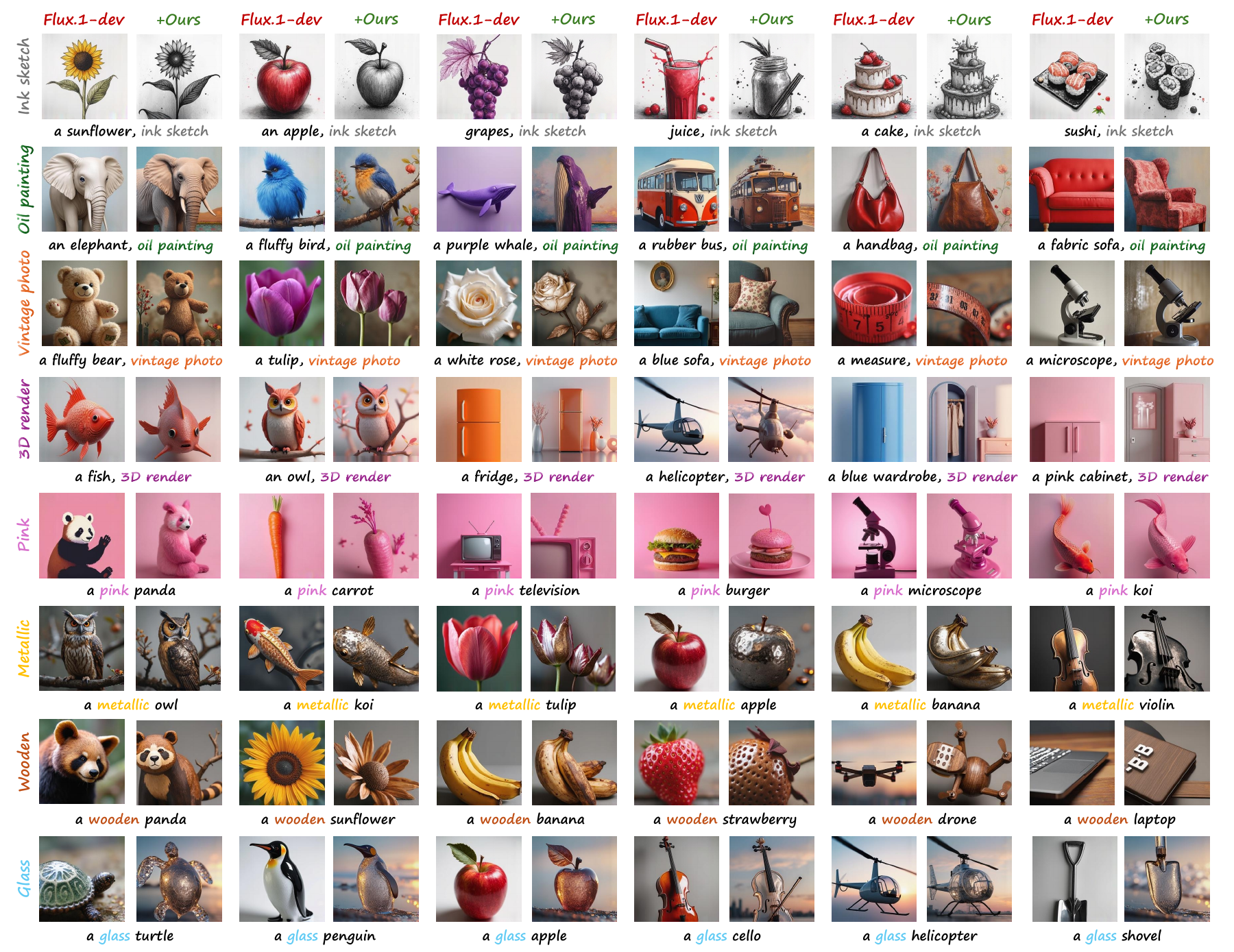
Prototype-guided correction on FLUX.1-dev failures (ink sketch, oil painting, vintage photo, colour, material, 3D rendering).
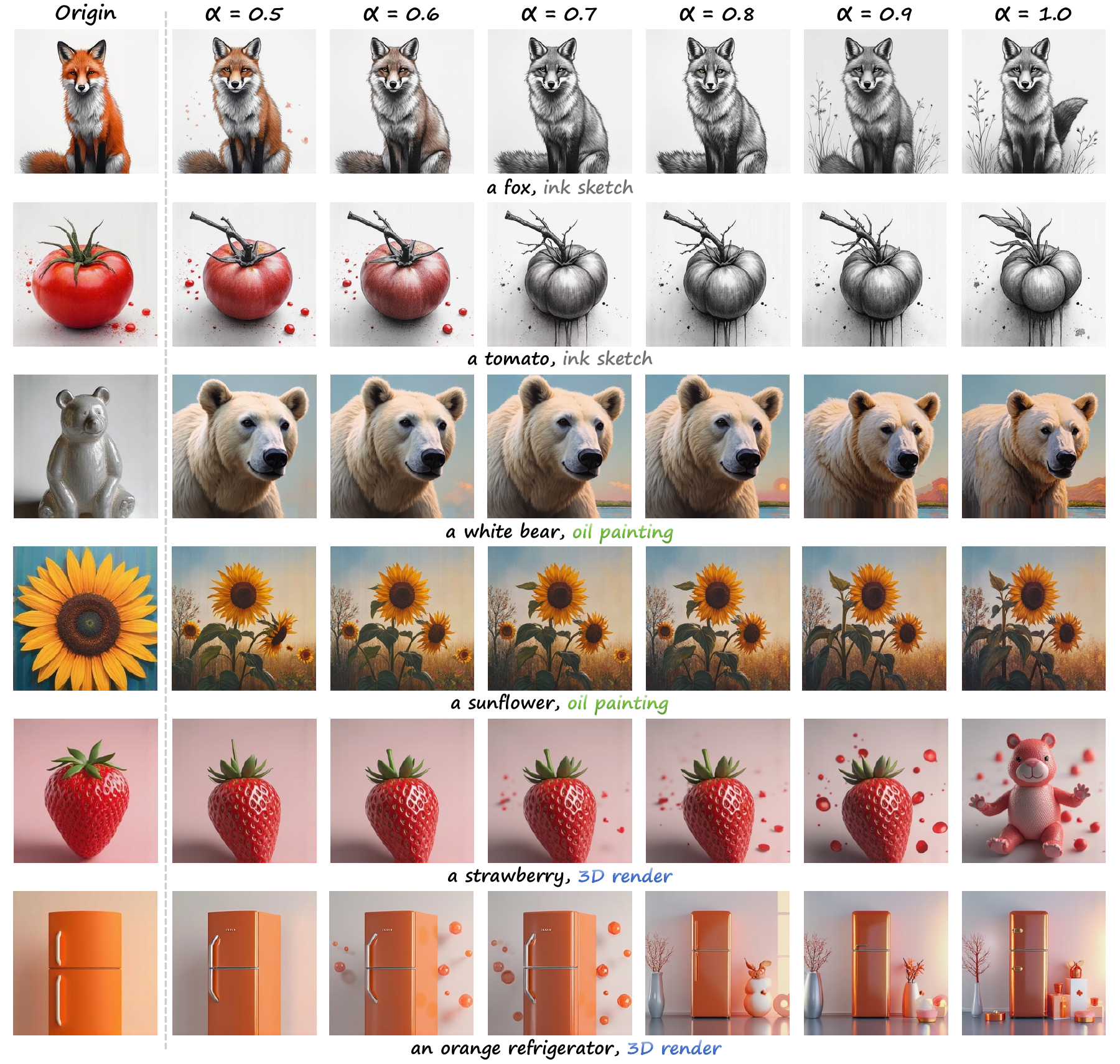
Intervention strength $\alpha$. Larger values strengthen the requested style but can change the layout; $\alpha \approx 0.8$ gives the best repair–preservation balance.
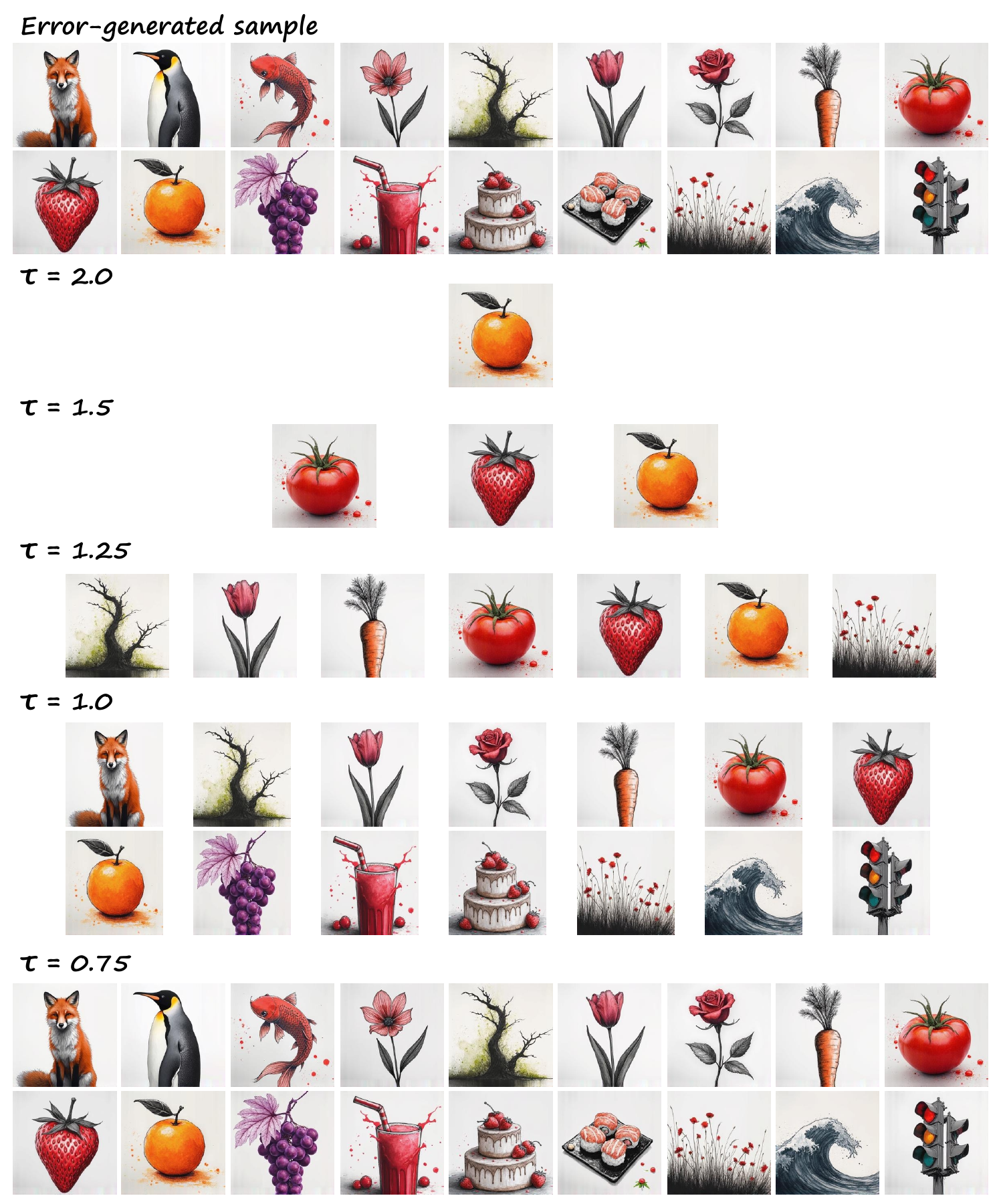
Reference filtering $\tau$. A lower threshold rejects more failed references and gives purer class prototypes, at the cost of fewer and less diverse samples.
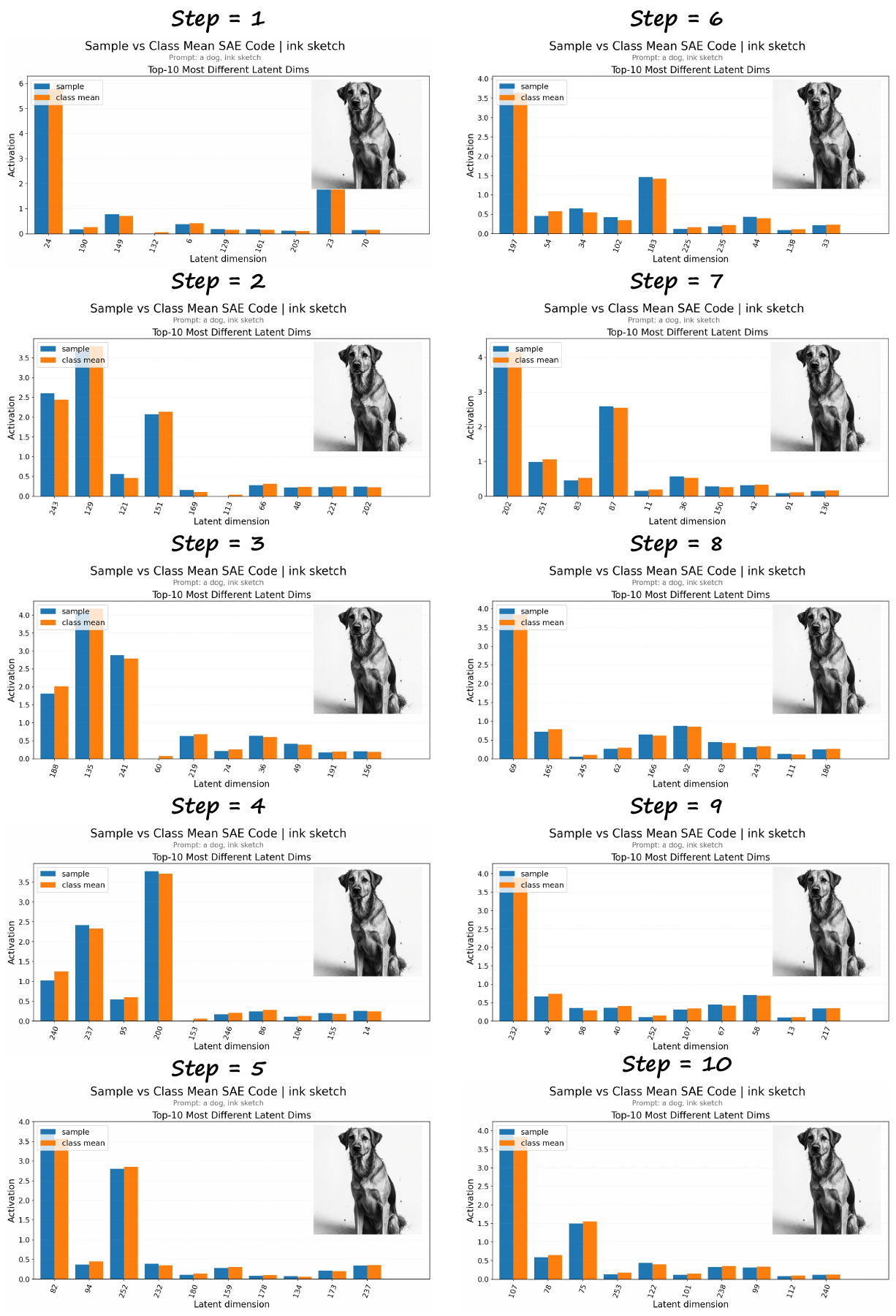
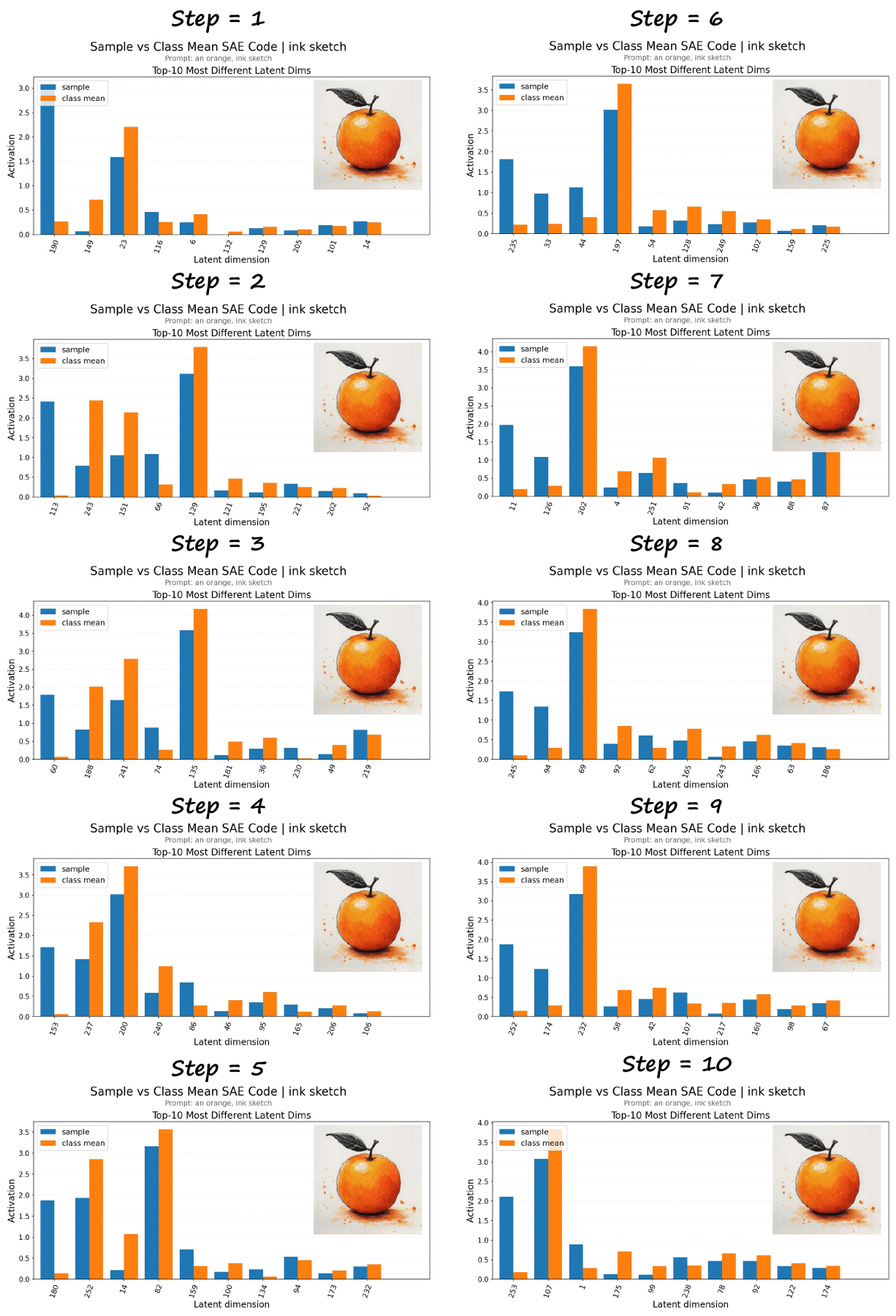
Step-wise SAE diagnosis. The successful dog, ink sketch sample (left) stays close to the class-mean sparse code during the first ten steps, while the failed orange, ink sketch sample (right) shows dominant-dimension mismatches from the earliest steps.
generate.py                    # sampling, feature extraction and prototype-guided correction (all backbones)
train_sae.py                   # one Top-K SAE per denoising step
select_reference_samples.py    # reliable reference selection in SAE space
build_concept_prototypes.py    # class-level concept prototypes
sae/                           # SAE model, dataset and config
src/                           # inference code of each backbone: flux1 · sd3_5 · sdxl · pixart · sd1_5
models/                        # local model weights (not included)
assets/                        # figures
The backbone implementations in src/ are adapted from the official FLUX.1, Stable Diffusion 3.5 and PixArt-α code bases and remain subject to their original licenses.
@inproceedings{yuan2026concept,
  title     = {Interpreting Object-Dependent Concept Brittleness in Text-to-Image Diffusion Models},
  author    = {Yuan, Yifan and Liu, Xiangyu and Shan, Hongming and Han, Yu and Jiang, Yu and Tan, Hao and Zhang, Junping and Shen, Linlin},
  booktitle = {Proceedings of the 34th ACM International Conference on Multimedia (MM '26)},
  year      = {2026},
  doi       = {10.1145/3767308.3835084}
}
 →
 →
 →
 →
 →
 →
 →