mlabonne/llm-course is an open-source project on GitHub, mainly written in several languages. Course to get into Large Language Models (LLMs) with roadmaps and Colab notebooks. It currently holds 82,899 stars and 0 forks with 0 open issues, and was last pushed on an unknown date (repository created unknown).
AI Homed tracks it on the AI Models & LLM Tools board.
 The LLM course is divided into three parts:
1. 🧩 LLM Fundamentals is optional and covers fundamental knowledge about mathematics, Python, and neural networks.
2. 🧑🔬 The LLM Scientist focuses on building the best possible LLMs using the latest techniques.
3. 👷 The LLM Engineer focuses on creating LLM-based applications and deploying them.
[!NOTE]
Based on this course, I co-wrote the LLM Engineer's Handbook, a hands-on book that covers an end-to-end LLM application from design to deployment. The LLM course will always stay free, but you can support my work by purchasing this book.
For a more comprehensive version of this course, check out the DeepWiki.
📝 Notebooks
A list of notebooks and articles I wrote about LLMs.
Toggle section (optional)
Tools
| Notebook | Description | Notebook |
|----------|-------------|----------|
| 🧐 LLM AutoEval | Automatically evaluate your LLMs using RunPod |  |
| 🥱 LazyMergekit | Easily merge models using MergeKit in one click. | |
| 🦎 LazyAxolotl | Fine-tune models in the cloud using Axolotl in one click. | |
| ⚡ AutoQuant | Quantize LLMs in GGUF, GPTQ, EXL2, AWQ, and HQQ formats in one click. | |
| 🌳 Model Family Tree | Visualize the family tree of merged models. | |
| 🚀 ZeroSpace | Automatically create a Gradio chat interface using a free ZeroGPU. | |
| ✂️ AutoAbliteration | Automatically abliteration models with custom datasets. | |
| 🧼 AutoDedup | Automatically deduplicate datasets using the Rensa library. | |
|
| 🥱 LazyMergekit | Easily merge models using MergeKit in one click. | |
| 🦎 LazyAxolotl | Fine-tune models in the cloud using Axolotl in one click. | |
| ⚡ AutoQuant | Quantize LLMs in GGUF, GPTQ, EXL2, AWQ, and HQQ formats in one click. | |
| 🌳 Model Family Tree | Visualize the family tree of merged models. | |
| 🚀 ZeroSpace | Automatically create a Gradio chat interface using a free ZeroGPU. | |
| ✂️ AutoAbliteration | Automatically abliteration models with custom datasets. | |
| 🧼 AutoDedup | Automatically deduplicate datasets using the Rensa library. | |
Fine-tuning
| Notebook | Description | Article | Notebook |
|---------------------------------------|-------------------------------------------------------------------------|---------------------------------------------------------------------------------------------|------------------------------------------------------------------------------------------------------------------------------------------------------|
| Fine-tune Llama 3.1 with Unsloth | Ultra-efficient supervised fine-tuning in Google Colab. | Article | |
| Fine-tune Llama 3 with ORPO | Cheaper and faster fine-tuning in a single stage with ORPO. | Article | |
| Fine-tune Mistral-7b with DPO | Boost the performance of supervised fine-tuned models with DPO. | Article | |
| Fine-tune Mistral-7b with QLoRA | Supervised fine-tune Mistral-7b in a free-tier Google Colab with TRL. | | |
| Fine-tune CodeLlama using Axolotl | End-to-end guide to the state-of-the-art tool for fine-tuning. | Article | |
| Fine-tune Llama 2 with QLoRA | Step-by-step guide to supervised fine-tune Llama 2 in Google Colab. | Article | |
Quantization
| Notebook | Description | Article | Notebook |
|---------------------------------------|-------------------------------------------------------------------------|---------------------------------------------------------------------------------------------|------------------------------------------------------------------------------------------------------------------------------------------------------|
| Introduction to Quantization | Large language model optimization using 8-bit quantization. | Article | |
| 4-bit Quantization using GPTQ | Quantize your own open-source LLMs to run them on consumer hardware. | Article | |
| Quantization with GGUF and llama.cpp | Quantize Llama 2 models with llama.cpp and upload GGUF versions to the HF Hub. | Article | |
| ExLlamaV2: The Fastest Library to Run LLMs | Quantize and run EXL2 models and upload them to the HF Hub. | Article | |
Other
| Notebook | Description | Article | Notebook |
|---------------------------------------|-------------------------------------------------------------------------|---------------------------------------------------------------------------------------------|------------------------------------------------------------------------------------------------------------------------------------------------------|
| Merge LLMs with MergeKit | Create your own models easily, no GPU required! | Article | |
| Create MoEs with MergeKit | Combine multiple experts into a single frankenMoE | Article | |
| Uncensor any LLM with abliteration | Fine-tuning without retraining | Article | |
| Improve ChatGPT with Knowledge Graphs | Augment ChatGPT's answers with knowledge graphs. | Article | |
| Decoding Strategies in Large Language Models | A guide to text generation from beam search to nucleus sampling | Article | |
🧩 LLM Fundamentals
This section introduces essential knowledge about mathematics, Python, and neural networks. You might not want to start here but refer to it as needed.
Toggle section (optional)
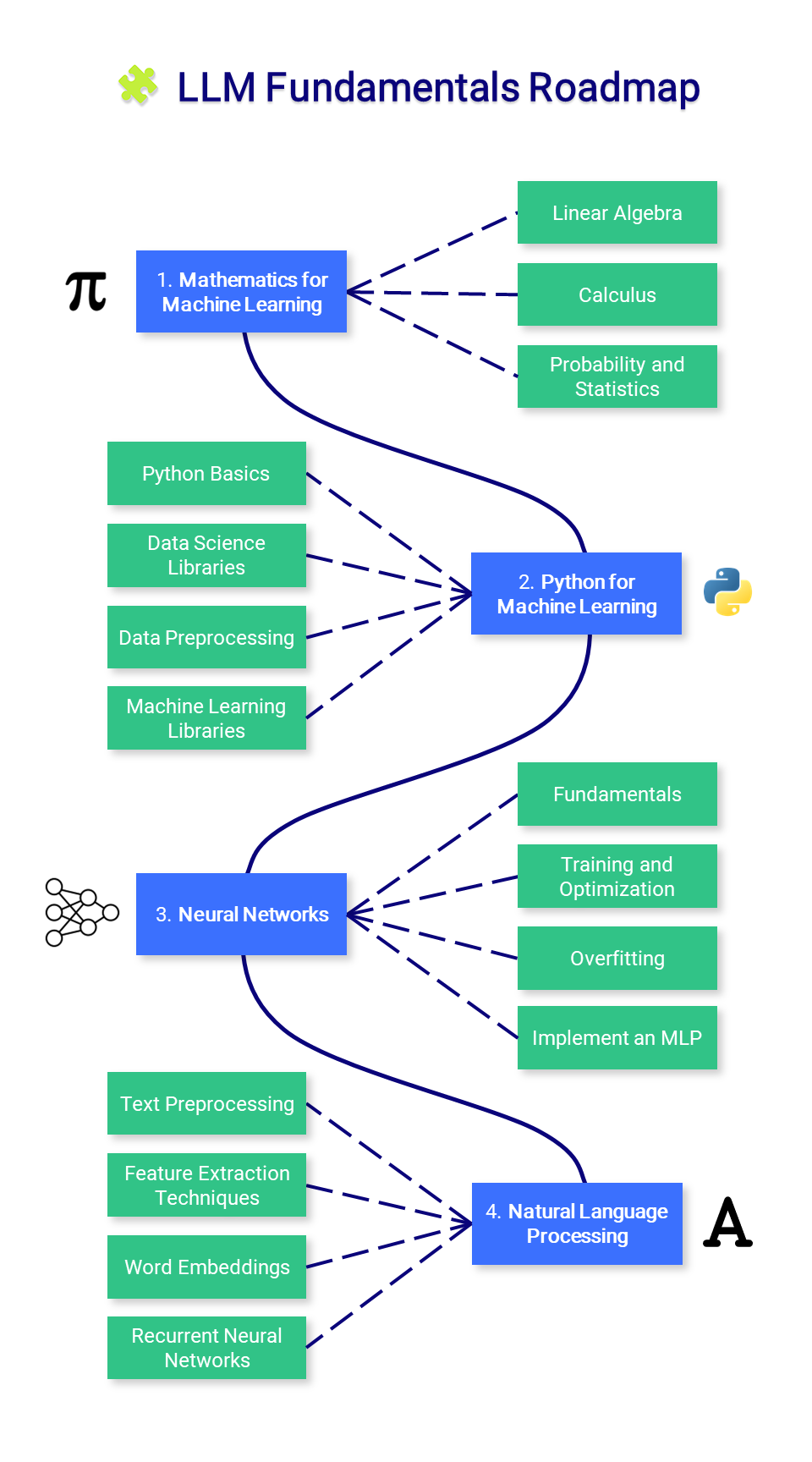
1. Mathematics for Machine Learning
Before mastering machine learning, it is important to understand the fundamental mathematical concepts that power these algorithms.
- Linear Algebra: This is crucial for understanding many algorithms, especially those used in deep learning. Key concepts include vectors, matrices, determinants, eigenvalues and eigenvectors, vector spaces, and linear transformations.
- Calculus: Many machine learning algorithms involve the optimization of continuous functions, which requires an understanding of derivatives, integrals, limits, and series. Multivariable calculus and the concept of gradients are also important.
- Probability and Statistics: These are crucial for understanding how models learn from data and make predictions. Key concepts include probability theory, random variables, probability distributions, expectations, variance, covariance, correlation, hypothesis testing, confidence intervals, maximum likelihood estimation, and Bayesian inference.
📚 Resources:
---
2. Python for Machine Learning
Python is a powerful and flexible programming language that's particularly good for machine learning, thanks to its readability, consistency, and robust ecosystem of data science libraries.
- Python Basics: Python programming requires a good understanding of the basic syntax, data types, error handling, and object-oriented programming.
- Data Science Libraries: It includes familiarity with NumPy for numerical operations, Pandas for data manipulation and analysis, Matplotlib and Seaborn for data visualization.
- Data Preprocessing: This involves feature scaling and normalization, handling missing data, outlier detection, categorical data encoding, and splitting data into training, validation, and test sets.
- Machine Learning Libraries: Proficiency with Scikit-learn, a library providing a wide selection of supervised and unsupervised learning algorithms, is vital. Understanding how to implement algorithms like linear regression, logistic regression, decision trees, random forests, k-nearest neighbors (K-NN), and K-means clustering is important. Dimensionality reduction techniques like PCA and t-SNE are also helpful for visualizing high-dimensional data.
📚 Resources:
---
3. Neural Networks
Neural networks are a fundamental part of many machine learning models, particularly in the realm of deep learning. To utilize them effectively, a comprehensive understanding of their design and mechanics is essential.
- Fundamentals: This includes understanding the structure of a neural network, such as layers, weights, biases, and activation functions (sigmoid, tanh, ReLU, etc.)
- Training and Optimization: Familiarize yourself with backpropagation and different types of loss functions, like Mean Squared Error (MSE) and Cross-Entropy. Understand various optimization algorithms like Gradient Descent, Stochastic Gradient Descent, RMSprop, and Adam.
- Overfitting: Understand the concept of overfitting (where a model performs well on training data but poorly on unseen data) and learn various regularization techniques (dropout, L1/L2 regularization, early stopping, data augmentation) to prevent it.
- Implement a Multilayer Perceptron (MLP): Build an MLP, also known as a fully connected network, using PyTorch.
📚 Resources:
---
4. Natural Language Processing (NLP)
NLP is a fascinating branch of artificial intelligence that bridges the gap between human language and machine understanding. From simple text processing to understanding linguistic nuances, NLP plays a crucial role in many applications like translation, sentiment analysis, chatbots, and much more.
- Text Preprocessing: Learn various text preprocessing steps like tokenization (splitting text into words or sentences), stemming (reducing words to their root form), lemmatization (similar to stemming but considers the context), stop word removal, etc.
- Feature Extraction Techniques: Become familiar with techniques to convert text data into a format that can be understood by machine learning algorithms. Key methods include Bag-of-words (BoW), Term Frequency-Inverse Document Frequency (TF-IDF), and n-grams.
- Word Embeddings: Word embeddings are a type of word representation that allows words with similar meanings to have similar representations. Key methods include Word2Vec, GloVe, and FastText.
- Recurrent Neural Networks (RNNs): Understand the working of RNNs, a type of neural network designed to work with sequence data. Explore LSTMs and GRUs, two RNN variants that are capable of learning long-term dependencies.
📚 Resources:
🧑🔬 The LLM Scientist
This section of the course focuses on learning how to build the best possible LLMs using the latest techniques.
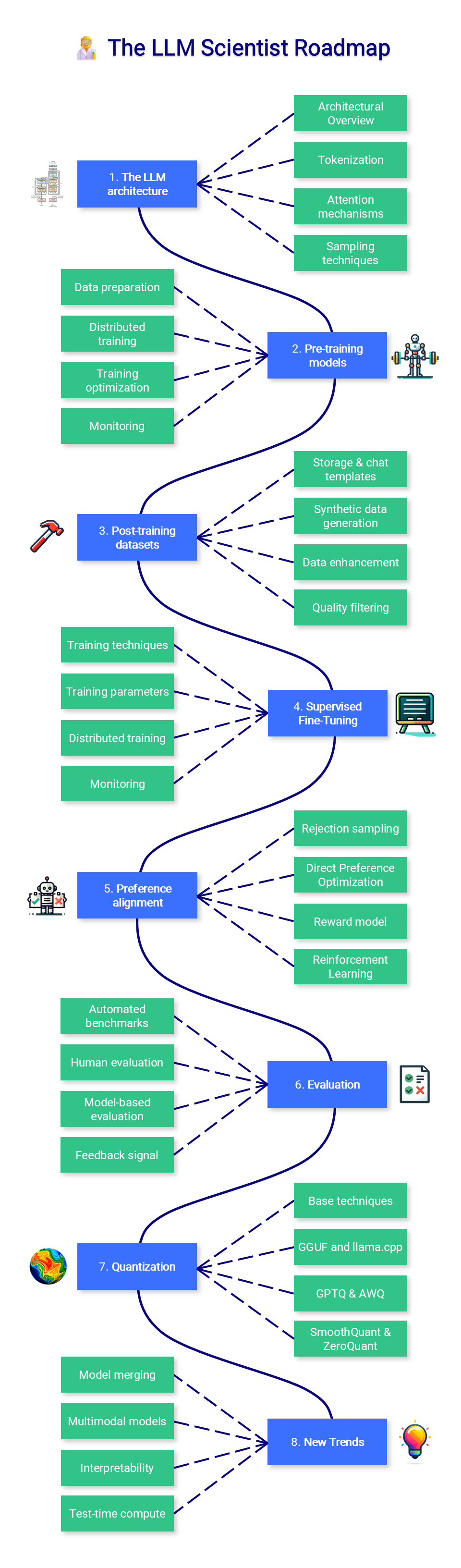
1. The LLM Architecture
An in-depth knowledge of the Transformer architecture is not required, but it's important to understand the main steps of modern LLMs: converting text into numbers through tokenization, processing these tokens through layers including attention mechanisms, and finally generating new text through various sampling strategies.
- Architectural overview: Understand the evolution from encoder-decoder Transformers to decoder-only architectures like GPT, which form the basis of modern LLMs. Focus on how these models process and generate text at a high level.
- Tokenization: Learn the principles of tokenization - how text is converted into numerical representations that LLMs can process. Explore different tokenization strategies and their impact on model performance and output quality.
- Attention mechanisms: Master the core concepts of attention mechanisms, particularly self-attention and its variants. Understand how these mechanisms enable LLMs to process long-range dependencies and maintain context throughout sequences.
- Sampling techniques: Explore various text generation approaches and their tradeoffs. Compare deterministic methods like greedy search and beam search with probabilistic approaches like temperature sampling and nucleus sampling.
📚
References:
- Visual intro to Transformers by 3Blue1Brown: Visual introduction to Transformers for complete beginners.
- LLM Visualization by Brendan Bycroft: Interactive 3D visualization of LLM internals.
- nanoGPT by Andrej Karpathy: A 2h-long YouTube video to reimplement GPT from scratch (for programmers). He also made a video about tokenization.
- Attention? Attention! by Lilian Weng: Historical overview to introduce the need for attention mechanisms.
- Decoding Strategies in LLMs by Maxime Labonne: Provide code and a visual introduction to the different decoding strategies to generate text.
---
2. Pre-Training Models
Pre-training is a computationally intensive and expensive process. While it's not the focus of this course, it's important to have a solid understanding of how models are pre-trained, especially in terms of data and parameters. Pre-training can also be performed by hobbyists at a small scale with <1B models.
- Data preparation: Pre-training requires massive datasets (e.g., Llama 3.1 was trained on 15 trillion tokens) that need careful curation, cleaning, deduplication, and tokenization. Modern pre-training pipelines implement sophisticated filtering to remove low-quality or problematic content.
- Distributed training: Combine different parallelization strategies: data parallel (batch distribution), pipeline parallel (layer distribution), and tensor parallel (operation splitting). These strategies require optimized network communication and memory management across GPU clusters.
- Training optimization: Use adaptive learning rates with warm-up, gradient clipping, and normalization to prevent explosions, mixed-precision training for memory efficiency, and modern optimizers (AdamW, Lion) with tuned hyperparameters.
- Monitoring: Track key metrics (loss, gradients, GPU stats) using dashboards, implement targeted logging for distributed training issues, and set up performance profiling to identify bottlenecks in computation and communication across devices.
📚
References:
- FineWeb by Penedo et al.: Article to recreate a large-scale dataset for LLM pretraining (15T), including FineWeb-Edu, a high-quality subset.
- RedPajama v2 by Weber et al.: Another article and paper about a large-scale pre-training dataset with a lot of interesting quality filters.
- nanotron by Hugging Face: Minimalistic LLM training codebase used to make SmolLM2.
- Parallel training by Chenyan Xiong: Overview of optimization and parallelism techniques.
- Distributed training by Duan et al.: A survey about efficient training of LLM on distributed architectures.
- OLMo 2 by AI2: Open-source language model with model, data, training, and evaluation code.
- LLM360 by LLM360: A framework for open-source LLMs with training and data preparation code, data, metrics, and models.
---
3. Post-Training Datasets
Post-training datasets have a precise structure with instructions and answers (supervised fine-tuning) or instructions and chosen/rejected answers (preference alignment). Conversational structures are a lot rarer than the raw text used for pre-training, which is why we often need to process seed data and refine it to improve the accuracy, diversity, and complexity of the samples. More information and examples are available in my repo 💾 LLM Datasets.
- Storage & chat templates: Because of the conversational structure, post-training datasets are stored in a specific format like ShareGPT or OpenAI/HF. Then, these formats are mapped to a chat template like C
 →
→

 →
→ →
→ →
→ →
→ →
→ →
→ →
→