1
 →
→
Mano-P: Open-source GUI-VLA agent for edge devices. #1 on OSWorld (specialized, 58.2%). Runs locally on Apple M4 Mac mini/MacBook
Mininglamp-AI/Mano-P is an open-source project on GitHub, mainly written in several languages. Mano-P: Open-source GUI-VLA agent for edge devices. #1 on OSWorld (specialized, 58.2%). It currently holds 2,776 stars and 272 forks with 0 open issues, and was last pushed on an unknown date (repository created unknown).
AI Homed tracks it on the Local & On-Device AI board.
 Mano-P 2.0
GUI-Aware Agent Model for Edge Devices
Private AI

中文 | English
📖 Overview | 🎯 Key Highlights | 🎬 Use Cases | 📊 Benchmark | 🔧 Skills | 🤖 Models | ⚡ Inference SDK | ⚗️ Approach | 🌟 Technical Advantages | 🔗 Applications | 📄 Citation | ❓ FAQ
---
---
Mano-P: "Mano" means "hand" in Spanish, and "P" stands for Private. We believe that both individuals and organizations can create their own Private AI, and a bright future of human-machine collaboration is on the horizon.
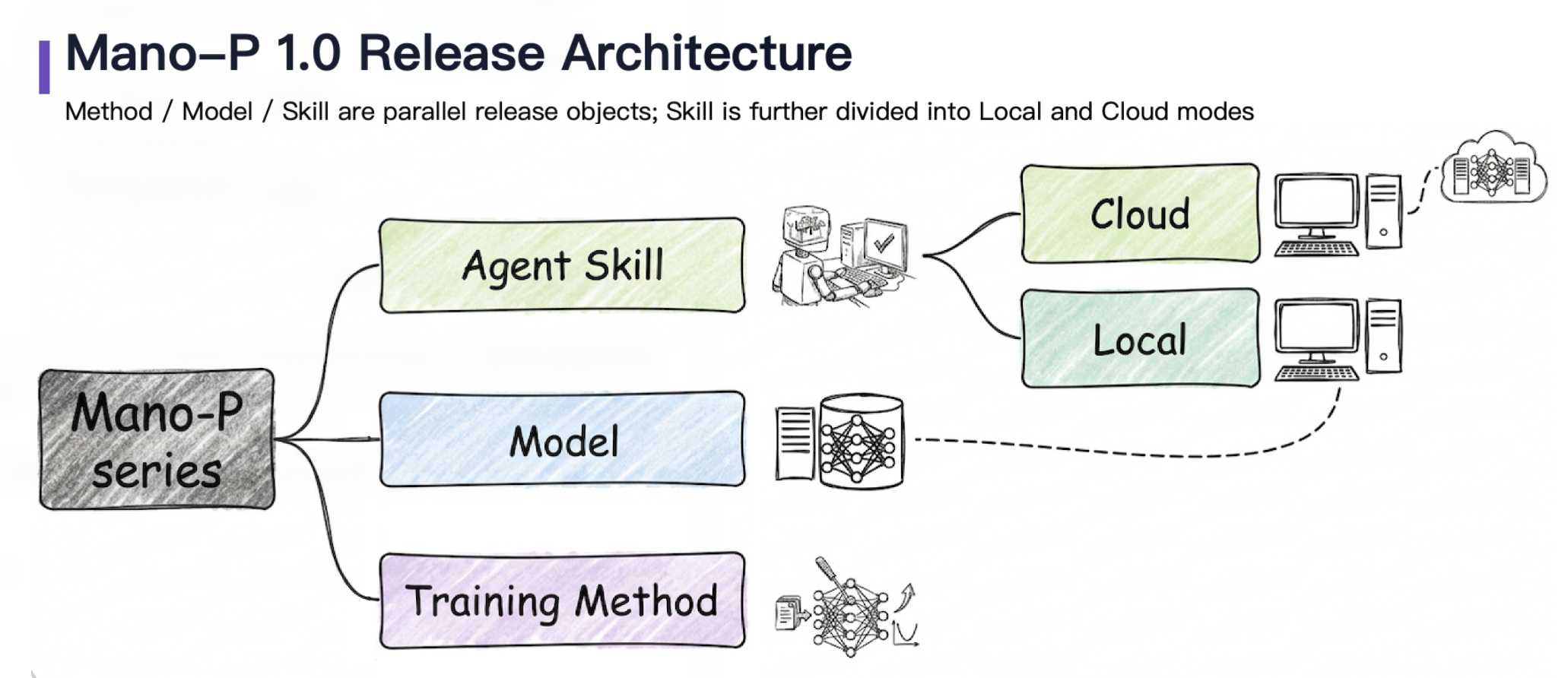
Mano-P is a GUI-VLA agent project designed specifically for edge devices. It serves both as an open-source project and a hardware product solution. As an open-source project, Mano-P is being released in a phased, progressive manner, targeting three distinct groups of developers. In the first phase, we will open-source the Mano-CUA Skills. This phase is aimed at Agent enthusiasts—such as users of OpenClaw or Claude Code—enabling them to leverage the capabilities of Mano-CUA Skills to construct more intelligent CUA task workflows and overcome the bottlenecks associated with human intervention. In the second phase, we will open-source the local-side models and SDK components of Mano-CUA. This phase targets developers with high security requirements, allowing them to directly utilize GUI-VLA models capable of running inference locally on a Mac mini to build their own custom Skills, Tools, and more; crucially, all your CUA operations will be executed entirely on your local Mac mini and will not be uploaded to external servers. In the third phase, we will open-source the training methodologies and the pruning and quantization techniques used for the Mano-P models. This phase is designed for developers with specific model training needs, empowering them to apply our training methods to create their own on-device GUI-VLA models tailored to their unique requirements.
Regarding our GUI-VLA models—which are capable of running inference directly on Mac mini and MacBook devices—we currently support two deployment methods: First, direct deployment on Mac mini or MacBook models equipped with an M4 chip and 32GB or more of RAM; and second, deployment utilizing a compute stick connected via a USB 4.0 port or higher. We will be releasing detailed instructions for both deployment methods in the near future, and we plan to expand our support to include additional deployment options in the future.
Mano-P builds upon the complete technical framework of the Mano project (see Mano Technical Report), employing the Mano-Action bidirectional self-reinforcement learning method, three-stage progressive training (SFT → Offline Reinforcement Learning → Online Reinforcement Learning), "think-act-verify" loop reasoning mechanism, and a closed-loop data circulation system to achieve high-precision GUI understanding and operation capabilities. The edge version is optimized through mixed-precision quantization, visual token pruning, and edge inference adaptation, enabling large-scale parameter models to run efficiently on edge devices like Mac mini/MacBook/computing sticks.
https://github.com/user-attachments/assets/8512ab65-f836-4779-979a-4c636fe61fd2
We demonstrated the fully automated application construction process of Mano-AFK. After receiving natural language requirements, the system sequentially completes requirement clarification, technical architecture design, code generation, local deployment, and multi-level testing (API interface testing, LLM based page visual inspection, and end-to-end GUI automation testing driven by VLA model). When the test fails, the system automatically locates the root cause of the problem, fixes the code, and deploys verification again, iterating until all test cases pass. The entire process does not require manual intervention, and ultimately delivers a runnable application with complete requirement documents and build reports.
https://github.com/user-attachments/assets/04730188-e664-4f92-8ba7-023269880718
We fully demonstrated the actual workflow of a commercial video intelligent system. Starting from the user's command, the system automatically completes the entire process of video generation, uploading, analysis, editing, and secondary evaluation. During the process, the system can autonomously operate web pages and editing software, complete fine operations such as file processing and subtitle modification, and generate analysis reports containing subjective evaluations and objective indicators. By comparing the differences between the initial and refined versions, visually present the overall capabilities and application effects of the system.
https://github.com/user-attachments/assets/992f4961-3028-45c9-a7c2-29a8e5bf93a9
Mano-P, The small-sized end side GUI-VLA model can run directly on your computer, supporting direct inference operation on Macmini/Macbook with M4 chip and above, as well as direct operation on plug and play computing power sticks. In the CUA scenario, break through the bottleneck of human participation in the Agent workflow. Mano-P, The first step in leading Private AI.
https://github.com/user-attachments/assets/ff11fd5b-9ee7-4a74-b8e6-3ad3071d3af8
Mano-P excels not only in enterprise-level business automation but also integrates seamlessly into daily life. This video demonstrates the system's application in Mahjong gameplay: through pure visual understanding of the game interface, it autonomously completes tile recognition, analysis, and decision-making. This case validates Mano-P's general-purpose capabilities beyond work scenarios—from office automation to leisure entertainment, from structured data processing to unstructured game interactions, truly realizing the vision of "Private AI." One model, adapting to every aspect of life and work.
https://github.com/user-attachments/assets/b987f367-5c47-4659-890b-3e8a6e741603
This video demonstrates the combined capability of Mano-AFK and the Cider inference acceleration SDK. Starting from a single natural-language requirement, Mano-AFK autonomously performs requirement clarification, architecture design, code generation, and local deployment. In the E2E testing stage it drives a real browser through the local Mano-P vision model — accelerated by Cider — to run GUI automation tests; on failure, it localizes the defect, patches the code, and re-verifies until a runnable application is delivered. Cider supplies the INT8 activation-quantization primitives that give Mano-P a substantial prefill speedup on Apple Silicon, so the entire build–test–fix loop runs fully on-device, balancing autonomy, privacy, and performance.
---
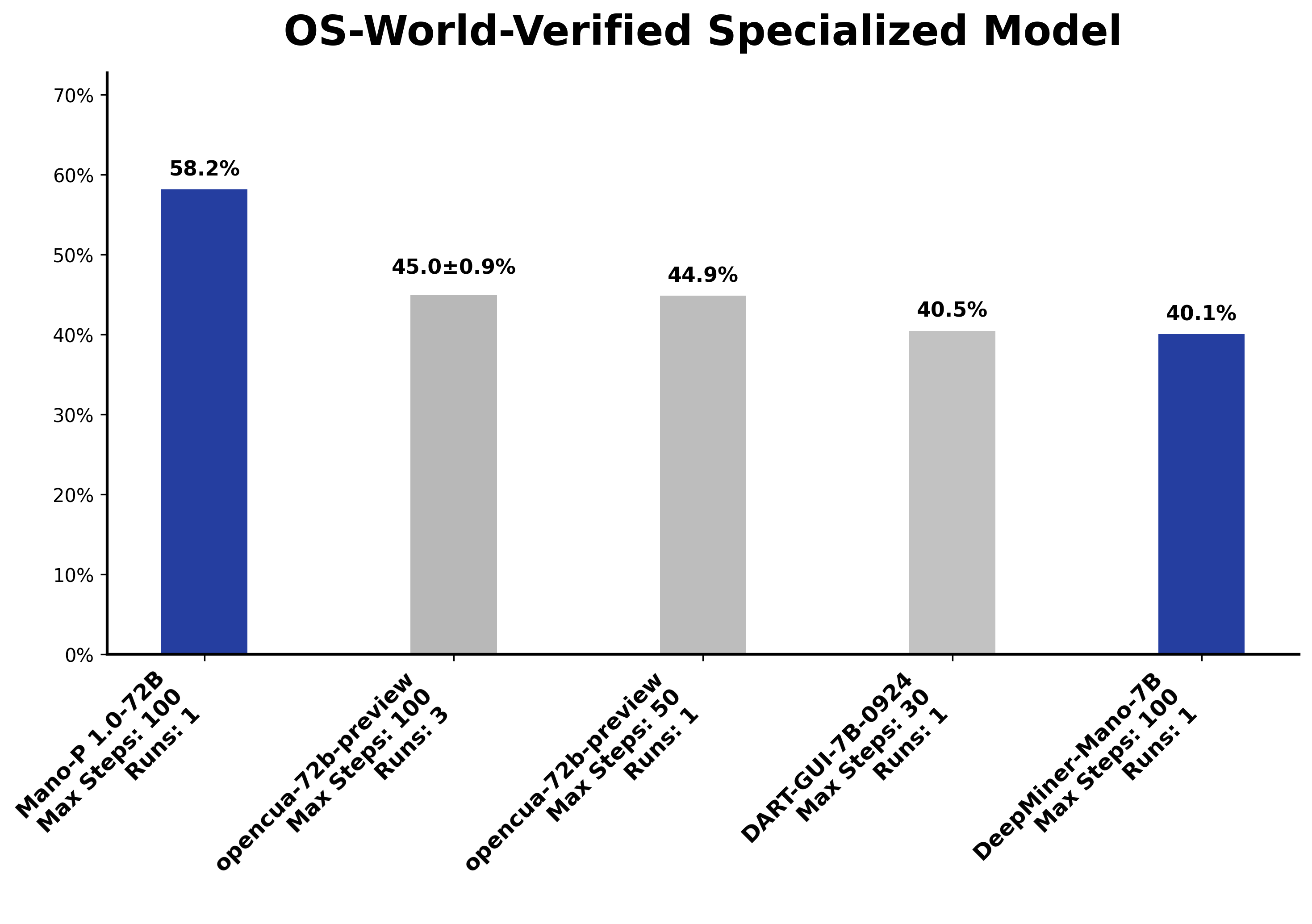
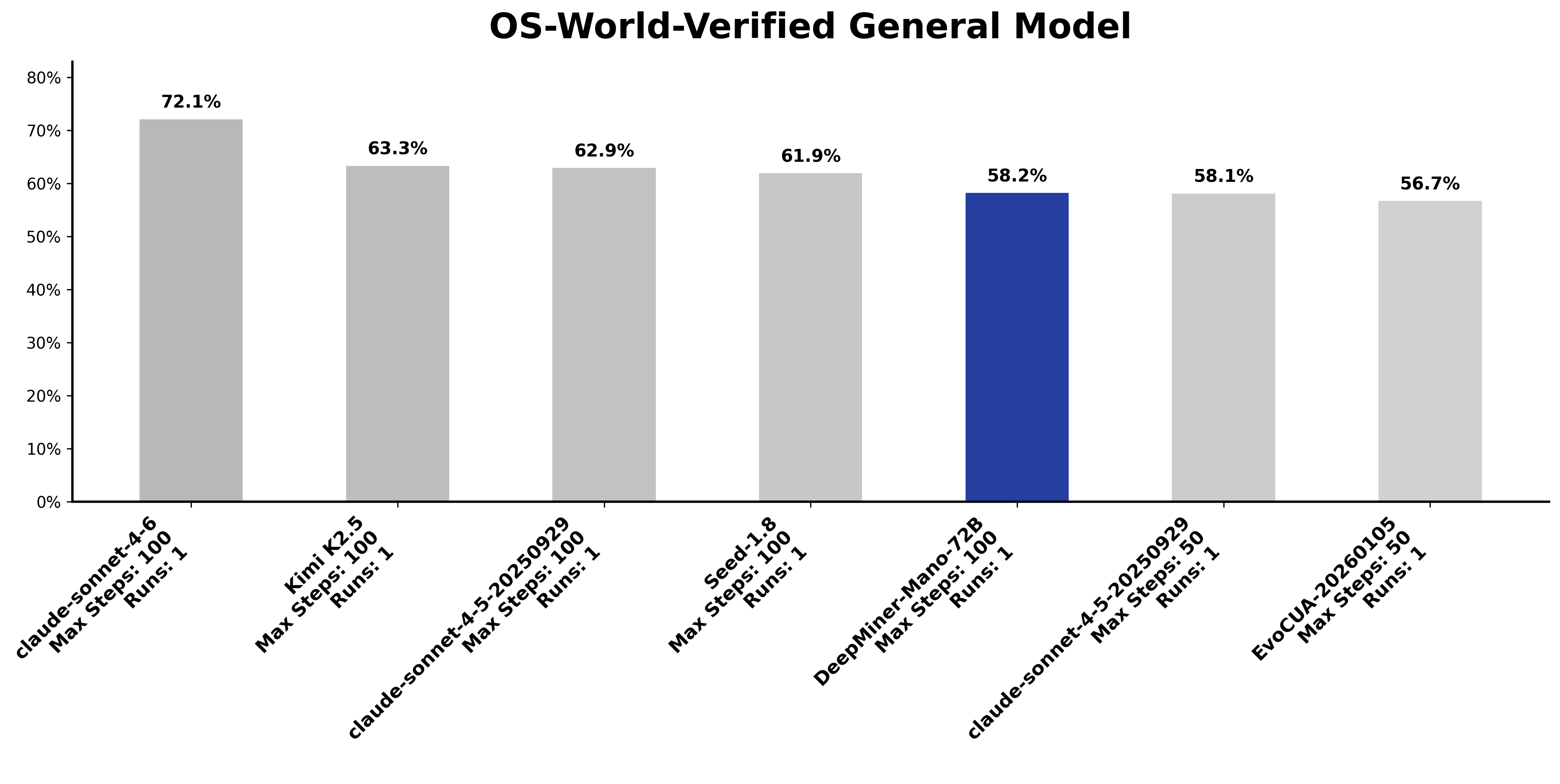
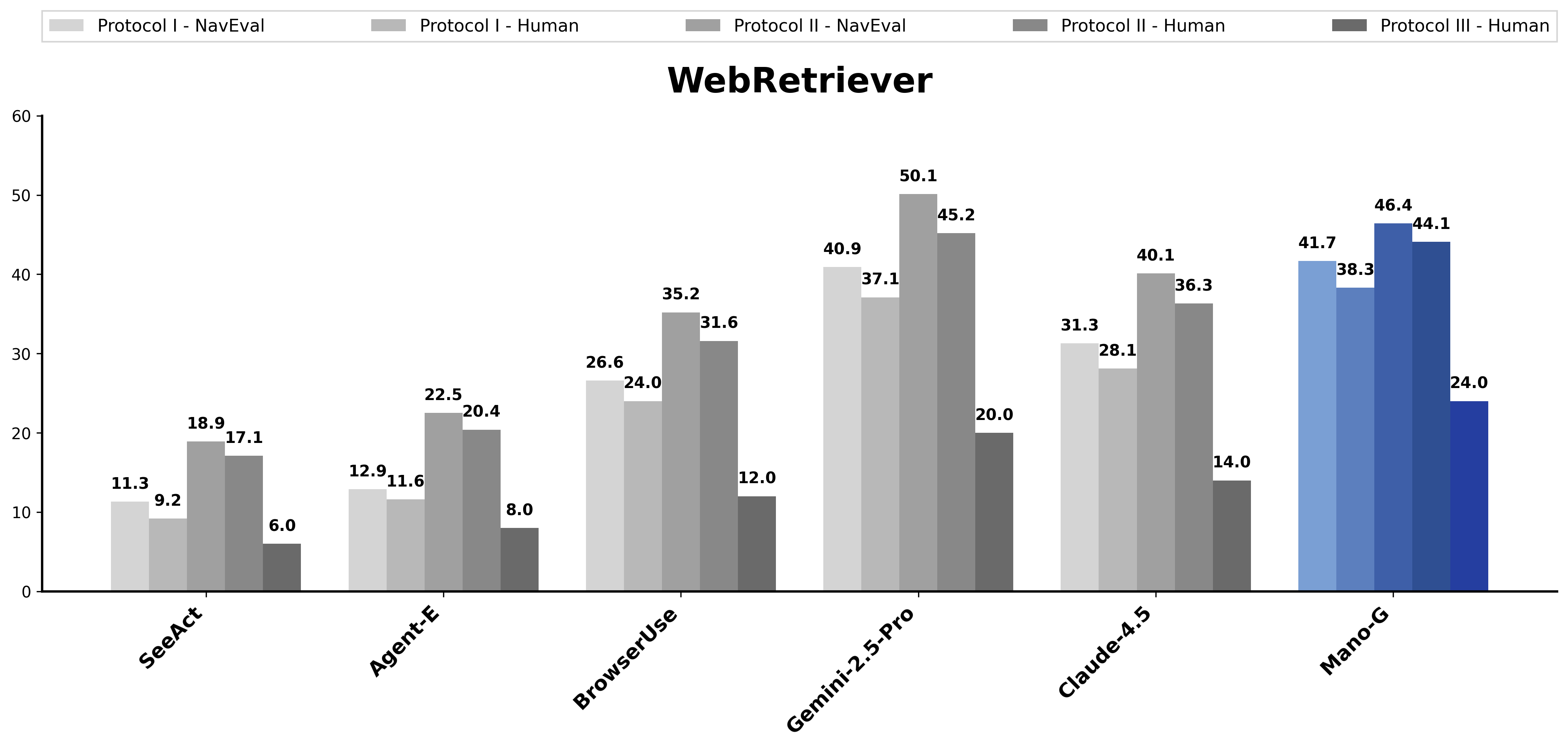
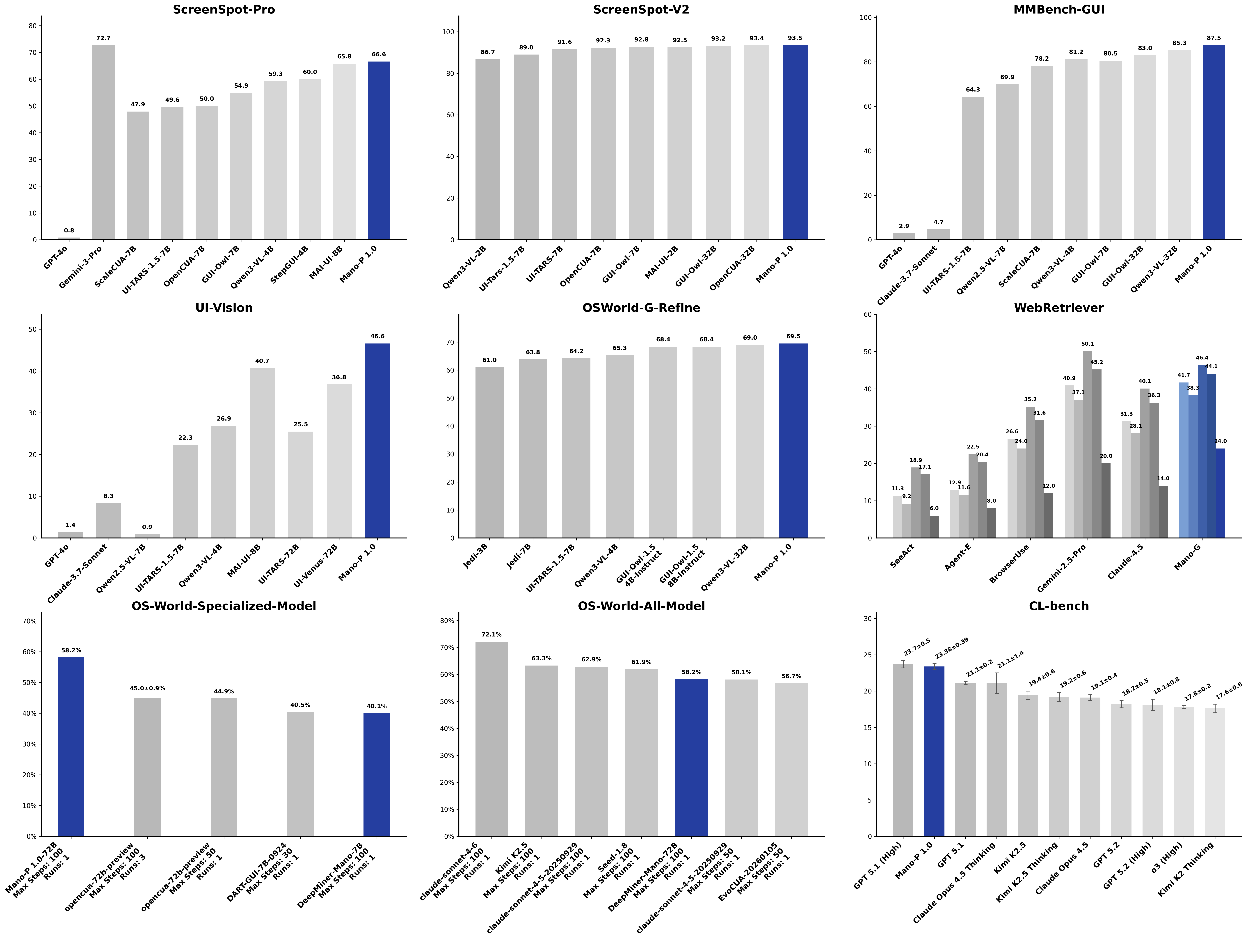
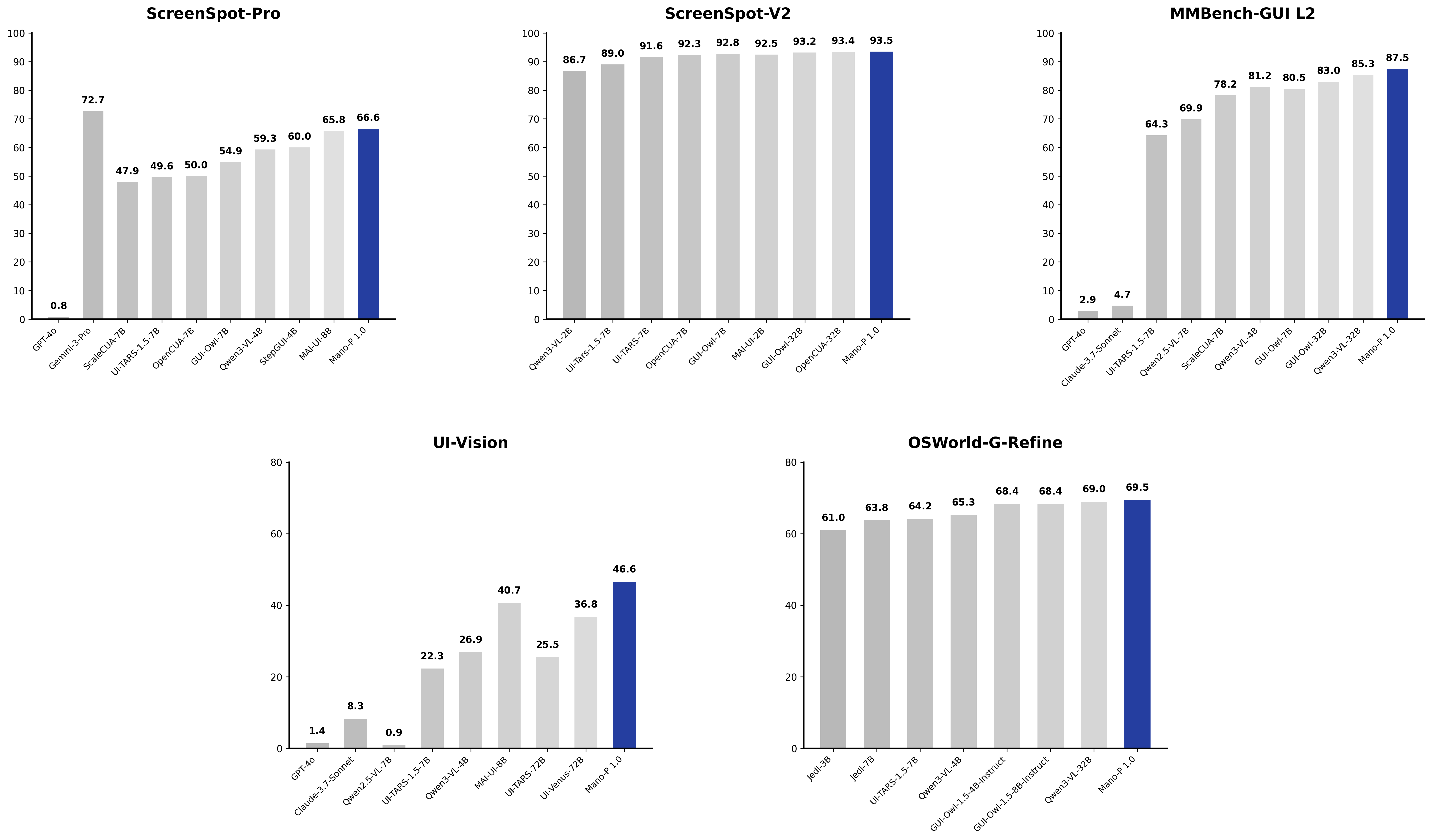
Performance of the Mano series models in multiple benchmarks:
| Models | Protocol | CA | CV | PAR | Saliency | |||||||
|---|---|---|---|---|---|---|---|---|---|---|---|---|
| Acc | F1 | Acc | F1 | Acc | F1 | KL↓ | CC↑ | SIM↑ | NSS↑ | AUC↑ | ||
| Random | P1 | 10.42 | 11.03 | 10.76 | 10.95 | 15.94 | 16.00 | 2.1789 | 0.0452 | 0.2852 | 0.1081 | 0.5340 |
| P2 | 10.01 | 10.74 | 10.32 | 10.50 | 14.39 | 15.04 | 4.3378 | 0.0270 | 0.2274 | 0.0665 | 0.5273 | |
| Zero-shot for MLLMs | ||||||||||||
| GPT4o | P1 | 15.17 | 6.57 | 16.11 | 9.58 | 16.71 | 10.34 | 1.9423 | 0.4660 | 0.4602 | 1.2842 | 0.7848 |
| P2 | 10.26 | 4.77 | 12.16 | 7.66 | 15.00 | 8.55 | 2.2650 | 0.4097 | 0.4028 | 1.2418 | 0.7807 | |
| Gemini 2.0 Flash | P1 | 17.18 | 5.13 | 25.06 | 8.39 | 24.94 | 9.52 | 1.4726 | 0.3380 | 0.3751 | 0.8629 | 0.7296 |
| P2 | 10.45 | 4.26 | 12.60 | 4.95 | 15.96 | 7.90 | 1.6373 | 0.3542 | 0.3490 | 1.0027 | 0.7590 | |
| GPT-5.2 | P1 | 17.83 | 7.67 | 22.22 | 12.55 | 16.17 | 9.74 | 1.3262 | 0.4852 | 0.4632 | 1.3078 | 0.7969 |
| P2 | 15.31 | 5.14 | 19.88 | 10.27 | 13.56 | 7.42 | 1.5444 | 0.4379 | 0.4092 | 1.3006 | 0.7999 | |
| Claude Sonnet 4.5 | P1 | 10.34 | 5.8 | 13.26 | 9.84 | 16.02 | 9.94 | 1.4235 | 0.4912 | 0.4213 | 1.2956 | 0.8042 |
| P2 | 10.34 | 5.55 | 13.27 | 7.08 | 16.02 | 9.6 | 1.2855 | 0.4564 | 0.4781 | 1.3112 | 0.7915 | |
| Llama 4 Scout | P1 | 13.98 | 9.96 | 10.25 | 6.51 | 13.27 | 8.11 | 3.7166 | 0.3331 | 0.3849 | 0.8828 | 0.7238 |
| P2 | 10.00 | 7.33 | 11.10 | 8.49 | 14.35 | 7.42 | 3.7434 | 0.3019 | 0.3452 | 0.8848 | 0.7258 | |
| Qwen2.5-VL-7B | P1 | 15.88 | 5.21 | 10.07 | 6.07 | 12.26 | 4.96 | 12.0586 | 0.0999 | 0.2154 | 0.2578 | 0.5852 |
| P2 | 10.25 | 3.95 | 10.89 | 5.83 | 14.39 | 5.73 | 12.7596 | 0.0762 | 0.1855 | 0.2195 | 0.5753 | |
| InternVL3-8B | P1 | 13.35 | 7.78 | 14.71 | 8.02 | 10.20 | 6.95 | 12.6480 | 0.0572 | 0.1895 | 0.1140 | 0.5769 |
| P2 | 10.58 | 6.70 | 10.94 | 8.12 | 12.68 | 6.32 | 12.1385 | 0.0604 | 0.1819 | 0.1395 | 0.5859 | |
| Fine-tune for MLLMs | ||||||||||||
| Qwen2.5-VL-7B | P1 | 22.51 | 19.11 | 23.39 | 10.83 | 32.06 | 25.88 | 1.5091 | 0.6953 | 0.6118 | 1.8937 | 0.8579 |
| P2 | 13.72 | 13.25 | 13.03 | 10.94 | 21.24 | 20.65 | 2.2496 | 0.5359 | 0.4793 | 1.6439 | 0.8221 | |
| InternVL3-8B | P1 | 20.94 | 18.41 | 21.96 | 11.02 | 30.33 | 24.66 | 1.2551 | 0.7014 | 0.6340 | 1.9896 | 0.8670 |
| P2 | 12.81 | 11.83 | 12.16 | 11.11 | 19.26 | 19.27 | 1.8759 | 0.6282 | 0.5467 | 2.0621 | 0.8627 | |
| Mano-CUA 1.1 | ||||||||||||
| Stage I | P1 | 31.27 | 30.53 | 27.31 | 25.18 | 35.16 | 34.45 | 0.6794 | 0.7670 | 0.7015 | 2.1347 | 0.8710 |
| P2 | 21.89 | 22.06 | 18.27 | 18.57 | 23.77 | 23.87 | 1.5759 | 0.6482 | 0.6167 | 2.1021 | 0.8627 | |
| Stage II | P1 | 32.59 | 31.46 | 27.57 | 25.76 | 37.73 | 35.79 | 0.6736 | 0.7686 | 0.7120 | 2.1688 | 0.8853 |
| P2 | 20.55 | 21.26 | 15.37 | 15.15 | 25.36 | 25.83 | 0.5617 | 0.6440 | 0.6130 | 2.1090 | 0.8602 | |
| Stage III | P1 | 34.58 | 33.99 | 31.92 | 28.37 | 39.42 | 37.63 | 0.6073 | 0.7853 | 0.7248 | 2.2103 | 0.8938 |
| P2 | 25.29 | 25.83 | 20.21 | 19.29 | 26.49 | 26.54 | 1.4617 | 0.6725 | 0.6330 | 2.1788 | 0.8776 |
| Dataset | Method | Saliency | ||||
|---|---|---|---|---|---|---|
| KL↓ | CC↑ | SIM↑ | NSS↑ | AUC↑ | ||
| MIT1003 | FastSal | 1.036 | 0.590 | 0.478 | 2.008 | 0.875 |
| SAM-Resnet | 1.247 | 0.746 | 0.597 | 2.752 | 0.902 | |
| DAV | 0.753 | 0.699 | 0.566 | 2.574 | 0.897 | |
| UNISAL | 1.014 | 0.734 | 0.597 | 2.759 | 0.902 | |
| Transalnet | 0.660 | 0.722 | 0.592 | 2.631 | 0.903 | |
| SUM | 0.563 | 0.768 | 0.630 | 2.839 | 0.913 | |
| Mano-CUA 1.1 | 0.648 | 0.770 | 0.698
GitHub Stars & Activity2,776Stars 272Forks 0Open issues -Language GitHub PopularityGitHub stars2,776 Forks272 Open issues0 Primary language- License- Stars gained today0 Created- Last pushed- Trending HistoryTrending statusnot on today's boards Related AI Projects1 →2  → →3  → →4  → →5  → →6  → →7  → →8  → →More AI Rankings |