1
 →
→
mindscale-noah/MindMemOS is an open-source project on GitHub, mainly written in Python. It currently holds 989 stars and 0 forks with 0 open issues, and was last pushed on an unknown date (repository created unknown).
AI Homed tracks it on the AI Agent Memory board.


简体中文 │ Website │ API Docs │ PYPI SDK │ Deployment Guide
Accurately remember user and task context and reuse it across agents; evolve memory through ongoing interactions, automatically distill Skills, and connect with file-based knowledge systems so experience truly becomes capability.
⭐ Star us on GitHub to automatically upgrade to a Pro quota membership.
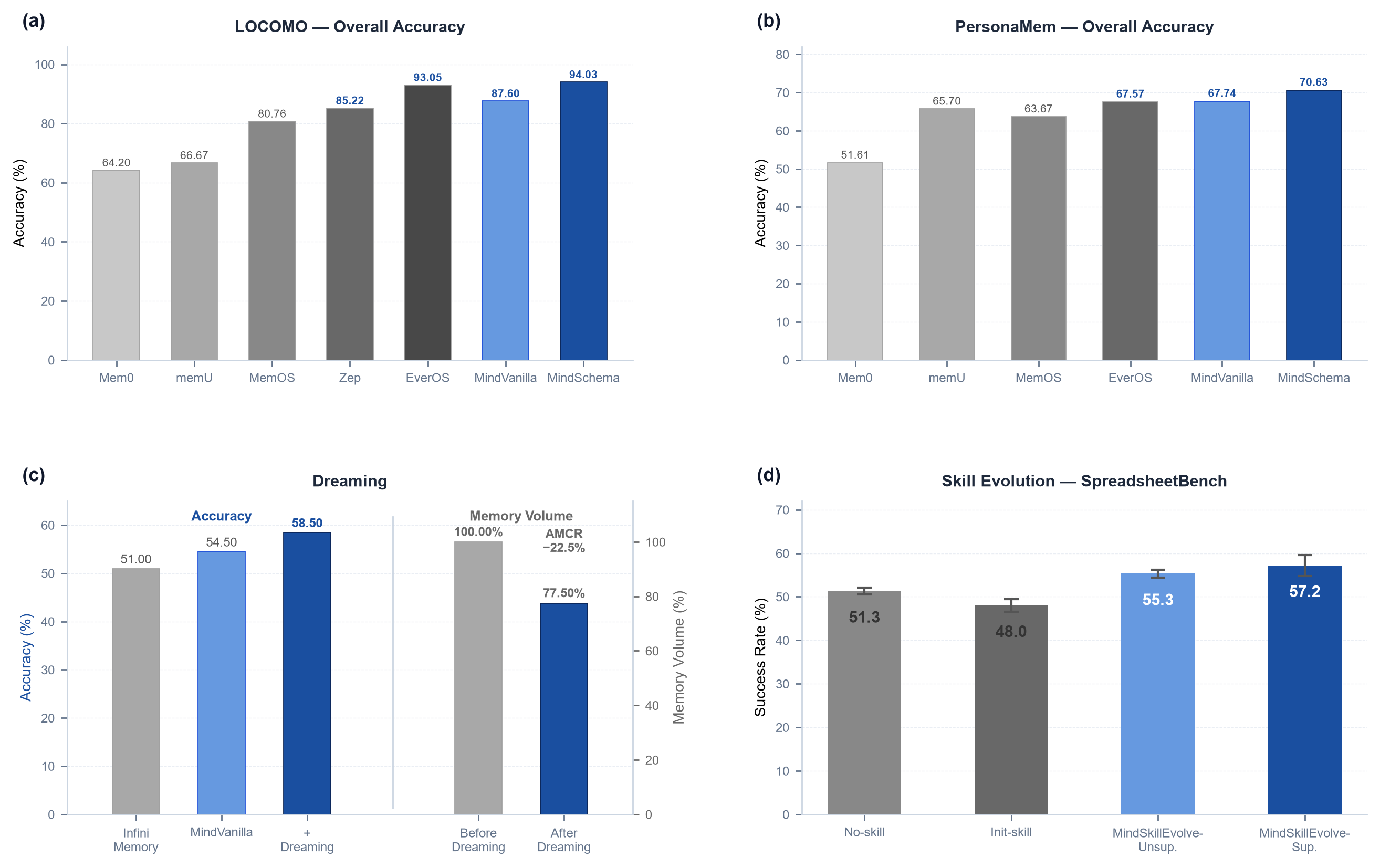
MindMemOS offers two deployment modes (official cloud service, local self-hosting) and three access methods (HTTP API, Python SDK / CLI, agent plugin). Any combination works — server and client speak the same protocol:
| Access Method | Use Case | Cloud base_url | Local base_url |
| :--- | :--- | :--- | :--- |
| HTTP API | Call directly from business apps | https://mindmemos.cn | http://127.0.0.1:8000 |
| Python SDK / CLI | Integrate into business apps | https://mindmemos.cn | http://127.0.0.1:8000 |
| OpenClaw Plugin | Agent auto-recalls / writes memory | https://mindmemos.cn | http://127.0.0.1:8000 |
| DeepSeek Harness Plugin | Agent auto-recalls / writes memory (dsh) | https://mindmemos.cn | http://127.0.0.1:8000 |
To try it without deploying, use the official cloud service (request an API key on the website); for on-premises or offline use, start with Local Deployment below.
MindMemOS uses uv to manage dependencies and run local commands. For detailed configuration instructions, see docs/deploy/instruction.md.
cp .env.example .env
cp config/mindmemos/dev.example.yaml config/mindmemos/dev.yaml
Before startup, configure at least the following three model routers in config/mindmemos/dev.yaml:
chat_model_router: supports memory extraction, Skill evolution, and other generation tasks.embed_model_router: generates semantic embeddings; make sure its dimensions match the Qdrant dimension configuration.rerank_model_router: optional; reranks memory retrieval results.algo_config.add.schema.version defaults to v2 (rule-based graph fusion) and can be pinned to v1 (develop-compatible flow) per project. Storage is compatible in both directions; see the deployment guide for binding and effective timing.
Configure an API key and its bound project_id in config/mindmemos/api_keys.yaml.
Start the local service:
make dev
make dev starts the full Docker dependency stack before starting FastAPI.
To start only core dependencies:
make dev-core          # Qdrant + Neo4j + Kafka
make db-observability  # Qdrant + Neo4j + Kafka + ClickHouse + OTel + Grafana
The default local service port is 8000:
FastAPI: http://127.0.0.1:8000
Stop the local service:
make dev-down
Cloud and local self-hosting use the same access protocol. Local keys come from config/mindmemos/api_keys.yaml; cloud keys are obtained from the website.
HTTP is the base access method — the SDK and plugins also talk HTTP underneath. Once the service is up, first use curl to verify the endpoints work, then wire up your business logic. Define the address and key before calling (pick local or cloud):
export BASE_URL=http://127.0.0.1:8000   # Local self-host; change to https://mindmemos.cn for cloud
export API_KEY=dev-api-key-001          # Local example key; use a website-issued key for cloud
Add a memory:
curl -sS -X POST "$BASE_URL/v1/memory/add" \
  -H "Authorization: Bearer $API_KEY" \
  -H "Content-Type: application/json" \
  -d '{
    "user_id": "u_123",
    "messages": [{"role": "user", "content": "I like iced Americanos."}]
  }'
Search memories:
curl -sS -X POST "$BASE_URL/v1/memory/search" \
  -H "Authorization: Bearer $API_KEY" \
  -H "Content-Type: application/json" \
  -d '{"query": "What kind of coffee does the user like?", "top_k": 3}'
A code of ok with readable memory content means the access works. curl is just a smoke-test helper; the shown format is for bash. Other environments / languages and the remaining endpoints (get / list / delete / update / feedback / dreaming / skills, etc.) are all covered in the API docs.
Install the Python SDK:
pip install mindmemos-sdk
Run the authentication command and configure the service address, API key, and default user when prompted:
mindmemos auth
| Setting | Local Service | Cloud Service |
| :--- | :--- | :--- |
| base_url | http://127.0.0.1:8000 | https://mindmemos.cn |
| api_key | An enabled API key from config/mindmemos/api_keys.yaml | An API key obtained from the MindMemOS website |
| user_id | A stable identifier for the current end user, such as u_123 | A stable identifier for the current end user, such as u_123 |
The configuration is saved to ~/.mindmemos/settings.json. Check the current configuration with:
mindmemos config show
The local service automatically determines the project_id and memory algorithm from the API key, so SDK calls do not need to pass project_id. The user_id distinguishes users within the same project and can be overridden in an individual add or search call.
If you prefer not to use the local configuration file, pass connection parameters explicitly when creating the client:
from mindmemos_sdk import MindMemOSClient
with MindMemOSClient(
    base_url="http://127.0.0.1:8000",
    api_key="<api_key>",
    user_id="u_123",
) as client:
    ...
Explicit parameters take precedence over values in ~/.mindmemos/settings.json.
After completing the configuration above, MindMemOSClient() automatically reads the service address, API key, and default user_id. The SDK adds the authentication header automatically, so there is no need to construct HTTP requests manually:
from mindmemos_sdk import DialogueMessage, MindMemOSClient
with MindMemOSClient() as client:
    add_result = client.memory.add(
        messages=[
            DialogueMessage(
                role="user",
                content="I like iced Americanos.",
            )
        ],
        mode="sync",
    )
for item in add_result.memories:
        print(item.operation, item.memory_id, item.content)
search_result = client.memory.search(
        "What kind of coffee does the user like?",
        top_k=5,
        search_strategy="fast",
        # token_budget=2000,  # optional: strict token budget (enables retention)
    )
for memory in search_result.memories:
        print(memory.id, memory.memory)
Trigger cloud evolution for a registered Skill:
from mindmemos_sdk import MindMemOSClient
with MindMemOSClient() as client:
    result = client.skills.evolve("my-skill", mode="sync")
print("evolved:", result.evolved)
    print("pending:", result.pending_count)
    print("threshold:", result.threshold)
    print("new versions:", result.new_version_ids)
Local and cloud services use the same SDK call pattern. To switch between them, reconfigure only the base_url and corresponding API key.
After running mindmemos auth, you can also add and search memories directly with the CLI included in the SDK:
mindmemos memory add --content "I like iced Americanos"
mindmemos memory search "coffee preferences" --top-k 5
The memory subcommand also supports get / update / delete / feedback / dreaming, and the skill subcommand supports register / list / evolve / push / pull / history and more. For the full command list, parameter reference, and troubleshooting, see the CLI Guide.
Installing via our mindmemos-cli skill is recommended: deploy skills/mindmemos-cli/ to your agent's skills directory and let the agent follow its instructions. The skill's reference docs cover installation, permissions, and common troubleshooting.
First install the SDK and complete auth configuration (required): the plugin communicates with the local machine through the mindmemos CLI, so you must install the Python SDK first and make sure the mindmemos command is available:
pip install mindmemos-sdk    # or: uv add mindmemos-sdk
mindmemos --version          # confirm the command is available
Then configure base_url, API key, and user_id with mindmemos auth (pointing at either the cloud or a local service):
mindmemos auth
mindmemos config show        # confirm the configuration took effect
Skipping these two steps before installing the plugin causes the logs to error out (mindmemos command not found / auth not configured), and the plugin will not be able to read or write memories properly.
Install and enable the plugin:
openclaw plugins install @mindmemos/openclaw-plugin
openclaw plugins enable mindmemos-memory
(@mindmemos/openclaw-plugin is the npm package name; mindmemos-memory is the plugin id.) Manual installation easily runs into two pitfalls:
agent_end write hook needs allowConversationAccess; otherwise everything looks fine, but memories are never actually stored after a turn: openclaw config set plugins.entries.mindmemos-memory.hooks.allowConversationAccess true
openclaw gateway restart
cli PATH: an OpenClaw process launched from the GUI does not inherit your terminal PATH. Configure mindmemos as an absolute path or wrap it with uv run mindmemos, or the logs will report ENOENT.Full commands, configuration options, and troubleshooting are in the OpenClaw plugin integration docs.
Installing via our mindmemos-cli skill is recommended: deploy skills/mindmemos-cli/ to your agent's skills directory and let the agent follow its instructions. The skill's reference docs cover installation and common troubleshooting.
First install the SDK and complete auth configuration (required): the plugin communicates with the local machine through the mindmemos CLI, so you must install the Python SDK first and make sure the mindmemos command is available:
pip install mindmemos-sdk    # or: uv add mindmemos-sdk
mindmemos --version          # confirm the command is available
Then configure base_url, API key, and user_id with mindmemos auth (pointing at either the cloud or a local service):
mindmemos auth
mindmemos config show        # confirm the configuration took effect
Skipping these two steps before installing the plugin causes the logs to error out (mindmemos command not found / auth not configured), and the plugin will not be able to read or write memories properly.
Install the plugin into a dsh profile (dsh plugin forwards to pnpm and installs the package into the profile's node_modules):
dsh plugin --profile add @mindmemos/deepseek-harness-plugin
(@mindmemos/deepseek-harness-plugin is the npm package name; mindmemos-memory is the plugin id.) dsh composes plugins through layered cordis.patch.yml files, so register the plugin by adding an insert entry to the profile patch (~/.dsh/profiles//cordis.patch.yml):
- insert:
- id: mindmemos-memory
name: '@mindmemos/deepseek-harness-plugin'
config:
userId: alice
appId: deepseek-harness
Restart dsh with that profile. Once registered, the plugin recalls and injects relevant memories before each user turn and writes the conversation back automatically when the turn ends.
Full commands, configuration options, and troubleshooting are in the DeepSeek Harness plugin integration docs.
Contributions of all kinds are welcome. Please open pull requests against the develop branch. After review,
accepted changes will be merged into develop; maintainers periodically merge stable develop updates into main
for release.
Join the MindMemOS Feishu group for project updates, usage discussions, and community participation.
If you find MindMemOS useful in your research, please cite our technical report:
@misc{liang2026mindmemos,
  title        = {MindMemOS: A Portable and Self-Evolving Memory Operating Layer for AI Agents},
  author       = {Liang, Kaichao and Cui, Yuqi and Kong, Hao and Huang, Xinyuan and Hou, Guohaotian and Kang, Qingcan and Chen, Liang and Yin, Yiyang and Ye, Ke and Guo, Jiaquan and Chen, Da and Zeng, Lingan and Peng, Yixing and Yao, Rong and Kai, Shixiong and Yuan, Mingxuan},
  year         = {2026},
  eprint       = {2608.12428},
  archivePrefix= {arXiv},
  primaryClass = {cs.AI},
  url          = {https://arxiv.org/abs/2608.12428},
}
This project is open source under the MIT License.
→ →
→ →
→ →
→ →
→ →
→ →
→ →
→