1
 →
→
Local-first healthcare AI: clinical NER & HIPAA PII de-identification that runs 100% on-device. 2,200+ medical models, 21 languages, Apple MLX + Python, no cloud
maziyarpanahi/openmed is an open-source project on GitHub, mainly written in Python. Local-first healthcare AI: clinical NER & HIPAA PII de-identification that runs 100% on-device. It currently holds 5,346 stars and 680 forks with 0 open issues, and was last pushed on an unknown date (repository created unknown).
AI Homed tracks it on the Local & On-Device AI board.

Turn clinical text into structured, de-identified insight on hardware you control.
OpenMed's core local runtime performs extraction and de-identification after required model artifacts are available. Model downloads, remote-provider adapters, telemetry-enabled paths, and user-configured integrations may use a network; review each model and dataset's terms.
PyPI package · Python 3.10+ · Model catalog · Research paper · Apache-2.0 SDK source
OpenMedKit · Apple Silicon / MLX · Android / ONNX Runtime Mobile · Browser / Transformers.js · Documentation
2,266 manifest entries · 35 model-backed PII languages · Apache-2.0 SDK
English · 简体中文 · Español · Français · Deutsch · Italiano · Português · Nederlands · العربية · हिन्दी · తెలుగు · 日本語 · Türkçe · فارسی · Kiswahili
---
This iPhone example uses OpenMed's local runtime after the required model artifacts are available:
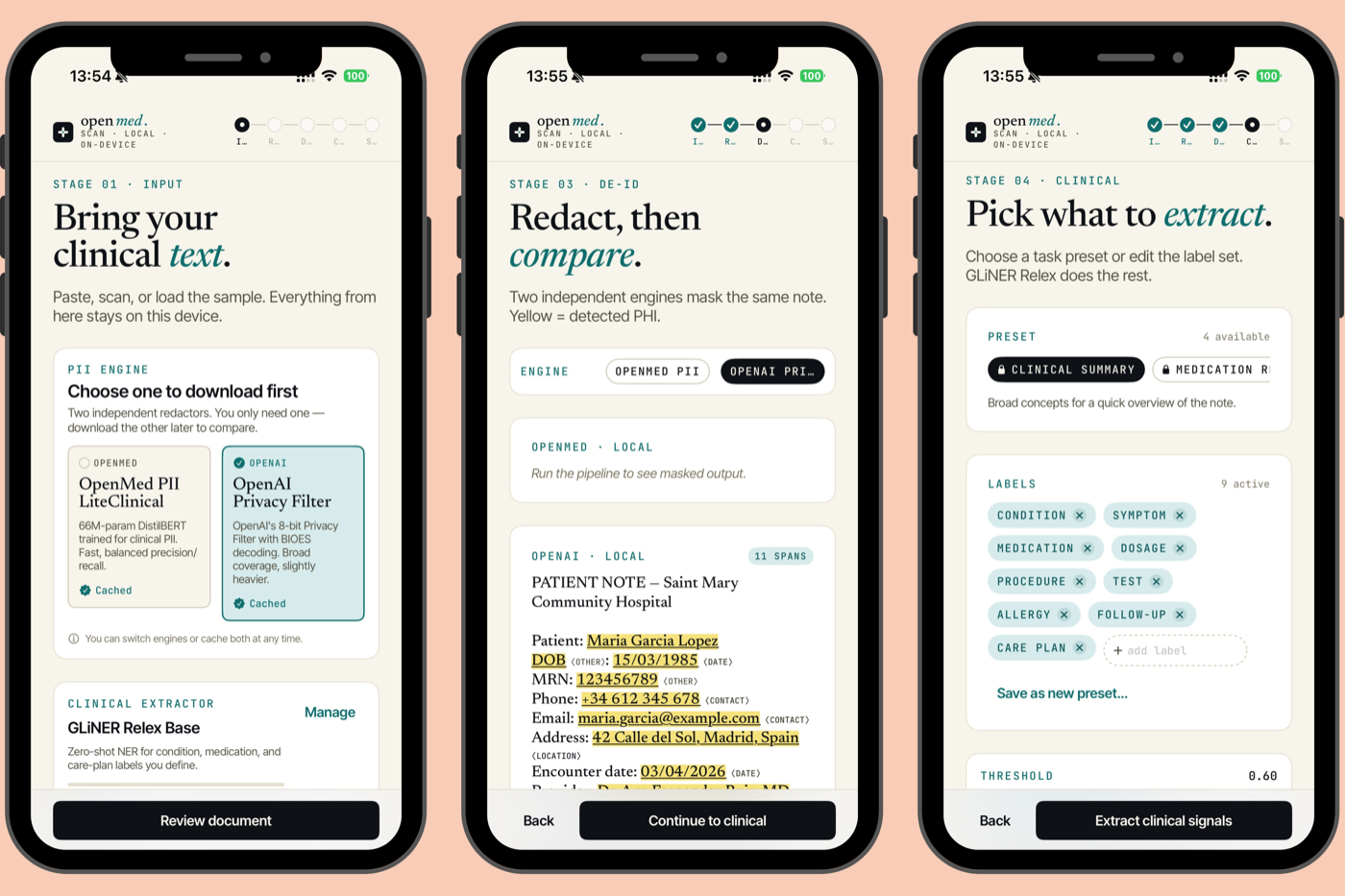
---
from openmed import analyze_text
result = analyze_text(
    "Patient started on imatinib for chronic myeloid leukemia.",
    model_name="disease_detection_superclinical",
)
for entity in result.entities:
    print(f"{entity.label:<12} {entity.text:<28} {entity.confidence:.2f}")
DISEASE      chronic myeloid leukemia     0.98
DRUG         imatinib                     0.95
A clinical NER model using the local runtime after its required artifacts are available.
---
Start with the consumer agent-usage guide, or load the curated llms.txt documentation index. For callable local interfaces, use the MCP server, the typed tool registry, or the command-line interface. Ready-made cross-tool procedures live in the repository skills catalog.
---
| Deployment consideration | OpenMed SDK boundary | | --- | --- | | Core runtime | Processes locally after required artifacts are available | | Optional network paths | Downloads, remote adapters, telemetry-enabled paths, and user integrations may use a network | | Validation | Deployment owners validate model and dataset terms, privacy behavior, and clinical fitness | | Interfaces | Python, Swift, Android, browser, and service surfaces where supported |
On supported Apple hardware, OpenMed can use MLX and OpenMedKit for local processing after required artifacts are available. Model acquisition and any user-configured remote integrations remain separate network boundaries.
// Add OpenMedKit to your app
dependencies: [
    .package(url: "https://github.com/maziyarpanahi/openmed.git", from: "2.5.0"),
]
Expected result: Swift Package Manager resolves OpenMedKit and makes
import OpenMedKit available to your app target.
pip install --upgrade "openmed[mlx]".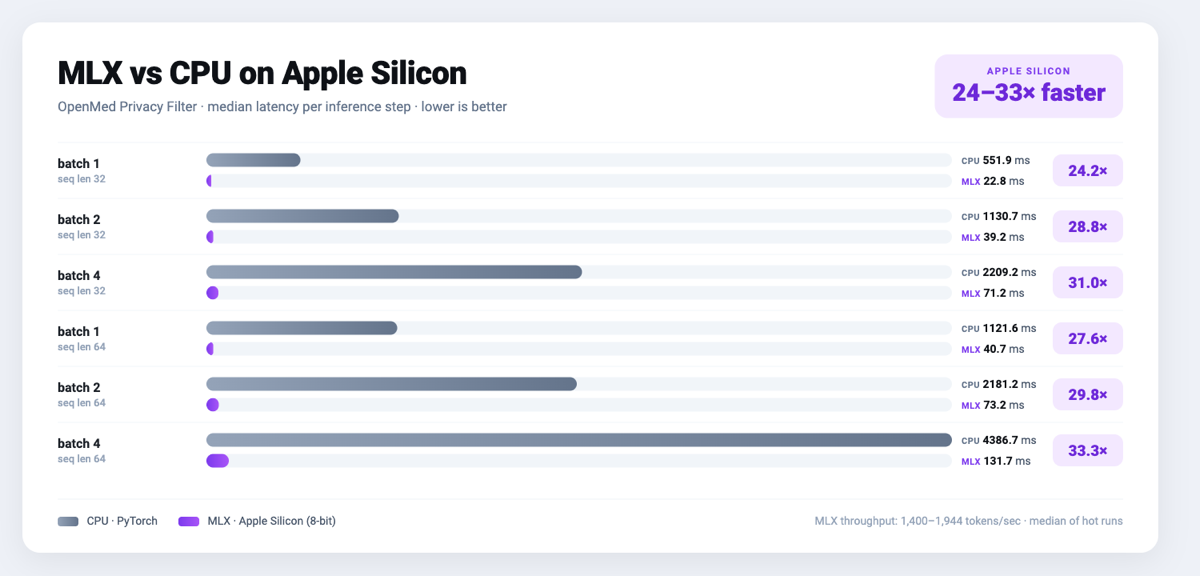
---
OpenMedKit also ships as a native Android/Kotlin library for local document
intake, OCR handoff, PII redaction, and token-classification inference through
ONNX Runtime Mobile. Mobile model repositories include stable tensor names,
dynamic sequence axes, tokenizer files, labels, and Android-ready fp32, fp16,
INT8, and optional .ort outputs.
Add the scoped JitPack repository in settings.gradle.kts:
dependencyResolutionManagement {
    repositories {
        google()
        mavenCentral()
        maven {
            url = uri("https://jitpack.io")
            content { includeGroup("com.github.maziyarpanahi") }
        }
    }
}
Then use the immutable OpenMed v2.5.0 release:
dependencies {
    implementation("com.github.maziyarpanahi:openmed:v2.5.0")
}
See the Android installation guide for local builds and publishing details.
val model = OpenMedKit.fromDirectory(modelDir)
val entities = model.analyzeText("Patient Alice Nguyen was seen in cardiology.")
model.onnx, model_fp16.onnx,model_int8.onnx, tokenizer assets, labels, and openmed-onnx.json.
Guides: Android ONNX export · Android span parity · OpenMedKit Android
from openmed import OnnxModel
model = OnnxModel.from_pretrained(
    "OpenMed/OpenMed-PII-ClinicalE5-Small-33M-v1-onnx-android"
)
entities = model("Patient Alice Nguyen was seen in cardiology.")
npm install openmed @huggingface/transformers
import { loadOnnxModel } from "openmed";
const model = await loadOnnxModel(
  "OpenMed/OpenMed-PII-ClinicalE5-Small-33M-v1-onnx-android",
);
const entities = await model("Patient Alice Nguyen was seen in cardiology.");
---
flowchart LR
    A["Clinical text"] --> B["OpenMed
(local-first)"]
    B --> C["Medical entities"]
    B --> D["PII detected"]
    B --> E["De-identified text"]
    style B fill:#0D6E6E,stroke:#0A5656,stroke-width:2px,color:#ffffff
    style C fill:#D6EBEB,stroke:#0D6E6E,color:#0E1116
    style D fill:#F7DCD8,stroke:#C5453A,color:#0E1116
    style E fill:#F5E27A,stroke:#A9A088,color:#0E1116
Rendered result: a local clinical-text pipeline that returns medical entities, PII findings, and de-identified text without sending data to a cloud API.
---
The skills/ catalog ships portable Agent Skills for on-device de-identification, clinical NER, FHIR export, evaluation, and the healthcare workflows around them. The same SKILL.md folders work in Claude Code, OpenAI Codex, OpenCode, and compatible agents; the installer uses each client's skills directory plus the cross-client ~/.agents/skills convention.
git clone https://github.com/maziyarpanahi/openmed && cd openmed
./install-skills.sh          # installs for Claude Code, Codex, OpenCode, and ~/.agents/skills
Then ask your agent for the pipeline using synthetic placeholders:
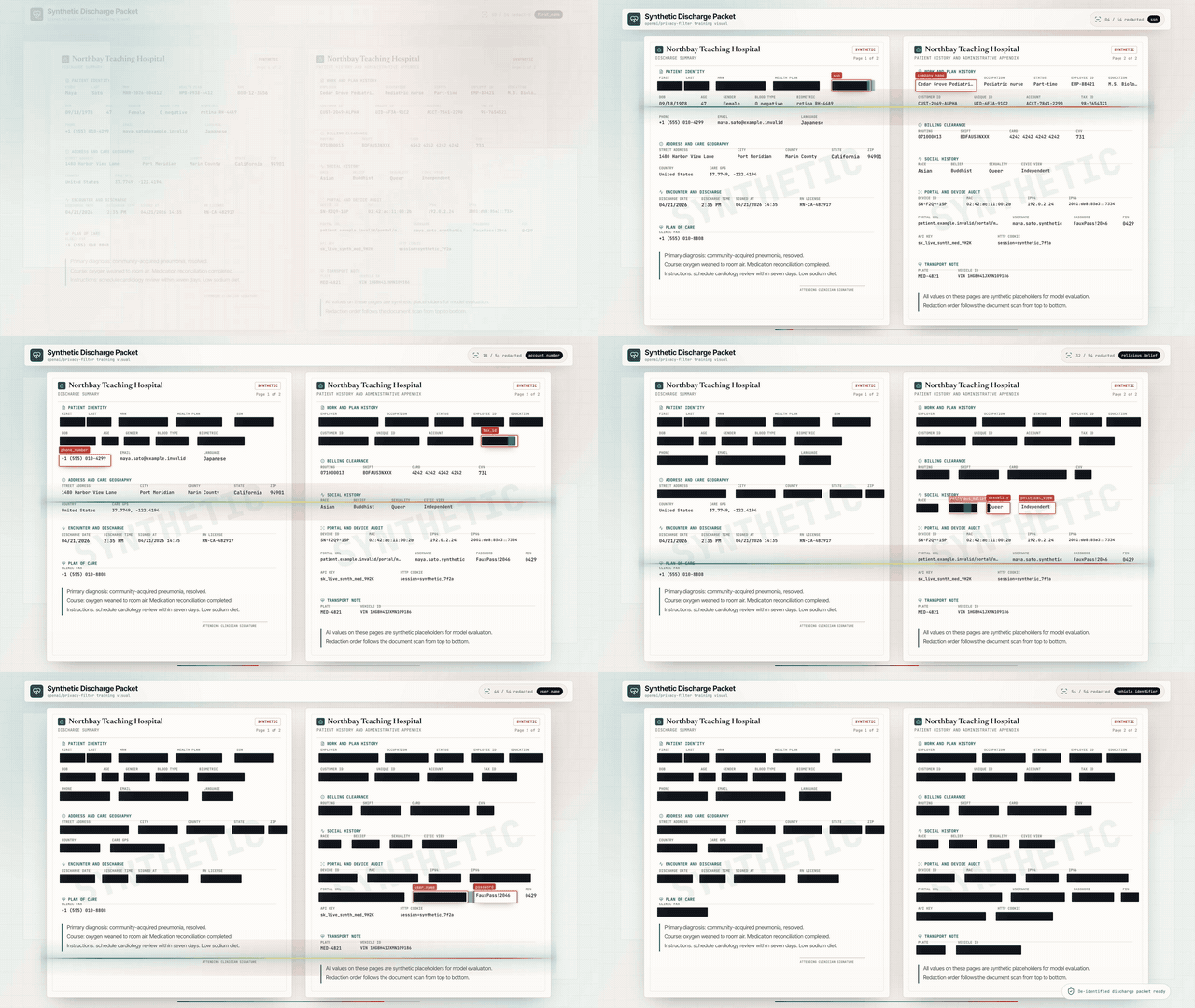
Build a local OpenMed pipeline that de-identifies a synthetic discharge note and extracts medication entities.
It loads the right skills and produces an on-device pipeline (openmed.deidentify(...) → openmed.analyze_text(...)). After the one-time model download, run that pipeline locally on real notes; do not paste real PHI into a cloud-hosted agent prompt. See the skills catalog and 30-second example.
---
# Core + Hugging Face runtime (Linux, macOS, Windows; CPU or CUDA)
pip install --upgrade "openmed[hf]"
Add the REST service
pip install --upgrade "openmed[hf,service]"
Apple Silicon acceleration (MLX)
pip install --upgrade "openmed[mlx]"
Expected result:
Successfully installed openmed-...
|
Python API Example output: |
REST service Example output:
|
Batch Example output: |
Browser / WebGPU
Package ONNX token-classification exports for in-browser inference through Transformers.js:
python -m openmed.onnx.convert \
  --model dslim/bert-base-NER \
  --output dist/example-onnx \
  --include-transformersjs
Example output:
Exported Transformers.js bundle to dist/example-onnx
import { pipeline } from "@huggingface/transformers";
const detector = await pipeline(
  "token-classification",
  "/models/openmed-pii/transformersjs",
  { device: "webgpu" },
);
const entities = await detector("Patient Casey Example called 212-555-0198.");
console.log(entities.slice(0, 2));
Example output:
[
  { entity: "NAME", word: "Casey Example", score: 0.99 },
  { entity: "PHONE", word: "212-555-0198", score: 0.98 },
]
Offline / air-gapped? Point model_name (or model_id) at a local directory and OpenMed loads it without contacting the Hugging Face Hub:
from openmed import OpenMedConfig, analyze_text
result = analyze_text(
    "Patient presents with chronic myeloid leukemia and Type 2 diabetes.",
    model_id="./models/OpenMed-NER-DiseaseDetect-SuperClinical-434M",
    config=OpenMedConfig(device="cpu"),
)
for entity in result.entities:
    print(f"{entity.label:<12} {entity.text:<28} {entity.confidence:.2f}")
Example output:
DISEASE      chronic myeloid leukemia     0.98
DISEASE      Type 2 diabetes              0.96
Because model_id points to a local directory, this example does not contact
the Hugging Face Hub or any external model provider.
---
A curated registry of specialized medical NER models; browse the full catalog.
| Model | Specialization | Entity types | Size |
|-------|----------------|--------------|------|
| disease_detection_superclinical | Disease & conditions | DISEASE, CONDITION, DIAGNOSIS | 434M |
| pharma_detection_superclinical | Drugs & medications | DRUG, MEDICATION, TREATMENT | 434M |
| pii_superclinical_large | PII & de-identification | NAME, DATE, SSN, PHONE, EMAIL, ADDRESS | 434M |
| anatomy_detection_electramed | Anatomy & body parts | ANATOMY, ORGAN, BODY_PART | 109M |
| gene_detection_genecorpus | Genes & proteins | GENE, PROTEIN | 109M |
---
from openmed import extract_pii, deidentify
text = "Patient: John Doe, DOB: 01/15/1970, SSN: 123-45-6789"
Extract PII with smart merging (prevents tokenization fragmentation)
result = extract_pii(text, model_name="pii_superclinical_large", use_smart_merging=True)
print([(e.label, e.text) for e in result.entities])
De-identify with the method you need
print(deidentify(text, method="mask").deidentified_text)
print(deidentify(text, method="replace").deidentified_text)
print(deidentify(text, method="hash").deidentified_text)
print(deidentify(text, method="shift_dates", date_shift_days=180).deidentified_text)
Example output:
[('NAME', 'John Doe'), ('DATE', '01/15/1970'), ('SSN', '123-45-6789')]
Patient: [NAME], DOB: [DATE], SSN: [SSN]
Patient: Emily Chen, DOB: 03/22/1985, SSN: 456-78-9012
Patient: 6b8f...c4a1, DOB: 48b1...91de, SSN: 3f13...e912
Patient: John Doe, DOB: 07/14/1970, SSN: 123-45-6789
01/15/1970 whole instead of fragmenting it.BatchProcessor(operation="extract_pii" | "deidentify", batch_size=16) or incremental streaming helpers.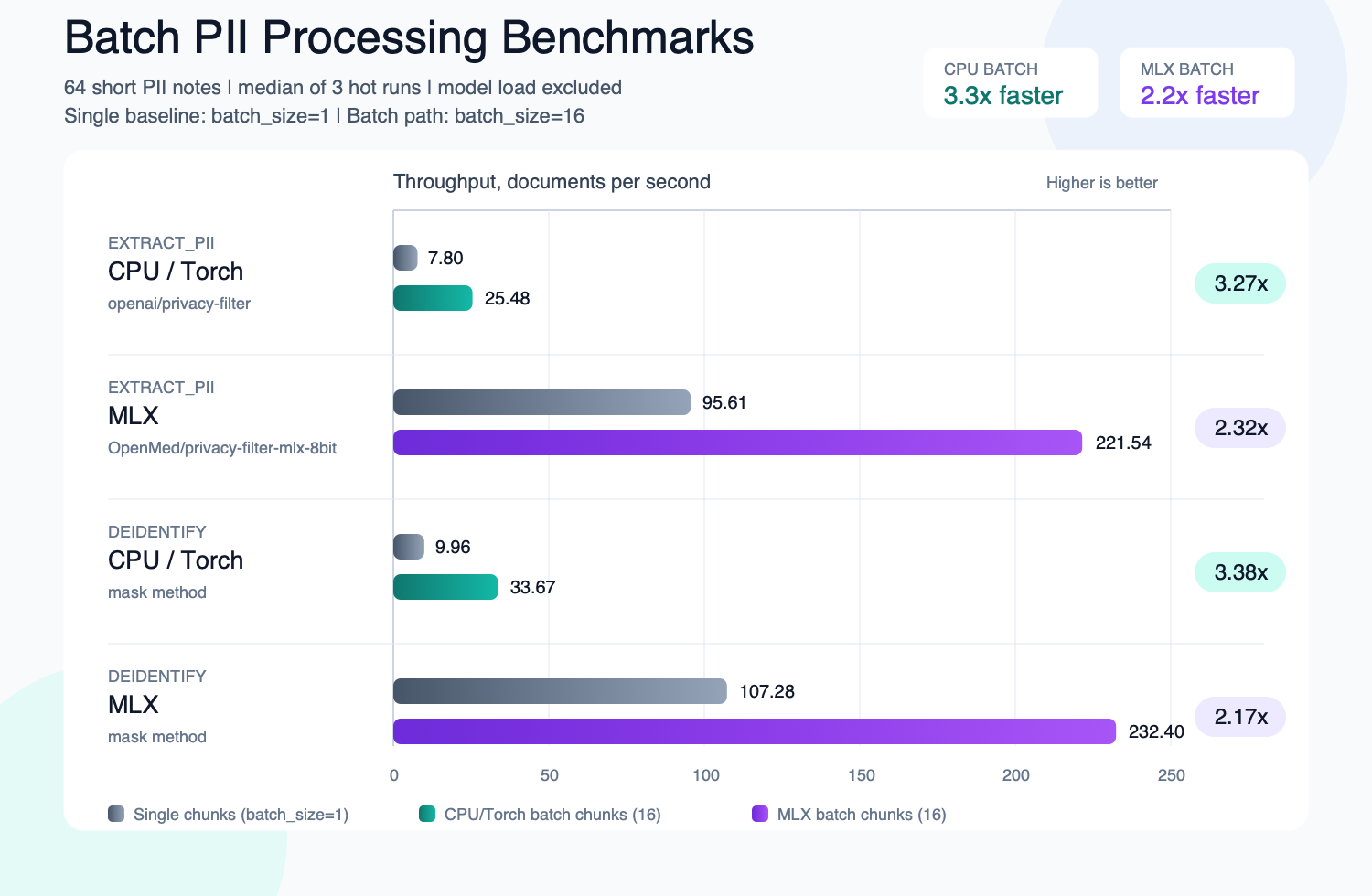
Complete PII notebook · Smart merging · Anonymization quickstart
Same model code (gpt-oss-style sparse-MoE transformer with local attention, sink tokens, RoPE+YaRN, tiktoken o200k_base), different training data. All route through the same extract_pii() / deidentify() API; only model_name= changes.
openai/privacy-filter is a Hugging Face model identifier for local weights;
using it here does not call the OpenAI API.
| Variant | PyTorch (CPU + CUDA) | MLX (Apple Silicon) | MLX 8-bit |
| --- | --- | --- | --- |
| OpenAI Privacy Filter | openai/privacy-filter | OpenMed/privacy-filter-mlx | …-mlx-8bit |
| Nemotron-PII fine-tune | OpenMed/privacy-filter-nemotron | …-nemotron-mlx | …-nemotron-mlx-8bit |
| OpenMed Multilingual | OpenMed/privacy-filter-multilingual | …-multilingual-mlx | …-multilingual-mlx-8bit |
from openmed import extract_pii
text = "Patient Sarah Connor (DOB: 03/15/1985) at MRN 4471882."
variants = {
    "baseline": extract_pii(text, model_name="openai/privacy-filter"),
    "nemotron": extract_pii(text, model_name="OpenMed/privacy-filter-nemotron"),
    "mlx": extract_pii(text, model_name="OpenMed/privacy-filter-mlx"),
}
print([(e.label, e.text) for e in variants["baseline"].entities])
Example output:
[('NAME', 'Sarah Connor'), ('DATE', '03/15/1985'), ('ID', '4471882')]
On non-Apple-Silicon hosts, MLX model names are automatically substituted with the matching PyTorch checkpoint (with a one-time warning): reuse one model name where a matching backend artifact is available. See Privacy Filter architecture & backend routing.
---
Extraction and de-identification support 38 supported PII language codes:
am, ar, as, bn, cs, da, de, el, en, es, fa, fr, gu, he, hi, id,
it, ja, kn, ko, mr, nl, no, or, pt, ro, ru, sv, sw, ta,
te, th, tr, uk, vi, xh, zh, and zu, with the registry-backed PII model catalog in total.
Russian routing currently uses a documented multilingual default-model
placeholder. Bengali, Chinese, and Tamil have dedicated registry entries.
An optional, user-configured Indic NER family accepts two additional routes
(ml and pa) and can also serve Assamese, Bengali, Gujarati, Hindi, Kannada,
Marathi, Odia, Tamil, and Telugu. Set OPENMED_INDIC_NER_MODEL; OpenMed never
bundles or automatically selects those optional weights.
OpenMed also includes validator-backed national-ID coverage for additional
ID-only locales such as Polish, Latvian, Slovak, Malay, Filipino, and Finnish.
See the per-language guide for each code's default PII model, Faker locale, and a before/after de-identification example.
python -c "from openmed import extract_pii; print([(e.label, e.text) for e in extract_pii('Dr. Pedro Almeida, CPF: 123.456.789-09, email: pedro@hospital.pt', lang='pt').entities])"
Example output:
[('NAME', 'Pedro Almeida'), ('ID', '123.456.789-09'), ('EMAIL', 'pedro@hospital.pt')]
from openmed import extract_pii
portuguese = extract_pii("Paciente: Pedro Almeida, CPF: 123.456.789-09, telefone: +351 912 345 678", lang="pt", use_smart_merging=True)
dutch      = extract_pii("Patiënt: Eva de Vries, BSN: 123456782, telefoon: +31 6 12345678", lang="nl", use_smart_merging=True)
hindi      = extract_pii("रोगी: अनीता शर्मा, फोन: +91 9876543210, पता: नई दिल्ली 110001", lang="hi", use_smart_merging=True)
arabic     = extract_pii("المريضة ليلى حسن، الهاتف +20 10 1234 5678، الرقم القومي 29801011234567.", lang="ar", use_smart_merging=True)
japanese   = extract_pii("患者 佐藤 花子、電話 +81 90 1234 5678、マイナンバー 1234 5678 9012.", lang="ja", use_smart_merging=True)
turkish    = extract_pii("Hasta Ayşe Yılmaz, telefon +90 532 123 45 67, TCKN 10000000146.", lang="tr", use_smart_merging=True)
for r in (portuguese, dutch, hindi, arabic, japanese, turkish):
    print([(e.label, e.text) for e in r.entities])
Example output:
[('NAME', 'Pedro Almeida'), ('ID', '123.456.789-09'), ('PHONE', '+351 912 345 678')]
[('NAME', 'Eva de Vries'), ('ID', '123456782'), ('PHONE', '+31 6 12345678')]
[('NAME', 'अनीता शर्मा'), ('PHONE', '+91 9876543210'), ('ADDRESS', 'नई दिल्ली 110001')]
[('NAME', 'ليلى حسن'), ('PHONE', '+20 10 1234 5678'), ('ID', '29801011234567')]
[('NAME', '佐藤 花子'), ('PHONE', '+81 90 1234 5678'), ('ID', '1234 5678 9012')]
[('NAME', 'Ayşe Yılmaz'), ('PHONE', '+90 532 123 45 67'), ('ID', '10000000146')]
---
A Docker-friendly FastAPI service with request validation, shared pipeline preload, and unified error envelopes.
pip install --upgrade "openmed[hf,service]"
uvicorn openmed.service.app:app --host 0.0.0.0 --port 8080
or with Docker
docker build -t openmed:local .
docker run --rm -p 8080:8080 -e OPENMED_PROFILE=prod openmed:local
Example output:
INFO: Uvicorn running on http://0.0.0.0:8080
curl -X POST http://127.0.0.1:8080/pii/extract \
  -H "Content-Type: application/json" \
  -d '{"text":"Paciente: Maria Garcia, DNI: 12345678Z","lang":"es"}'
Abbreviated example response:
{
  "text": "Paciente: Maria Garcia, DNI: 12345678Z",
  "entities": [
    {"text": "Maria Garcia", "label": "NAME", "confidence": 0.99, "start": 10, "end": 22},
    {"text": "12345678Z", "label": "ID", "confidence": 0.98, "start": 29, "end": 38}
  ],
  "model_name": "OpenMed/privacy-filter-multilingual"
}
Model lifecycle and service controls: free memory on demand with
GET /models/loaded, POST /models/unload, and a keep_alive idle window;
v1.8 also includes API-key/JWT auth, no-PHI request logging, tracing, gRPC,
async jobs, webhooks, warm pools, dynamic batching, request coalescing, rate
and concurrency limits, /livez, /readyz, and opt-in metrics:
OPENMED_SERVICE_KEEP_ALIVE=10m uvicorn openmed.service.app:app --host 0.0.0.0 --port 8080
curl -X POST http://127.0.0.1:8080/models/unload -H "Content-Type: application/json" -d '{"all":true}'
Example response:
{
  "unloaded": true,
  "released": {"models": 1, "tokenizers": 1, "pipelines": 1},
  "active_models": {}
}
See the full REST service guide.
---
Full guides at openmed.life/docs.
AI agents can load the curated llms.txt index or the inlined [llms-full.txt](https://openmed.life/docs/llms-
→ →
→ →
→ →
→ →
→ →
→ →
→ →
→