1
 →
→
Implementation of Video Diffusion Models, Jonathan Ho's new paper extending DDPMs to Video Generation - in Pytorch
lucidrains/video-diffusion-pytorch is an open-source project on GitHub, mainly written in Python. Implementation of Video Diffusion Models, Jonathan Ho's new paper extending DDPMs to Video Generation - in Pytorch It currently holds 1,386 stars and 141 forks with 0 open issues, and was last pushed on an unknown date (repository created unknown).
AI Homed tracks it on the AI Video Projects board and on the AI AI Video Projects list.

these fireworks do not exist
Text to video, it is happening! Official Project Page
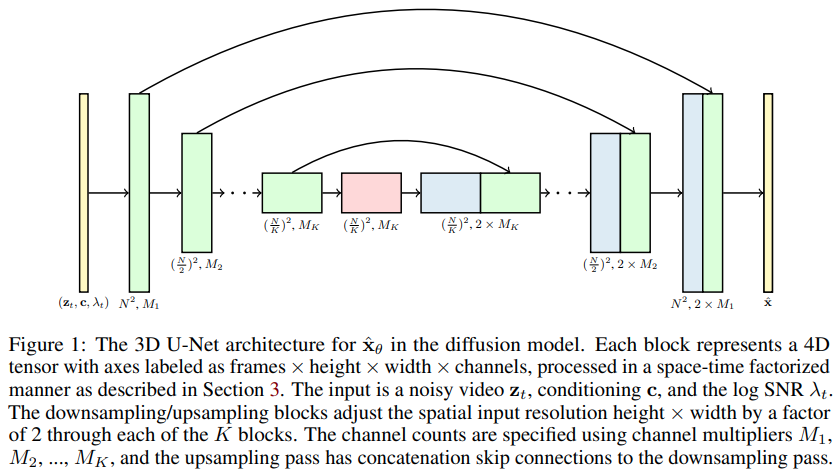
Implementation of Video Diffusion Models, Jonathan Ho's new paper extending DDPMs to Video Generation - in Pytorch. It uses a special space-time factored U-net, extending generation from 2d images to 3d videos
14k for difficult moving mnist (converging much faster and better than NUWA) - wip
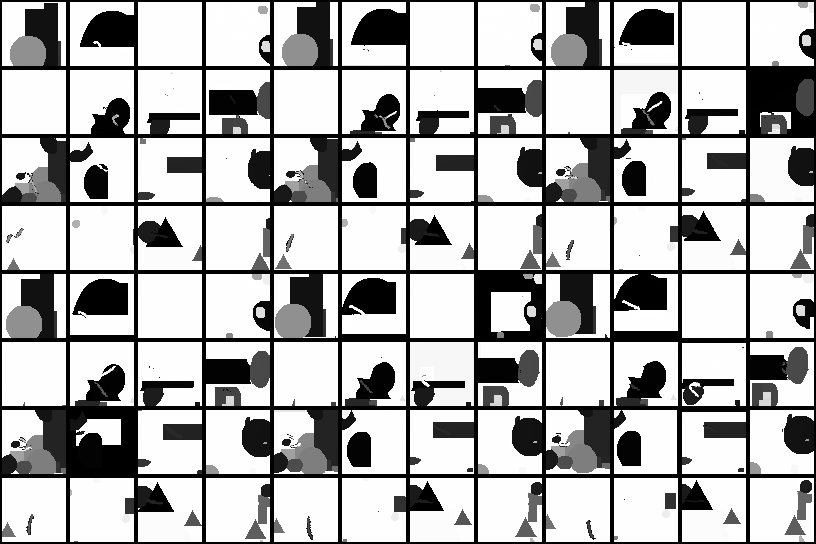
The above experiments are possible only due to resources provided by Stability.ai
Any new developments for text-to-video synthesis will be centralized at Imagen-pytorch
$ pip install video-diffusion-pytorch
import torch
from video_diffusion_pytorch import Unet3D, GaussianDiffusion
model = Unet3D(
    dim = 64,
    dim_mults = (1, 2, 4, 8)
)
diffusion = GaussianDiffusion(
    model,
    image_size = 32,
    num_frames = 5,
    timesteps = 1000,   # number of steps
    loss_type = 'l1'    # L1 or L2
)
videos = torch.randn(1, 3, 5, 32, 32) # video (batch, channels, frames, height, width) - normalized from -1 to +1
loss = diffusion(videos)
loss.backward()
after a lot of training
sampled_videos = diffusion.sample(batch_size = 4)
sampled_videos.shape # (4, 3, 5, 32, 32)
For conditioning on text, they derived text embeddings by first passing the tokenized text through BERT-large. Then you just have to train it like so
import torch
from video_diffusion_pytorch import Unet3D, GaussianDiffusion
model = Unet3D(
    dim = 64,
    cond_dim = 64,
    dim_mults = (1, 2, 4, 8)
)
diffusion = GaussianDiffusion(
    model,
    image_size = 32,
    num_frames = 5,
    timesteps = 1000,   # number of steps
    loss_type = 'l1'    # L1 or L2
)
videos = torch.randn(2, 3, 5, 32, 32) # video (batch, channels, frames, height, width)
text = torch.randn(2, 64)             # assume output of BERT-large has dimension of 64
loss = diffusion(videos, cond = text)
loss.backward()
after a lot of training
sampled_videos = diffusion.sample(cond = text)
sampled_videos.shape # (2, 3, 5, 32, 32)
You can also directly pass in the descriptions of the video as strings, if you plan on using BERT-base for text conditioning
import torch
from video_diffusion_pytorch import Unet3D, GaussianDiffusion
model = Unet3D(
    dim = 64,
    use_bert_text_cond = True,  # this must be set to True to auto-use the bert model dimensions
    dim_mults = (1, 2, 4, 8),
)
diffusion = GaussianDiffusion(
    model,
    image_size = 32,    # height and width of frames
    num_frames = 5,     # number of video frames
    timesteps = 1000,   # number of steps
    loss_type = 'l1'    # L1 or L2
)
videos = torch.randn(3, 3, 5, 32, 32) # video (batch, channels, frames, height, width)
text = [
    'a whale breaching from afar',
    'young girl blowing out candles on her birthday cake',
    'fireworks with blue and green sparkles'
]
loss = diffusion(videos, cond = text)
loss.backward()
after a lot of training
sampled_videos = diffusion.sample(cond = text, cond_scale = 2)
sampled_videos.shape # (3, 3, 5, 32, 32)
This repository also contains a handy Trainer class for training on a folder of gifs. Each gif must be of the correct dimensions image_size and num_frames.
import torch
from video_diffusion_pytorch import Unet3D, GaussianDiffusion, Trainer
model = Unet3D(
    dim = 64,
    dim_mults = (1, 2, 4, 8),
)
diffusion = GaussianDiffusion(
    model,
    image_size = 64,
    num_frames = 10,
    timesteps = 1000,   # number of steps
    loss_type = 'l1'    # L1 or L2
).cuda()
trainer = Trainer(
    diffusion,
    './data',                         # this folder path needs to contain all your training data, as .gif files, of correct image size and number of frames
    train_batch_size = 32,
    train_lr = 1e-4,
    save_and_sample_every = 1000,
    train_num_steps = 700000,         # total training steps
    gradient_accumulate_every = 2,    # gradient accumulation steps
    ema_decay = 0.995,                # exponential moving average decay
    amp = True                        # turn on mixed precision
)
trainer.train()
Sample videos (as gif files) will be saved to ./results periodically, as are the diffusion model parameters.
One of the claims in the paper is that by doing factored space-time attention, one can force the network to attend on the present for training images and video in conjunction, leading to better results.
It was not clear how they achieved this, but I furthered a guess.
To arrest attention to the present moment for a certain percentage of batch videos samples, simply pass prob_focus_present = on the diffusion forward method
loss = diffusion(videos, cond = text, prob_focus_present = 0.5) # for 50% of videos, focus on the present during training
loss.backward()
If you have a better idea how this is done, just open a github issue.
@misc{ho2022video,
  title   = {Video Diffusion Models},
  author  = {Jonathan Ho and Tim Salimans and Alexey Gritsenko and William Chan and Mohammad Norouzi and David J. Fleet},
  year    = {2022},
  eprint  = {2204.03458},
  archivePrefix = {arXiv},
  primaryClass = {cs.CV}
}
@misc{Saharia2022,
    title   = {Imagen: unprecedented photorealism × deep level of language understanding},
    author  = {Chitwan Saharia*, William Chan*, Saurabh Saxena†, Lala Li†, Jay Whang†, Emily Denton, Seyed Kamyar Seyed Ghasemipour, Burcu Karagol Ayan, S. Sara Mahdavi, Rapha Gontijo Lopes, Tim Salimans, Jonathan Ho†, David Fleet†, Mohammad Norouzi*},
    year    = {2022}
}
 →
→ →
→ →
→ →
→ →
→ →
→ →
→