1
 →
→
Implementation of Imagen, Google's Text-to-Image Neural Network, in Pytorch
lucidrains/imagen-pytorch is an open-source project on GitHub, mainly written in Python. Implementation of Imagen, Google's Text-to-Image Neural Network, in Pytorch It currently holds 8,423 stars and 0 forks with 0 open issues, and was last pushed on an unknown date (repository created unknown).
AI Homed tracks it on the AI Image Projects board and on the AI AI Image Projects list.
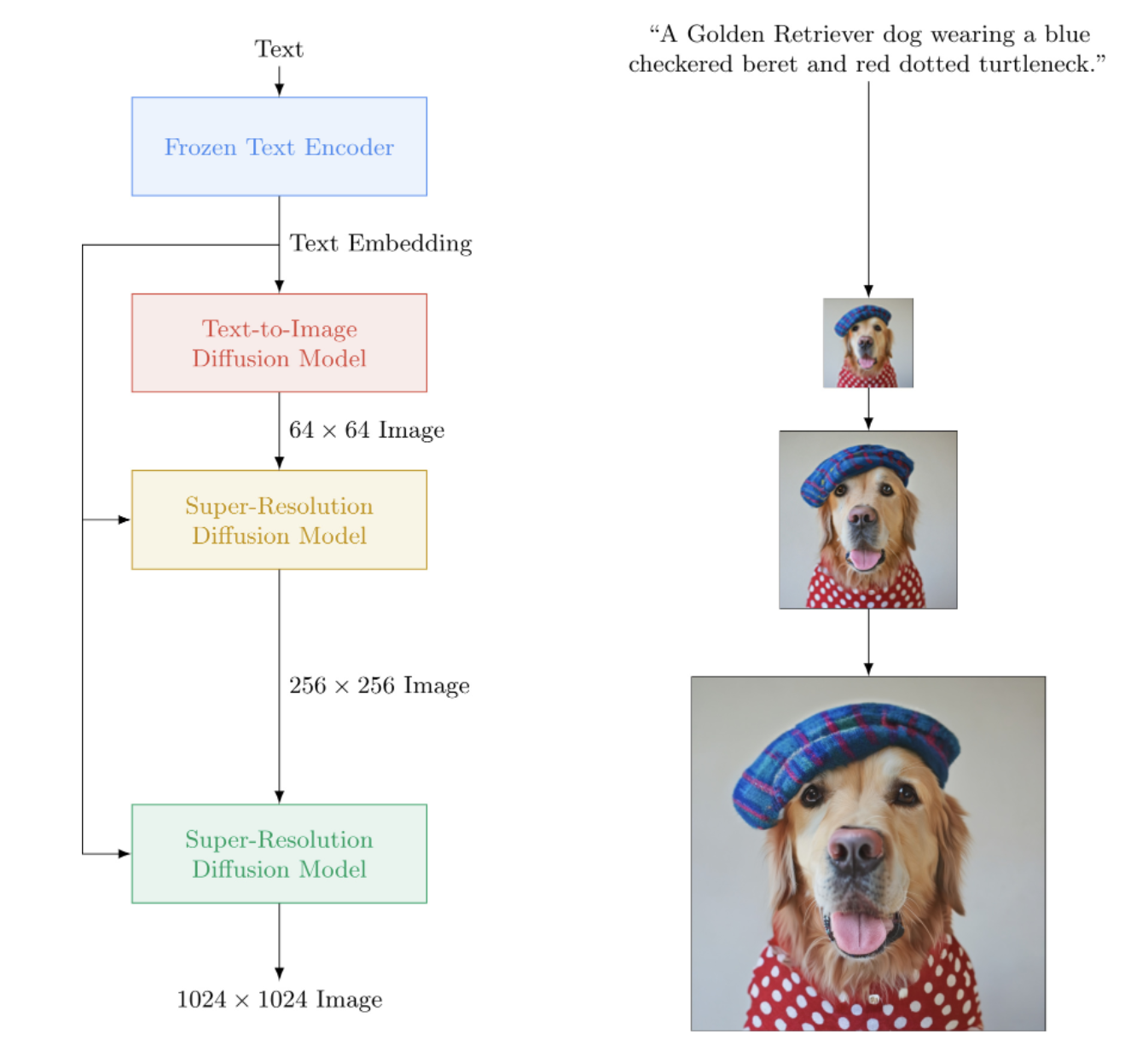
Implementation of Imagen, Google's Text-to-Image Neural Network that beats DALL-E2, in Pytorch. It is the new SOTA for text-to-image synthesis.
Architecturally, it is actually much simpler than DALL-E2. It consists of a cascading DDPM conditioned on text embeddings from a large pretrained T5 model (attention network). It also contains dynamic clipping for improved classifier free guidance, noise level conditioning, and a memory efficient unet design.
It appears neither CLIP nor prior network is needed after all. And so research continues.
AI Coffee Break with Letitia | Assembly AI | Yannic Kilcher
Please join if you are interested in helping out with the replication with the LAION community
$ pip install imagen-pytorch
import torch
from imagen_pytorch import Unet, Imagen
unet for imagen
unet1 = Unet(
    dim = 32,
    cond_dim = 512,
    dim_mults = (1, 2, 4, 8),
    num_resnet_blocks = 3,
    layer_attns = (False, True, True, True),
    layer_cross_attns = (False, True, True, True)
)
unet2 = Unet(
    dim = 32,
    cond_dim = 512,
    dim_mults = (1, 2, 4, 8),
    num_resnet_blocks = (2, 4, 8, 8),
    layer_attns = (False, False, False, True),
    layer_cross_attns = (False, False, False, True)
)
imagen, which contains the unets above (base unet and super resoluting ones)
imagen = Imagen(
    unets = (unet1, unet2),
    image_sizes = (64, 256),
    timesteps = 1000,
    cond_drop_prob = 0.1
).cuda()
mock images (get a lot of this) and text encodings from large T5
text_embeds = torch.randn(4, 256, 768).cuda()
images = torch.randn(4, 3, 256, 256).cuda()
feed images into imagen, training each unet in the cascade
for i in (1, 2):
    loss = imagen(images, text_embeds = text_embeds, unet_number = i)
    loss.backward()
do the above for many many many many steps
now you can sample an image based on the text embeddings from the cascading ddpm
images = imagen.sample(texts = [
    'a whale breaching from afar',
    'young girl blowing out candles on her birthday cake',
    'fireworks with blue and green sparkles'
], cond_scale = 3.)
images.shape # (3, 3, 256, 256)
For simpler training, you can directly supply text strings instead of precomputing text encodings. (Although for scaling purposes, you will definitely want to precompute the textual embeddings + mask)
The number of textual captions must match the batch size of the images if you go this route.
# mock images and text (get a lot of this)
texts = [
    'a child screaming at finding a worm within a half-eaten apple',
    'lizard running across the desert on two feet',
    'waking up to a psychedelic landscape',
    'seashells sparkling in the shallow waters'
]
images = torch.randn(4, 3, 256, 256).cuda()
feed images into imagen, training each unet in the cascade
for i in (1, 2):
    loss = imagen(images, texts = texts, unet_number = i)
    loss.backward()
With the ImagenTrainer wrapper class, the exponential moving averages for all of the U-nets in the cascading DDPM will be automatically taken care of when calling update
import torch
from imagen_pytorch import Unet, Imagen, ImagenTrainer
unet for imagen
unet1 = Unet(
    dim = 32,
    cond_dim = 512,
    dim_mults = (1, 2, 4, 8),
    num_resnet_blocks = 3,
    layer_attns = (False, True, True, True),
)
unet2 = Unet(
    dim = 32,
    cond_dim = 512,
    dim_mults = (1, 2, 4, 8),
    num_resnet_blocks = (2, 4, 8, 8),
    layer_attns = (False, False, False, True),
    layer_cross_attns = (False, False, False, True)
)
imagen, which contains the unets above (base unet and super resoluting ones)
imagen = Imagen(
    unets = (unet1, unet2),
    text_encoder_name = 't5-large',
    image_sizes = (64, 256),
    timesteps = 1000,
    cond_drop_prob = 0.1
).cuda()
wrap imagen with the trainer class
trainer = ImagenTrainer(imagen)
mock images (get a lot of this) and text encodings from large T5
text_embeds = torch.randn(64, 256, 1024).cuda()
images = torch.randn(64, 3, 256, 256).cuda()
feed images into imagen, training each unet in the cascade
loss = trainer(
    images,
    text_embeds = text_embeds,
    unet_number = 1,            # training on unet number 1 in this example, but you will have to also save checkpoints and then reload and continue training on unet number 2
    max_batch_size = 4          # auto divide the batch of 64 up into batch size of 4 and accumulate gradients, so it all fits in memory
)
trainer.update(unet_number = 1)
do the above for many many many many steps
now you can sample an image based on the text embeddings from the cascading ddpm
images = trainer.sample(texts = [
    'a puppy looking anxiously at a giant donut on the table',
    'the milky way galaxy in the style of monet'
], cond_scale = 3.)
images.shape # (2, 3, 256, 256)
You can also train Imagen without text (unconditional image generation) as follows
import torch
from imagen_pytorch import Unet, Imagen, SRUnet256, ImagenTrainer
unets for unconditional imagen
unet1 = Unet(
    dim = 32,
    dim_mults = (1, 2, 4),
    num_resnet_blocks = 3,
    layer_attns = (False, True, True),
    layer_cross_attns = False,
    use_linear_attn = True
)
unet2 = SRUnet256(
    dim = 32,
    dim_mults = (1, 2, 4),
    num_resnet_blocks = (2, 4, 8),
    layer_attns = (False, False, True),
    layer_cross_attns = False
)
imagen, which contains the unets above (base unet and super resoluting ones)
imagen = Imagen(
    condition_on_text = False,   # this must be set to False for unconditional Imagen
    unets = (unet1, unet2),
    image_sizes = (64, 128),
    timesteps = 1000
)
trainer = ImagenTrainer(imagen).cuda()
now get a ton of images and feed it through the Imagen trainer
training_images = torch.randn(4, 3, 256, 256).cuda()
train each unet separately
in this example, only training on unet number 1
loss = trainer(training_images, unet_number = 1)
trainer.update(unet_number = 1)
do the above for many many many many steps
now you can sample images unconditionally from the cascading unet(s)
images = trainer.sample(batch_size = 16) # (16, 3, 128, 128)
Or train only super-resoluting unets
import torch
from imagen_pytorch import Unet, NullUnet, Imagen
unet for imagen
unet1 = NullUnet()  # add a placeholder "null" unet for the base unet
unet2 = Unet(
    dim = 32,
    cond_dim = 512,
    dim_mults = (1, 2, 4, 8),
    num_resnet_blocks = (2, 4, 8, 8),
    layer_attns = (False, False, False, True),
    layer_cross_attns = (False, False, False, True)
)
imagen, which contains the unets above (base unet and super resoluting ones)
imagen = Imagen(
    unets = (unet1, unet2),
    image_sizes = (64, 256),
    timesteps = 250,
    cond_drop_prob = 0.1
).cuda()
mock images (get a lot of this) and text encodings from large T5
text_embeds = torch.randn(4, 256, 768).cuda()
images = torch.randn(4, 3, 256, 256).cuda()
feed images into imagen, training each unet in the cascade
loss = imagen(images, text_embeds = text_embeds, unet_number = 2)
loss.backward()
do the above for many many many many steps
now you can sample an image based on the text embeddings as well as low resolution images
lowres_images = torch.randn(3, 3, 64, 64).cuda()  # starting un-resoluted images
images = imagen.sample(
    texts = [
        'a whale breaching from afar',
        'young girl blowing out candles on her birthday cake',
        'fireworks with blue and green sparkles'
    ],
    start_at_unet_number = 2,              # start at unet number 2
    start_image_or_video = lowres_images,  # pass in low resolution images to be resoluted
    cond_scale = 3.)
images.shape # (3, 3, 256, 256)
At any time you can save and load the trainer and all associated states with the save and load methods. It is recommended you use these methods instead of manually saving with a state_dict call, as there are some device memory management being done underneath the hood within the trainer.
ex.
trainer.save('./path/to/checkpoint.pt')
trainer.load('./path/to/checkpoint.pt')
trainer.steps # (2,) step number for each of the unets, in this case 2
You can also rely on the ImagenTrainer to automatically train off DataLoader instances. You simply have to craft your DataLoader to return either images (for unconditional case), or of ('images', 'text_embeds') for text-guided generation.
ex. unconditional training
from imagen_pytorch import Unet, Imagen, ImagenTrainer
from imagen_pytorch.data import Dataset
unets for unconditional imagen
unet = Unet(
    dim = 32,
    dim_mults = (1, 2, 4, 8),
    num_resnet_blocks = 1,
    layer_attns = (False, False, False, True),
    layer_cross_attns = False
)
imagen, which contains the unet above
imagen = Imagen(
    condition_on_text = False,  # this must be set to False for unconditional Imagen
    unets = unet,
    image_sizes = 128,
    timesteps = 1000
)
trainer = ImagenTrainer(
    imagen = imagen,
    split_valid_from_train = True # whether to split the validation dataset from the training
).cuda()
instantiate your dataloader, which returns the necessary inputs to the DDPM as tuple in the order of images, text embeddings, then text masks. in this case, only images is returned as it is unconditional training
dataset = Dataset('/path/to/training/images', image_size = 128)
trainer.add_train_dataset(dataset, batch_size = 16)
working training loop
for i in range(200000):
    loss = trainer.train_step(unet_number = 1, max_batch_size = 4)
    print(f'loss: {loss}')
if not (i % 50):
        valid_loss = trainer.valid_step(unet_number = 1, max_batch_size = 4)
        print(f'valid loss: {valid_loss}')
if not (i % 100) and trainer.is_main: # is_main makes sure this can run in distributed
        images = trainer.sample(batch_size = 1, return_pil_images = True) # returns List[Image]
        images[0].save(f'./sample-{i // 100}.png')
Thanks to 🤗 Accelerate, you can do multi GPU training easily with two steps.
First you need to invoke accelerate config in the same directory as your training script (say it is named train.py)
$ accelerate config
Next, instead of calling python train.py as you would for single GPU, you would use the accelerate CLI as so
$ accelerate launch train.py
That's it!
Imagen can also be used via CLI directly.
ex.
$ imagen config
$ imagen config --path ./configs/config.json
In the config you are able to change settings for the trainer, dataset and the imagen config.
The Imagen config parameters can be found here
The Elucidated Imagen config parameters can be found here
The Imagen Trainer config parameters can be found here
For the dataset parameters all dataloader parameters can be used.
This command allows you to train or resume training your model
ex.
$ imagen train
$ imagen train --unet 2 --epoches 10
You can pass following arguments to the training command.
--config specify the config file to use for training [default: ./imagen_config.json]--unet the index of the unet to train [default: 1]--epoches how many epoches to train for [default: 50]Be aware when sampling your checkpoint should have trained all unets to get a usable result.
ex.
$ imagen sample --model ./path/to/model/checkpoint.pt "a squirrel raiding the birdfeeder"
image is saved to ./a_squirrel_raiding_the_birdfeeder.png
You can pass following arguments to the sample command.
--model specify the model file to use for sampling--cond_scale conditioning scale (classifier free guidance) in decoder--load_ema load EMA version of unets if availableImagenConfig and ElucidatedImagenConfig or create a checkpoint via the CLI directly
For proper training, you'll likely want to setup config-driven training anyways.
ex.
import torch
from imagen_pytorch import ImagenConfig, ElucidatedImagenConfig, ImagenTrainer
in this example, using elucidated imagen
imagen = ElucidatedImagenConfig(
    unets = [
        dict(dim = 32, dim_mults = (1, 2, 4, 8)),
        dict(dim = 32, dim_mults = (1, 2, 4, 8))
    ],
    image_sizes = (64, 128),
    cond_drop_prob = 0.5,
    num_sample_steps = 32
).create()
trainer = ImagenTrainer(imagen)
do your training ...
then save it
trainer.save('./checkpoint.pt')
you should see a message informing you that ./checkpoint.pt is commandable from the terminal
It really should be as simple as that
You can also pass this checkpoint file around, and anyone can continue finetune on their own data
from imagen_pytorch import load_imagen_from_checkpoint, ImagenTrainer
imagen = load_imagen_from_checkpoint('./checkpoint.pt')
trainer = ImagenTrainer(imagen)
continue training / fine-tuning
Inpainting follows the formulation laid out by the recent Repaint paper. Simply pass in inpaint_images and inpaint_masks to the sample function on either Imagen or ElucidatedImagen
inpaint_images = torch.randn(4, 3, 512, 512).cuda()      # (batch, channels, height, width)
inpaint_masks = torch.ones((4, 512, 512)).bool().cuda()  # (batch, height, width)
inpainted_images = trainer.sample(texts = [
    'a whale breaching from afar',
    'young girl blowing out candles on her birthday cake',
    'fireworks with blue and green sparkles',
    'dust motes swirling in the morning sunshine on the windowsill'
], inpaint_images = inpaint_images, inpaint_masks = inpaint_masks, cond_scale = 5.)
inpainted_images # (4, 3, 512, 512)
For video, similarly pass in your videos to inpaint_videos keyword on .sample. Inpainting mask can either be the same across all frames (batch, height, width) or different (batch, frames, height, width)
inpaint_videos = torch.randn(4, 3, 8, 512, 512).cuda()   # (batch, channels, frames, height, width)
inpaint_masks = torch.ones((4, 8, 512, 512)).bool().cuda()  # (batch, frames, height, width)
inpainted_videos = trainer.sample(texts = [
    'a whale breaching from afar',
    'young girl blowing out candles on her birthday cake',
    'fireworks with blue and green sparkles',
    'dust motes swirling in the morning sunshine on the windowsill'
], inpaint_videos = inpaint_videos, inpaint_masks = inpaint_masks, cond_scale = 5.)
inpainted_videos # (4, 3, 8, 512, 512)
Tero Karras of StyleGAN fame has written a new paper with results that have been corroborated by a number of independent researchers as well as on my own machine. I have decided to create a version of Imagen, the ElucidatedImagen, so that one can use the new elucidated DDPM for text-guided cascading generation.
Simply import ElucidatedImagen, and then instantiate the instance as you did before. The hyperparameters are different than the usual ones for discrete and continuous time gaussian diffusion, and can be individualized for each unet in the cascade.
Ex.
from imagen_pytorch import ElucidatedImagen
instantiate your unets ...
imagen = ElucidatedImagen(
    unets = (unet1, unet2),
    image_sizes = (64, 128),
    cond_drop_prob = 0.1,
    num_sample_steps = (64, 32), # number of sample steps - 64 for base unet, 32 for upsampler (just an example, have no clue what the optimal values are)
    sigma_min = 0.002,           # min noise level
    sigma_max = (80, 160),       # max noise level, @crowsonkb recommends double the max noise level for upsampler
    sigma_data = 0.5,            # standard deviation of data distribution
    rho = 7,                     # controls the sampling schedule
    P_mean = -1.2,               # mean of log-normal distribution from which noise is drawn for training
    P_std = 1.2,                 # standard deviation of log-normal distribution from which noise is drawn for training
    S_churn = 80,                # parameters for stochastic sampling - depends on dataset, Table 5 in apper
    S_tmin = 0.05,
    S_tmax = 50,
    S_noise = 1.003,
).cuda()
rest is the same as above
This repository will also start accumulating new research around text guided video synthesis. For starters it will adopt the 3d unet architecture described by Jonathan Ho in Video Diffusion Models
Update: verified working by Hadrien Reynaud!
Ex.
import torch
from imagen_pytorch import Unet3D, ElucidatedImagen, ImagenTrainer
unet1 = Unet3D(dim = 64, dim_mults = (1, 2, 4, 8)).cuda()
unet2 = Unet3D(dim = 64, dim_mults = (1, 2, 4, 8)).cuda()
elucidated imagen, which contains the unets above (base unet and super resoluting ones)
imagen = ElucidatedImagen(
    unets = (unet1, unet2),
    image_sizes = (16, 32),
    random_crop_sizes = (None, 16),
    temporal_downsample_factor = (2, 1),        # in this example, the first unet would receive the video temporally downsampled by 2x
    num_sample_steps = 10,
    cond_drop_prob = 0.1,
    sigma_min = 0.002,                          # min noise level
    sigma_max = (80, 160),                      # max noise level, double the max noise level for upsampler
    sigma_data = 0.5,                           # standard deviation of data distribution
    rho = 7,                                    # controls the sampling schedule
    P_mean = -1.2,                              # mean of log-normal distribution from which noise is drawn for training
    P_std = 1.2,                                # standard deviation of log-normal distribution from which noise is drawn for training
    S_churn = 80,                               # parameters for stochastic sampling - depends on dataset, Table 5 in apper
    S_tmin = 0.05,
    S_tmax = 50,
    S_noise = 1.003,
).cuda()
mock videos (get a lot of this) and text encodings from large T5
texts = [
    'a whale breaching from afar',
    'young girl blowing out candles on her birthday cake',
    'fireworks with blue and green sparkles',
    'dust motes swirling in the morning sunshine on the windowsill'
]
videos = torch.randn(4, 3, 10, 32, 32).cuda() # (batch, channels, time / video frames, height, width)
feed images into imagen, training each unet in the cascade
for this example, only training unet 1
trainer = ImagenTrainer(imagen)
you can also ignore time when training on video initially, shown to improve results in video-ddpm paper. eventually will make the 3d unet trainable with either images or video. research shows it is essential (with current data regimes) to train first on text-to-image. probably won't be true in another decade. all big data becomes small data
trainer(videos, texts = texts, unet_number = 1, ignore_time = False)
trainer.update(unet_number = 1)
videos = trainer.sample(texts = texts, video_frames = 20) # extrapolating to 20 frames from training on 10 frames
videos.shape # (4, 3, 20, 32, 32)
You can also train on text - image pairs first. The Unet3D will automatically convert it to single framed videos and learn without the temporal components (by automatically setting ignore_time = True), whether it be 1d convolutions or causal attention across time.
This is the current approach taken by all the big artificial intelligence labs (Brain, MetaAI, Bytedance)
→ →→
→→ →
→ →→→
→→→ →
→