1
 →
→
Open Lakehouse Format for Multimodal AI. Convert from Parquet in 2 lines of code for 100x faster random access, vector index, and data versioning.
lance-format/lance is an open-source project on GitHub, mainly written in Rust. Open Lakehouse Format for Multimodal AI. Convert from Parquet in 2 lines of code for 100x faster random access, vector index, and data versioning. It currently holds 7,086 stars and 0 forks with 0 open issues, and was last pushed on an unknown date (repository created unknown).
AI Homed tracks it on the AI Image Projects board and on the AI AI Image Projects list.

The Open Lakehouse Format for Multimodal AI
High-performance vector search, full-text search, random access, and feature engineering capabilities for the lakehouse.
Compatible with Pandas, DuckDB, Polars, PyArrow, Ray, Spark, and more integrations on the way.
Documentation • Community • Discord • Mailing List
[CI]: https://github.com/lance-format/lance/actions/workflows/rust.yml [CI Badge]: https://github.com/lance-format/lance/actions/workflows/rust.yml/badge.svg [Docs]: https://lance.org [Docs Badge]: https://img.shields.io/badge/docs-passing-brightgreen [crates.io]: https://crates.io/crates/lance [crates.io badge]: https://img.shields.io/crates/v/lance.svg [Python versions]: https://pypi.org/project/pylance/ [Python versions badge]: https://img.shields.io/pypi/pyversions/pylance
[![CI Badge]][CI] [![Docs Badge]][Docs] [![crates.io badge]][crates.io] [![Python versions badge]][Python versions]
Lance is an open lakehouse format for multimodal AI. It contains a file format, table format, and catalog spec that allows you to build a complete lakehouse on top of object storage to power your AI workflows. Lance is perfect for:
1. Building search engines and feature stores with hybrid search capabilities. 2. Large-scale ML training requiring high performance IO and random access. 3. Storing, querying, and managing multimodal data including images, videos, audio, text, and embeddings.
The key features of Lance include:
[!TIP]
Lance is in active development and we welcome contributions. Please see our contributing guide for more information.
Lance releases frequently because the SDKs, integrations, and performance work are moving quickly. This does not mean the Lance file format changes incompatibly in every release. The Lance file format is identified by the data_storage_version stored in each dataset, and stable storage versions are a long-term compatibility contract.
data_storage_version, future Lance releases will continue to support reading that storage version.data_storage_version for deterministic writes.next file format alias is unstable and should only be used for experimentation, never for production data.data_storage_version. See the format versioning guide for the current compatibility matrix.
Installation
pip install pylance
To install a preview release:
pip install --pre --extra-index-url https://pypi.fury.io/lance-format pylance
[!TIP]
Preview releases are released more often than full releases and contain the
latest features and bug fixes. They receive the same level of testing as full releases.
We guarantee they will remain published and available for download for at
least 6 months. When you want to pin to a specific version, prefer a stable release.
Converting to Lance
import lance
import pandas as pd
import pyarrow as pa
import pyarrow.dataset
df = pd.DataFrame({"a": [5], "b": [10]})
uri = "/tmp/test.parquet"
tbl = pa.Table.from_pandas(df)
pa.dataset.write_dataset(tbl, uri, format='parquet')
parquet = pa.dataset.dataset(uri, format='parquet')
lance.write_dataset(parquet, "/tmp/test.lance")
Reading Lance data
dataset = lance.dataset("/tmp/test.lance")
assert isinstance(dataset, pa.dataset.Dataset)
Pandas
df = dataset.to_table().to_pandas()
df
DuckDB
import duckdb
If this segfaults, make sure you have duckdb v0.7+ installed
duckdb.query("SELECT * FROM dataset LIMIT 10").to_df()
Vector search
Download the sift1m subset
wget ftp://ftp.irisa.fr/local/texmex/corpus/sift.tar.gz
tar -xzf sift.tar.gz
Convert it to Lance
import lance
from lance.vector import vec_to_table
import numpy as np
import struct
nvecs = 1000000
ndims = 128
with open("sift/sift_base.fvecs", mode="rb") as fobj:
    buf = fobj.read()
    data = np.array(struct.unpack("<128000000f", buf[4 : 4 + 4  nvecs  ndims])).reshape((nvecs, ndims))
    dd = dict(zip(range(nvecs), data))
table = vec_to_table(dd)
uri = "vec_data.lance"
sift1m = lance.write_dataset(table, uri, max_rows_per_group=8192, max_rows_per_file=1024*1024)
Build the index
sift1m.create_index("vector",
                    index_type="IVF_PQ",
                    num_partitions=256,  # IVF
                    num_sub_vectors=16)  # PQ
Search the dataset
# Get top 10 similar vectors
import duckdb
dataset = lance.dataset(uri)
Sample 100 query vectors. If this segfaults, make sure you have duckdb v0.7+ installed
sample = duckdb.query("SELECT vector FROM dataset USING SAMPLE 100").to_df()
query_vectors = np.array([np.array(x) for x in sample.vector])
Get nearest neighbors for all of them
rs = [dataset.to_table(nearest={"column": "vector", "k": 10, "q": q})
      for q in query_vectors]
| Directory | Description | |--------------------|--------------------------| | rust | Core Rust implementation | | python | Python bindings (PyO3) | | java | Java bindings (JNI) | | docs | Documentation source |
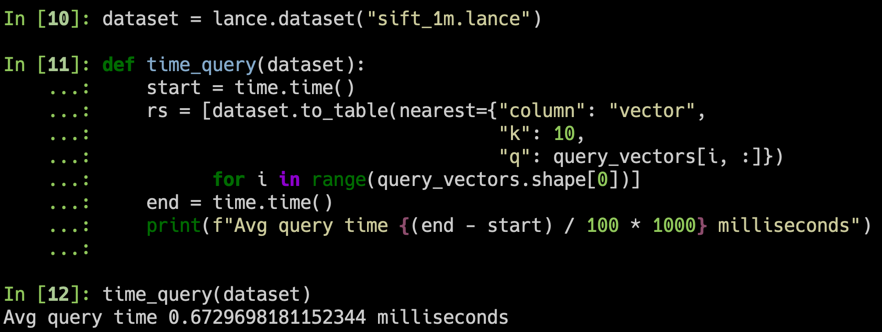
We used the SIFT dataset to benchmark our results with 1M vectors of 128D
1. For 100 randomly sampled query vectors, we get <1ms average response time (on a 2023 m2 MacBook Air)
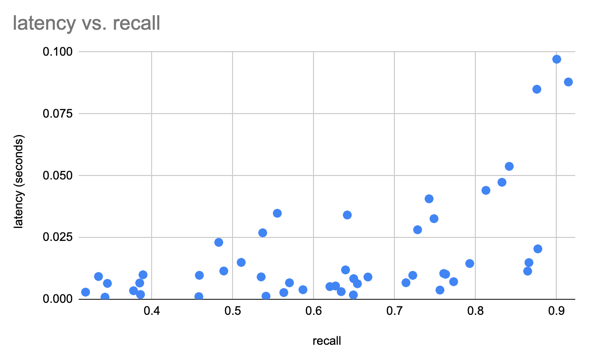
2. ANNs are always a trade-off between recall and performance
We create a Lance dataset using the Oxford Pet dataset to do some preliminary performance testing of Lance as compared to Parquet and raw image/XMLs. For analytics queries, Lance is 50-100x better than reading the raw metadata. For batched random access, Lance is 100x better than both parquet and raw files.

The machine learning development cycle involves multiple stages:
graph LR
    A[Collection] --> B[Exploration];
    B --> C[Analytics];
    C --> D[Feature Engineer];
    D --> E[Training];
    E --> F[Evaluation];
    F --> C;
    E --> G[Deployment];
    G --> H[Monitoring];
    H --> A;
Traditional lakehouse formats were designed for SQL analytics and struggle with AI/ML workloads that require:
A comparison of different formats across ML development stages:
| | Lance | Parquet & ORC | JSON & XML | TFRecord | Database | Warehouse | |---------------------|-------|---------------|------------|----------|----------|-----------| | Analytics | Fast | Fast | Slow | Slow | Decent | Fast | | Feature Engineering | Fast | Fast | Decent | Slow | Decent | Good | | Training | Fast | Decent | Slow | Fast | N/A | N/A | | Exploration | Fast | Slow | Fast | Slow | Fast | Decent | | Infra Support | Rich | Rich | Decent | Limited | Rich | Rich |
→ →
→ →
→ →
→ →
→ →
→ →→
→→