1
 →
→
A curated list of Jev use cases, projects, SDKs, and resources. Jev is TypeSafe AI's System One model for fast, typed decisions in software — Choice, Score, and Noul with calibrated probabilities.
kraayenjon/awesome-jev is an open-source project on GitHub, mainly written in several languages. A curated list of Jev use cases, projects, SDKs, and resources. Jev is TypeSafe AI's System One model for fast, typed decisions in software — Choice, Score It currently holds 66 stars and 11 forks with 4 open issues, and was last pushed on 2026-09-20 (repository created 2026-09-18).
AI Homed tracks it on the Today's Trending board.
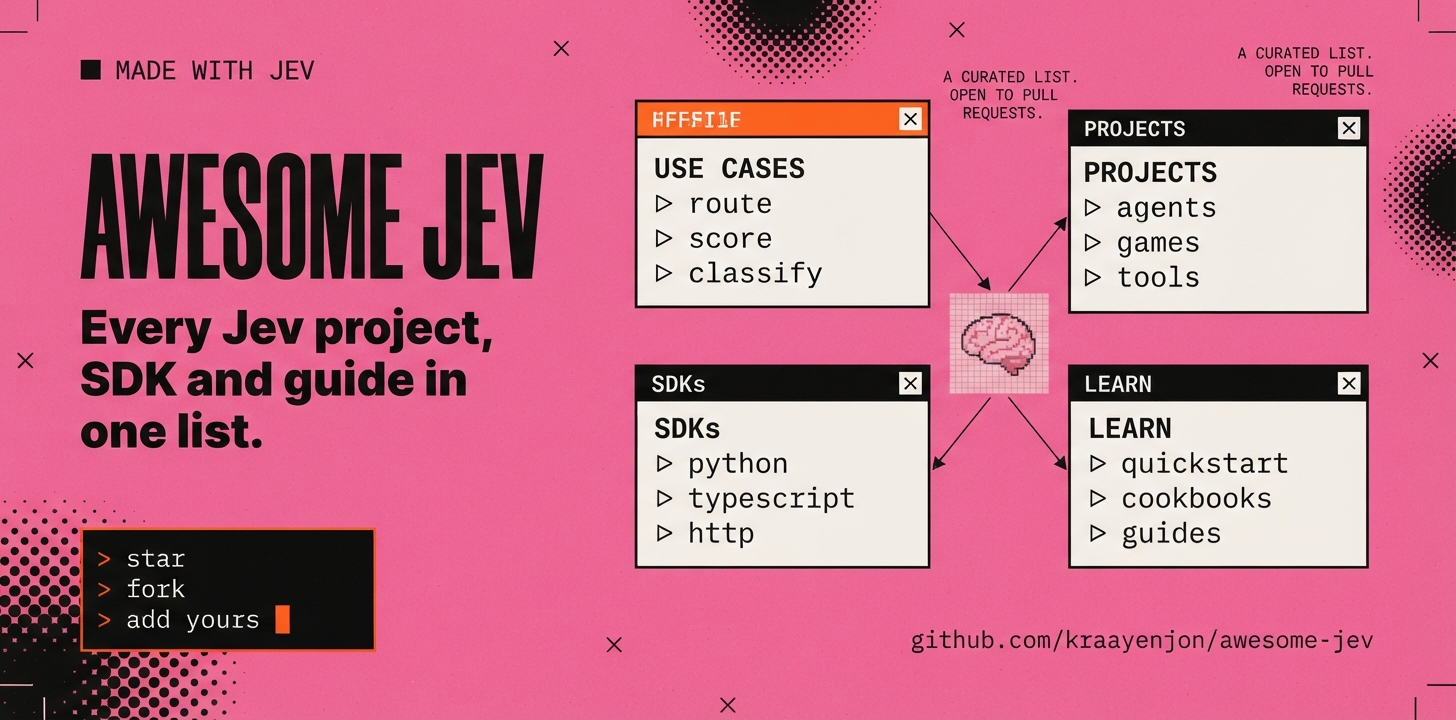

A curated list of Jev use cases, projects, SDKs, tools, and learning resources.
Jev is the first System One model from TypeSafe AI — an AI model that returns typed decisions (Choice, Score, Noul) with calibrated probabilities instead of generated text.
Looking for real-world Jev use cases with numbers? madewithjev.com is a directory of what people are building with Jev — every build with the cost, latency, and source the author reported. Submit yours →
Jev launched in early access on September 15, 2026. This list is unofficial and not affiliated with TypeSafe AI. Pull requests are welcome — the ecosystem is days old and growing fast.
Large language models generate text. Jev does not. It evaluates typed questions against a state and returns values your code can branch on, sort by, and route with — plus calibrated probabilities and confidence. TypeSafe AI calls this model class a System One model: fast, structured decisions that software can use directly, trained with RLCD (Reinforcement Learning for Calibrated Decisions).
text or JSON state + typed questions → constrained answers + probabilities → your code
Jev exposes three question types. Questions in one request run in parallel against the same state.
| Question | Goal | Returns |
|---|---|---|
| Choice | Pick one option from a list | choice, probabilities, confidence |
| Score | Rate the state on a rubric | score, probabilities, confidence |
| Noul | Is this statement true? | noul (0–1) |
Use it to classify, route, score, detect, rank, extract, verify, and gate automation — anywhere you would otherwise write a brittle regex or pay an LLM to return JSON you then have to parse. Questions describe judgments; your code owns composition, thresholds, and side effects.
From TypeSafe's launch post:
| | Existing LLMs | System One + Jev | |---|---|---| | Optimized with | RLHF / RLVR | RLCD (Reinforcement Learning for Calibrated Decisions) | | Optimizes for | Human preference; verifiable rewards | Calibrated decisions with honest probabilities | | Output | Strings that need parsing and validation | Type-safe structured values, defined in advance | | Sampling | Sequential, token by token | Parallel, all outputs in a single query | | Cost | $0.20–$10 / MTok input, output ~5x more | $0.042 / MTok input, output free | | Speed (vendor-reported) | 3–329 s end-to-end for frontier models | 70–500 ms end-to-end | | Confidence | Tends to be overconfident if asked | Calibrated confidence on every answer | | Best at | Chat, writing, code, open-ended reasoning | Decisions inside software: classify, route, score, verify |
Jev is not a replacement for an LLM. When you need free-form text, pair them: let Jev route, retrieve, verify, or guard the call, then let the LLM write inside the boundaries your code enforces.
Snapshot reviewed September 18, 2026. Check Models for current values — limits can change dynamically.
| Item | Current detail |
|---|---|
| Model alias | jev-latest (current version: jev-1.13.0) |
| Endpoint | POST https://api.typesafe.ai/v1/systemone |
| Price | $0.042 / 1M input tokens; output tokens free |
| Listed limits | 250,000 tokens/second, 1,200 requests/minute |
| Choice cardinality | Up to 255 options per Choice question |
| Modalities | Text only — no images, audio, or video |
| Direct access | Early access via waitlist at typesafe.ai |
| No-waitlist access | Vercel AI Gateway (typesafe-ai/jev) and Cloudflare Workers AI (typesafe/jev) |
Get an API key from the TypeSafe console, then:
Python — pip install typesafe-sdk
from typesafe_sdk import Choice, Noul, Score, TypeSafeClient
state = {"ticket": "I was charged twice and need the duplicate refunded today."}
with TypeSafeClient() as client:  # reads TYPESAFE_API_KEY from the environment
    response = client.system_one(
        state=state,
        questions={
            "intent": Choice(
                instructions="What is the customer's main request?",
                criteria={
                    "refund": "The customer wants money returned.",
                    "technical_help": "The customer needs a bug or integration fixed.",
                    "information": "The customer is asking for information only.",
                    "other": "None of the other options clearly fits.",
                },
            ),
            "is_urgent": Noul(instructions="Does the ticket explicitly communicate time pressure?"),
            "frustration": Score(
                instructions="How frustrated does the customer appear?",
                criteria=["Calm and neutral", "Concerned but civil", "Very angry or using strong language"],
            ),
        },
    )
print(response.answers["intent"].choice)        # "refund"
print(response.answers["is_urgent"].noul)       # 0.0–1.0
print(response.answers["frustration"].score)    # probability-weighted rubric position
JavaScript / TypeScript — npm install @typesafe-ai/sdk
import { choice, noul, score, TypeSafeClient } from "@typesafe-ai/sdk";
const client = new TypeSafeClient();
const result = await client.systemOne({
  state: { ticket: "I was charged twice and need the duplicate refunded today." },
  questions: {
    intent: choice("What is the customer's main request?", {
      refund: "The customer wants money returned.",
      technical_help: "The customer needs a bug or integration fixed.",
      information: "The customer is asking for information only.",
      other: "None of the other options clearly fits.",
    }),
    isUrgent: noul("Does the ticket explicitly communicate time pressure?"),
  },
});
On Vercel AI Gateway, use experimental_evaluate from the AI SDK with the model id typesafe-ai/jev. See the official quick start for details.
TYPESAFE_API_KEY).POST https://api.typesafe.ai/v1/systemone.typesafe-ai/jev for the AI SDK's experimental_evaluate, no TypeSafe waitlist required.typesafe/jev via env.AI.run, with worked support-routing and risk-escalation examples.Production-shaped uses with the cost and latency their authors reported. Each links to a full breakdown on madewithjev.com, the Jev use-case directory that maintains this list.
| Build | What it does | Reported numbers | Source | |---|---|---|---| | Jev plays Doom | Game loop asking Jev what to do ~10 times a second | ~10 queries/s, ~$7/hour | X | | jev-ultrafast | Browser Use's agent with the next-action decision moved to Jev | ~2.9k stars | GitHub | | Flight search with Browser Use | Booking flow driven end to end | ~7 s, ~$0.004 | X | | Stagehand on a remote browser | Browser tasks at a tenth of a cent each | ~$0.001/task | X | | jev-trader | Buy/sell decided inside a 300 ms Monad block, on Kuru's order book | 300 ms decision window | GitHub | | Triage across 1,500 emails | A full inbox sorted in one pass | ~1,500 emails | X | | Every's editorial vibe check | 37 documents, 21 questions each; 6 of 7 planted defects caught | 1,709 judgments, <$0.01, 0.35 s median | Every | | 1kpapers | A corpus classified by topic and published as a site | 1,018 papers | Site | | Jev plays chess | Legal moves as a Choice, compared with reasoning models | illegal moves impossible by construction | dev.to | | 3,282 posts, eight questions each | Ian Nuttall's X back catalogue scored for what travels | 4.25M tokens, $0.1282, 8 m 34 s | X | | Post scoring with SuperX | 61 questions about a draft before it ships | ~1 s, $0.0004/draft | X | | 724 competitor ads, broken down | Hook, format, offer, CTA per ad across 37 brands | ~40 s, ~$0.09 | X | | typesafe-computer-use | macOS computer use, one typed decision per step | ~$0.0002/step | GitHub | | jev-drone | Tactical judgment loop flying on hardware | control at 2.5 Hz | GitHub | | Wikiracing | Pick one link out of thousands until you arrive | 255-option Choice ceiling | TypeSafe |
All figures are as reported by each author, not measured by this list. → Browse the full directory at madewithjev.com
Official first, then community clients. Community packages are not affiliated with TypeSafe.
Official
pip install typesafe-sdk. Docs.npm install @typesafe-ai/sdk. Docs.TypeSafeClient replacement backed by LLM APIs, to compare Jev against chat models on the same questions. pip install system-one-adapter.@ai-sdk/typesafe-ai with experimental_evaluate; use typeSafeAi.evaluationModel('jev-latest') or the Gateway id typesafe-ai/jev.go get github.com/Gaurav-Gosain/jev-go. Also Stumble/jev-go - dependency-free, works against TypeSafe direct and Vercel AI Gateway, with an interactive CLI and an installable agent skill.system_one and model listing. Also Jev (OTP) - Jev as a peer GenServer; answers arrive as messages you pattern-match, with network-free tests.pip install jevclient), separate from the official SDK.Open-source projects that put Jev in a real loop. Grouped by what Jev decides.
TYPE_TEXT. Zürich → London on Google Flights in ~7 s. Library, local inspector, and measurements included.jev_noul / jev_choice / jev_score as SQL functions via libcurl.→ →
→ →
→ →
→ →
→ →
→ →→
→→