1
 →
→
The easiest way to use deep metric learning in your application. Modular, flexible, and extensible. Written in PyTorch.
KevinMusgrave/pytorch-metric-learning is an open-source project on GitHub, mainly written in Python. The easiest way to use deep metric learning in your application. Modular, flexible, and extensible. Written in PyTorch. It currently holds 6,341 stars and 0 forks with 0 open issues, and was last pushed on an unknown date (repository created unknown).
AI Homed tracks it on the AI Image Projects board and on the AI AI Image Projects list.

August 17: v2.9.0
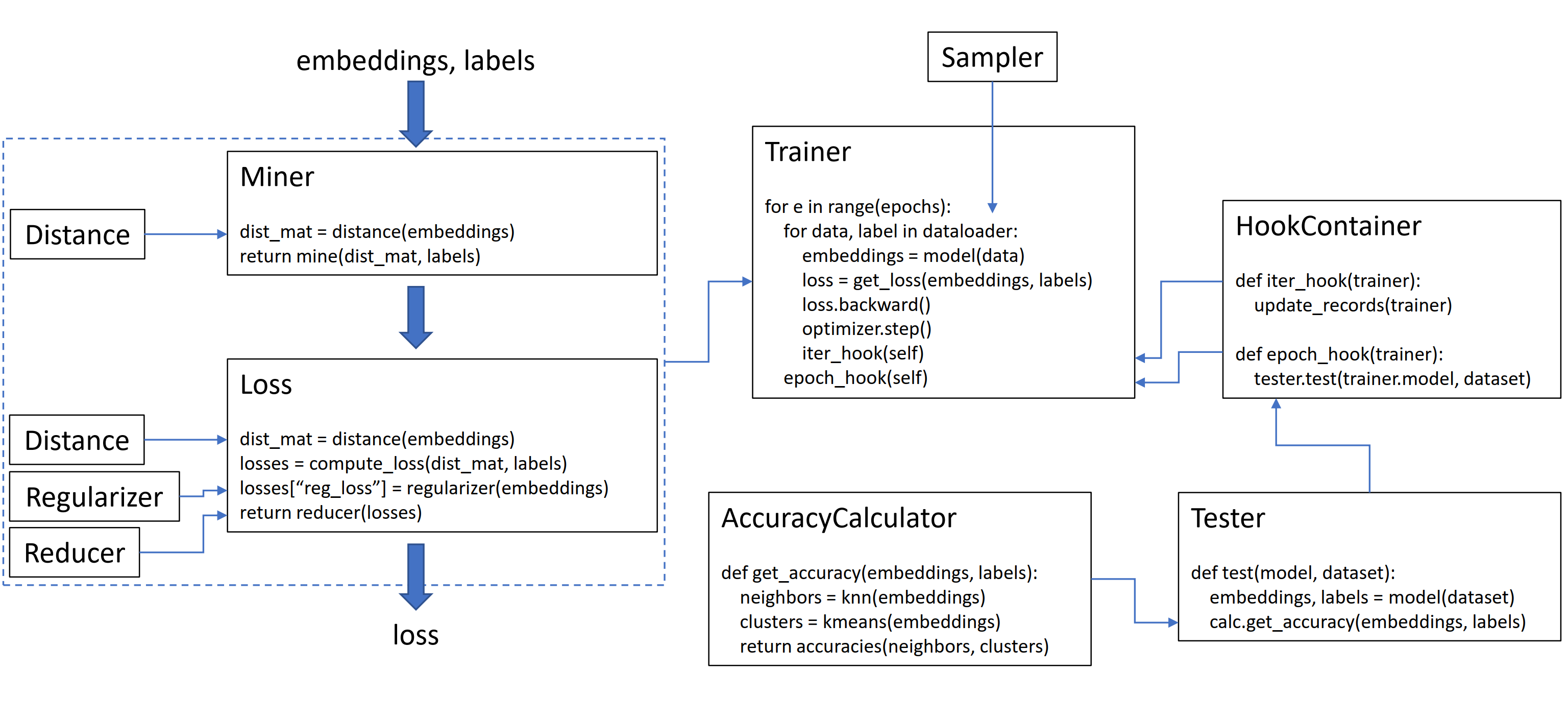
from pytorch_metric_learning import losses
loss_func = losses.TripletMarginLoss()
To compute the loss in your training loop, pass in the embeddings computed by your model, and the corresponding labels. The embeddings should have size (N, embedding_size), and the labels should have size (N), where N is the batch size.
# your training loop
for i, (data, labels) in enumerate(dataloader):
	optimizer.zero_grad()
	embeddings = model(data)
	loss = loss_func(embeddings, labels)
	loss.backward()
	optimizer.step()
The TripletMarginLoss computes all possible triplets within the batch, based on the labels you pass into it. Anchor-positive pairs are formed by embeddings that share the same label, and anchor-negative pairs are formed by embeddings that have different labels.
Sometimes it can help to add a mining function:
from pytorch_metric_learning import miners, losses
miner = miners.MultiSimilarityMiner()
loss_func = losses.TripletMarginLoss()
your training loop
for i, (data, labels) in enumerate(dataloader):
	optimizer.zero_grad()
	embeddings = model(data)
	hard_pairs = miner(embeddings, labels)
	loss = loss_func(embeddings, labels, hard_pairs)
	loss.backward()
	optimizer.step()
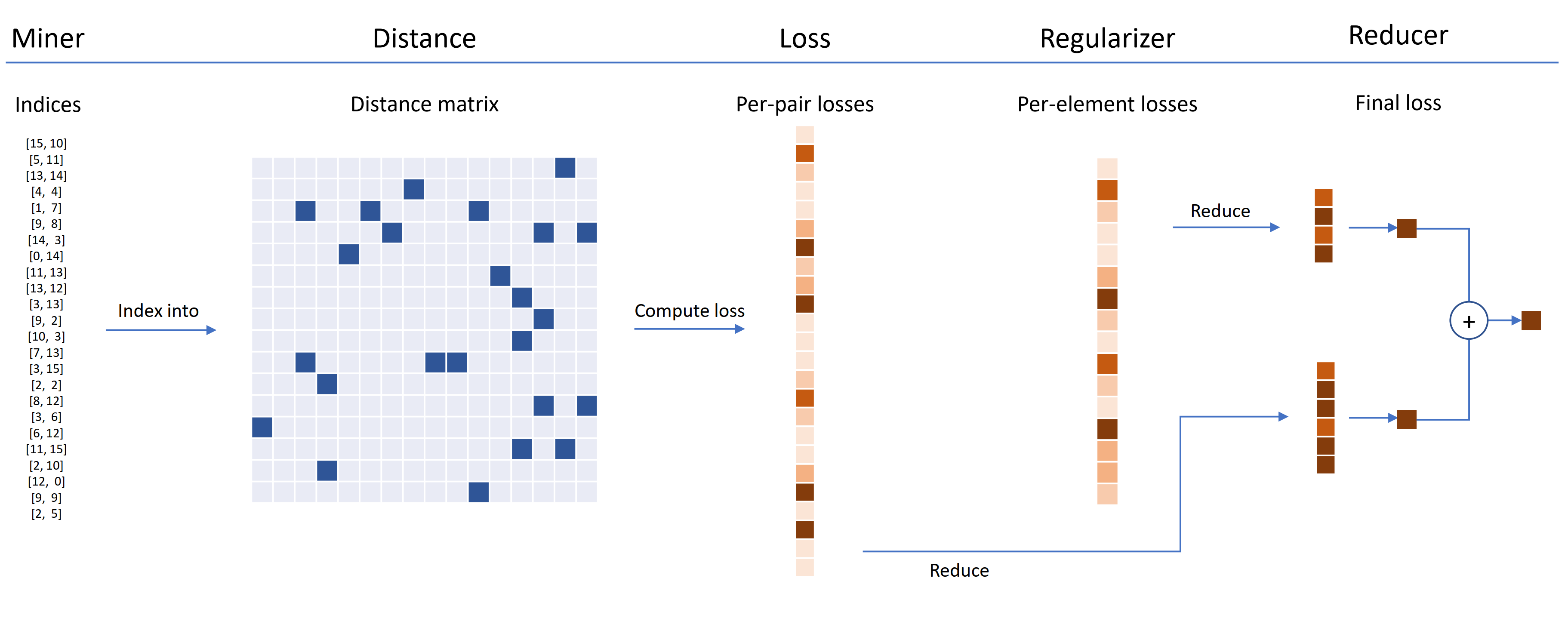
Now here's an example of a customized TripletMarginLoss:
from pytorch_metric_learning.distances import CosineSimilarity
from pytorch_metric_learning.reducers import ThresholdReducer
from pytorch_metric_learning.regularizers import LpRegularizer
from pytorch_metric_learning import losses
loss_func = losses.TripletMarginLoss(distance = CosineSimilarity(),
				     reducer = ThresholdReducer(high=0.3),
			 	     embedding_regularizer = LpRegularizer())
A SelfSupervisedLoss wrapper is provided for self-supervised learning:
from pytorch_metric_learning.losses import SelfSupervisedLoss
loss_func = SelfSupervisedLoss(TripletMarginLoss())
your training for-loop
for i, data in enumerate(dataloader):
	optimizer.zero_grad()
	embeddings = your_model(data)
	augmented = your_model(your_augmentation(data))
	loss = loss_func(embeddings, augmented)
	loss.backward()
	optimizer.step()
If you're interested in MoCo-style self-supervision, take a look at the MoCo on CIFAR10 notebook. It uses CrossBatchMemory to implement the momentum encoder queue, which means you can use any tuple loss, and any tuple miner to extract hard samples from the queue.
To learn more about all of the above, see the documentation.
pytorch-metric-learning >= v0.9.90` requires `torch >= 1.6 -
pytorch-metric-learning < v0.9.90` doesn't have a version requirement, but was tested with ``torch >= 1.2
Pip
To get the latest dev version:
To install on Windows:
To install with evaluation and logging capabilities
(This will install the unofficial pypi version of faiss-gpu, plus record-keeper and tensorboard):
To install with evaluation and logging capabilities (CPU)
(This will install the unofficial pypi version of faiss-cpu, plus record-keeper and tensorboard):
Conda
To use the testing module, you'll need faiss, which can be installed via conda as well. See the installation instructions for faiss.

Benchmark results
See powerful-benchmarker to view benchmark results and to use the benchmarking tool.
Development
Development is done on the git checkout dev
Unit tests can be run with the default ``unittest`` library:
python -m unittest discover
You can specify the test datatypes and test device as environment variables. For example, to test using float32 and float64 on the CPU:
TEST_DTYPES=float32,float64 TEST_DEVICE=cpu python -m unittest discover
To run a single test file instead of the entire test suite, specify the file name:
python -m unittest tests/losses/test_angular_loss.py
Code is formatted using ``black` and `isort``:
pip install black isort
./format_code.sh
| Contributor | Highlights |
| -- | -- |
|domenicoMuscill0| - ManifoldLoss
- P2SGradLoss
- HistogramLoss
- DynamicSoftMarginLoss
- RankedListLoss |
|mlopezantequera | - Made the testers work on any combination of query and reference sets
- Made AccuracyCalculator work with arbitrary label comparisons |
|cwkeam | - SelfSupervisedLoss
- VICRegLoss
- Added mean reciprocal rank accuracy to AccuracyCalculator
- BaseLossWrapper|
| ir2718 | - ThresholdConsistentMarginLoss
- SmoothAPLoss
- The Datasets module |
|marijnl| - BatchEasyHardMiner
- TwoStreamMetricLoss
- GlobalTwoStreamEmbeddingSpaceTester
- Example using trainers.TwoStreamMetricLoss |
| chingisooinar | SubCenterArcFaceLoss |
| elias-ramzi | HierarchicalSampler |
| fjsj | SupConLoss |
| AlenUbuntu | CircleLoss |
| interestingzhuo | PNPLoss |
| wconnell | Learning a scRNAseq Metric Embedding |
| mkmenta | Improved get_all_triplets_indices (fixed the INT_MAX error) |
| AlexSchuy | optimized ``utils.loss_and_miner_utils.get_random_triplet_indices`` |
| JohnGiorgi | ``all_gather`` in utils.distributed |
| Hummer12007 | ``utils.key_checker`` |
| vltanh | Made ``InferenceModel.train_indexer`` accept datasets |
| btseytlin | ``get_nearest_neighbors`` in InferenceModel |
| mlw214 | Added ``return_per_class`` to AccuracyCalculator |
| layumi | InstanceLoss |
| NoTody | Helped add ref_emb and ref_labels to the distributed wrappers. |
| ElisonSherton | Fixed an edge case in ArcFaceLoss. |
| stompsjo | Improved documentation for NTXentLoss. |
| Puzer | Bug fix for PNPLoss. |
| elisim | Developer improvements to DistributedLossWrapper. |
| lucamarini22 | |
| marcpaga | |
| GaetanLepage | |
| z1w | |
| thinline72 | |
| tpanum | |
| fralik | |
| joaqo | |
| JoOkuma | |
| gkouros | |
| yutanakamura-tky | |
| KinglittleQ | |
| martin0258 | |
| michaeldeyzel | |
| HSinger04 | |
| rheum | |
| bot66 | |
@article{Musgrave2020PyTorchML,
  title={PyTorch Metric Learning},
  author={Kevin Musgrave and Serge J. Belongie and Ser-Nam Lim},
  journal={ArXiv},
  year={2020},
  volume={abs/2008.09164}
}
 →→
→→ →
→ →→
→→ →
→ →
→