1
 →
→
AI-powered prompt optimization hook for Claude Code. Transforms simple prompts into comprehensive, structured instructions using Claude Opus 4.6's advanced reasoning capabilities.
johnpsasser/claude-code-prompt-optimizer is an open-source project on GitHub, mainly written in TypeScript. AI-powered prompt optimization hook for Claude Code. Transforms simple prompts into comprehensive It currently holds 47 stars and 4 forks with 0 open issues, and was last pushed on an unknown date (repository created unknown).
AI Homed tracks it on the AI Prompt Engineering board.
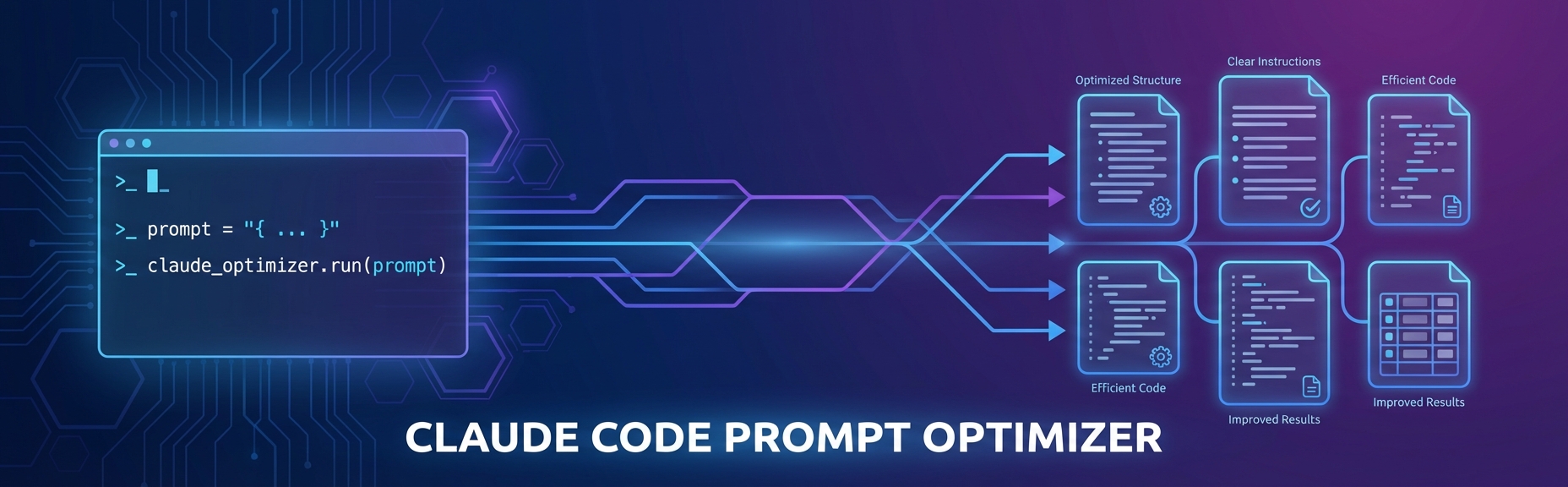

A Claude Code hook that transforms simple prompts into detailed, structured instructions. Add `` to any prompt and it'll expand your request into something Claude can really sink its teeth into.
When you tag a prompt with ``, this hook intercepts it and runs it through Claude's extended thinking mode. The result is a fleshed-out version of your original request with:
CLAUDE_CODE_OAUTH_TOKEN (Claude Pro/MAX subscribers)ANTHROPIC_API_KEY (API credit users)claude logingit clone https://github.com/johnpsasser/claude-code-prompt-optimizer.git
cd claude-code-prompt-optimizer
npm run install-hook
The installer handles dependencies, auth setup, hook configuration, and verification.
The Agent SDK checks for credentials in this order:
| Priority | Method | Variable | Best For |
|----------|--------|----------|----------|
| 1 | OAuth token | CLAUDE_CODE_OAUTH_TOKEN | Claude Pro/MAX subscribers |
| 2 | API key | ANTHROPIC_API_KEY | API credit users |
| 3 | Stored OAuth | (none — uses claude login) | Already logged in |
If CLAUDE_CODE_OAUTH_TOKEN is set, the API key is ignored. If neither env var is set, the Agent SDK falls back to stored OAuth credentials from claude login.
Auth resolution is adaptive and can be forced with OPTIMIZER_AUTH:
| OPTIMIZER_AUTH | Behavior |
|------------------|----------|
| auto (default) | An explicit CLAUDE_CODE_OAUTH_TOKEN wins. Inside a Claude Code session with no token, the (often invalid) parent-injected API key is stripped so the CLI uses your stored claude login. Outside Claude Code, a real ANTHROPIC_API_KEY is honored. |
| oauth | Always strip API keys and use OAuth / stored login. |
| apikey | Always keep ANTHROPIC_API_KEY (for pure API-credit users). |
# Get your token
claude auth token
Add to shell profile
export CLAUDE_CODE_OAUTH_TOKEN="your-oauth-token"
export ANTHROPIC_API_KEY="sk-ant-api03-..."
If you prefer to configure things yourself instead of using npm run install-hook:
git clone https://github.com/johnpsasser/claude-code-prompt-optimizer.git
cd claude-code-prompt-optimizer
npm install
Set one of the environment variables above in your shell profile.
Add the hook to ~/.claude/settings.json:
{
  "hooks": {
    "UserPromptSubmit": [
      {
        "hooks": [
          {
            "type": "command",
            "command": "/path/to/claude-code-prompt-optimizer/src/hooks/optimize-prompt.sh"
          }
        ]
      }
    ]
  }
}
chmod +x src/hooks/optimize-prompt.sh
Test it:
write a function to calculate fibonacci numbers
For detailed setup instructions and troubleshooting, see QUICKSTART.md.
Before:
create a REST API
After: The optimizer expands this into specs covering architecture, endpoints, error handling, auth, validation, and testing.
Before:
refactor this codebase for better performance
After: You get a structured plan with profiling steps, bottleneck identification, prioritized refactoring targets, and benchmarking criteria.
| Variable | Description | Default |
|----------|-------------|---------|
| CLAUDE_CODE_OAUTH_TOKEN | OAuth token for Claude Pro/MAX (optional if logged in) | - |
| ANTHROPIC_API_KEY | Anthropic API key (used if no OAuth token) | - |
| OPTIMIZER_AUTH | Auth strategy: auto, oauth, or apikey | auto |
| OPTIMIZER_MODEL | Override the optimization model | from config |
| OPTIMIZER_FALLBACK_MODEL | Model to retry with if the primary errors | from config |
| OPTIMIZER_EFFORT | Reasoning effort: low, medium, high, xhigh, max | from config |
| OPTIMIZER_TIMEOUT_MS | Abort + fall back to the original prompt after N ms | from config |
| DEBUG | Enable debug logging | false |
Debug logs go to /tmp/claude-code-hook-debug.log.
Model selection, per-model time budgets, the prompt-size cap, and the system
prompt live in src/hooks/optimizer.config.json and src/hooks/system-prompt.md,
so you can tune behavior without editing TypeScript. Environment variables above
take precedence over the config file.
{
  "matchSessionModel": true,
  "model": "claude-opus-5",
  "effort": "low",
  "maxPromptChars": 12000,
  "fallbackTimeoutMs": 30000,
  "defaultPolicy": { "budgetMs": 45000, "fallback": "claude-sonnet-5" },
  "modelPolicy": {
    "claude-opus-5":   { "budgetMs": 60000, "fallback": "claude-sonnet-5" },
    "claude-sonnet-5": { "budgetMs": 40000, "fallback": null }
  },
  "systemPromptFile": "system-prompt.md"
}
Session-model matching. With matchSessionModel enabled (the default), the
hook reads transcript_path from the hook payload and reuses the model that
produced the most recent assistant turn — so the prompt is rewritten by the
same model that will execute it, and mid-session /model switches are picked up
automatically. UserPromptSubmit carries no model field and there is no
$CLAUDE_MODEL, so the transcript is the only source for this. On the first
prompt of a session (no assistant turn yet) it falls back to model. Set
OPTIMIZER_MATCH_SESSION_MODEL=false to always use model instead.
Timeouts. Each model gets its own budgetMs from modelPolicy (Opus needs
roughly twice Sonnet's wall time for the same rewrite). If the primary times out
or errors, the chain advances to fallback with fallbackTimeoutMs; only when
every attempt is exhausted does the hook fail open and pass the prompt through
unmodified.
Keep the inner budgets under the outer hook timeout. Claude Code lowers the
UserPromptSubmitcommand-hook default to 30s, sohooks/hooks.jsonsets an
explicit"timeout": 120.budgetMs + fallbackTimeoutMsmust stay comfortably
below that value — if the outer timeout fires first, Claude Code kills the
process and the fail-open path never runs.
effort defaults to low: prompt optimization is a single-turn rewrite, not a
reasoning task, so minimal thinking keeps latency inside the budget. Raise it if
you want the optimizer to deliberate more.
maxPromptChars (default 12,000) short-circuits very long prompts — a pasted
document cannot be rewritten inside any sane budget, and attempting it was the
most reliable way to burn the entire hook timeout for nothing.
The hook always writes to /tmp/claude-code-prompt-optimizer.log (override with
OPTIMIZER_LOG_FILE), recording the chosen model and its source, elapsed time
per attempt, timeouts, and fail-open reasons. Prompts without an ``
tag short-circuit before any logging, so the common path stays free.
2026-08-20T04:24:26Z start session=abc chars=1204 model=claude-opus-5 source=session
2026-08-20T04:25:03Z ok model=claude-opus-5 effort=low ms=36294
claude-code-prompt-optimizer/
├── src/hooks/
│   ├── optimize-prompt.ts     # Core optimization logic (Agent SDK)
│   ├── optimize-prompt.sh     # Shell wrapper (fast-path short-circuit)
│   ├── optimizer.config.json  # Model matching, per-model budgets, size cap
│   └── system-prompt.md       # Editable optimization system prompt
├── scripts/
│   └── install.js             # Automated installer (symlinks into ~/.claude)
├── examples/                  # Usage examples
└── QUICKSTART.md              # Installation guide
1. The shell wrapper inspects every prompt and short-circuits in bash when there's no `` tag — no Node, no SDK load, no added latency on normal prompts 2. When tagged, it sends your prompt to Claude via the Agent SDK with a custom system prompt, under an overall timeout 3. Returns the expanded prompt back to Claude Code (falling back to your original prompt on timeout/error)
The optimizer uses the Claude Agent SDK (@anthropic-ai/claude-agent-sdk) which handles authentication automatically — OAuth tokens, API keys, and stored credentials all work seamlessly.
Hook not triggering:
chmod +x src/hooks/optimize-prompt.shCLAUDE_CODE_OAUTH_TOKEN or ANTHROPIC_API_KEY is exportedclaude login worksDEBUG=true to see which auth method is activenpm install```bash
→ →
→ →
→ →
→ →
→ →
→ →
→ →
→