
1
 →
→jenissimo/unfake.js is an open-source project on GitHub, mainly written in JavaScript. Fix AI pixel art and vector images right in your browser It currently holds 920 stars and 59 forks with 0 open issues, and was last pushed on an unknown date (repository created unknown).
AI Homed tracks it on the AI Image Projects board and on the AI AI Image Projects list.
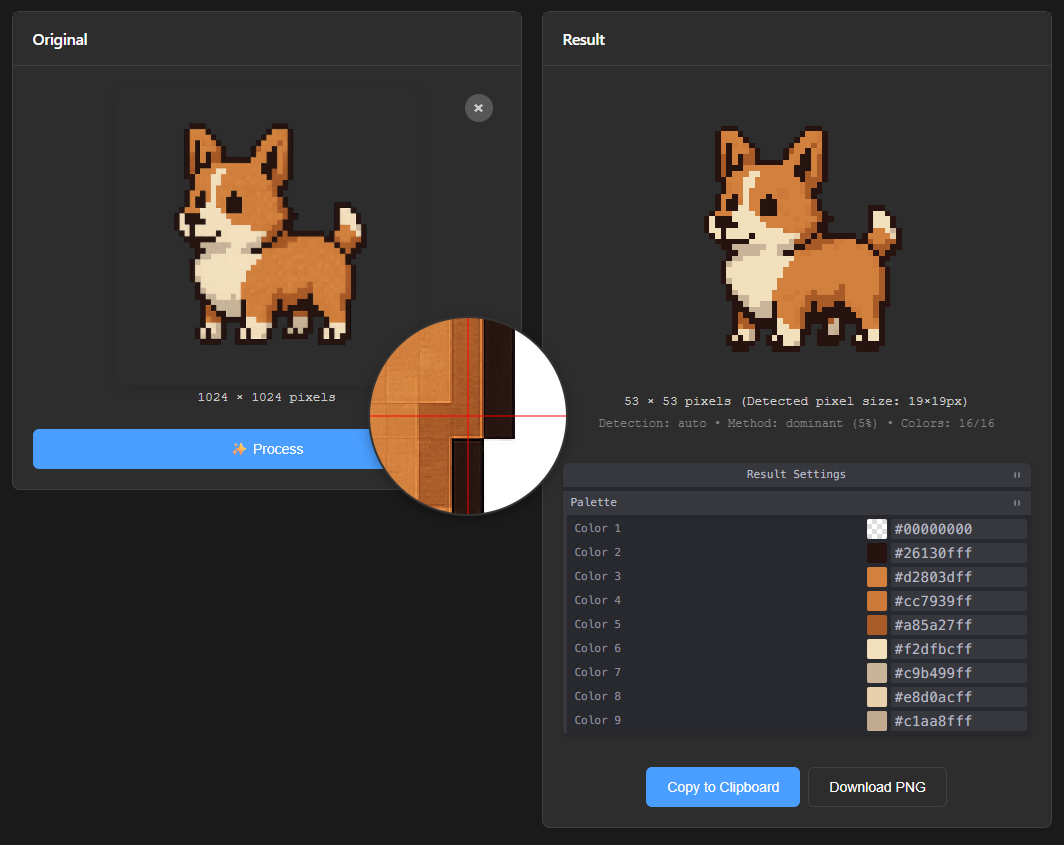
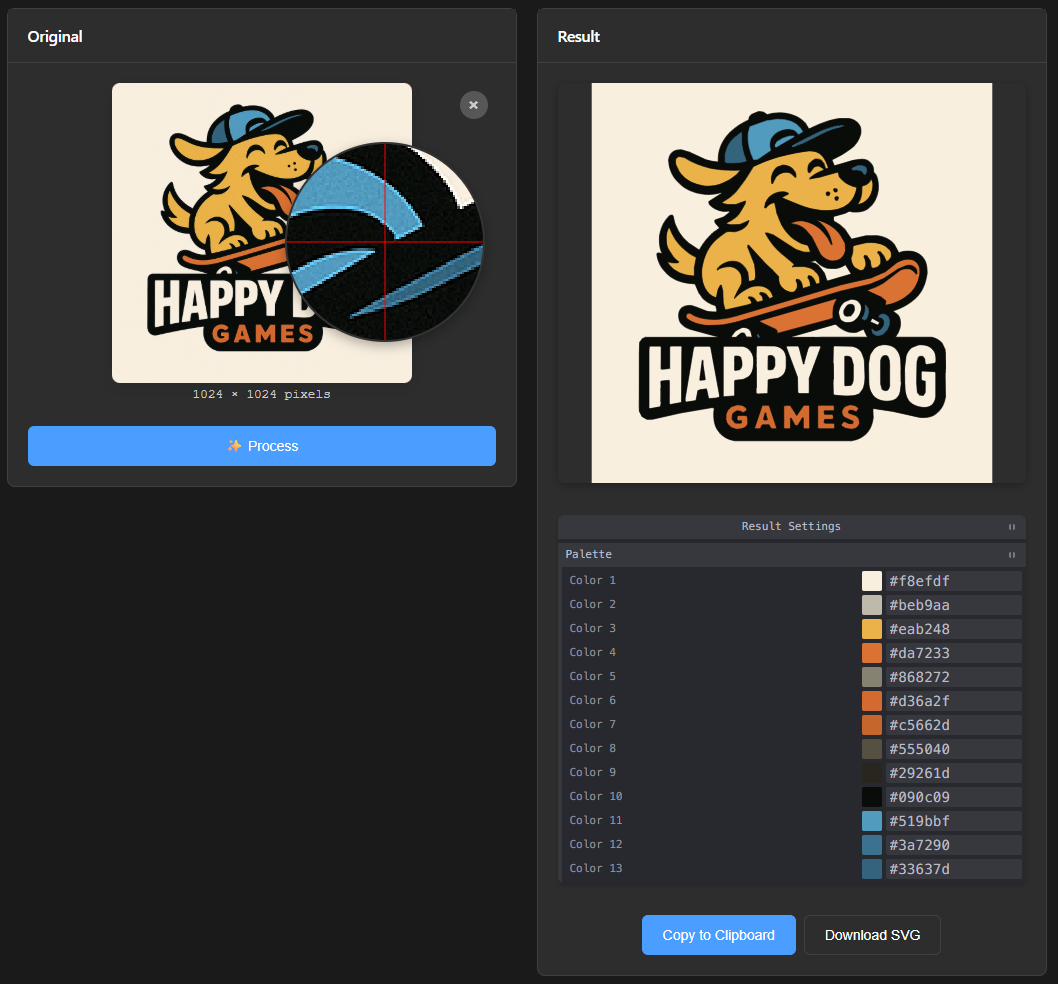
unfake.js is a versatile JavaScript library designed to bridge the gap between AI-generated images and clean, usable assets. It offers two primary modes of operation: a powerful Pixel Art Processor and a sophisticated Image Vectorizer. The library is bundled with a feature-rich browser-based tool for easy, interactive use.
Deep-Dive Articles
Want to learn more about how it works under the hood? Check out these in-depth articles on the pixel art cleanup pipeline:
runs-based or edge-aware algorithms. It can also accept a manual scale factor.dominant, median, content-adaptive, etc.) to reduce the image to its native 1x scale without introducing new colors or blurriness.imagequant (libimagequant) in the WASM core, with support for fixed custom palettes.imagetracer.js with extensive pre- and post-processing capabilities powered by the unfake-core WASM filters.
Bilateral or Median blur before vectorization to reduce noise and create smoother outlines.imagetracer.js options for fine-grained control over the final vector output.The project includes a browser-based tool (/browser-tool) that provides a user-friendly interface for all of the library's features.
Tweakpane panel to adjust all processing parameters in real-time..png for pixel art, .svg for vector) or copy it directly to the clipboard.⚠️ You need a local server!
> Modern browsers do not allow ES module imports (importmap, type="module") from local files (file://). To use the browser tool, you must run it via a local http(s) server.
Quick ways to start a server:
  python -m http.server 8080
  # or
  python3 -m http.server 8080
npx http-server -p 8080
browser-tool folder.
---
1. Start a local server using one of the methods above.
2. Open http://localhost:8080/browser-tool/ in your browser (or the port you chose).
3. Upload an image, tweak the settings, enjoy!
unfake.js) in Your Own ProjectThe library is written as ES modules. You can import and use its core functions processImage and vectorizeImage.
1. Pixel Processing Example:
import unfake from './lib/index.js';
const fileInput = document.getElementById('my-file-input');
const file = fileInput.files[0];
const options = {
file: file,
maxColors: 32,
detectMethod: 'auto', // 'auto', 'runs', 'edge'
downscaleMethod: 'dominant',
snapGrid: true,
cleanup: {
morph: true,
jaggy: true
}
};
try {
const { png, imageData, palette, manifest } = await unfake.processImage(options);
// png is a Uint8Array of the final PNG file
const blob = new Blob([png], { type: 'image/png' });
const url = URL.createObjectURL(blob);
// Now you can use the URL for an ![]() tag or download link
document.getElementById('result-image').src = url;
tag or download link
document.getElementById('result-image').src = url;
} catch (error) {
console.error("Pixel processing failed:", error);
}
2. Vectorization Example:
import unfake from './lib/index.js';
const fileInput = document.getElementById('my-file-input');
const file = fileInput.files[0];
const options = {
    file: file,
    preProcess: {
        enabled: true,
        filter: 'bilateral',
        value: 15
    },
    quantize: {
        enabled: true,
        maxColors: 'auto' // or a number like 16
    },
    // imagetracer.js options
    ltres: 1,
    qtres: 1,
};
try {
    const { svg, palette, manifest } = await unfake.vectorizeImage(options);

    // svg is a string containing the SVG markup
    document.getElementById('result-container').innerHTML = svg;
} catch (error) {
    console.error("Vectorization failed:", error);
}
The image-processing core lives in unfake-core, a headless Rust crate compiled to WebAssembly for the browser tool and to a native binary for the CLI (crates/; unfake detect / snap / downscale / quantize, with fixed palettes, a reserved chroma color, and a JSON pipeline manifest). It owns scale detection, grid snapping, downscaling (dominant / median / mode / mean / qvote), morphological cleanup, color quantization (imagequant), content-adaptive downscaling, the vector pre/post filters, and PNG encoding — no OpenCV. The JavaScript layer in browser-tool/ is a thin interface: file I/O, canvas, the Tweakpane UI, and calls into the WASM core.
bun run core:wasm   # build the WASM core into browser-tool/vendor/unfake-core/
bun run core:test   # cargo test
bun run core:eval   # CLI scale-detection eval on the bghira corpus
imagequant for quantization and the png crate for encoding.This project is licensed under the MIT License. See the LICENSE file for details.
→ →
→ →
→ →→
→→ →
→ →
→ →
→