1
 →

:sunrise: A comprehensive, cutting-edge open-source framework for next-generation Transformers, with compute-matched benchmarking and a platform for autonomous architecture research.
Interactive-Active-AI/NextTransformer is an open-source project on GitHub, mainly written in Python. :sunrise: A comprehensive, cutting-edge open-source framework for next-generation Transformers It currently holds 200 stars and 12 forks with 3 open issues, and was last pushed on 2026-11-03 (repository created 2026-10-31).
AI Homed tracks it on the Today's Trending board, currently at rank #86 with 0 new stars today.




English · 简体中文
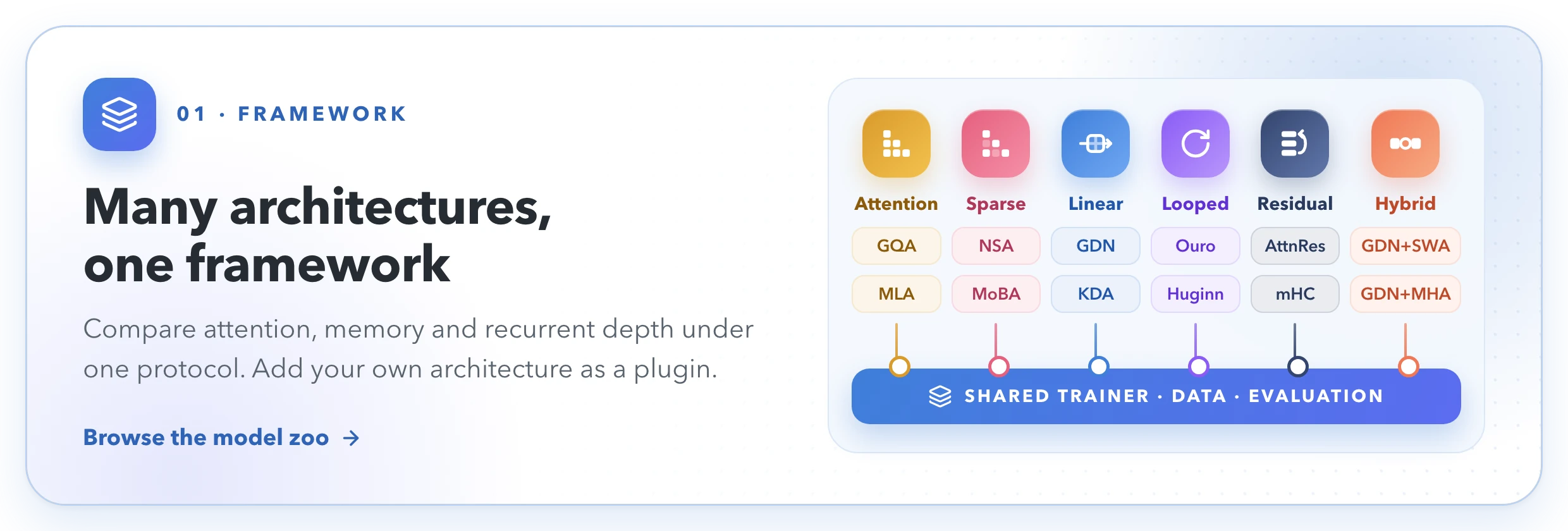
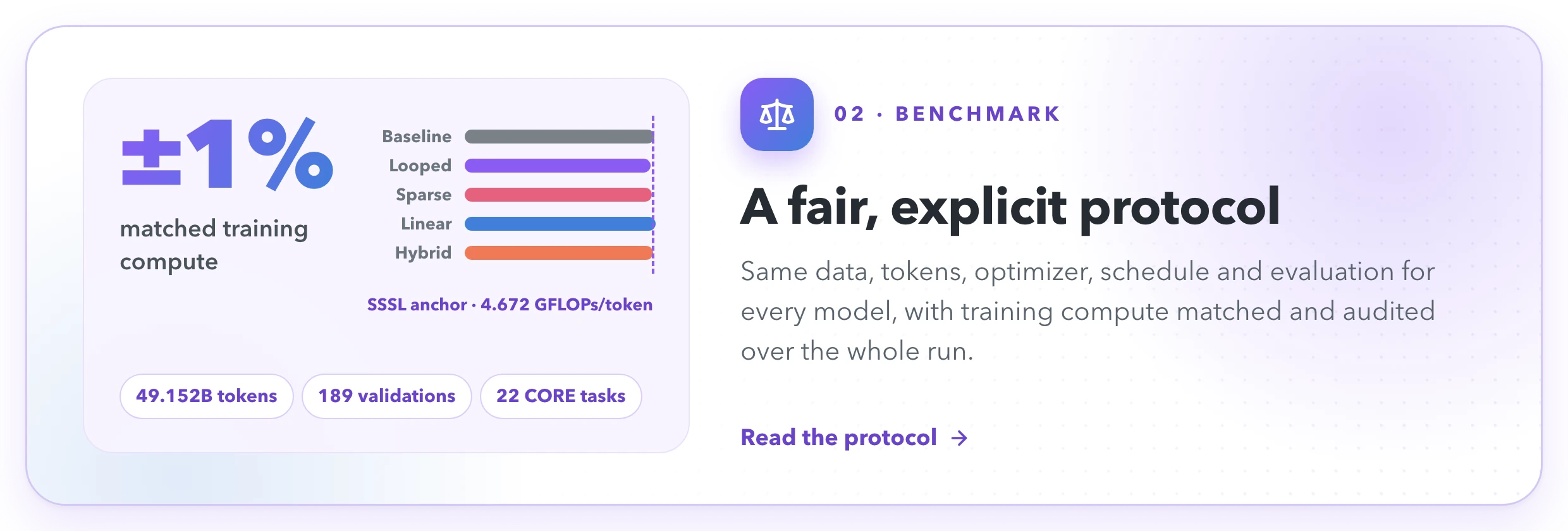
When the training budget is fixed, how should a language model spend its computation? NextTransformer trains recurrent depth, sparse and linear attention, residual-stream variants and hybrids on the same data, for the same 49.152B tokens, at the same theoretical training FLOPs per token, and evaluates them at the same checkpoints. Every result is an audited, file-backed record, and AI agents can research new architectures under the very same rules.
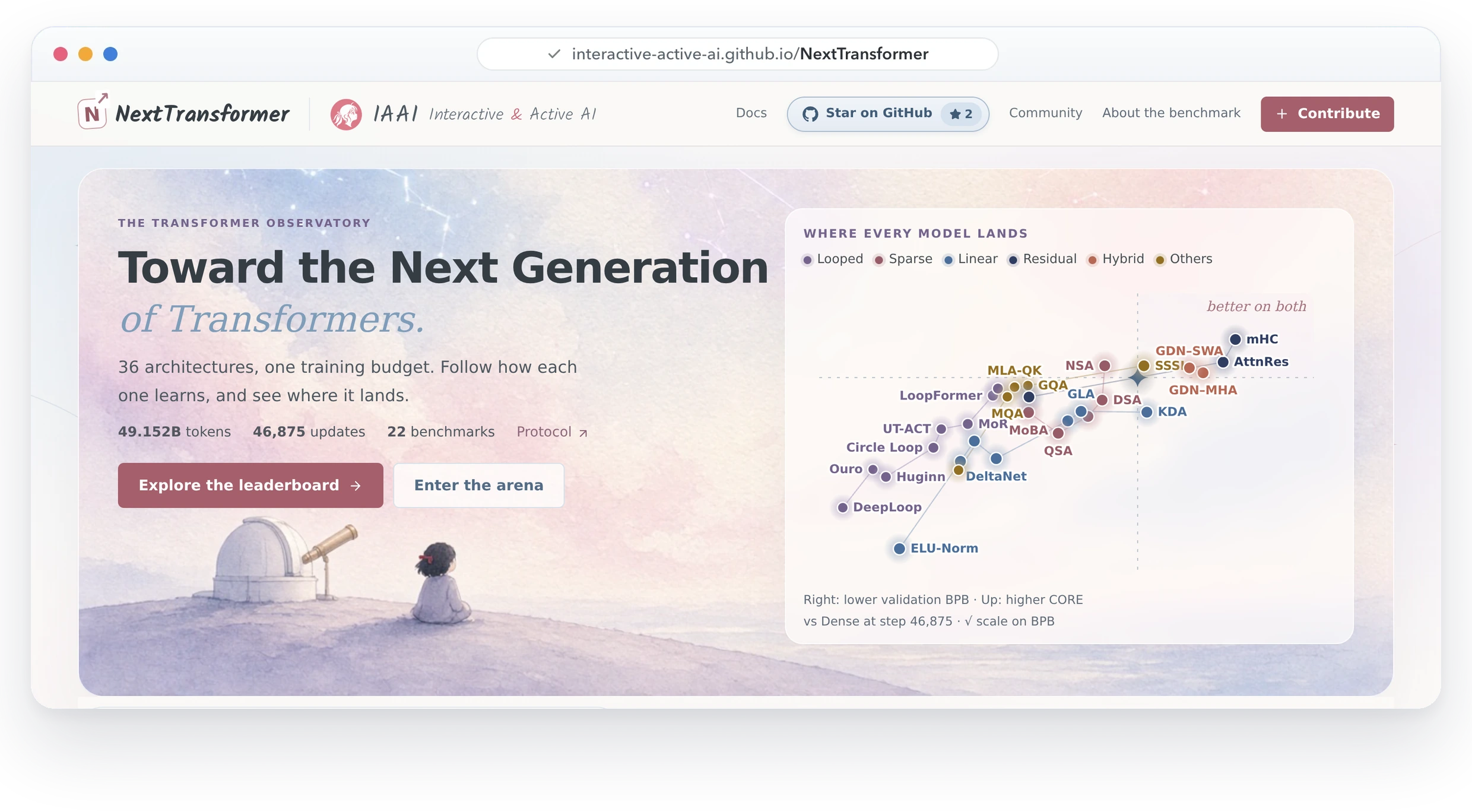
Learning curves of every run, a replayable leaderboard, all 22 CORE tasks, architecture diagrams and model cards, in your browser.
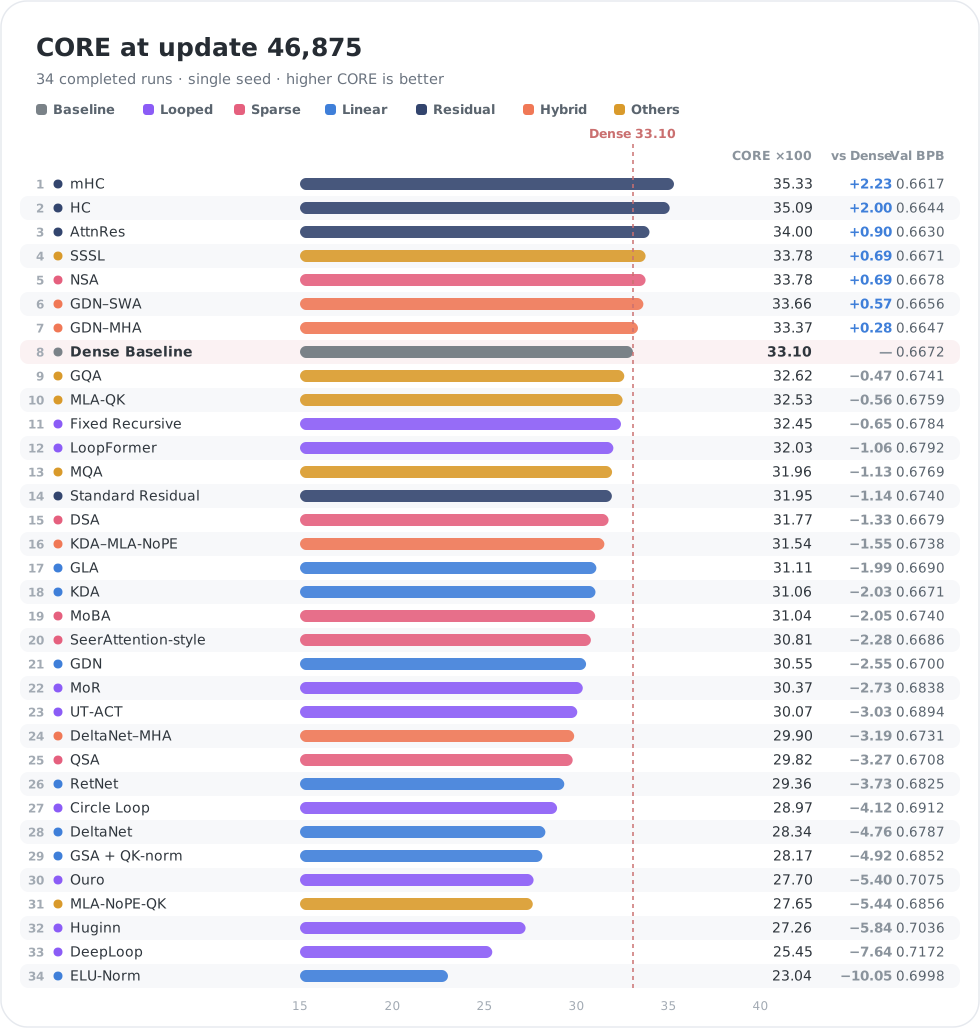
Full leaderboard · Training replay
1. Install (Linux, NVIDIA GPUs, uv):
git clone https://github.com/Interactive-Active-AI/NextTransformer.git && cd NextTransformer
uv sync --frozen --extra gpu --extra upstream && source .venv/bin/activate
uv pip install --no-deps --require-hashes -r requirements/linear.txt   # linear-attention kernels
2. Prepare the data (ClimbMix at a pinned revision, about 600 GB, plus the tokenizer and CORE bundle):
cp site.native.example.json site.local.json        # set runtime_dir, resources and data_dir
hf download karpathy/climbmix-400b-shuffle --repo-type dataset \
  --revision 915333b4f8b8684f39aeaafea600fea6f43fb703 --local-dir /path/to/climbmix-400b-shuffle
source launch/env.sh --site-config site.local.json
python -m nexttransformer.prepare --site-config site.local.json
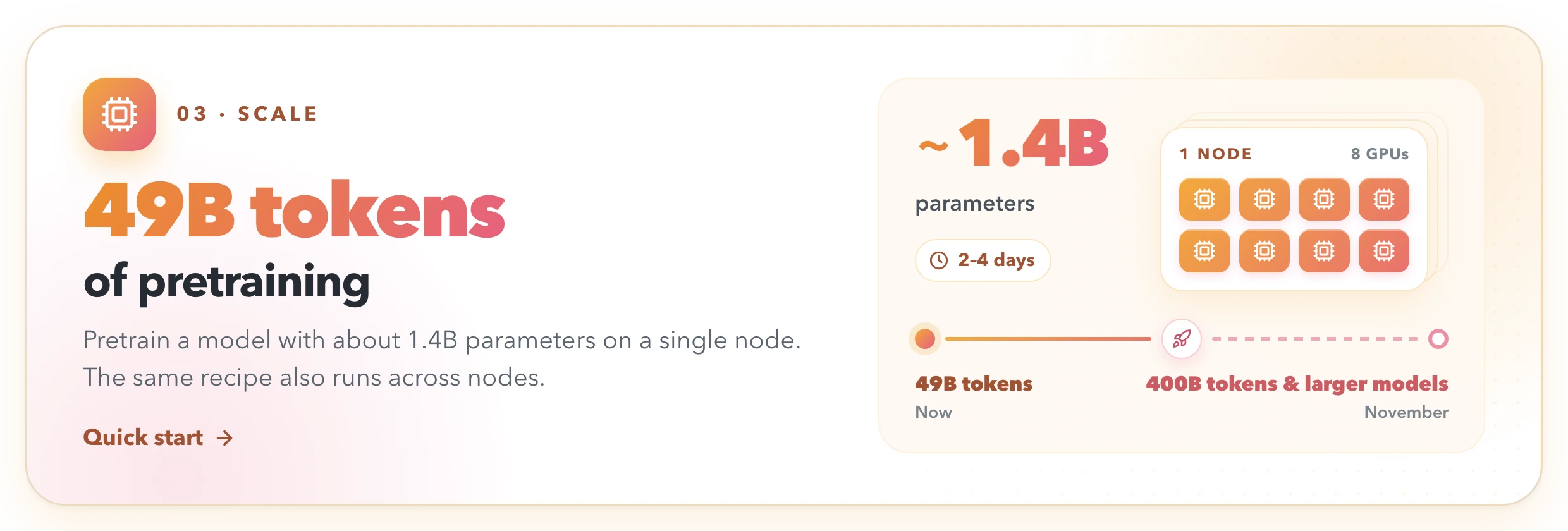
3. Train on one node with 8 GPUs:
launch/train.sh --config configs/baseline/dense_full.json --site-config site.local.json \
  --output runs/dense_full --micro-batch 8 --formal --resume auto
4. Multi-node training (2 nodes × 8 GPUs)
Install uv pip install accelerate==1.15.0 in the training environment. Submit one distributed job with the following per-node entry point. Map the platform's node rank, main node address and port to the three variables shown:
export FLA_DISABLE_BACKEND_DISPATCH=1   # registered FLA Triton path (linear and hybrid methods)
accelerate launch --config_file launch/accelerate.yaml \
  --machine_rank "$NODE_RANK" --main_process_ip "$MASTER_ADDR" --main_process_port "$MASTER_PORT" \
  -m nexttransformer.train --config configs/linear/gdn.json --site-config site.local.json \
  --output runs/gdn --micro-batch 16 --formal
On Slurm, submit sbatch launch/slurm.sbatch for the same example. The batch script gets the launch parameters from the allocation. Cluster setup and other node counts
Evaluation runs on schedule during training. The quick start guide covers smoke tests, evaluation, auditing and exporting a result.
| Family | Models |
|---|---|
| | Dense Baseline |
|
| Standard Residual · AttnRes · HC · mHC |
|
| UT-ACT · Fixed Recursive · Huginn · Ouro · DeepLoop · MoR · LoopFormer · Circle Loop |
|
| DSA · QSA · NSA · SeerAttention-style · MoBA |
|
| DeltaNet · GSA + QK-norm · GLA · KDA · RetNet · ELU-Norm · GDN |
|
| GDN–MHA · GDN–SWA · DeltaNet–MHA · KDA–MLA-NoPE · GDN–QSA\ · MoBA–MHA\ |
|
| SSSL · MQA · GQA · MLA-QK · MLA-NoPE-QK |
\* Results coming soon. Papers, adaptations and configurations are in the model zoo.
| | | |---|---| | Data | ClimbMix at a pinned revision · one 32,768-token tokenizer · 2,048-token context · one global sample order | | Budget | 49.152B input tokens · 46,875 updates of 1,048,576 tokens · seed 42 | | Compute | 4.672 GFLOPs per input token (forward, backward, auxiliary and optimizer work); ±1% at admission, ±2% over the run | | Evaluation | Validation BPB at 189 points · full CORE-22 at six checkpoints · an independent final BPB | | Baseline | Dense: full causal attention in every layer, trained under the same budget |
Parameters, memory and speed are outcomes, not controls. The protocol explains every rule and the compute accounting what is counted.
1. Write a plugin: a folder nexttransformer/methods// with a method.json and a few hooks. No shared file changes.
2. Calibrate it to the shared budget: python -m nexttransformer.protocol.calibrate --methods ...
3. Open a pull request. Once admitted, train it with --formal and submit the result in a second pull request.
Start with the plugin guide and CONTRIBUTING.md.
[!NOTE]
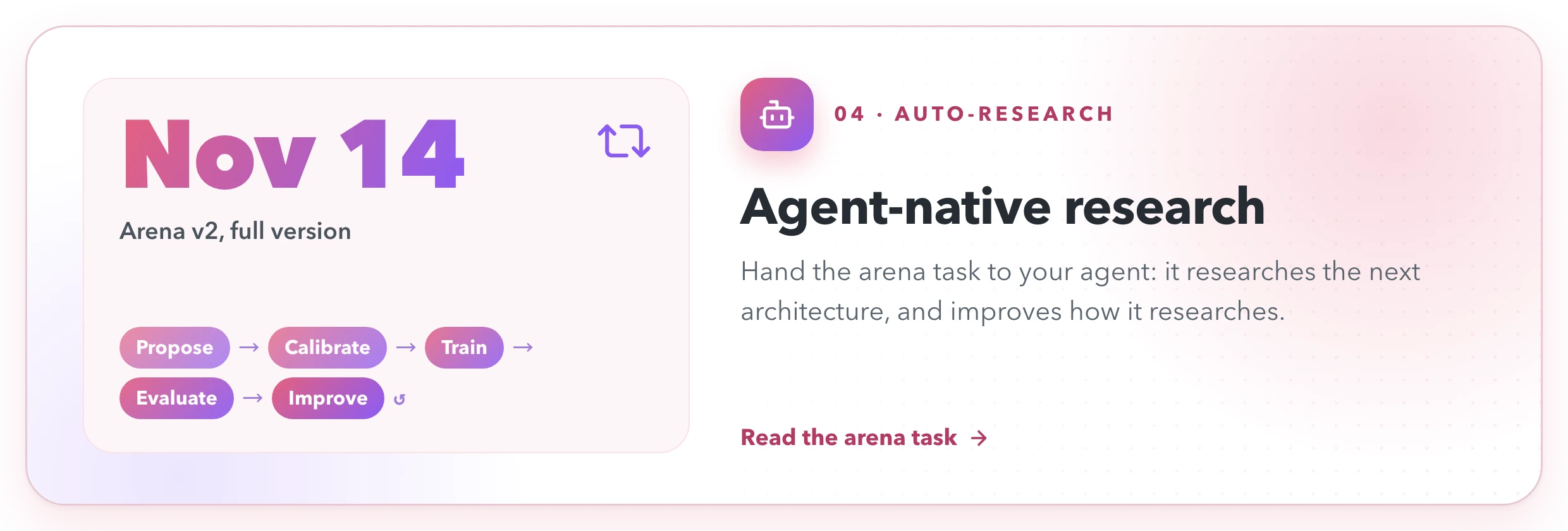
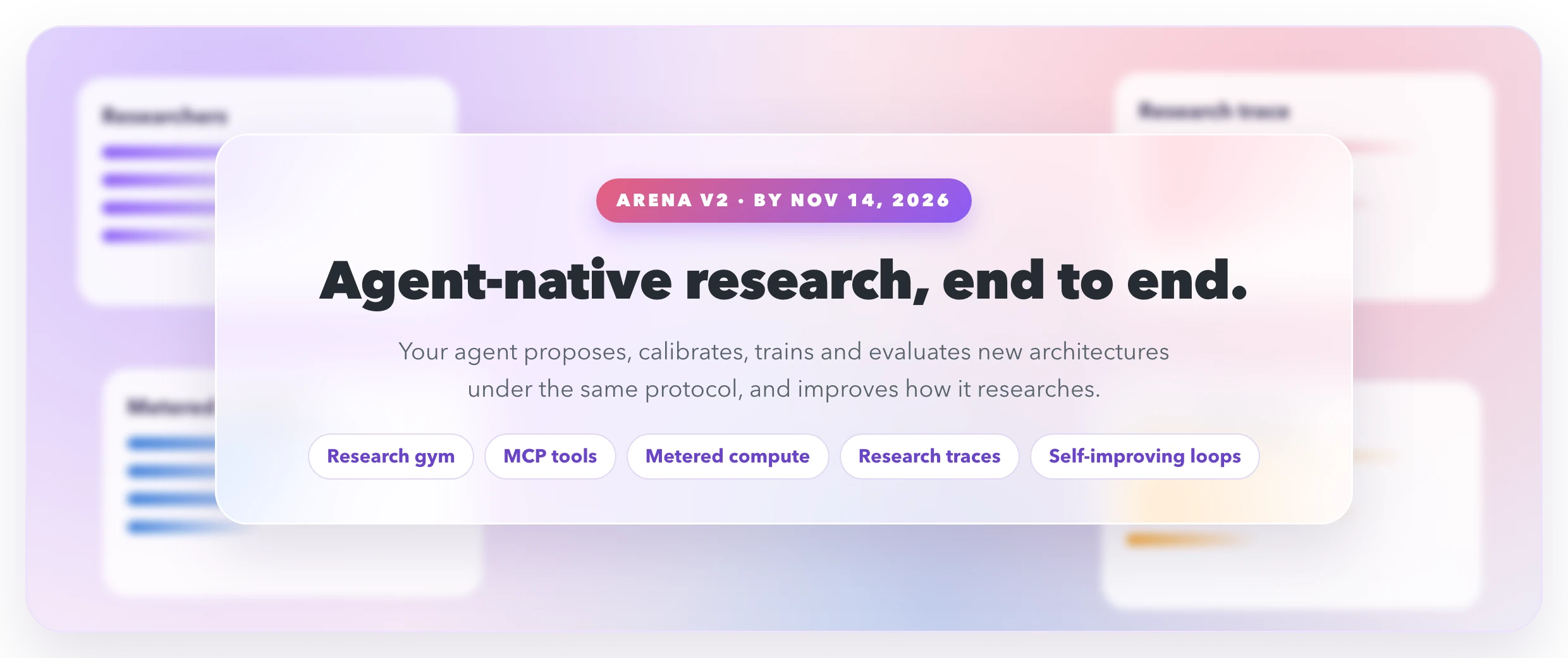
The arena is in active development. Arena v2, with full support for autonomous agent research (a research gym
with MCP tools, metered compute, research traces and self-improving research loops), ships by November 14, 2026.
Any LLM, with or without a research framework, can already enter an architecture today: it is trained under the same protocol, ranked on the same leaderboard, and disclosed with how it was found. See the arena.
@software{nexttransformer2026,
  title   = {NextTransformer: An Open Framework and Fair Benchmark for Next-Generation Transformer Architectures},
  author  = {{NextTransformer contributors}},
  year    = {2026},
  version = {0.1.0},
  url     = {https://github.com/Interactive-Active-AI/NextTransformer}
}
NextTransformer builds on nanochat and ideas from modded-nanogpt, uses flash-linear-attention kernels, and trains on ClimbMix. We thank the authors of every method in the zoo. Released under the MIT License; see third-party notices.
→ →
 →
 →
 →
 →
 →
 →