1
 →
→
Local AI music studio unifying ACE-Step 1.5 and YuE2-3B in one Vue interface — text-to-music generation, stem separation, MIDI transcription, and LoRA fine-tuning, with a built-in multitrack DAW.
inikolax/remiqora is an open-source project on GitHub, mainly written in Vue. Local AI music studio unifying ACE-Step 1.5 and YuE2-3B in one Vue interface — text-to-music generation, stem separation, MIDI transcription It currently holds 106 stars and 15 forks with 0 open issues, and was last pushed on an unknown date (repository created unknown).
AI Homed tracks it on the Today's Trending board, currently at rank #96 with 0 new stars today.
English · Русский

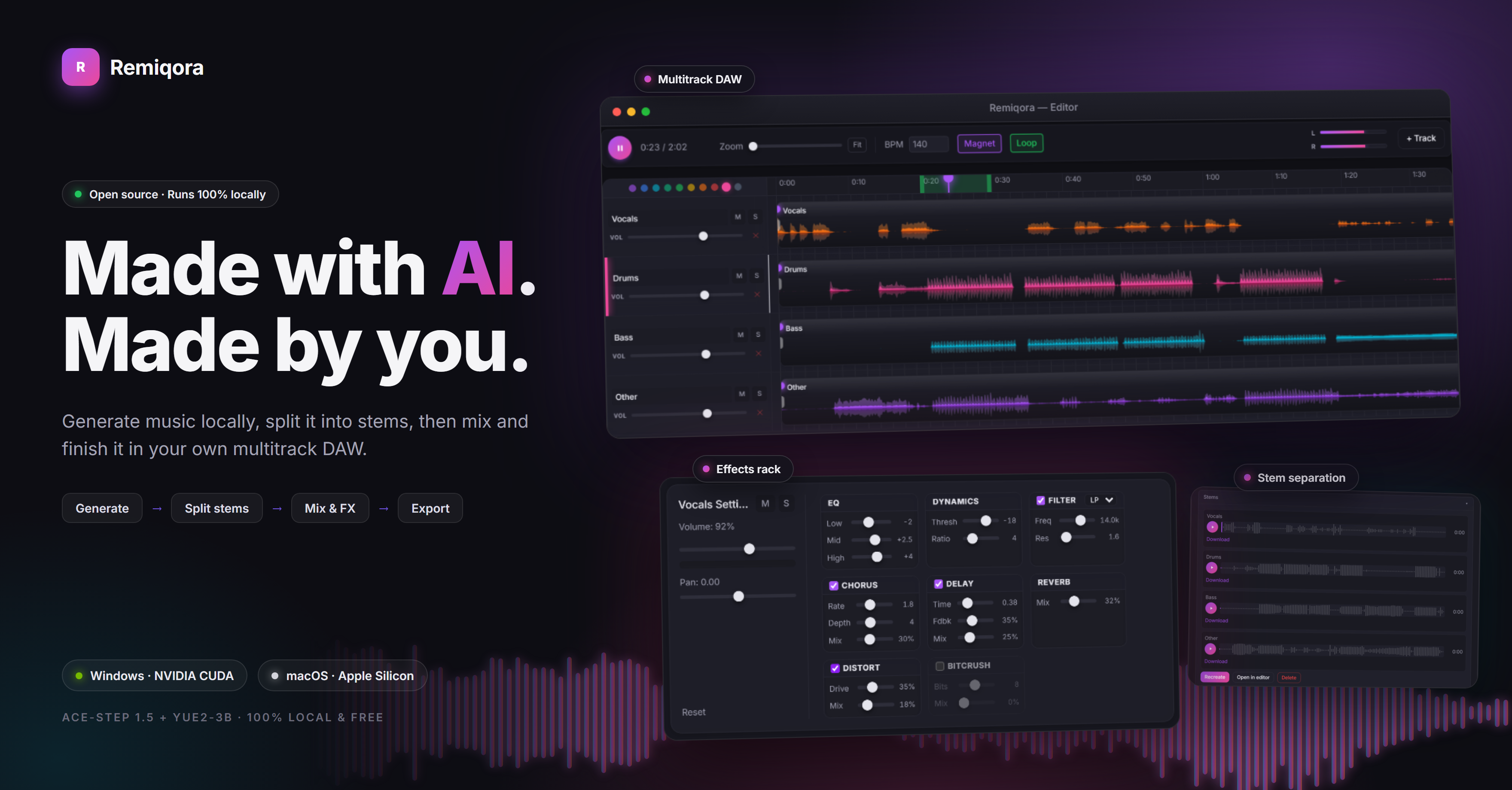
Made with AI. Made by you.
A local, GPU-powered music generation and production studio — one interface for ACE-Step 1.5 and YuE2-3B, with a built-in multitrack DAW.
🚧 Actively in development — expect breaking changes, bugs, and rough edges. Not a stable release yet.
Why · What's inside · ACE-Step · YuE2 · LoRA · DAW · Built with · License · Installation
---
ACE-Step and YuE2 are two independent music generation engines, each with its own web UI, its own result-storage format, and its own process that has to be started and stopped by hand. They typically cannot run simultaneously on a single consumer GPU. Remiqora solves this with a single layer on top:
| Module | What it does | |---|---| | ACE-Step 1.5 | Fast generation from text/style tags, covers, section repainting, extracting/adding parts on top of a reference track. | | YuE2-3B | Full-length track generation with CoT score planning (a symbolic ABC plan before the audio). | | SheetSage2 | Extracts melody and harmony from a reference track into ABC notation — used as YuE2's input. | | LoRA training | Dataset → auto-labeling → preprocessing → training → export — the whole ACE-Step fine-tuning pipeline for your own voice/style, in the browser. | | Demucs | Splits any track into 4 stems: vocals, drums, bass, other. | | MuScriptor | Transcribes audio (the full mix or a single stem) into MIDI notes. | | Built-in DAW | A multitrack timeline editor for assembling tracks/stems into a final mix: an effects rack on every channel, auto-BPM and time-stretch, WAV/MP3 export. |
The interface is fully bilingual (Russian/English, switcher in the header).
---
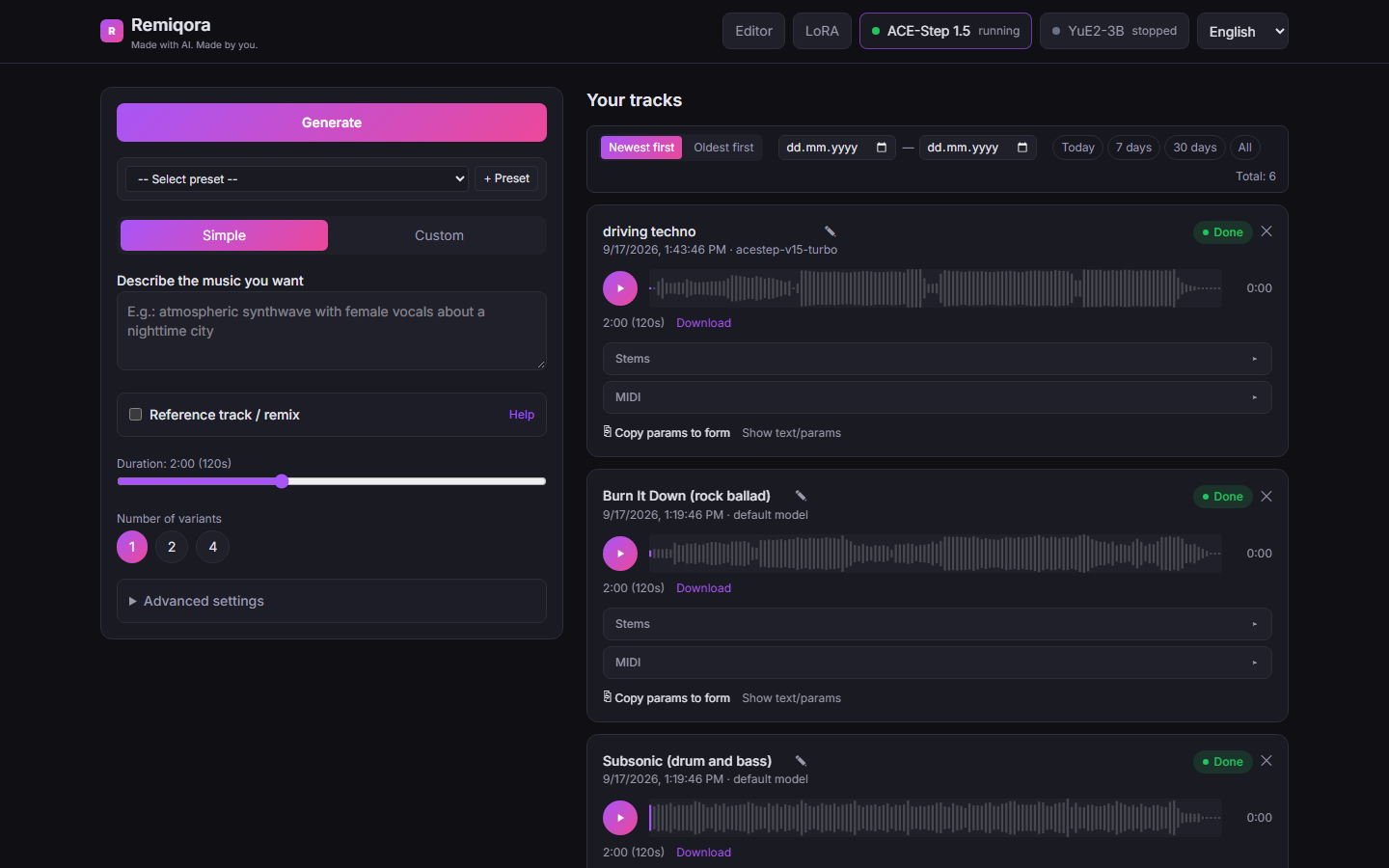
Two input modes: “Simple” — a single text description the model uses to infer both style and lyrics on its own; and “Custom” — style tags with autocomplete plus lyrics with structure markup ([Verse]/[Chorus]/[Bridge]) and performance annotations ((whisper), (falsetto)), or an “Instrumental” checkbox.
Attaching a reference track unlocks 5 remix scenarios:
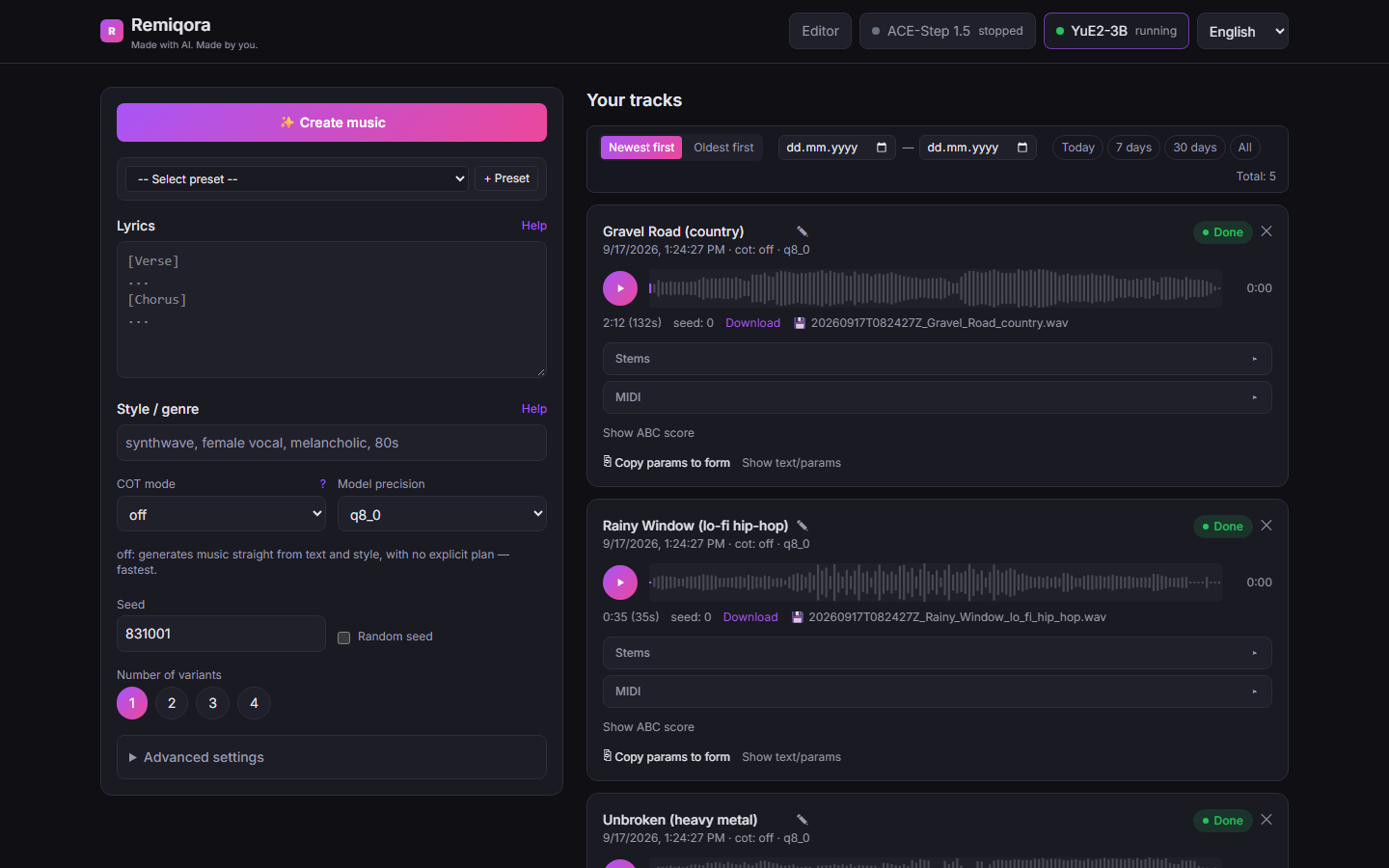
Three CoT (Chain-of-Thought) modes: off — straight to audio; melody — the arrangement is built around a given melody (ABC); full — the model first builds a symbolic plan (melody + chords), then generates the audio.
SheetSage2 lets you upload a reference track and pull its melody into ABC notation, right in the form, with one click — editable by hand afterwards. Beyond that: q8_0/q4_0 precision, batch of 1–4, a full set of sampling parameters for audio generation and the ABC planner separately, local presets, and viewing/reusing the ABC score of an already-generated track.
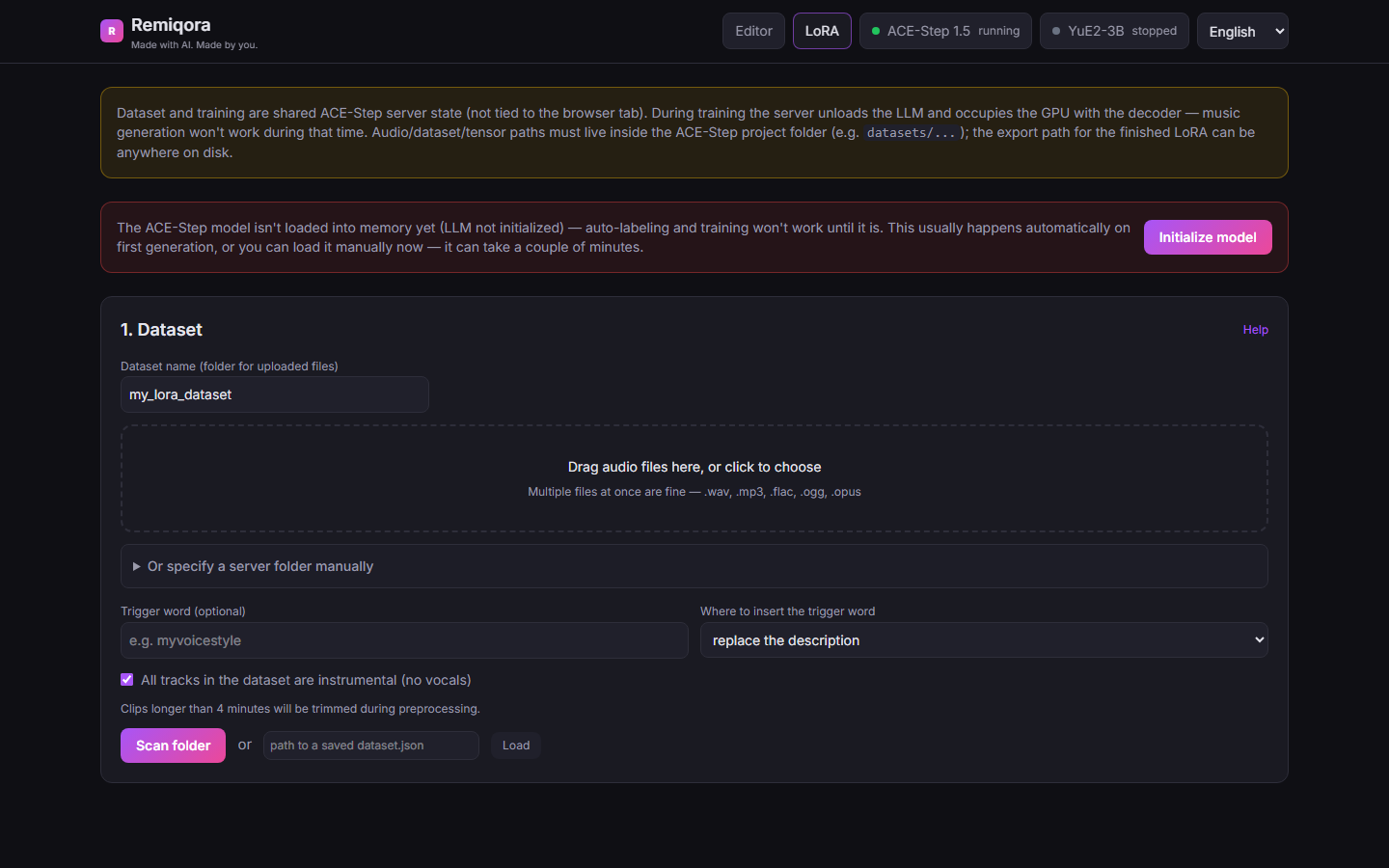
The full ACE-Step fine-tuning pipeline on your own dataset, no console required:
1. Dataset — upload audio files straight from the browser (drag & drop) or point at an existing server folder, a trigger word, an "all tracks are instrumental" flag. 2. Automatic labeling — LLM-generated description, genre, BPM/key, lyrics transcription/reformatting. 3. Review and edit — a table of every sample where you can fix the description/genre/tags before training. 4. Preprocessing — converts labeled samples into tensors. 5. Training — LoRA rank/alpha/dropout, learning rate, epochs, batch size, FP8, gradient checkpointing, live progress with an ETA and a TensorBoard link. 6. Export and registry — the finished adapter is immediately added to the LoRA list on the generation form.
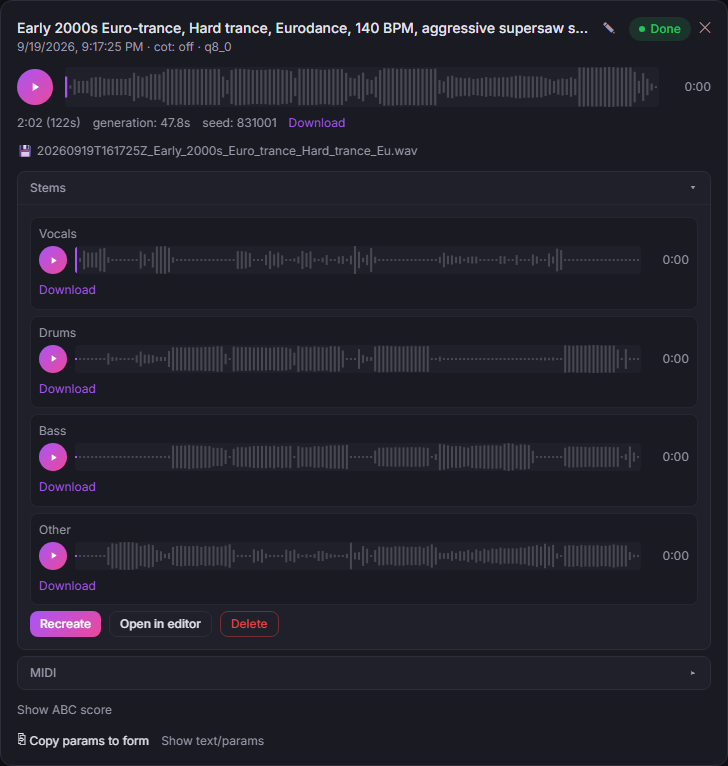
One click splits any saved track into 4 isolated stems (Demucs htdemucs), with a progress bar, a separate player and download per stem, and the option to redo or delete. Runs alongside the active generation model (without stopping it), sharing a GPU lock. The "Open in editor" button allows you to instantly send all 4 stems into a new built-in DAW project for further mixdown.
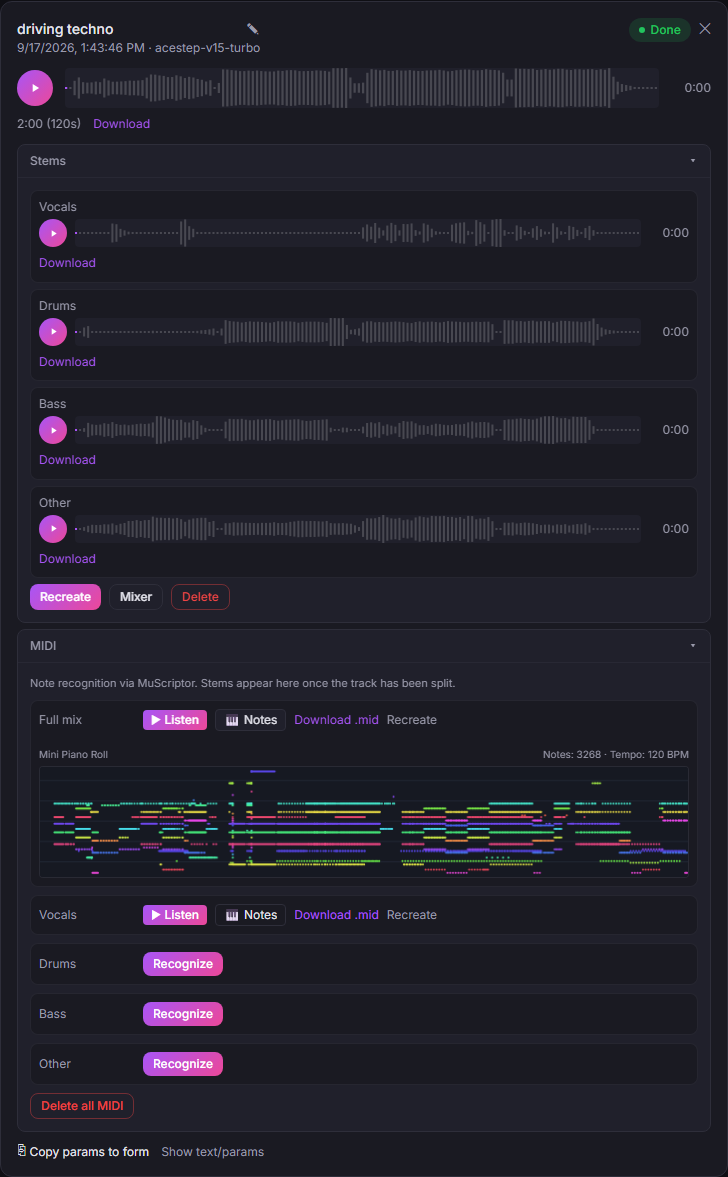
Transcribes the full mix, or any already-separated stem, into MIDI. Technically this isn't a separate process — it's a model loaded into the already-running YuE2 server, so transcription requires YuE2 to be the active model. Result: a built-in Web Audio synth player, a mini piano roll, a note count and BPM readout, and .mid download.
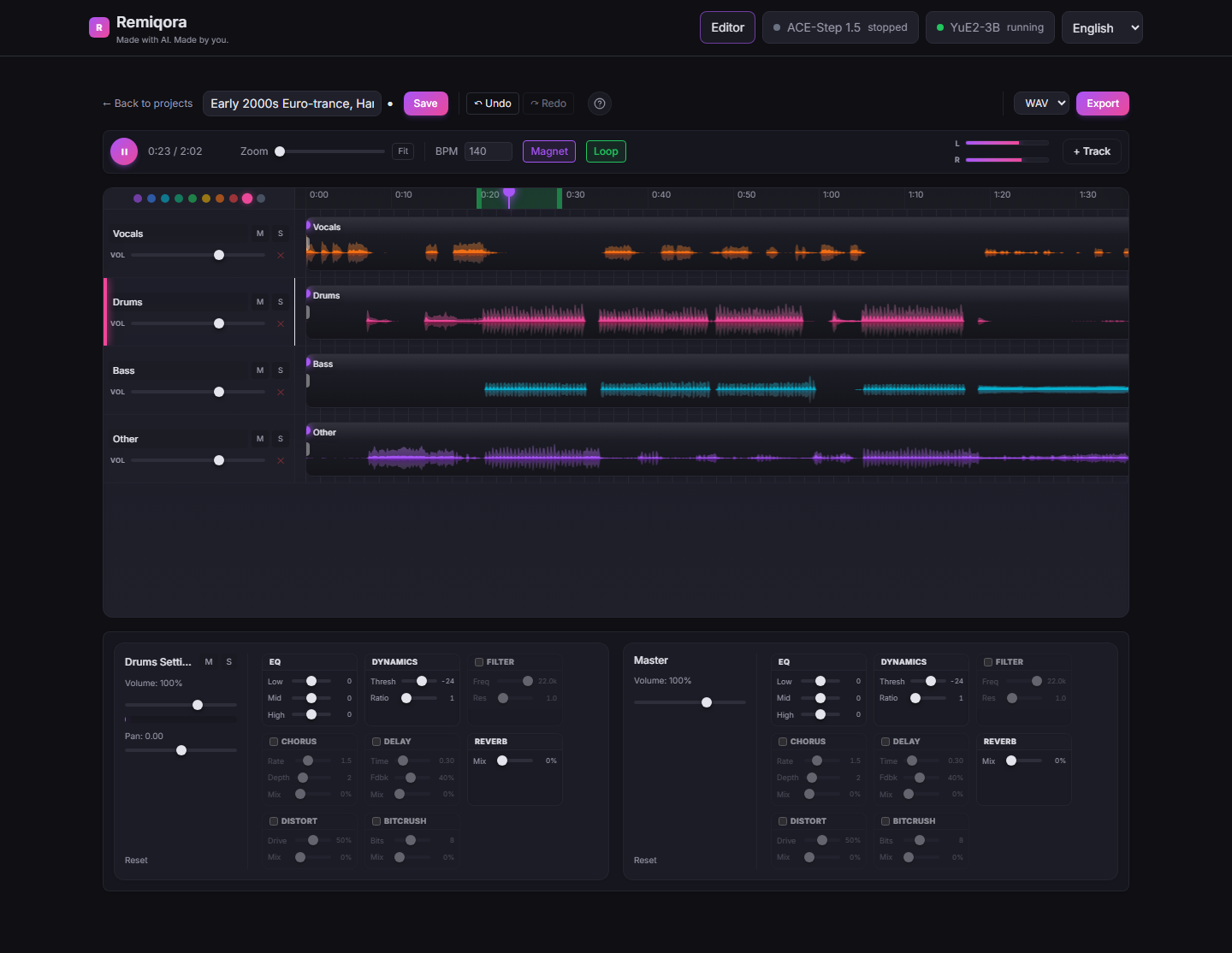
Any number of tracks, onto which you can add anything from the shared library (a full mix, a single stem, a file uploaded from disk) — via a picker dialog or by dragging a file straight onto a track. The quickest way in is through stems: the "Open in editor" button on the stems panel creates a ready-made four-track project (vocals, drums, bass, other).
S), duplicate (Ctrl+D), delete (Delete).Ctrl+Z / Ctrl+Y) — up to 30 steps of history. Zoom with Ctrl+wheel or the slider and Fit button; pan the timeline with Shift+drag or the middle mouse button.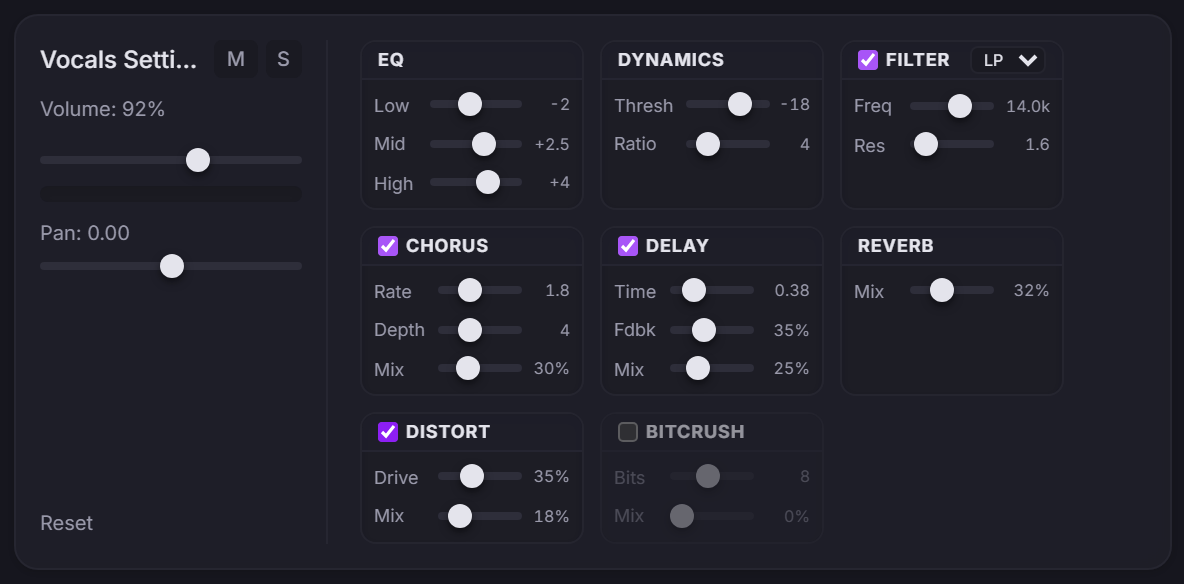
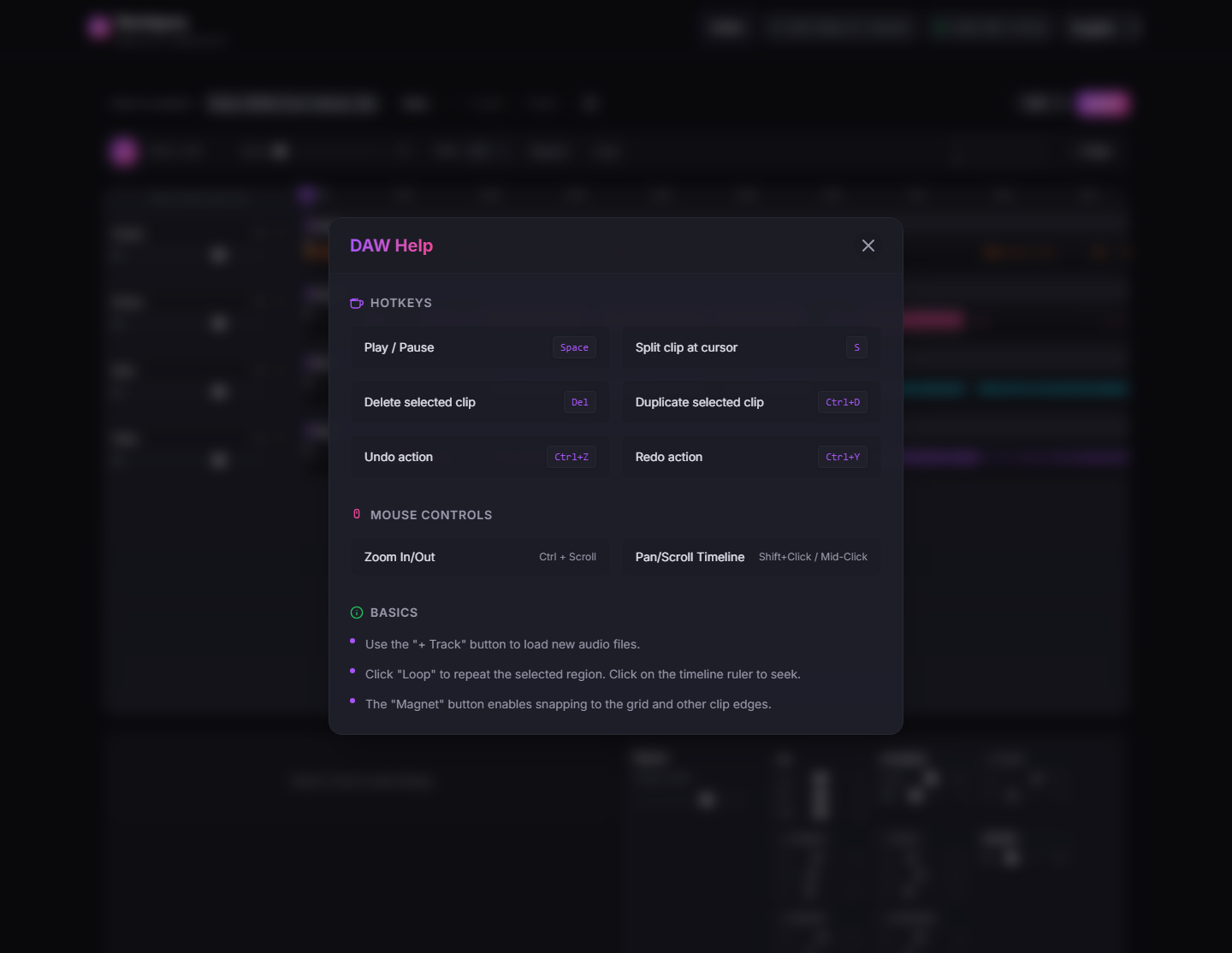
The "?" button in the toolbar opens built-in help: a list of hotkeys, mouse controls, and short tips on Loop and Magnet.
backend/ — FastAPI (Python). app/orchestrator/ manages the models' process lifecycle (start/stop/health-poll) and enforces their mutual exclusion on a single GPU. app/api/routes_proxy.py reverse-proxies /api/ace/ → ACE-Step's REST API (port 8001) and /api/yue2/ → YuE2's native server (audiocpp_server.exe, port 8080). app/db.py + routes_tracks.py are the shared SQLite database and files, organized per model, regardless of how a track was created (generation, upload, or assembled in the editor).frontend/ — Vue 3 + TypeScript + Tailwind v4 + Pinia + vue-router + vue-i18n. A fully native implementation (not an iframe) on top of the models' original APIs — src/audio/ contains its own Web Audio engine (mixer, timeline, effects, a MIDI parser and synth, WAV/MP3 encoders).acestep-api and audiocpp_server.exe) runs from their original code — everything else (UI, proxying, storage, file upload/transcoding) is written in this repository. YuE2's own web UI (web-ui/server.py) is no longer used — the one useful part of it (transcoding non-WAV uploads via ffmpeg) has been ported to backend/app/api/routes_yue2_upload.py.Remiqora is a UI and orchestrator on top of third-party inference engines. Their code isn't vendored into this repository — only small functional patches (external/patches/) on top of the originals:
| Project | What's used | License |
|---|---|---|
| ACE-Step-1.5 | Text/style-driven music generation engine, LoRA training | MIT |
| audio.cpp (dev branch) | YuE2 (generation), SheetSage2 (melody extraction), MuScriptor (MIDI transcription) | Apache-2.0 |
| Demucs | Stem separation (htdemucs) | MIT |
Patch details and exact base commits are in external/patches/README.md.
---
Remiqora's own code (this repository) is MIT-licensed. That covers the UI and orchestrator only — it is a separate thing from the license of a track you generate with it. Remiqora is an orchestrator, not a generator with its own model — all audio is produced by third-party engines (ACE-Step 1.5, YuE2-3B, and the SheetSage2/MuScriptor tools built on top of them). Because of that:
setup_prereqs.bat
Via winget (built into Windows 10/11), installs Git, Python, uv, Node.js,
CMake, ffmpeg, plus Visual Studio Build Tools (C++ workload) and the CUDA
Toolkit — those are large, need admin rights, and can take a while.
setup_prereqs.bat -SkipHeavy installs only the small, fast tools, leaving
Build Tools/CUDA for you to install manually from links the script prints.
The NVIDIA GPU driver is deliberately left out — install it by hand from nvidia.com/drivers for your card: silently swapping a video driver on someone else's machine is risky (it can blank the screen and usually needs a reboot on your schedule, not the script's).
After installing, close the terminal and open a new one so PATH picks up the freshly installed tools.
On macOS (Apple Silicon):
./setup_prereqs.sh
uv, Node.js, CMake,
ffmpeg and Ninja. No separate GPU driver step: Metal is built into macOS.
CMake/Ninja are only actually used by the --from-source build path below —
the default YuE2 setup needs no compiler at all.
setup_models.bat
The script:
1. Clones ace-step/ACE-Step-1.5 (MIT) and 0xShug0/audio.cpp (Apache-2.0,
dev branch — YuE2 support is dev-only for now) into external/.
2. Applies a small patch to ACE-Step (a task-cancellation API; audio.cpp
needs no patch, see external/patches/README.md) — without the upstream
custom web-uis, which aren't needed.
3. Runs uv sync for ACE-Step and builds audiocpp_server (CUDA release,
yue2,sheetsage2,muscriptor models) for audio.cpp.
4. Downloads the YuE2/SheetSage2/MuScriptor GGUF weights (~10 GB) via
audio.cpp's tools/model_manager_v2.py.
5. Sets up a demucs uv project in external/Demucs for stem separation,
routed at PyTorch's cu128 wheel index so it gets a CUDA build (a plain
uv add demucs would silently resolve a CPU-only torch wheel instead).
6. Creates backend/.env with paths to the freshly cloned repositories,
including FFMPEG_BIN_DIR — auto-detected from ffmpeg's winget install
(setup_prereqs.bat), even right after installing it in the same
terminal, before a new one would pick it up on PATH.
ACE-Step's own weights don't need a separate download — acestep-api pulls
them from HuggingFace/ModelScope on first request, the same way its Gradio
UI does.
The script is idempotent — safe to re-run (the -SkipBuild / -SkipWeights
flags skip the corresponding steps). It expects git,
uv, Python 3,
CMake, the CUDA Toolkit and Visual Studio Build Tools (C++ workload) to
already be installed — if any is missing, that step is simply skipped with a
hint on what to install.
After that, the only manual step left is checking CUDA_BIN_DIR in
backend/.env (FFMPEG_BIN_DIR is filled in automatically — unless ffmpeg
wasn't found at all, in which case the script says so and it needs setting
by hand).
Hard machine requirements the script can't remove: Windows, a CUDA-capable NVIDIA GPU (tested on an RTX 4080 16 GB), and an installed video driver.
On macOS (Apple Silicon):
./setup_models.sh
audiocpp_server is installed from audio.cpp's own prebuilt
macOS/Metal release (a pinned tag, sha256-verified before extracting) —
no compiler needed at all, unlike the Windows path, which always builds
from source since there's no prebuilt CUDA release. The Demucs uv project
also isn't routed at a CUDA wheel index — a plain torch dependency
already resolves an MPS-capable wheel on darwin/arm64, same as
ACE-Step-1.5's own pyproject.toml does. The written backend/.env has no
CUDA_BIN_DIR — there's no CUDA toolkit on this path.
Pass --from-source to build audio.cpp from the same pinned dev commit
Windows uses instead of downloading the release (useful if the release lags
behind a dev-only fix, or on Intel Macs, which the prebuilt asset doesn't
cover) — that path needs full Xcode.app (not just the Command Line
Tools) for its Metal shader compiler; setup_prereqs.sh prints exact steps
if it's missing. --skip-build / --skip-weights mirror -SkipBuild /
-SkipWeights. Otherwise it expects git, uv and Python 3 to already be
installed (cmake too, for --from-source).
Hard machine requirements this path can't remove: macOS, Apple Silicon
(M-series) for the default prebuilt path (Intel needs --from-source).
Tested on a MacBook Air, Apple M5, 24 GB RAM — including a from-scratch run
against a machine with no prior Homebrew packages or project state, all the
way through generating audio with YuE2 on the Metal backend.
This path is newer and less exercised than the Windows/CUDA one — expect it
to be slower (Metal instead of CUDA). --from-source in particular may
need occasional manual fixing up (a bumped commit pin) if audio.cpp's dev
branch drifts upstream; the default release-based path is pinned to a fixed
tag instead, so it doesn't drift on its own.
dev.bat
backend/.venv and frontend/node_modules on first run, and opens a browser at http://localhost:5173.
For production mode — build the SPA and serve everything from a single port:
prod_run.bat
npm run build and serves the finished SPA bundle together with the API at http://127.0.0.1:9000.
Stem separation's demucs uv project is set up by setup_models.bat above; the htdemucs weights themselves download automatically on first use.
On macOS: ./dev.sh and ./prod_run.sh are the equivalents — same
behavior, except the backend/frontend run as background jobs of the script
itself (stop both with Ctrl+C) rather than in separate terminal windows.
---
Settings live in backend/.env (template: backend/.env.example;
setup_models.bat creates it automatically with paths to the cloned repositories):
ACE_STEP_DIR=E:\AI\ACE\ACE-Step-1.5
YUE2_DIR=E:\AI\YuE2-3B
DEMUCS_DIR=E:\AI\Demucs
FFMPEG_BIN_DIR=E:\AI\ACE\tools\ffmpeg-shared\ffmpeg-master-latest-win64-gpl-shared\bin
CUDA_BIN_DIR=C:\Program Files\NVIDIA GPU Computing Toolkit\CUDA\v13.4\bin
ACE_STEP_DIR — root of the cloned and patched ACE-Step-1.5.YUE2_DIR — root of the cloned and patched audio.cpp (where audiocpp_server.exe is built and the YuE2/SheetSage2/MuScriptor GGUF weights live).DEMUCS_DIR — root of the demucs uv project used for stem separation.FFMPEG_BIN_DIR — folder containing ffmpeg.exe/ffprobe.exe.CUDA_BIN_DIR — the bin folder of the installed CUDA Toolkit (needs to be on PATH for audiocpp_server.exe). Windows only — on macOS this is left unset, since YuE2 runs on the Metal backend instead..bat/.ps1 scripts for the former, .sh scripts for the latter. No Linux scripts yet, though the backend itself has no Windows-only code left blocking it.--from-source instead builds the same dev commit Windows uses, and may occasionally need that pin bumped if dev drifts.→ →
→ →
→ →
→ →
→ →
→ →
→ →
→