1
 →
→
An educational Jev-like visual inference experiment on Apple Silicon: shared context, direct candidate scoring, and local visual demos.
hr98w/jev-visual is an open-source project on GitHub, mainly written in Python. An educational Jev-like visual inference experiment on Apple Silicon: shared context, direct candidate scoring, and local visual demos. It currently holds 163 stars and 20 forks with 0 open issues, and was last pushed on an unknown date (repository created unknown).
AI Homed tracks it on the Today's Trending board, currently at rank #85 with 0 new stars today.
English · 简体中文
A small, runnable project for learning vision-language model inference on Apple Silicon. Use Qwen3.5-0.8B with MLX to answer multiple questions about one image: choose an option, judge yes/no, or score ordered levels. Includes a local browser UI, CLI and HTTP API.
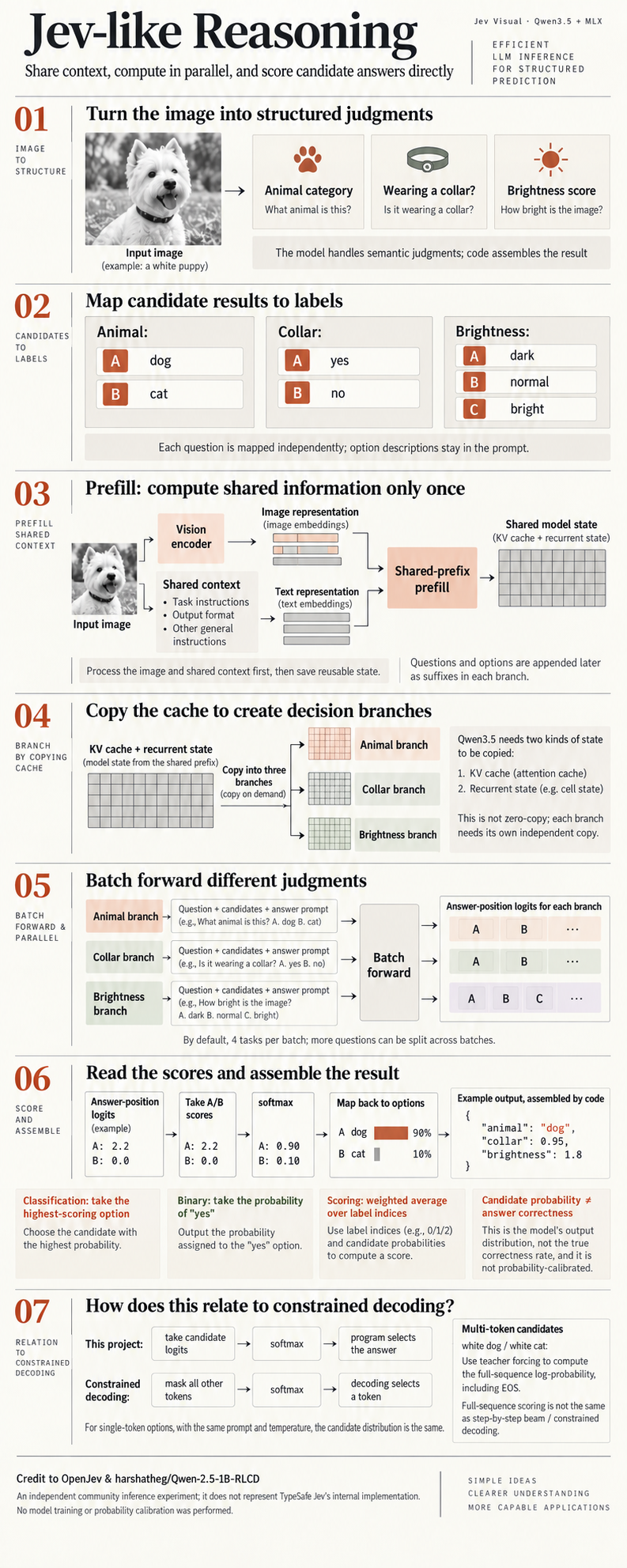
This project explores a Jev-like inference pattern for open multimodal language models. It avoids autoregressive structured generation by reusing shared multimodal context and directly scoring candidate outputs from model logits.
> This is an independent community implementation and does not claim to reproduce TypeSafe Jev's proprietary model architecture, RLCD training, calibration, or serving system.
| AI sorting factory | Breakout | Camera gestures |
|---|---|---|
|
Classify conveyor objects and choose a sorting lane. Watch video |
Locate the ball in five regions to control the paddle. Watch video |
Recognize hand gestures from camera frames to control particles. Watch video |
Breakout exposes the limits of Qwen3.5-0.8B-4bit in our non-thinking, direct-scoring setup. Asking it to follow the ball or choose Left/Right was unreliable: repeated choices could pin the paddle against an edge. The working approach simplifies the task:
1. Use one full-size screenshot, a larger ball, a wider paddle and a slower Easy mode. 2. Draw five numbered regions and ask only which region contains the ball. 3. Move the paddle toward that region's fixed center. The movement code reads the paddle position, never the ball position; human players have the same target buttons.
This reduces game control to visual classification, without a hidden ball tracker or solver. In a separate recorded test, 80 decisions produced 9 bricks cleared and 6 returns, with 2 lives remaining; the test stopped before completion. It is a simplified demo, not evidence of general game-playing ability. These trials do not isolate the effect of 4-bit quantization. Implementation and observations.
Open /demo/ on the local server to try these demos, the camera gesture console and the 2×2 cube. The current model cannot reliably solve the cube. Setup, tests and limitations.
Requires an Apple Silicon Mac with Metal. Tested on M4 / 16GB, macOS 15.1, Python 3.13.1. First setup downloads dependencies and approximately 596 MiB of model weights; inference then runs locally.
From the repository root:
# If needed, install uv with Homebrew: brew install uv
uv venv --python 3.13
source .venv/bin/activate
uv pip install -r requirements-lock.txt
uv pip install --no-deps -e .
jev-visual-download
JEV_VISUAL_MODEL_PATH=.models/Qwen3.5-0.8B-4bit \
  uvicorn jev_visual.server:app --host 127.0.0.1 --port 8788
Open http://127.0.0.1:8788, upload an image and click Analyze image. Use one worker; first inference may be slower. This server is for local use. API docs: /docs.
Or try the included request:
jev-visual examples/photo-request.json --model-path .models/Qwen3.5-0.8B-4bit
image + context → shared prefill → fork cache → batch question suffixes
                → read candidate scores → assemble typed answers in code
Read the code in this order:
1. preprocessing.py: image preparation, prompts and token boundaries. 2. adapters.py: vision encoding, prefill, KV/recurrent-state reuse and the LM head. 3. scoring.py: A/B/C labels, native single tokens and complete sequence log-probabilities, including EOS. 4. schema.py → engine.py: normalize candidate scores, assemble results and coordinate execution.
This uses existing weights; no training or calibration. Candidate probabilities are relative to supplied options, not correctness estimates. Only the Qwen3.5 adapter is verified. Cache sharing is within one request and copies state; it is not zero-copy sharing. Supports 1–64 questions, 2–26 options each.
Inference details · Request examples, Python API and tests
With the environment activated and model downloaded, stop the server before benchmarking:
python -m pytest -q                # Unit/API tests; no model inference
python -m examples.verify_scoring  # Compare scores against full model forwards
python -m benchmarks.run
python -m benchmarks.report
The benchmark compares generate JSON → independent candidate scoring → shared-prefix batched scoring, at 1 / 4 / 16 / 64 decisions, with three repetitions and model loading/warmup excluded. New outputs go to artifacts/.
The recorded M4 / 16GB run took 37.30s → 2.40s for independent versus shared scoring at 64 decisions (medians). Generated JSON failed the complete schema at 4/16/64 decisions; its timing is not successful-completion latency. This is a scaling experiment, not an accuracy evaluation or Jev comparison.
Benchmark method · Results and metrics · Raw records
Original code: MIT. Third-party licenses: notices.
Credit to OpenJev and harshatheg/Qwen-2.5-1B-RLCD for the candidate-scoring and shared-context ideas. Detailed credits and licenses.
→ →
→ →
→ →
→ →
→ →
→ →
→ →
→