1
 →
→
[CVPR 2026] PersonaLive! : Expressive Portrait Image Animation for Live Streaming
GVCLab/PersonaLive is an open-source project on GitHub, mainly written in Python. [CVPR 2026] PersonaLive! : Expressive Portrait Image Animation for Live Streaming It currently holds 3,764 stars and 0 forks with 0 open issues, and was last pushed on an unknown date (repository created unknown).
AI Homed tracks it on the AI Video Projects board and on the AI AI Video Projects list.


training code.paper!inference code, config, and pretrained weights!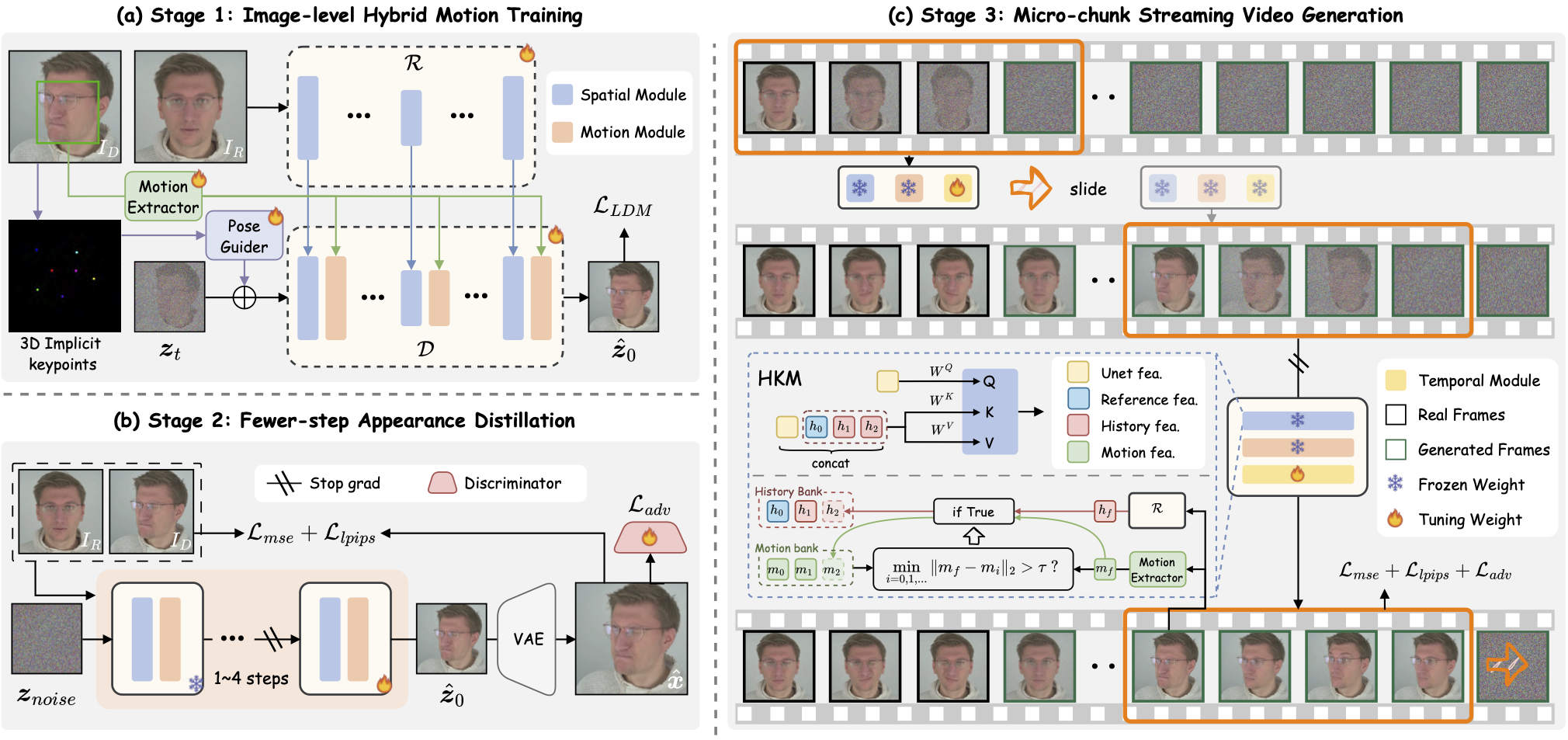
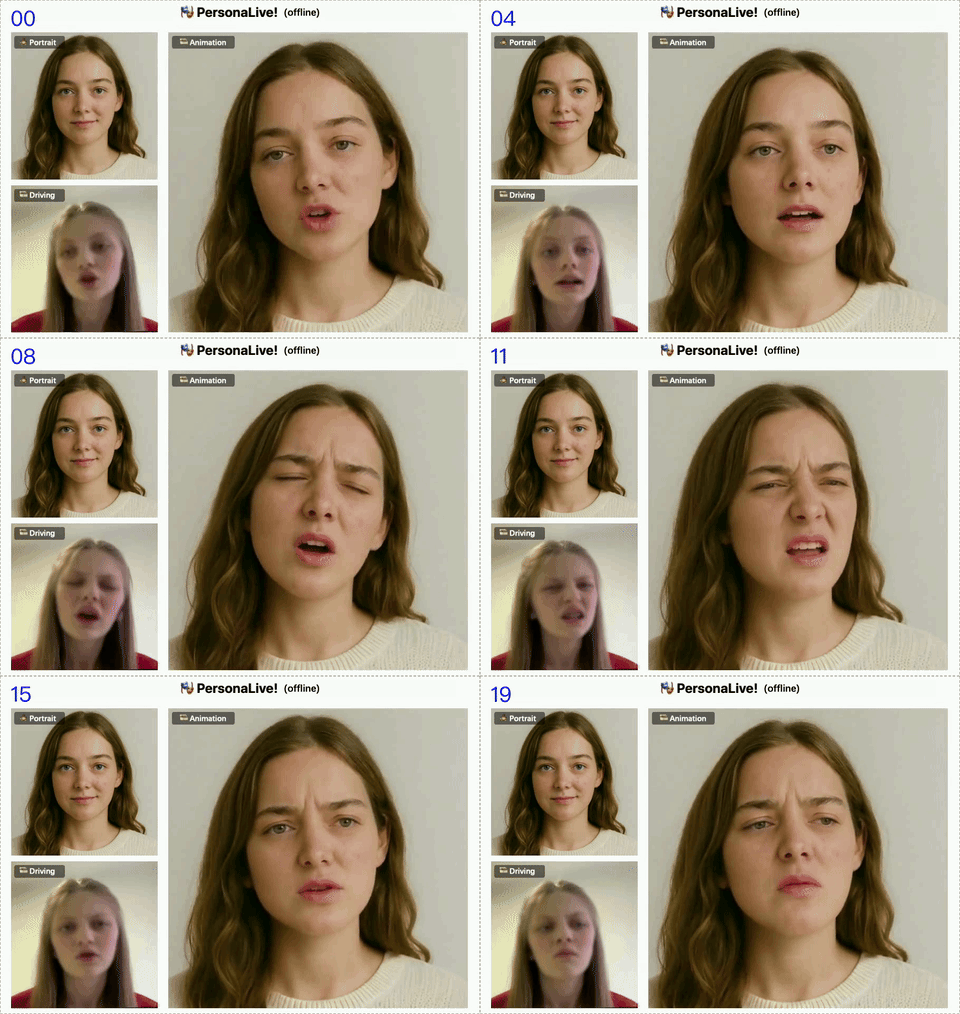
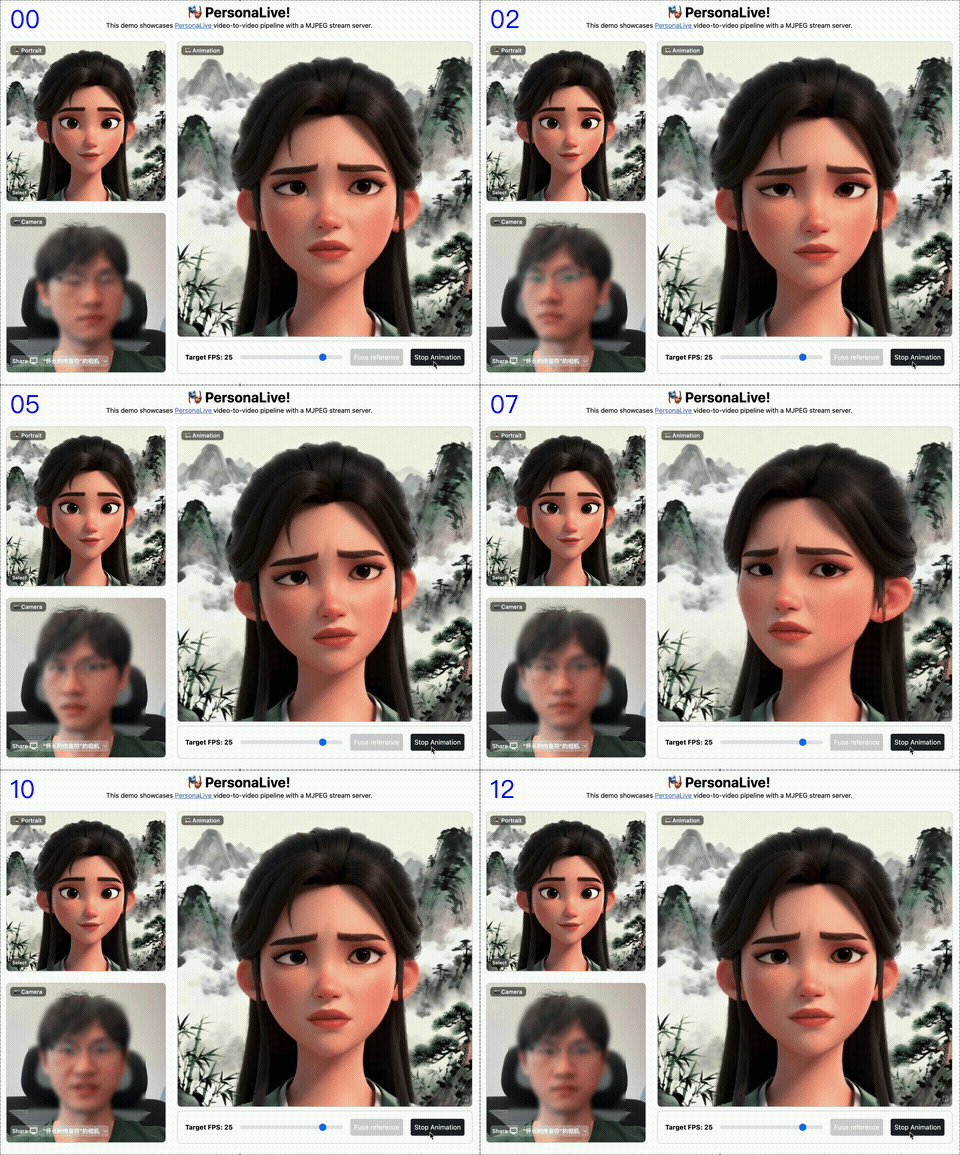
We present PersonaLive, a real-time and streamable diffusion framework capable of generating infinite-length portrait animations.
# clone this repo
git clone https://github.com/GVCLab/PersonaLive
cd PersonaLive
Create conda environment
conda create -n personalive python=3.10
conda activate personalive
Install packages with pip
pip install -r requirements_base.txt
python tools/download_weights.py
Option 2: Download pre-trained weights into the ./pretrained_weights folder from one of the below URLs:
Finally, these weights should be organized as follows:
pretrained_weights
├── onnx
│   ├── unet_opt
│   │   ├── unet_opt.onnx
│   │   └── unet_opt.onnx.data
│   └── unet
├── personalive
│   ├── denoising_unet.pth
│   ├── motion_encoder.pth
│   ├── motion_extractor.pth
│   ├── pose_guider.pth
│   ├── reference_unet.pth
│   └── temporal_module.pth
├── sd-vae-ft-mse
│   ├── diffusion_pytorch_model.bin
│   └── config.json
├── sd-image-variations-diffusers
│   ├── image_encoder
│   │   ├── pytorch_model.bin
│   │   └── config.json
│   ├── unet
│   │   ├── diffusion_pytorch_model.bin
│   │   └── config.json
│   └── model_index.json
└── tensorrt
    └── unet_work.engine
python inference_offline.py
-L: Max number of frames to generate. (Default: 100)--use_xformers: Enable xFormers memory efficient attention. (Default: True)--stream_gen: Enable streaming generation strategy. (Default: True)--reference_image: Path to a specific reference image. Overrides settings in config.--driving_video: Path to a specific driving video. Overrides settings in config.python inference_offline.py --use_xformers False
# install Node.js 18+
curl -o- https://raw.githubusercontent.com/nvm-sh/nvm/v0.39.1/install.sh | bash
nvm install 18
source web_start.sh
20 minutes depending on your device. Note that TensorRT optimizations may lead to slight variations or a small drop in output quality.
# Install packages with pip
pip install -r requirements_trt.txt
src/models/motion_encoder/FAN_temporal_feature_extractor.py
self.pos_embed.pos_embed.requires_grad = False
Converting the model to TensorRT
python torch2trt.py
# Install PyCUDA manually using Conda (avoids compilation issues):
conda install -c conda-forge pycuda "numpy<2.0"
Open requirements_trt.txt and comment out or remove the line "pycuda==2024.1.2"
Install other packages with pip
pip install -r requirements_trt.txt
Converting the model to TensorRT
python torch2trt.py
H100. We recommend ALL users (including H100 users) re-run python torch2trt.py locally to ensure best compatibility.
python inference_online.py --acceleration none (for RTX 50-Series) or xformers or tensorrt
http://0.0.0.0:7860 in your browser. (*If http://0.0.0.0:7860 does not work well, try http://localhost:7860)
How to use: Upload Image ➡️ Fuse Reference ➡️ Start Animation ➡️ Enjoy! 🎉
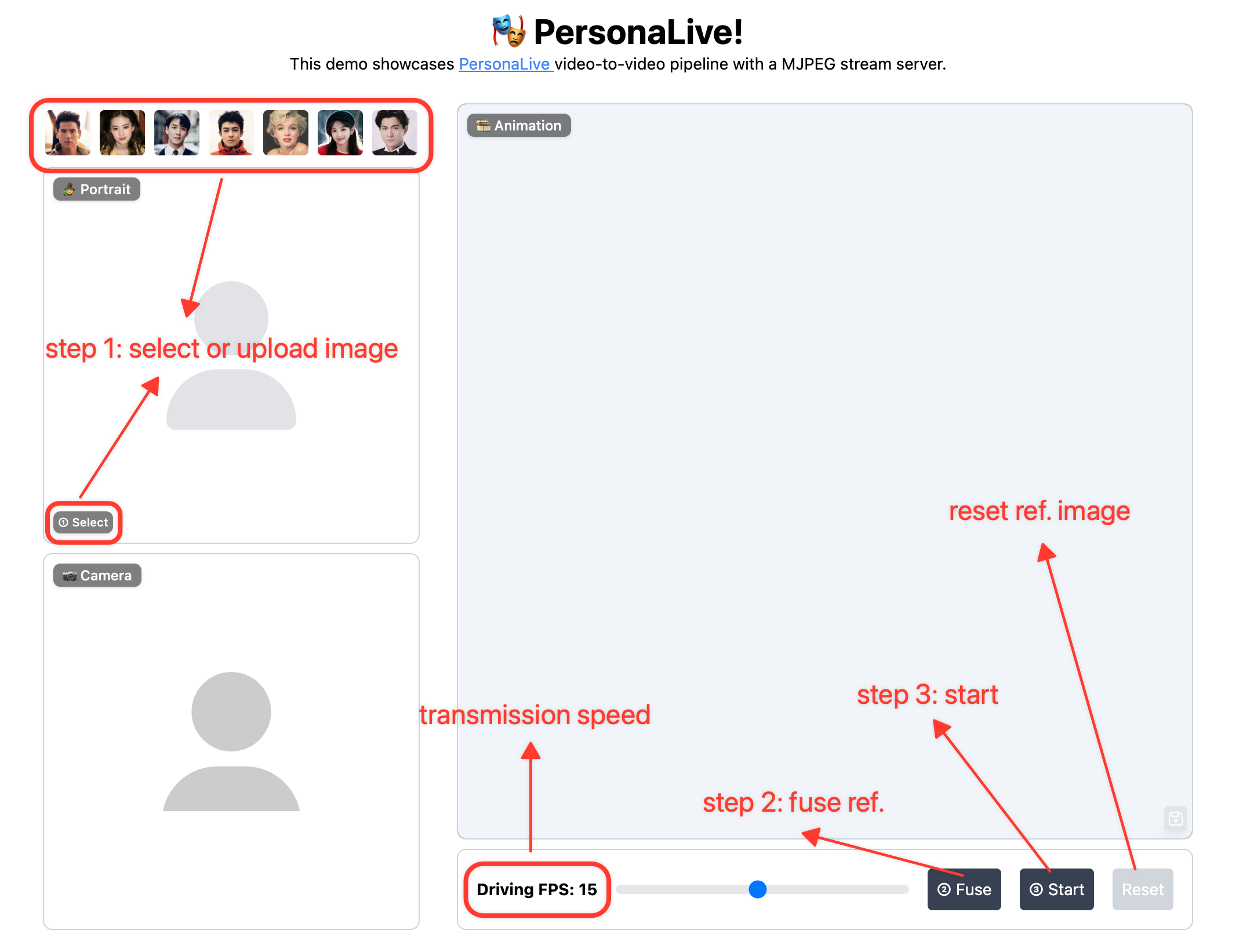
Regarding Latency: Latency varies depending on your device's computing power. You can try the following methods to optimize it:
1. Lower the "Driving FPS" setting in the WebUI to reduce the computational workload.
2. You can increase the multiplier (e.g., set to num_frames_needed * 4 or higher) to better match your device's inference speed. https://github.com/GVCLab/PersonaLive/blob/6953d1a8b409f360a3ee1d7325093622b29f1e22/webcam/util.py#L73
PersonaLive training is organized into three stages. Approximate training time on 8x H100 with default configs: Stage 1 ~13h, Stage 2 ~15h, Stage 3 ~20h.
pip install -r requirements_train.txt
If you use multi-GPU or multi-node training, configure Accelerate once before launching training:
accelerate config
videos directory and a matching boxes directory:
Datasets
├── VFHQ
│   ├── videos
│   │   ├── example1.mp4
│   │   ├── example2.mp4
│   │   └── ...
│   └── boxes
│       ├── example1.pt
│       ├── example2.pt
│       └── ...
└── ...
Preprocessing example:
# 1) Extract face / eye / mouth boxes from each frame
python tools/get_boxes.py --video_dir ./Datasets/VFHQ/videos --save_dir ./Datasets/VFHQ/boxes --workers 8
2) Generate meta json: [{"video_path": ".../videos/xxx.mp4"}, ...]
python tools/extract_meta_info.py --root_path ./Datasets/VFHQ --dataset_name VFHQ
Then set data.meta_paths in each training config:
data:
meta_paths:
- "./data/VFHQ_meta.json"
- "./data/OtherDataset_meta.json"
pretrained_weights
├── xnemo
│   ├── xnemo_motion_encoder.pth
│   ├── xnemo_denoising_unet.pth
│   ├── xnemo_reference_unet.pth
│   └── xnemo_temporal_module.pth
├── sd-vae-ft-mse
│   ├── diffusion_pytorch_model.bin
│   └── config.json
├── sd-image-variations-diffusers
│   ├── image_encoder
│   │   ├── pytorch_model.bin
│   │   └── config.json
│   ├── unet
│   │   ├── diffusion_pytorch_model.bin
│   │   └── config.json
│   └── model_index.json
├── pose_guider.pth
└── stylegan2_discriminator_ffhq512.pth
accelerate launch train_stage1.py --config ./configs/train/personalive_stage1.yaml
Default output folder: ./exp_output/personalive_stage1/
Update configs/train/personalive_stage2.yaml to point to Stage 1 outputs:
motion_encoder_path: './exp_output/personalive_stage1/motion_encoder-xxxxx.pth'
denoising_unet_path: './exp_output/personalive_stage1/denoising_unet-xxxxx.pth'
reference_unet_path: './exp_output/personalive_stage1/reference_unet-xxxxx.pth'
pose_guider_path: './exp_output/personalive_stage1/pose_guider-xxxxx.pth'
Run:
accelerate launch train_stage2.py --config ./configs/train/personalive_stage2.yaml
Default output folder: ./exp_output/personalive_stage2/
Update configs/train/personalive_stage3.yaml to point to Stage 2 outputs:
motion_encoder_path: './exp_output/personalive_stage2/motion_encoder-xxxxx.pth'
denoising_unet_path: './exp_output/personalive_stage2/denoising_unet-xxxxx.pth'
reference_unet_path: './exp_output/personalive_stage2/reference_unet-xxxxx.pth'
pose_guider_path: './exp_output/personalive_stage2/pose_guider-xxxxx.pth'
discriminator_path: './exp_output/personalive_stage2/discriminator-xxxxx.pth'
Run:
accelerate launch train_stage3.py --config ./configs/train/personalive_stage3.yaml
Default output folder: ./exp_output/personalive_stage3/
Special thanks to the community for providing helpful setups! 🥂
download_weights.py, and to @andchir for adding audio merging functionality.@article{li2025personalive,
title={PersonaLive! Expressive Portrait Image Animation for Live Streaming},
author={Li, Zhiyuan and Pun, Chi-Man and Fang, Chen and Wang, Jue and Cun, Xiaodong},
journal={arXiv preprint arXiv:2512.11253},
year={2025}
}
 →
→ →
→ →
→ →
→ →
→ →
→ →
→