

1
 →
→google/magika is an open-source project on GitHub, mainly written in Rust. Fast and accurate AI powered file content types detection It currently holds 18,604 stars and 1,168 forks with 0 open issues, and was last pushed on an unknown date (repository created unknown).
AI Homed tracks it on the Today's Trending board.






Magika is a novel AI-powered file type detection tool that relies on the recent advance of deep learning to provide accurate detection. Under the hood, Magika employs a custom, highly optimized model that only weighs about a few MBs, and enables precise file identification within milliseconds, even when running on a single CPU. Magika has been trained and evaluated on a dataset of ~100M samples across 200+ content types (covering both binary and textual file formats), and it achieves an average ~99% accuracy on our test set.
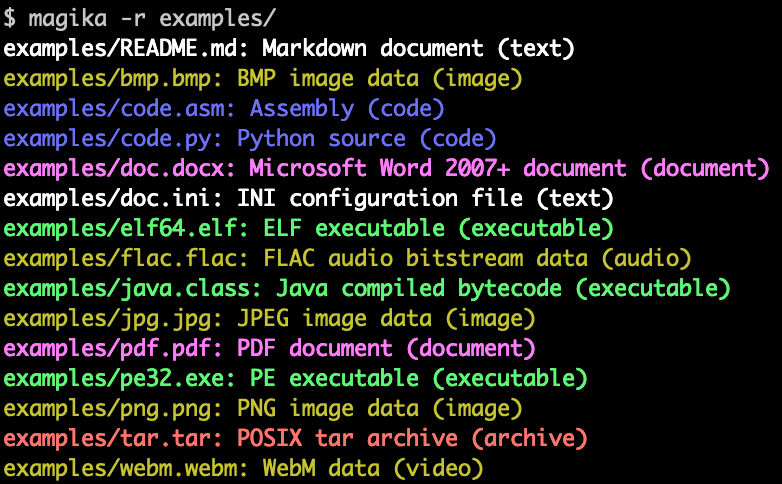
Here is an example of what Magika command line output looks like:
Magika is used at scale to help improve Google users' safety by routing Gmail, Drive, and Safe Browsing files to the proper security and content policy scanners, processing hundreds billions samples on a weekly basis. Magika has also been integrated with VirusTotal (example) and abuse.ch (example).
For more context you can read our initial announcement post on Google's OSS blog, you can consult Magika's website, and you can read more in our research paper, published at the IEEE/ACM International Conference on Software Engineering (ICSE) 2025.
You can try Magika without installing anything by using our web demo, which runs locally in your browser!
-r for recursively scanning a directory.high-confidence, medium-confidence, and best-guess.1. Getting Started 1. Installation 1. Quick Start 1. Documentation 1. Security Vulnerabilities 1. License 1. Disclaimer
Magika ships a CLI written in Rust, and can be installed in several ways.
Via magika python package:
pipx install magika
Via brew (macOS / Linux)
brew install magika
Via installer script:
curl -LsSf https://securityresearch.google/magika/install.sh | sh
or:
powershell -ExecutionPolicy Bypass -c "irm https://securityresearch.google/magika/install.ps1 | iex"
Via magika-cli Rust package:
cargo install --locked magika-cli
pip install magika
npm install magika
Here you can find a number of quick examples just to get you started.
To learn about Magika's inner workings, see the Core Concepts section of Magika's website.
% cd tests_data/basic && magika -r * | head
asm/code.asm: Assembly (code)
batch/simple.bat: DOS batch file (code)
c/code.c: C source (code)
css/code.css: CSS source (code)
csv/magika_test.csv: CSV document (code)
dockerfile/Dockerfile: Dockerfile (code)
docx/doc.docx: Microsoft Word 2007+ document (document)
docx/magika_test.docx: Microsoft Word 2007+ document (document)
eml/sample.eml: RFC 822 mail (text)
empty/empty_file: Empty file (inode)
% magika ./tests_data/basic/python/code.py --json
[
  {
    "path": "./tests_data/basic/python/code.py",
    "result": {
      "status": "ok",
      "value": {
        "dl": {
          "description": "Python source",
          "extensions": [
            "py",
            "pyi"
          ],
          "group": "code",
          "is_text": true,
          "label": "python",
          "mime_type": "text/x-python"
        },
        "output": {
          "description": "Python source",
          "extensions": [
            "py",
            "pyi"
          ],
          "group": "code",
          "is_text": true,
          "label": "python",
          "mime_type": "text/x-python"
        },
        "score": 0.996999979019165
      }
    }
  }
]
% cat tests_data/basic/ini/doc.ini | magika -
-: INI configuration file (text)
% magika --help
Determines file content types using AI
Usage: magika [OPTIONS] [PATH]...
Arguments:
  [PATH]...
          List of paths to the files to analyze.
Use a dash (-) to read from standard input (can only be used once).
Options:
  -r, --recursive
          Identifies files within directories instead of identifying the directory itself
--no-dereference
          Identifies symbolic links as is instead of identifying their content by following them
--colors
          Prints with colors regardless of terminal support
--no-colors
          Prints without colors regardless of terminal support
-s, --output-score
          Prints the prediction score in addition to the content type
-i, --mime-type
          Prints the MIME type instead of the content type description
-l, --label
          Prints a simple label instead of the content type description
--json
          Prints in JSON format
--jsonl
          Prints in JSONL format
--format
          Prints using a custom format (use --help for details).
The following placeholders are supported:
%p  The file path
            %l  The unique label identifying the content type
            %d  The description of the content type
            %g  The group of the content type
            %m  The MIME type of the content type
            %e  Possible file extensions for the content type
            %s  The score of the content type for the file
            %S  The score of the content type for the file in percent
            %b  The model output if overruled (empty otherwise)
            %%  A literal %
-h, --help
          Print help (see a summary with '-h')
-V, --version
          Print version
For more examples and documentation about the CLI, see https://crates.io/crates/magika-cli.
>>> from magika import Magika
>> m = Magika()
>> res = m.identify_bytes(b'function log(msg) {console.log(msg);}')
>> print(res.output.label)
javascript
>>> from magika import Magika
>> m = Magika()
>> res = m.identify_path('./tests_data/basic/ini/doc.ini')
>> print(res.output.label)
ini
>>> from magika import Magika
>> m = Magika()
>> with open('./tests_data/basic/ini/doc.ini', 'rb') as f:
>>     res = m.identify_stream(f)
>> print(res.output.label)
ini
For more examples and documentation about the Python module, see the Python Magika module section.
Please consult Magika's website for detailed documentation about:
Please contact us directly at magika-dev@google.com.
Apache 2.0; see LICENSE for details.
This project is not an official Google project. It is not supported by Google and Google specifically disclaims all warranties as to its quality, merchantability, or fitness for a particular purpose.
→ →
→ →
→ →
→ →
→ →
→ →
→ →
→