1
 →
→
Audio Plugin for Audio to MIDI transcription using deep learning.
DamRsn/NeuralNote is an open-source project on GitHub, mainly written in C++. Audio Plugin for Audio to MIDI transcription using deep learning. It currently holds 3,066 stars and 207 forks with 0 open issues, and was last pushed on an unknown date (repository created unknown).
AI Homed tracks it on the Today's Trending board, currently at rank #56 with 27 new stars today.

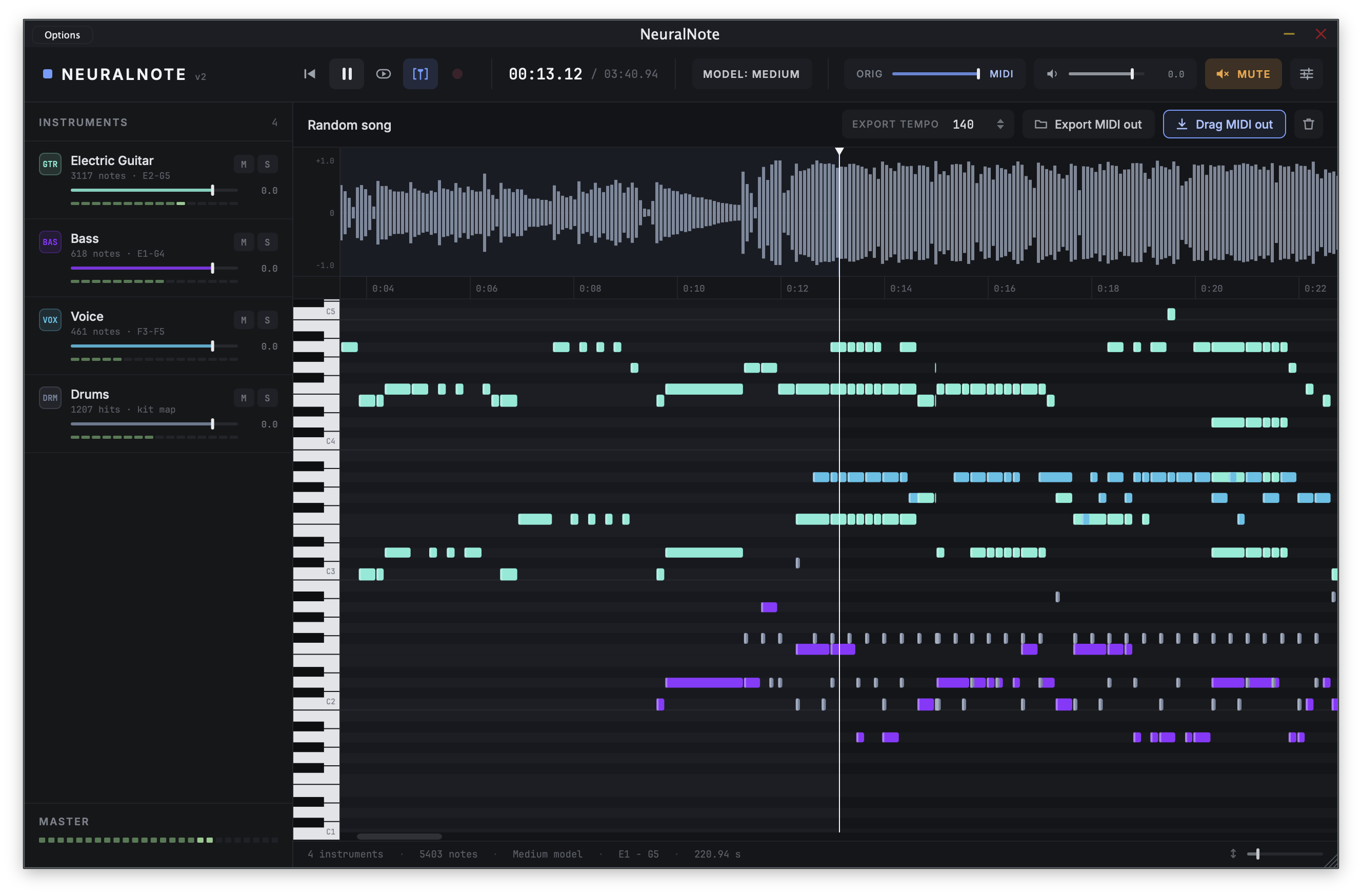
NeuralNote is the audio plugin that brings state-of-the-art audio-to-MIDI transcription into your favorite Digital Audio Workstation. See the website.
[!NOTE]
🎉 NeuralNote v2.0.0 is out! Download it from the website or the releases page.
> Testing so far covers only a few machines and GPUs. Whether something breaks or works great on your hardware,
please tell us in GitHub issues (see Hardware).
Download the latest release for your platform from the website or releases page.
NeuralNote_Installer_Mac_arm64.pkg installs the Standalone app, VST3 and AU. It isNeuralNote_Installer_Windows_x64.exe installs the Standalone app and VST3. It is not code signed,NeuralNote is a simple AudioFX plugin (VST®3/AU/Standalone app) that you apply to the track you want to transcribe.
Automatic to let the model detect them.Transcribe. The transcription runs in the background, and the MIDI fills into the piano roll as it isMuScriptor comes in three sizes, small, medium and large, which trade speed for quality. NeuralNote downloads
them as GGUF files from DamRsn/muscriptor-gguf on Hugging Face.
When no model is installed, all three sizes are available to download. The Model button in the top bar lets you
switch between installed models, download other sizes, and open the folder where they are stored.
| OS | Models folder |
| ------- | ----------------------------- |
| macOS | ~/Library/NeuralNote/models |
| Windows | %APPDATA%\NeuralNote\models |
| Linux | ~/.config/NeuralNote/models |
The downloads are about 210 MB for small, 620 MB for medium and 2.7 GB for large.
You can also put a model file in that folder by hand. Use a file from v1/ of the
HF repo, unchanged and with its original name (e.g.
muscriptor-medium-f16.gguf). NeuralNote only picks up files whose name and size match the ones it downloads.
You can remove a model by deleting it from this folder, and re-download it at any time.
Hardware. Transcription speed depends mostly on the model size and on your hardware. The GPU is used when available,
through Metal on macOS and Vulkan on Windows and Linux. A GPU is strongly recommended for the medium and large models.
Settings > Compute device picks the device: Auto (the default, which names the device it chose), a specific GPU, or
the CPU. The choice applies from the next transcription, and GPUs added or removed later are listed after restarting
NeuralNote (or your DAW). Only a few GPUs have been tested so far. If transcription fails, gives wrong results or is
unexpectedly slow on your machine, please open an issue, either here or
in muscriptor.cpp if the problem is in the engine itself. Please
include your OS, GPU and model size.
Approximate real-time factors measured on an Apple M1 Pro (above 1× means faster than real time):
| Size | GPU (Metal) | CPU |
| -------- | ----------- | --------------- |
| small | ~3.5× | ~2× |
| medium | ~1.5× | ~0.7× |
| large | ~0.5× | not recommended |
See muscriptor.cpp's performance notes for details.
Requirements:
gitmuscriptor.cpp fetches ggml, and themacOS needs Xcode's Metal toolchain, which compiles the GPU shaders at build time:
xcodebuild -downloadComponent MetalToolchain. Configuring with -DMUSCRIPTOR_METAL_PRECOMPILED=OFF builds without it
instead, and the shaders then compile when NeuralNote's window first opens in each app or DAW, and again after a macOS
update, which takes about 20 seconds.
Windows GPU support needs the Vulkan SDK at build time. Without it,
NeuralNote builds and transcribes on the CPU only. With it, configure from a Visual Studio developer prompt, or set
CC, CXX and RC in the environment: ggml builds its shader generator as a separate project that doesn't see
CMake's compiler settings.
Linux has been tested on Ubuntu 24.04 with Clang 20. Install the compiler, JUCE's Linux dependencies, and the Vulkan headers and shader compiler:
sudo apt install clang-20 ninja-build pkg-config python3 \
    libasound2-dev libjack-jackd2-dev ladspa-sdk libcurl4-openssl-dev libfreetype-dev libfontconfig1-dev \
    libx11-dev libxcomposite-dev libxcursor-dev libxext-dev libxinerama-dev libxrandr-dev libxrender-dev \
    libwebkit2gtk-4.1-dev libglu1-mesa-dev mesa-common-dev \
    libvulkan-dev glslc spirv-headers
Select the compiler through the environment when configuring, e.g. `CC=clang-20 CXX=clang++-20 cmake -B build -G Ninja -DCMAKE_BUILD_TYPE=Release`.
Ninja is optional but makes builds faster (-G Ninja).
Clone with submodules:
git clone --recurse-submodules https://github.com/DamRsn/NeuralNote
cd NeuralNote
If you already cloned without them, run git submodule update --init --recursive.
Configure and build:
cmake -B build -DCMAKE_BUILD_TYPE=Release
cmake --build build --config Release
The Standalone app and the plugins are written to build/NeuralNote_artefacts/Release/.
On macOS, a build contains only one architecture, the host's by default. To build for Intel Macs on Apple Silicon,
configure with -DCMAKE_OSX_ARCHITECTURES=x86_64. Such a build runs under Rosetta, and its plugins are not copied to
~/Library/Audio/Plug-Ins.
On Windows, the Standalone app supports ASIO devices. Distributing a build with ASIO requires signing Steinberg's
ASIO license agreement. To build without it, configure with
-DNEURALNOTE_ASIO=OFF.
The transcription engine is a separate, self-contained repo:
muscriptor.cpp. It is a C++/ggml port of MuScriptor, included here as a
git submodule (ThirdParty/muscriptor.cpp) and linked as a static library. It takes 16 kHz mono float32 audio and
returns note events. See its docs/API.md for the
public API. The GGUF weights it loads are available on
Hugging Face (see License).
If you find a bug or have a suggestion, please file a GitHub issue. Contributions are most welcome. Feel free to open a PR!
NeuralNote's code is published under the Apache-2.0 license. See the license file.
The MuScriptor model weights are not open source. They were released by Kyutai and Mirelo under the CC BY-NC 4.0 license, and are redistributed as GGUF files on Hugging Face under that same license. They may only be used non-commercially. The Apache-2.0 license covers NeuralNote's code only, not the weights.
Their full license notices are in Installers/license.txt.
Developed by Damien Ronssin, with AI assistance.
Developed by Damien Ronssin and Tibor Vass. The plugin user interface was designed by Perrine Morel.
Many thanks to the v1 contributors!
SCALE QUANTIZE.→ →
→ →
→ →
→ →
→ →
→ →
→ →
→