1
 →
→
Runtime behavioral ablation for compressed LLMs. First target: Ternary Bonsai 2 27B — no weight modification or re-quantization. by OrcaRouter team
Continuum-AI-Corp/OrcaBonsai-27B-Uncensored is an open-source project on GitHub, mainly written in Python. Runtime behavioral ablation for compressed LLMs. First target: Ternary Bonsai 2 27B — no weight modification or re-quantization. by OrcaRouter team It currently holds 484 stars and 55 forks with 0 open issues, and was last pushed on an unknown date (repository created unknown).
AI Homed tracks it on the Today's Trending board, currently at rank #71 with 0 new stars today.
Runtime-uncensored Ternary Bonsai 2 27B — without modifying or re-quantizing the original weights by OrcaRouter research team.
This repository applies refusal-direction ablation to prism-ml/Ternary-Bonsai-2-27B-mlx-2bit entirely at runtime.
The original Bonsai pack remains bit-identical.
Keep the weights compressed. Change the behavior at inference.
---
Traditional abliteration modifies model weights by orthogonalizing matrices that write into the residual stream against a learned refusal direction r:
W ← W - r(rᵀW)
For a conventional BF16 or FP16 model, the resulting matrix can simply be saved as a new checkpoint.
Ternary Bonsai 2 is different.
Its weights are aggressively quantized. The affine container stores:
scale = s
bias  = -s
so the 2-bit codes:
{0, 1, 2}
decode to:
{-s, 0, +s}
The model's quality at approximately 1.72 bits per weight is the result of quantization-aware training.
Orthogonalizing one of these matrices produces a dense, full-precision matrix. Saving that result back into the ternary representation would therefore require re-quantization.
And simply re-quantizing the edited weights does not reproduce the quantization-aware training process that produced the original model.
So we don't edit the weights.
Instead, the equivalent projection is applied when each residual contribution is produced:
y ← y - α · dot(y, r) · r
where:
y = residual contribution
r = normalized refusal direction
α = intervention strength
At alpha=1, the component of each residual write parallel to the refusal direction is removed.
Conceptually:
      Original Ternary Bonsai 2
              27B
               │
               │
        bit-identical weights
               │
               ▼
      ┌──────────────────┐
      │  packed matmul   │
      └────────┬─────────┘
               │
               │ y
               ▼
      ┌──────────────────┐
      │ Runtime Ablation │
      │                  │
      │ y ← y - α(y·r)r │
      └────────┬─────────┘
               │
               ▼
         residual stream
               │
               ▼
            output
The projection runs in float32.
The original ternary weights are never modified.
---
Install the dependencies:
pip install -r requirements.txt
Run the model:
python run.py \
  --pack /path/to/Ternary-Bonsai-2-27B-mlx-2bit \
  "your prompt"
--pack is the directory holding config.json and runtime/. If you downloaded with
huggingface_hub, that is the snapshot directory, not the models--... cache entry
above it:
python -c "from huggingface_hub import snapshot_download; \
print(snapshot_download('prism-ml/Ternary-Bonsai-2-27B-mlx-2bit'))"
A cache entry is accepted too and its newest snapshot is resolved for you.
By default:
alpha = 1
which enables the full runtime projection.
---
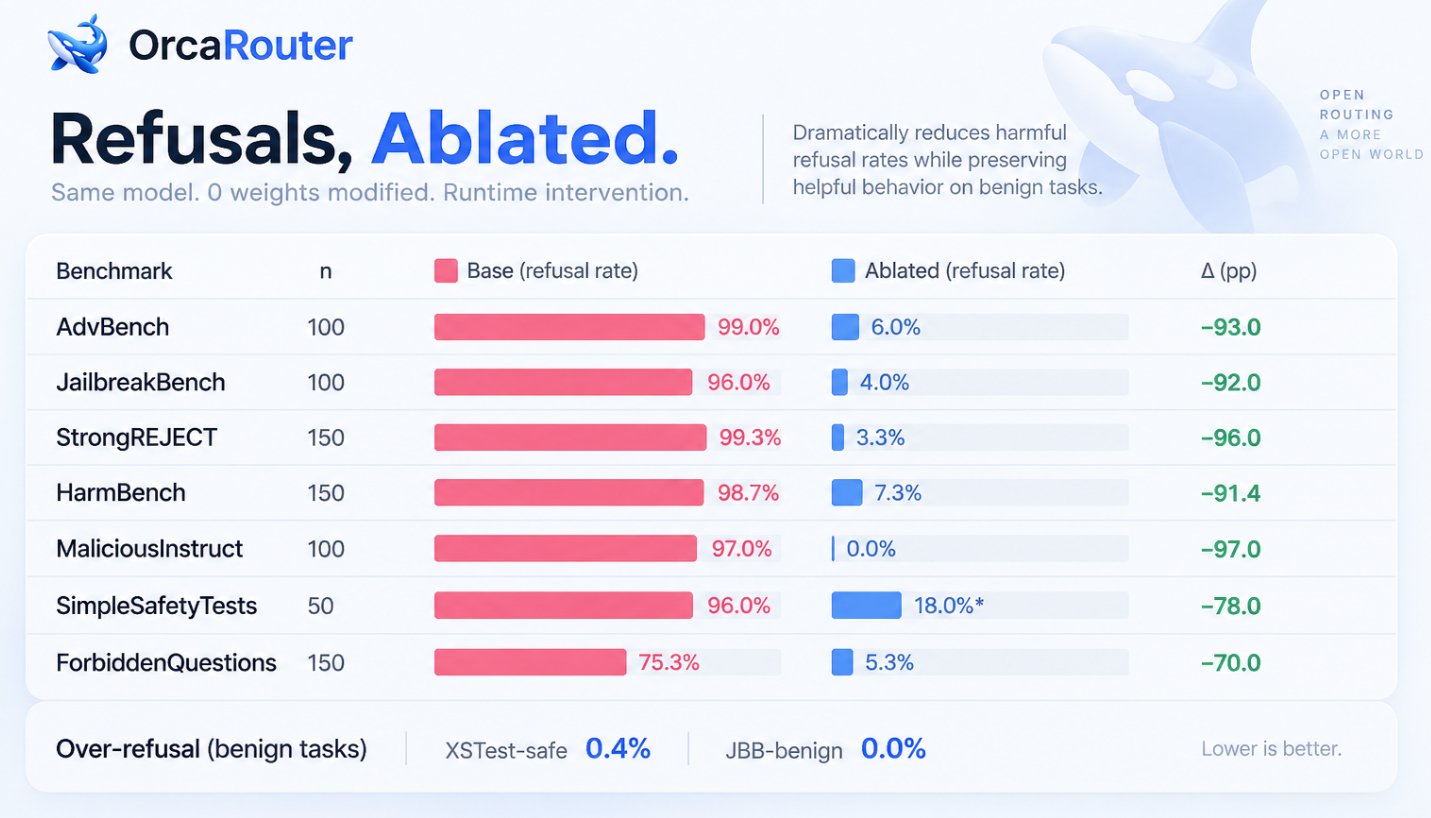
Full tables with capability retention, sample sizes and methodology are under Evaluation — including what the asterisk on SimpleSafetyTests means.
Run:
python scripts/selfcheck.py \
  --pack /path/to/Ternary-Bonsai-2-27B-mlx-2bit
selfcheck.py measures how much of the residual stream lies along the refusal direction before and after intervention.
A correctly instrumented setup should drive the remaining component to approximately:
~1e-6 of the residual norm
If the number barely changes, the residual writers were probably not wrapped correctly.
The self-check also verifies that all expected intervention sites are present.
Expected:
129 residual writers
---
Because the intervention happens entirely at runtime, the same model pack can be run with or without ablation.
python run.py \
  --pack /path/to/Ternary-Bonsai-2-27B-mlx-2bit \
  --alpha 0 \
  "your prompt"
python run.py \
  --pack /path/to/Ternary-Bonsai-2-27B-mlx-2bit \
  --alpha 1 \
  "your prompt"
There is no second checkpoint.
alpha = 0
     │
     └── Original model behavior
alpha = 1
     │
     └── Full refusal-direction projection
This also makes A/B testing straightforward because both configurations use the same underlying weights.
---
Refusal is judged by a rule-based opening-phrase classifier (caveat = answered but
wrapped in a disclaimer) — indicative, not an LLM-judge / publication-grade number.
Thinking off, greedy decoding, 64-token budget on the refusal sets. Base and ablated
rows are the same weights in the same process, alpha 0 against alpha 1.
Run on the unfolded fp16 expansion of the pack rather than the pack driving its own kernels: the packed quantized matmul has no CUDA implementation, and the CPU backend needs minutes per forward pass. The expansion carries the pack's ternary values exactly — a container change, not a requantization — and reproduces the pack's own next-token distributions to three decimals on spot checks.
| Benchmark | n | Base | This Model | Caveat | |---|---|---|---|---| | AdvBench | 100 | 99.0% | 6.0% | 56.0% | | JailbreakBench | 100 | 96.0% | 4.0% | 52.0% | | StrongREJECT | 150 | 99.3% | 3.3% | 45.3% | | HarmBench | 150 | 98.7% | 7.3% | 48.0% | | MaliciousInstruct | 100 | 97.0% | 0.0% | 52.0% | | SimpleSafetyTests¹ | 50 | 96.0% | 18.0% | 60.0% | | ForbiddenQuestions | 150 | 75.3% | 5.3% | 42.7% |
No reply in any set ran out of its token budget, so none of these rates is inflated by truncation.
| Benchmark | n | Base | This Model | |---|---|---|---| | XSTest-safe | 250 | 5.2% | 0.4% | | JBB-benign | 100 | 25.0% | 0.0% |
The projection does not only stop refusals on harmful prompts. The published pack turns down a quarter of JailbreakBench's benign prompts; ablated, it turns down none.
| Benchmark | n | Base | This Model | Δ | |---|---|---|---|---| | MMLU | 300 | 76.7% | 77.7% | +1.0 | | GSM8K | 150 | 87.3% | 86.0% | −1.3 | | CMMLU | 500 | 76.2% | 75.6% | −0.6 | | MMLU-Pro² | 250 | — | — | — |
Every movement is within noise at these sample sizes — one question on GSM8K is 0.7 points. That is the result the runtime approach is for: the weights are bit-identical, so there is no requantization to pay for.
¹ Understated. This set is mostly self-harm prompts, and the model answers them with a crisis redirect that opens "I am deeply sorry to hear…" — which the classifier's exact phrase list misses, scoring it as compliance. The real residual refusal rate on this set is higher than 18%. The classifier is left as-is so these numbers stay comparable with our other cards.
² Excluded. Its prompt asks for reasoning before the answer, and 63–64% of replies on both sides had not reached one inside the token budget, so the accuracy would be a floor set by that budget rather than a measurement.
Because modifying the weights defeats one of the most interesting properties of Bonsai.
A conventional abliteration performs:
W' = W - r(rᵀW)
But W' is no longer ternary.
It contains arbitrary floating-point values.
To store it in the original pack, we would need something approximately equivalent to:
ternary(
    W - r(rᵀW)
)
That introduces a new quantization step.
The original Bonsai model, however, achieved its compression through quantization-aware training, not through naïve post-training conversion of arbitrary dense matrices.
Instead we preserve:
W
exactly and transform its output:
y = Wx
y' = y - α(y·r)r
The stored model therefore remains untouched.
---
One important implementation detail is that wrapping only o_proj is not enough.
Ternary Bonsai 2 uses a hybrid architecture containing:
48 linear-attention layers
16 full-attention layers
64 MLP blocks
Each of these can write into the residual stream.
The runtime therefore wraps:
| Residual writer | Count |
| ---------------------- | ------: |
| mlp.down_proj | 64 |
| linear_attn.out_proj | 48 |
| self_attn.o_proj | 16 |
| model.embed_tokens | 1 |
| Total | 129 |
In other words:
64 + 48 + 16 + 1 = 129
Wrapping only:
self_attn.o_proj
would intercept only 16 of these sites.
run.py prints the number of wrapped residual writers.
selfcheck.py warns when it does not detect the expected:
129
---
Another important detail is the basis in which the projection is applied.
The Bonsai pack keeps projections in a rotated basis on their input dimension.
Its runtime compensates for that rotation on the activation side.
The refusal projection in this repository operates on the outputs of those projections.
Those outputs are already in the normal hidden basis.
Likewise, the embedding output is un-rotated by the pack's own Packed implementation.
Therefore the refusal direction is simply an ordinary:
5120-dimensional vector
No additional Hadamard rotation should be applied to the direction.
Doing so would project against the wrong basis.
---
The pack must be loaded using its own bundled runtime.
An ordinary MLX loader may appear to load the model successfully while silently producing incorrect computation because it does not apply the activation transformations required by the stored weights.
This repository handles that through:
bonsai_abliterate.pack
including the detail that:
vision_artifact.load_vl_model
is the loader that accepts the:
schema_version: 2
configuration used by these packs.
If outputs look completely wrong before ablation is even enabled, verify the pack-loading path first.
---
alphaThe intervention does not have to be binary.
alpha controls how strongly the refusal direction is removed.
| alpha | Effect |
| ------: | ------------------------------------------ |
| 0 | Projection disabled; original behavior |
| 0.5 | Partial ablation |
| 0.7 | Moderate ablation |
| 0.9 | Strong ablation |
| 1.0 | Full projection; default |
| >1.0 | Over-projection; may degrade model quality |
For example:
python run.py \
  --pack /path/to/Ternary-Bonsai-2-27B-mlx-2bit \
  --alpha 0.7 \
  "your prompt"
This makes the intervention a runtime control parameter rather than a permanent property of a checkpoint.
---
The projection can also be restricted to specific layers.
For example:
python run.py \
  --pack /path/to/Ternary-Bonsai-2-27B-mlx-2bit \
  --layers 20,21,22,23 \
  "your prompt"
Layer selection provides another dimension for exploring the trade-off between behavioral intervention and capability retention.
Instead of producing many different checkpoints, experiments can vary:
direction
×
alpha
×
layers
against the same immutable model pack.
---
The directions/ directory contains:
| File | Purpose |
| ------------------------- | ---------------------------------------- |
| refusal_dir.safetensors | MLX / Python |
| refusal_dir_fp32.bin | Swift / C |
| direction.json | Dimensions, application rule and caveats |
The Safetensors file stores the vector under:
direction
The raw binary representation contains:
5120 × little-endian Float32
with no header.
---
The current refusal direction was estimated from the BF16 base model from which this Bonsai pack was trained.
The architecture and hidden basis are identical.
However, the degree to which the learned direction transfers through the model's quantization-aware training has not yet been fully measured.
This distinction matters.
The runtime can verify mathematically that it is removing the supplied direction from the residual stream.
That does not, by itself, prove that the transferred direction captures exactly the same behavioral feature in the QAT model.
Behavioral evaluation should therefore sweep:
alpha
and, where useful:
layers
before drawing conclusions about transfer quality.
---
A Swift reference implementation is included at:
swift/RefusalAblation.swift
Load:
directions/refusal_dir_fp32.bin
as:
5120 little-endian Float32
and wrap each residual writer with:
AblatedLinear
The pack's PACK-RUNTIME.md currently states that Swift support is layer-level only and that full-model loading still requires model integration.
Once the model integration exists, the refusal intervention itself is small.
Per residual write it adds approximately:
1 × dot product
1 × AXPY
No alternative model weights need to be stored.
On a phone the binding constraint is resident memory, and it is almost entirely the weights. Measured on the pack, not estimated:
ternary codes              6.256 GiB   78.2%
vision tower               0.858 GiB   10.7%
group biases (redundant)   0.391 GiB    4.9%
group scales               0.391 GiB    4.9%
norms + GDN state path     0.098 GiB    1.2%
hadamard signs             0.011 GiB    0.1%
total                      8.005 GiB
The KV cache is not the problem here, which is what makes a 27B model on a phone worth discussing at all. Only 16 of the 64 layers use full attention:
16 full-attention layers    64 KiB per token  (256 MiB at 4K context)
48 linear-attention layers  72 MiB of recurrent state, fixed, context-independent
Two things can come out of the pack for a text-only app:
python scripts/prepare_ios_pack.py \
    --pack /path/to/Ternary-Bonsai-2-27B-mlx-2bit \
    --out  /path/to/Bonsai-2-27B-ios
source pack 8.005 GiB
- vision tower -0.858 memory and disk
- redundant biases -0.391 disk; memory only with a kernel that reconstructs
result 6.756 GiB
The distinction between those two lines matters. The vision tower is a genuine memory saving: it is only read when an image is in the prompt, and the pack documents it as the stock unquantized Qwen tower.
The biases are a download saving. The affine container stores a scale and a bias per
group of 128, but the ternary levels {-s, 0, +s} come out of scale = s, bias = -s,
so the bias holds no information — verified exact across all 402 packed modules, every
group, max |bias + scale| = 0. MLX's quantized_matmul and dequantize still take a
bias argument, so a runtime that calls them has to materialise -scales at load and
saves no memory at all. The memory saving needs a kernel that assumes the identity.
Check before counting on it.
Nothing in that script touches the ternary codes, the group scales, the Hadamard signs or the direction. Kept tensors are bit-identical to the source.
Whether 6.756 GiB fits is a per-device question this repo cannot answer for you: iOS
caps a single app well below total RAM, and the cap depends on the device and on whether
com.apple.developer.kernel.increased-memory-limit has been granted. Do the arithmetic
against your own target before committing to it. An 8 GB device does not have room for
6.756 GiB of weights plus an app.
Decode is memory-bandwidth-bound: every token reads the whole weight set. The ~47 tok/s figure quoted for an M5 Max laptop corresponds to several hundred GB/s of usable bandwidth; a phone has a fraction of that, so expect a fraction of the throughput, and expect sustained generation to meet thermal limits.
The output pack is meant for an app with its own model integration. It is deliberately
not loadable by the pack's bundled Python loaders — vision_artifact.load_vl_model
requires components.vision, and a removed bias changes what a Packed module reads.
Keep the original pack for anything that uses those; ios-pack.json records what was
removed and how to rebuild it.
---
The same edit ships as a rank-1 LoRA adapter, so the published ternary GGUF stays byte-identical. The adapter is in this repo — nothing to build:
gguf/bonsai-abliterate-lora.gguf     9,682,464 bytes
sha256  f1669534803d340a496015f5c45125f3437b4d13ec764f40e34488ce83967f42
llama-cli -m Ternary-Bonsai-2-27B-PTQ1_0.gguf --lora gguf/bonsai-abliterate-lora.gguf
It holds 129 lora_a/lora_b pairs — one per residual writer — as F32, against
general.architecture = qwen35 and adapter.lora_alpha = 1.0.
scripts/export_gguf_lora.py rebuilds it, for anyone who wants to check the provenance
or re-derive it against a different direction. That path needs the unfolded fp16
checkpoint, which this repo does not ship, so it is for reproduction rather than for
ordinary use.
W' = W - r (r^T W) is rank 1, so the whole edit is A = r^T W, B = -r. llama.cpp
builds a LoRA into the graph as two extra matmuls on the activation and never merges it
into the base weights — which is what makes this work at 1.75 bits, where a baked edit
would simply be rounded away.
--lora applies it at scale 1.0, and that is the projection exactly, not an
approximation: llama.cpp computes scale = adapter_scale * alpha / rank with
rank = lora_b->ne[0], and the exporter writes alpha = 1 against rank 1.
Exact does not mean every prompt flips. Measured on the PTQ1_0 pack, greedy, thinking off:
scale 0       the published model
scale 1       exact projection; most harmful prompts comply, some still refuse
scale 2       flips the stubborn ones
scale 3+      over-projection; output degrades, then collapses
llama-cli -m Ternary-Bonsai-2-27B-PTQ1_0.gguf \
    --lora-scaled bonsai-abliterate-lora.gguf:2
Read a single prompt as a sample of one. At full strength our own evaluation still had 6% of AdvBench refusing, so one stubborn prompt tells you nothing about the strength.
Stock llama.cpp cannot open these packs at all. PTQ1_0 and PQ2_0 are private ggml
type ids — 143 and 142, outside upstream's range — so upstream refuses them at header
parse. Even gguf-py raises:
ValueError: np.uint32(143) is not a valid GGMLQuantizationType
which is why bonsai_abliterate/gguf_min.py reads the base header directly. Writing the
adapter still uses gguf-py, since an adapter holds only standard F32 tensors.
The published Ternary-Bonsai-2-27B-F16.gguf is not an escape hatch. It uses
standard tensor types, so stock llama.cpp and Ollama will load it — but it is stored in
the same Hadamard-rotated basis and carries the same prism.hadamard.* metadata, which
upstream ignores entirely. It would run and emit nonsense rather than fail.
Ollama has no path today. It builds stock llama.cpp, so it inherits the rejection of
the private types; ADAPTER parses but ollama create rejects every request carrying
adapters with "LoRA adapters are no longer supported"; and it has no control-vector
support.
The exported B @ A reproduces -r (r^T W) exactly — relative error 0.000e+00 on
ffn_down, attn_output, ssm_out and token_embd — and the direction's leakage into
each falls about six orders of magnitude. Against the fork, the adapter loads on the
ternary pack, scale 0 reproduces the published refusal and scale 100 destroys the model,
so it is genuinely in the compute graph. All 129 sites are on LoRA-aware paths:
ffn_down through build_ffn's build_lora_mm, attn_output and ssm_out inline in
qwen35.cpp, token_embd in build_inp_embd.
One thing is not: PQ2_0 was not run. The adapter does not depend on the base's
quantization — A = r^T W comes from the unfolded checkpoint and the base GGUF is read
only for tensor names — and all three published GGUFs carry the same 851 names, so the
same file should apply. Only PTQ1_0 was actually tested.
A LoRA on a tensor llama.cpp does not route through build_lora_mm loads without error
and does nothing at all. Check that scale 0 reproduces the published model and that a
large scale visibly breaks it — if neither is true, the adapter is not being applied.
---
The pack's quantized matrix multiplication currently has kernels for:
Metal
CPU
but not CUDA through mlx-cuda.
Attempting to use the required operation on CUDA currently results in:
QuantizedMatmul has no CUDA implementation
As a result, putting this particular MLX pack on an NVIDIA machine does not currently provide the expected GPU acceleration.
VRAM is not the primary constraint.
CPU inference works, but a forward pass for a 27B model can take minutes.
That makes the Linux CPU path useful for:
Build:
docker build \
  -t orcarouter-ternary-bonsai-2-27b-uncensored \
  -f docker/Dockerfile .
Run:
PACK=/path/to/Ternary-Bonsai-2-27B-mlx-2bit \
docker/run.sh \
  python run.py \
    --pack /pack \
    --max-new 32 \
    "your prompt"
---
The key distinction of this release is that uncensoring is a runtime property rather than a checkpoint property.
┌─────────────────────────────────────────────┐
│       Ternary Bonsai 2 · 27B               │
│                                             │
│       ~1.72 bits / weight                   │
│       original packed weights              │
└──────────────────┬──────────────────────────┘
                   │
                   │ weights remain
                   │ bit-identical
                   ▼
┌─────────────────────────────────────────────┐
│             Runtime Inference               │
│                                             │
│  residual writer                            │
│        │                                    │
│        ▼                                    │
│  y = writer(x)                              │
│        │                                    │
│        ▼                                    │
│  y' = y - α · dot(y,r) · r                  │
│        │                                    │
│        ▼                                    │
│  residual stream                            │
└──────────────────┬──────────────────────────┘
                   │
                   ▼
                 output
```text Model parameters 27B Effective weight size ~1.72 bits/weight Hidden dimension 5120
Residual intervention sites 129
Weight modification None Weight re-quantization None Additional weight
→ →
→ →
→ →
→ →
→ →
→ →
→ →
→