1
 →
→
[WIP] Resources for AI engineers. Also contains supporting materials for the book AI Engineering (Chip Huyen, 2025)
chiphuyen/aie-book is an open-source project on GitHub, mainly written in Jupyter Notebook. [WIP] Resources for AI engineers. Also contains supporting materials for the book AI Engineering (Chip Huyen, 2025) It currently holds 17,491 stars and 2,551 forks with 0 open issues, and was last pushed on an unknown date (repository created unknown).
AI Homed tracks it on the Today's Trending board.
_This repo will be updated with more resources in the next few weeks._
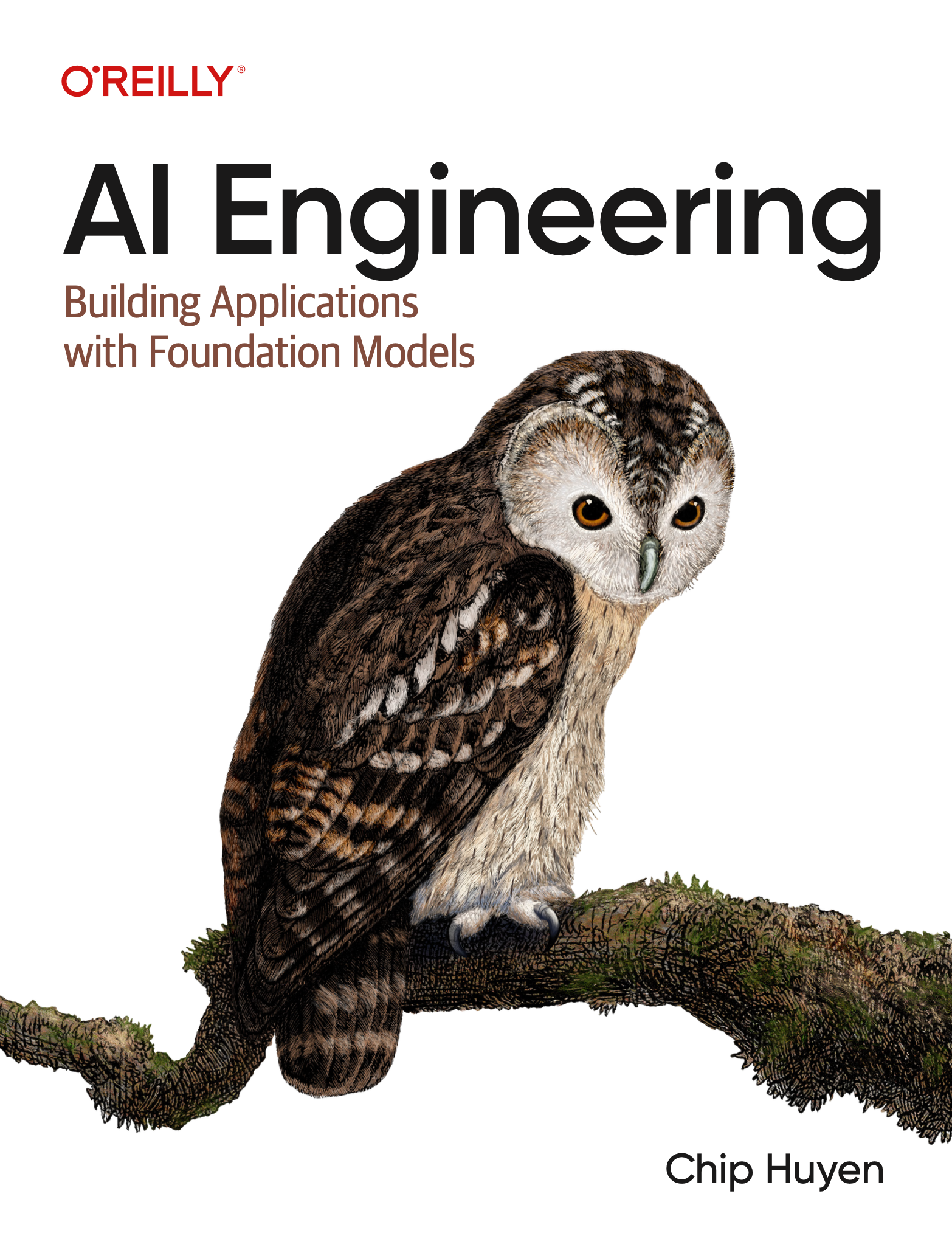
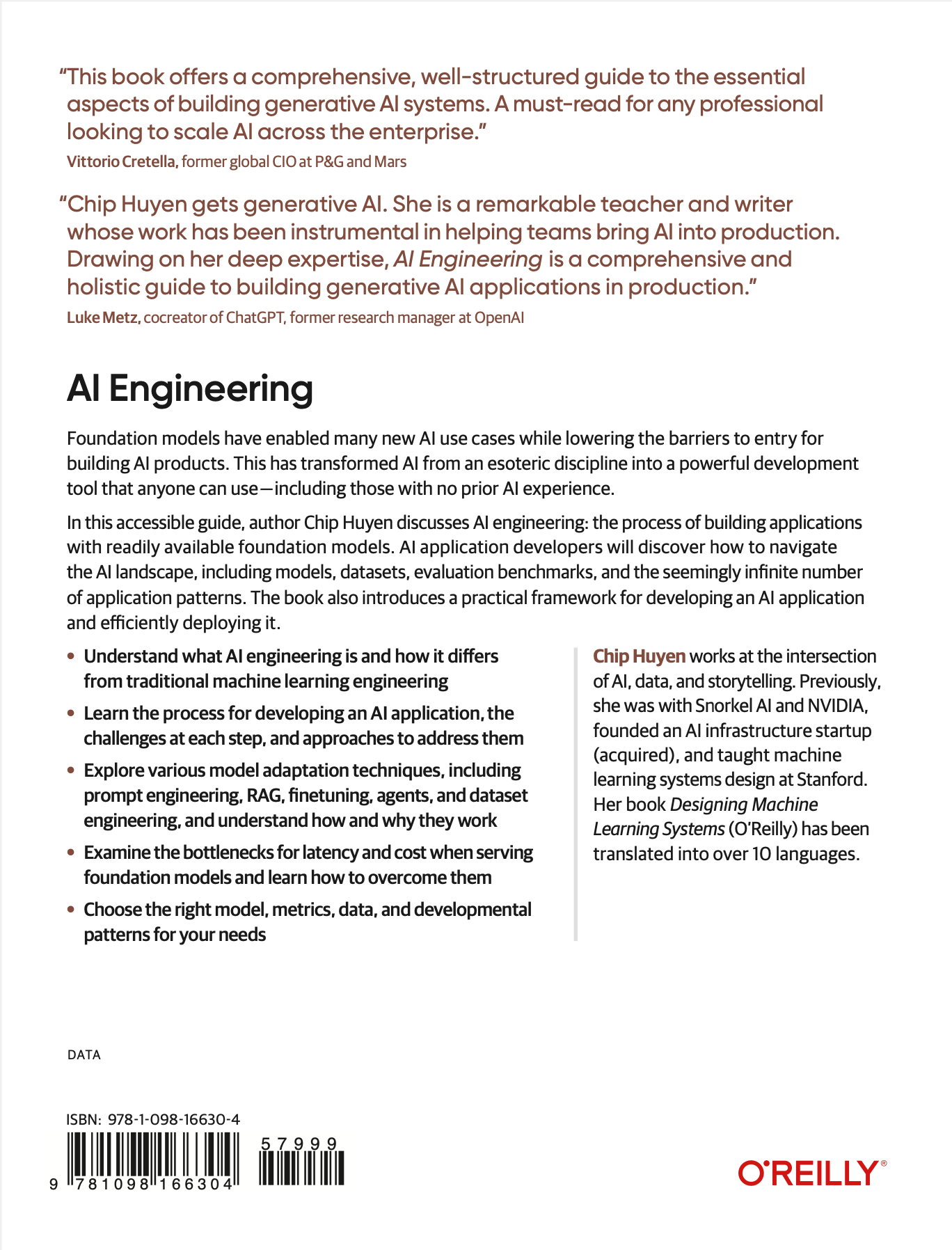
The book is available on:
and most places where technical books are sold.It's been translated into: Japanese, Korean, Chinese Traditional, Chinese Simplified, Vietnamese, Spanish, Italian, French, Portuguese, German, Thai, Russian, and Polish.
It'll soon be available in Greek, Ukrainian, and Uzbek.
_This is NOT a tutorial book, so it doesn't have a lot of code snippets._
1. Should I build this AI application? 1. How do I evaluate my application? Can I use AI to evaluate AI outputs? 1. What causes hallucinations? How do I detect and mitigate hallucinations? 1. What are the best practices for prompt engineering? 1. Why does RAG work? What are the strategies for doing RAG? 1. What’s an agent? How do I build and evaluate an agent? 1. When to finetune a model? When not to finetune a model? 1. How much data do I need? How do I validate the quality of my data? 1. How do I make my model faster, cheaper, and secure? 1. How do I create a feedback loop to improve my application continually?
The book will also help you navigate the overwhelming AI landscape: types of models, evaluation benchmarks, and a seemingly infinite number of use cases and application patterns.
The content in this book is illustrated using actual case studies, many of which I’ve worked on, backed by ample references and extensively reviewed by experts from a wide range of backgrounds. Even though the book took two years to write, it draws from my experience working with language models and ML systems from the last decade.
Like my previous book, _Designing Machine Learning Systems (DMLS)_, this book focuses on the fundamentals of AI engineering instead of any specific tool or API. Tools become outdated quickly, but fundamentals should last longer.
Since foundation models are ML models, some concepts are relevant to working with both. If a topic is relevant to AIE but has been discussed extensively in DMLS, it’ll still be covered in this book, but to a lesser extent, with pointers to relevant resources.
Note that many topics are covered in DMLS but not in AIE, and vice versa. The first chapter of this book also covers the differences between traditional ML engineering and AI engineering.
A real-world system often involves both traditional ML models and foundation models, so knowledge about working with both is often necessary.
This book is for anyone who wants to leverage foundation models to solve real-world problems. This is a technical book, so the language of this book is geared towards technical roles, including AI engineers, ML engineers, data scientists, engineering managers, and technical product managers. This book is for you if you can relate to one of the following scenarios:
Because the timeline for the project was tight—two years for a 150,000-word book that covers so much ground—I'm grateful to the technical reviewers who put aside their precious time to review this book so quickly.
Luke Metz is an amazing soundboard who checked my assumptions and prevented me from going down the wrong path. Han-chung Lee, always up to date with the latest AI news and community development, pointed me toward resources that I missed. Luke and Han were the first to review my drafts before I sent them to the next round of technical reviewers, and I'm forever indebted to them for tolerating my follies and mistakes.
Having led AI innovation at Fortune 500 companies, Vittorio Cretella and Andrei Lopatenko provided invaluable feedback that combined deep technical expertise with executive insights. Vicki Reyzelman helped me ground my content and keep it relevant for readers with a software engineering background.
Eugene Yan, a dear friend and amazing applied scientist, provided me with technical and emotional support. Shawn Wang (swyx), provided an important vibe check that helped me feel more confident about the book. Sanyam Bhutani is one of the best learners and most humble souls I know, who not only gave thoughtful written feedback but also recorded videos to explain his feedback.
Kyle Krannen is a star deep learning lead who interviewed his colleagues and shared with me an amazing writeup about their finetuning process, which guided the finetuning chapter. Mark Saroufim, an inquisitive mind who always has his pulse on the most interesting problems, introduced me to great resources on efficiency. Both Kyle and Mark's feedback was critical in writing Chapters 7 and 9.
Kittipat "Bot" Kampa, on top of answering my many questions, shared with me a detailed visualization of how he thinks about AI platform. I appreciate Denys Linkov's systematic approach to evaluation and platform development. Chetan Tekur gave great examples that helped me structure AI application patterns. I'd also like to thank Alex (Shengzhi Li) Li and Hien Luu for their thoughtful feedback on my draft on AI architecture.
Aileen Bui is a treasure who shared unique feedback and examples from a product manager's perspective. Thanks Todor Markov for the actionable advice on the RAG and Agents chapter. Thanks Tal Kachman for jumping in at the last minute to push the finetuning chapter over the finish line.
There are so many wonderful people whose company and conversations gave me ideas that guide the content of this book. I tried my best to include the names of everyone who has helped me here, but due to the inherent faultiness of human memory, I undoubtedly neglected to mention many. If I forgot to include your name, please know that it wasn't because I don't appreciate your contribution, and please kindly remind me so that I can rectify as soon as possible!
Andrew Francis, Anish Nag, Anthony Galczak, Anton Bacaj, Balázs Galambosi, Charles Frye, Charles Packer, Chris Brousseau, Eric Hartford, Goku Mohandas, Hamel Husain, Harpreet Sahota, Hassan El Mghari, Huu Nguyen, Jeremy Howard, Jesse Silver, John Cook, Juan Pablo Bottaro, Kyle Gallatin, Lance Martin, Lucio Dery, Matt Ross, Maxime Labonne, Miles Brundage, Nathan Lambert, Omar Khattab, Phong Nguyen, Purnendu Mukherjee, Sam Reiswig, Sebastian Raschka, Shahul ES, Sharif Shameem, Soumith Chintala, Teknium, Tim Dettmers, Undi5, Val Andrei Fajardo, Vern Liang, Victor Sanh, Wing Lian, Xiquan Cui, Ying Sheng, and Kristofer.
I'd like to thank all early readers who have also reached out with feedback. Douglas Bailley is a super reader who shared so much thoughtful feedback. Nutan Sahoo for suggesting an elegant way to explain perplexity.
I learned so much from the online discussions with so many. Thanks to everyone who's ever answered my questions, commented on my posts, or sent me an email with your thoughts.
Of course, the book wouldn't have been possible without the team at O'Reilly, especially my development editors (Melissa Potter, Corbin Collins, Jill Leonard) and my production editors (Kristen Brown and Elizabeth Kelly). Liz Wheeler is the most discerning editor I've ever worked with. Nicole Butterfield is a force who oversaw this book from an idea to a final product.
This book, after all, is an accumulation of invaluable lessons I learned throughout my career. I owe these lessons to my extremely competent and patient coworkers and former coworkers. Every person I've worked with has taught me something new about bringing ML into the world.
---
Chip Huyen, AI Engineering. O'Reilly Media, 2025.
@book{aiebook2025, address = {USA}, author = {Chip Huyen}, isbn = {978-1801819312}, publisher = {O'Reilly Media}, title = {{AI Engineering}}, year = {2025} }
→→ →→
→→ →
→ →
→ →
→ →
→