
1
 →
→
Streamlines and simplifies prompt design for both developers and non-technical users with a low code approach.
character-ai/prompt-poet is an open-source project on GitHub, mainly written in Python. Streamlines and simplifies prompt design for both developers and non-technical users with a low code approach. It currently holds 1,154 stars and 94 forks with 0 open issues, and was last pushed on an unknown date (repository created unknown).
AI Homed tracks it on the AI Prompt Engineering board.
Prompt Poet streamlines and simplifies prompt design for both developers and non-technical users with its low code approach. Using a mix of YAML and Jinja2, Prompt Poet allows for flexible, dynamic prompt creation, enhancing the efficiency and quality of interactions with AI models. It saves time on engineering string manipulations, enabling everyone to focus more on crafting the optimal prompts for their users.
pip install prompt-poet
import os
import getpass
from prompt_poet import Prompt
from langchain import ChatOpenAI
Uncomment if you need to set OPENAI_API_KEY.
os.environ["OPENAI_API_KEY"] = getpass.getpass()
raw_template = """
- name: system instructions
role: system
content: |
Your name is {{ character_name }} and you are meant to be helpful and never harmful to humans.
- name: user query
role: user
content: |
{{ username}}: {{ user_query }}
- name: response
role: user
content: |
{{ character_name }}:
"""
template_data = {
"character_name": "Character Assistant",
"username": "Jeff",
"user_query": "Can you help me with my homework?"
}
prompt = Prompt(
raw_template=raw_template,
template_data=template_data
)
model = ChatOpenAI(model="gpt-4o-mini")
response = model.invoke(prompt.messages)
- name: system instructions
role: system
content: |
Your name is {{ character_name }} and you are meant to be helpful and never harmful to humans.
- name: user query
role: user
content: |
{{ username}}: {{ user_query }}
- name: reply_prompt
role: user
content: |
{{ character_name }}:
{% for message in current_chat_messages %}
- name: chat_message
role: user
content: |
{{ message.author }}: {{ message.content }}
{% endfor %}
{% for message in current_chat_messages %}
- name: chat_message
role: user
truncation_priority: 1
content: |
{{ message.author }}: {{ message.content }}
{% endfor %}
{% if modality == "audio" %}
- name: special audio instruction
role: system
content: |
{{ username }} is currently using audio. Keep your answers succinct.
{% endif %}
{% if extract_user_query_topic(user_query) == "homework_help" %}
{% for homework_example in fetch_few_shot_homework_examples(username, character_name) %}
- name: homework_example_{{ loop.index }}
role: user
content: |
{{ homework_example }}
{% endfor %}
{% endif %}
- name: system instructions
role: system
content: |
Your name is {{ character_name }} and you are meant to be helpful and never harmful to humans.
- name: user query
role: user
content: |
<|space|>{{ username}}: {{ user_query }}
- name: system instructions
role: system
content: |
Your name is {{ character_name }} and you are meant to be helpful and never harmful to humans.
{% if modality == "audio" %}
- name: special audio instruction
role: system
content: |
{{ username }} is currently using audio modality. Keep your answers succinct and to the point.
{% endif %}
{% if extract_user_query_topic(user_query) == "homework_help" %}
{% for homework_example in fetch_few_shot_homework_examples(username, character_name) %}
- name: homework_example_{{ loop.index }}
role: user
content: |
{{ homework_example }}
{% endfor %}
{% endif %}
{% for message in current_chat_messages %}
- name: chat_message
role: user
truncation_priority: 1
content: |
{{ message.author }}: {{ message.content }}
{% endfor %}
- name: user query
role: user
content: |
{{ username}}: {{ user_query }}
- name: reply_prompt
role: user
content: |
{{ character_name }}:
{% include 'sections/system_instruction.yml.j2' %}
{% include 'sections/audio_instruction.yml.j2' %}
{% if extract_user_query_topic(user_query) == "homework_help" %}
{% include 'sections/homework_examples.yml.j2' %}
{% endif %}
{% include 'sections/chat_messages.yml.j2' %}
{% include 'sections/user_query.yml.j2' %}
{% include 'sections/reply_prompt.yml.j2' %}
- name: system_instructions
role: system
sections:
- name: character_intro
content: |
Your name is {{ character_name }} and you are a helpful assistant.
- name: safety_rules
content: |
Never be harmful to humans. Always be respectful and kind.
- name: conversation_style
content: |
Keep your responses concise and engaging.
You can then access detailed statistics:
prompt = Prompt(raw_template=raw_template, template_data=template_data)
prompt.tokenize()
Get hierarchical statistics
stats = prompt.section_stats
print(stats)
>> [
    {
        "part_name": "system_instructions",
        "part_tokens": 150,
        "part_role": "system",
        "has_sections": True,
        "sections": [
            {"section_name": "character_intro", "section_tokens": 50},
            {"section_name": "safety_rules", "section_tokens": 60},
            {"section_name": "conversation_style", "section_tokens": 40}
        ]
    }
]
Or get a flat mapping of token counts
counts = prompt.get_section_token_counts()
print(counts)
>> {
    "system_instructions": {
        "character_intro": 50,
        "safety_rules": 60,
        "conversation_style": 40
    }
}
Important Notes:
content OR sections, not both|) to preserve newlines for proper separation when concatenatedprompt.tokenize()
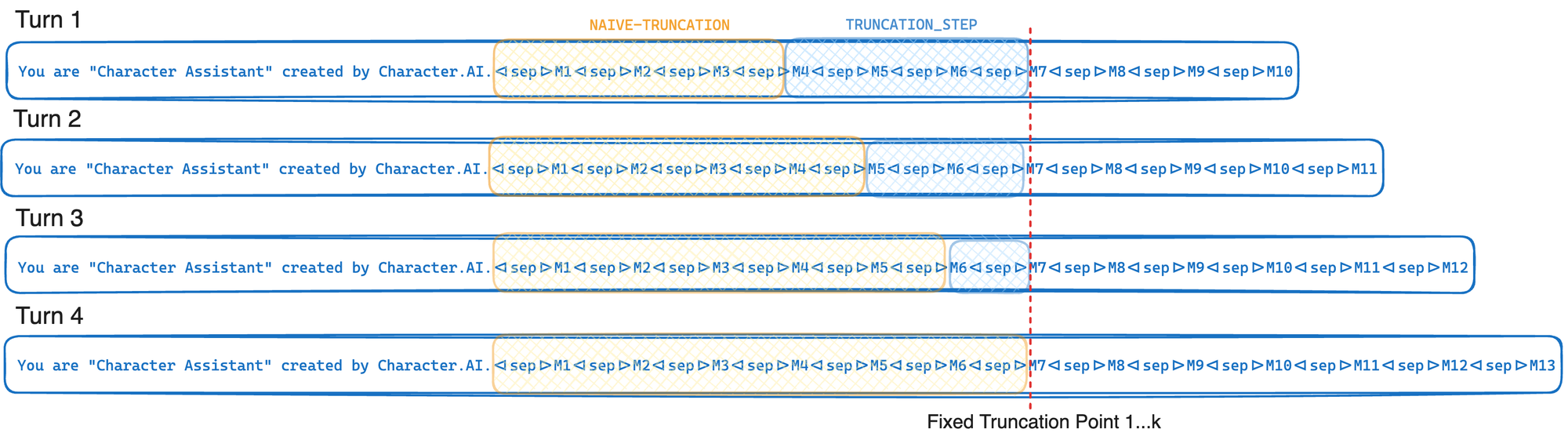
prompt.truncate(token_limit=TOKEN_LIMIT, truncation_step=TRUNCATION_STEP)
Inspect prompt as a raw string.
prompt.string: str
>> "..."
Inpsect the prompt as raw tokens.
prompt.tokens: list[int]
>> [...]
Inspect the prompt as LLM API message dicts.
prompt.messages: list[dict]
>> [...]
Inspect the prompt as first class parts.
prompt.parts: list[PromptPart]
>> [...]
extract_user_query_topic can perform arbitrary processing of the user's query used in the template's control flow--perhaps by performing a round-trip to a topic classifier.
{% if extract_user_query_topic(user_query) == "homework_help" %}
{% for homework_example in fetch_few_shot_homework_examples(username, character_name) %}
- name: homework_example_{{ loop.index }}
role: user
content: |
{{ homework_example }}
{% endfor %}
{% endif %}
tiktoken_encoding_name. Alternatively, users can provide their own encode function with the top-level encode_func: Callable[[str], list[int]].
from tiktoken import get_encoding
encode_func = get_encoding("o200k_base")
prompt = Prompt(
    raw_template=raw_template,
    template_data=template_data,
    encode_func=encode_func
)
prompt.tokenize()
prompt.tokens
>> [...]
TOKEN_LIMIT = 128000
TRUNCATION_STEP = 4000
Tokenize and truncate the prompt.
prompt.tokenize()
prompt.truncate(token_limit=TOKEN_LIMIT, truncation_step=TRUNCATION_STEP)
response = model.invoke(prompt.messages)
Filename: chat_template.yml.j2
- name: system instructions
role: system
content: |
Your name is {{ character_name }} and you are meant to be helpful and never harmful to humans.
- name: user query
role: user
content: |
{{ username}}: {{ user_query }}
- name: response
role: user
content: |
{{ character_name }}:
Run this python code from the same directory you have saved the file chat_template.yml.j2 to.
from prompt_poet import Prompt
prompt = Prompt(
    template_path="chat_template.yml.j2",
    template_data=template_data
)
print(prompt.string)
>> 'Your name is Character Assistant and you are meant to be helpful and never harmful to humans.Jeff: Can you help me with my homework?Character Assistant:'
 →
→ →
→ →
→ →
→ →
→ →
→ →
→