1
 →
→
[SIGGRAPH Asia 2026] 4DAnyone: Create Anyone in 4D from a Casual Monocular Video
ant-research/4DAnyone is an open-source project on GitHub, mainly written in Python. [SIGGRAPH Asia 2026] 4DAnyone: Create Anyone in 4D from a Casual Monocular Video It currently holds 1,360 stars and 102 forks with 0 open issues, and was last pushed on an unknown date (repository created unknown).
AI Homed tracks it on the AI Video Projects board and on the AI AI Video Projects list.

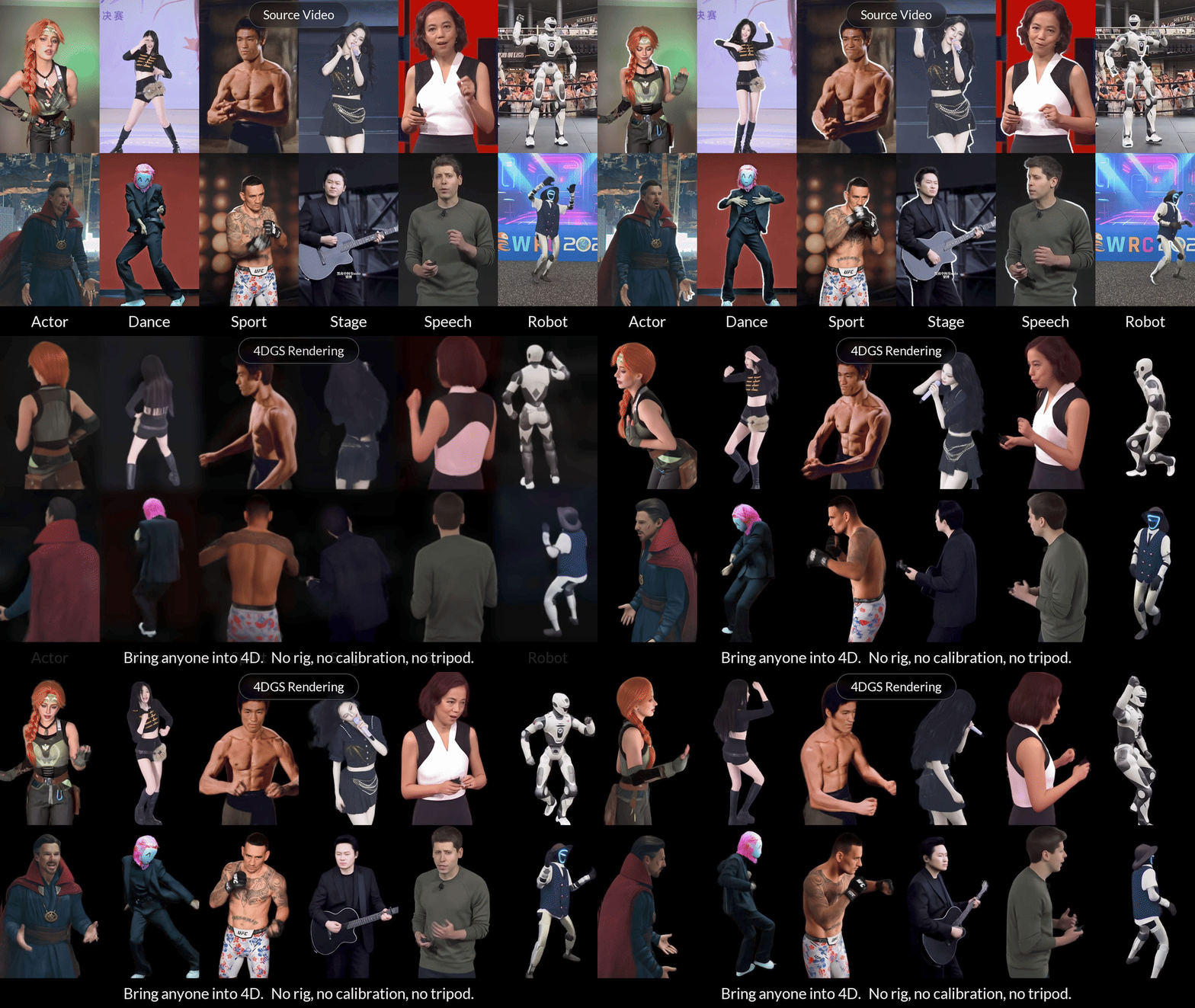
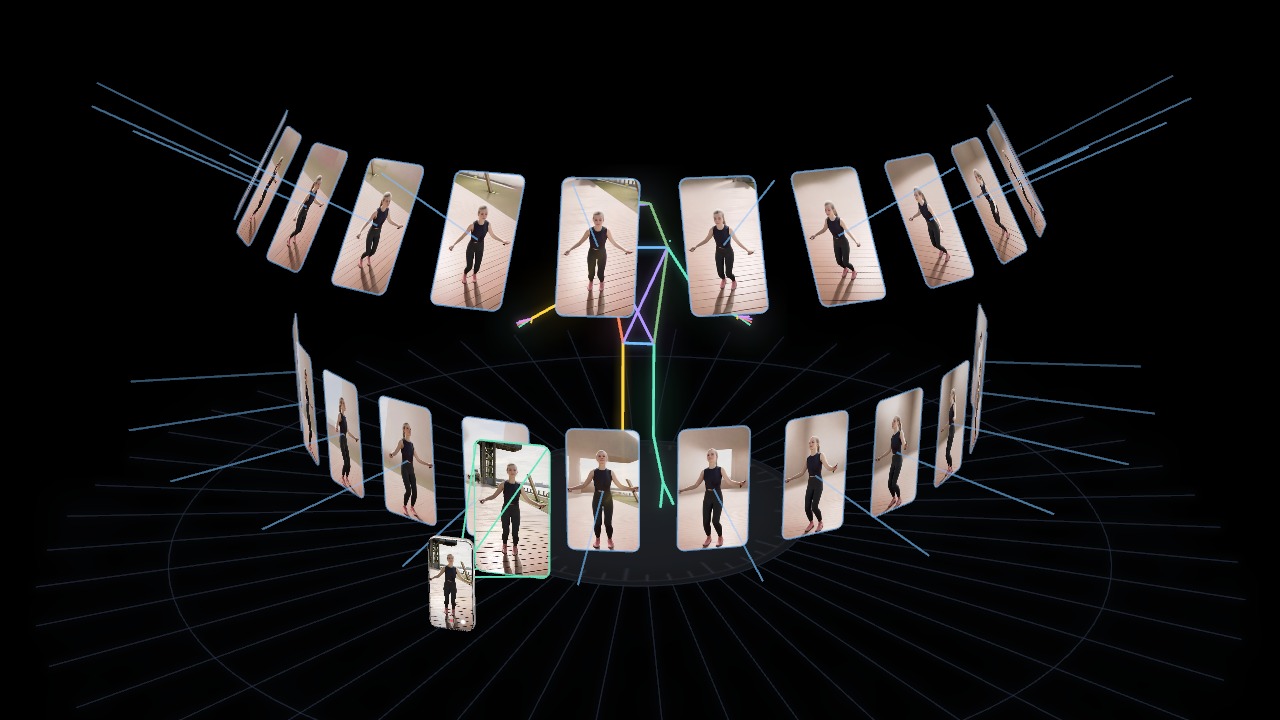
4DAnyone turns a casual monocular video into dozens of synchronized, view-consistent videos, enabling downstream 4DGS reconstruction.
[!note]
We're actively improving 4DAnyone. We recommend using the latest code.
git clone https://github.com/ant-research/4DAnyone.git
cd 4DAnyone
git submodule update --init third_party/GVHMR
conda create -n 4danyone python=3.11 -y
conda activate 4danyone
pip install -r requirements.txt
For faster inference, optionally install FlashAttention-3 or SageAttention. The installed backend is enabled automatically.
Missing models and examples are downloaded automatically on first use. You can also download them manually:
python scripts/download_smplx.py
python scripts/download_model.py
python scripts/download_example.py
This repository provides two models: 4DAnyone-Base with the standard denoising schedule and the distilled 4DAnyone-Turbo for faster four-step denoising. 4DAnyone-Turbo is enabled by default for faster inference while maintaining generation quality comparable to 4DAnyone-Base. See Inference performance for GPU memory, inference speed, and generation quality benchmarks.
4DAnyone supports flexible target-view counts, pitch layers, and yaw coverage. Run python inference.py --help to see all available options. Here are several common camera configurations:
A compact 360° layout for basic coverage. Start here for an initial test.
python inference.py \
    --video_path "data/source/pexels/2785536-uhd_2160_3840_25fps.mp4" \
    --output_dir "data/fdanyone/pexels/2785536-uhd_2160_3840_25fps" \
    --views_per_layer 6
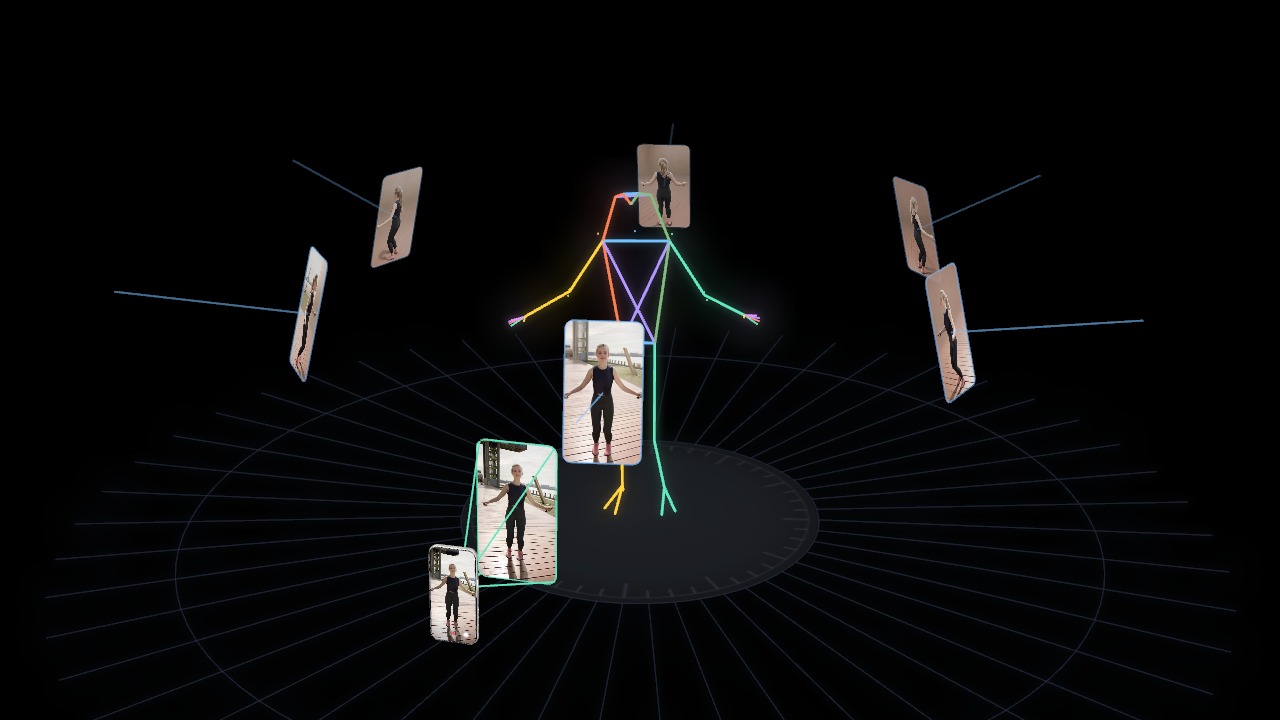
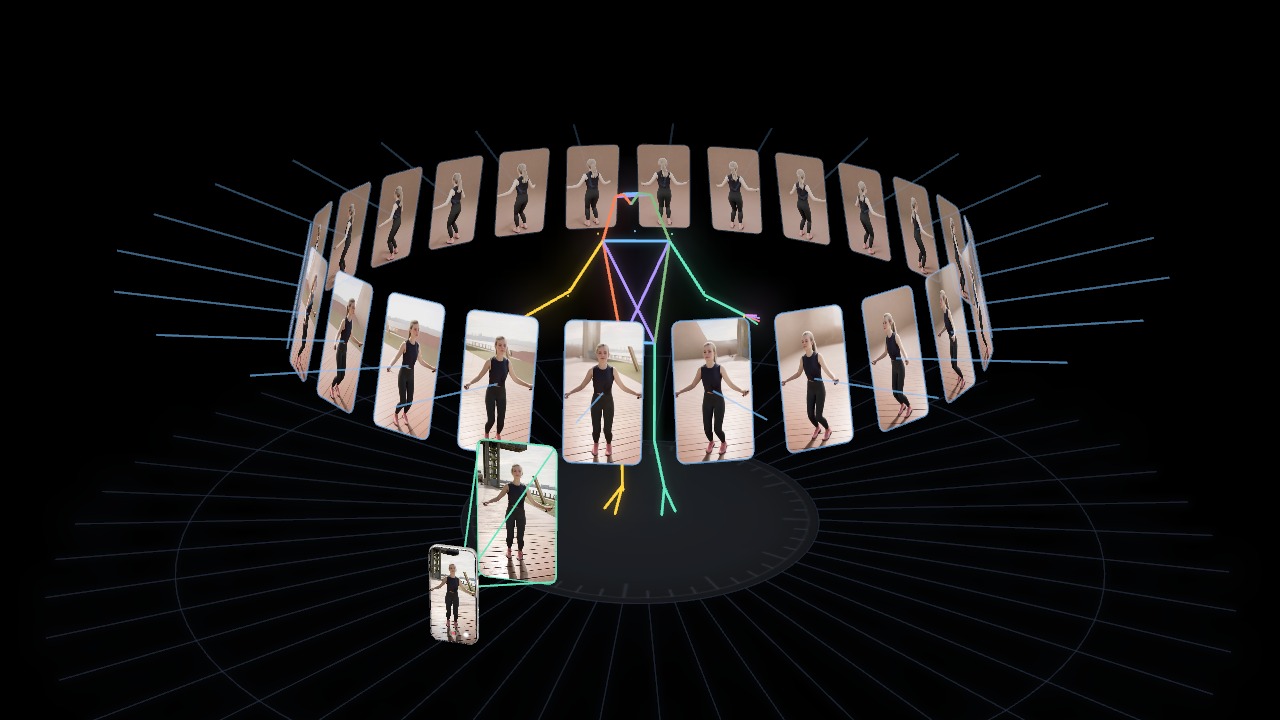
A dense 360° layout with broad angular coverage, suitable for 4DGS reconstruction.
python inference.py \
    --video_path "data/source/pexels/2785536-uhd_2160_3840_25fps.mp4" \
    --output_dir "data/fdanyone/pexels/2785536-uhd_2160_3840_25fps" \
    --views_per_layer 24
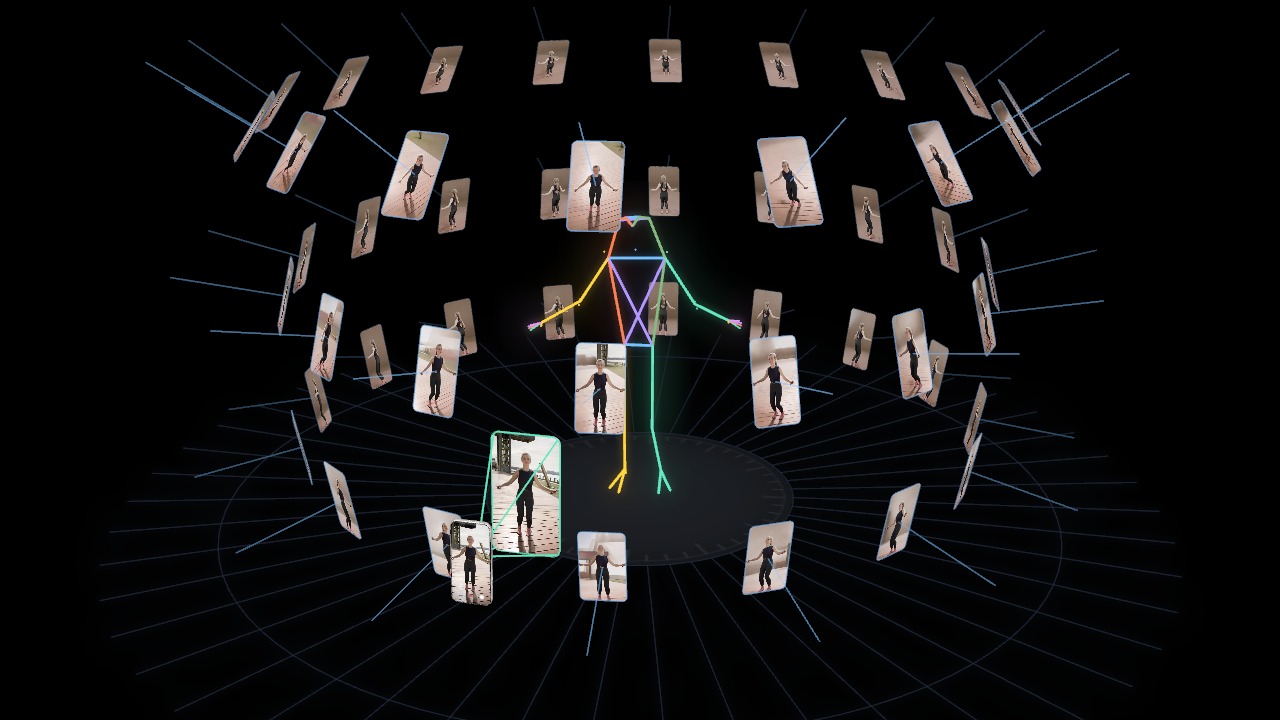
This layout distributes views across three pitch rings for broader coverage, enabling free-viewpoint 4DGS rendering.
python inference.py \
    --video_path "data/source/pexels/2785536-uhd_2160_3840_25fps.mp4" \
    --output_dir "data/fdanyone/pexels/2785536-uhd_2160_3840_25fps" \
    --views_per_layer 16 --layer_pitches '[-10,15,35]'
A two-layer layout for dense coverage across the frontal 180° arc.
python inference.py \
    --video_path "data/source/pexels/2785536-uhd_2160_3840_25fps.mp4" \
    --output_dir "data/fdanyone/pexels/2785536-uhd_2160_3840_25fps" \
    --views_per_layer 12 --layer_pitches '[0,30]' --start_yaw -90 --yaw_span 180
/                           # input filename without its extension
├── metadata.json                 # run settings, timings, resources
├── cameras.json                  # intrinsics and poses for N target views
├── gvhmr/                        # reusable motion recovery
│   ├── motion.json               # source timeline and motion metadata
│   └── motion.safetensors        # motion tensors
├── skeletons/00.mp4 ... .mp4  # pose conditioning for each target view
└── videos/00.mp4 ... .mp4     # target videos
Use an input video with:
We provide a Gradio space for interactive inference and visualization. It is built with Rerun, inspired by the community 4DAnyone-Rerun Space.
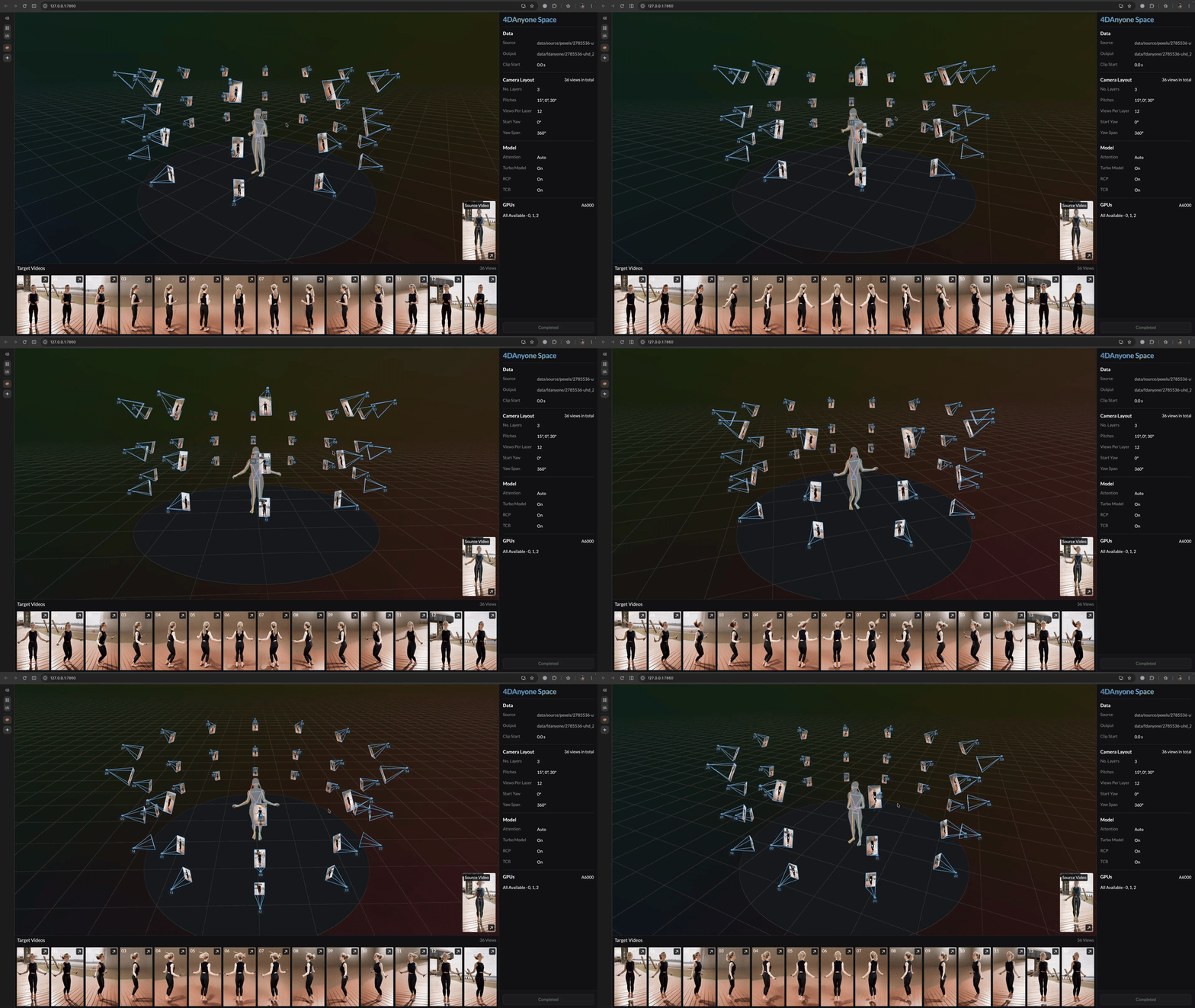
Install the GUI packages in the 4danyone environment:
pip install -r requirements-gui.txt
Pass an existing output directory to view inference results:
python app.py \
    --output_dir "data/fdanyone/pexels/2785536-uhd_2160_3840_25fps" \
    --server_port 7860
Choose a source video and a new output directory to run inference:
python app.py \
    --video_path "data/source/pexels/2785536-uhd_2160_3840_25fps.mp4" \
    --output_dir "data/fdanyone/pexels/2785536-uhd_2160_3840_25fps" \
    --server_port 7860
Open http://127.0.0.1:7860 in your browser. For a remote GPU server, first forward the port from your local computer:
ssh -N -L 7860:127.0.0.1:7860 user@gpu-host
https://github.com/user-attachments/assets/a51ec078-2970-4a37-9061-104211e1618d
For 3DGS reconstruction, see the nerfstudio guide.
We will integrate an open-source 4DGS reconstruction method. Stay tuned!
If you find 4DAnyone useful or interesting, please cite our work and consider giving the repository a star ⭐:
@article{jin2026fdanyone,
  title={4DAnyone: Create Anyone in 4D from a Casual Monocular Video},
  author={Jin, Yudong and Xie, Tao and Zhang, Qihang and Shen, Zehong and Xu, Zhen and Shen, Yujun and Bao, Hujun and Zhou, Xiaowei and Xu, Yinghao},
  journal={arXiv preprint arXiv:2608.20335},
  year={2026},
  url={https://arxiv.org/abs/2608.20335}
}
 →
→ →
→ →
→ →
→ →
→ →
→ →
→