1
 →
→
Kandinsky 2 — multilingual text2image latent diffusion model
ai-forever/Kandinsky-2 is an open-source project on GitHub, mainly written in Jupyter Notebook. Kandinsky 2 — multilingual text2image latent diffusion model It currently holds 2,812 stars and 319 forks with 0 open issues, and was last pushed on an unknown date (repository created unknown).
AI Homed tracks it on the AI Image Projects board and on the AI AI Image Projects list.
 — Inference example
— Fine-tuning with LoRA
+ Habr post + Demo fusionbrain.ai + Telegram-bot
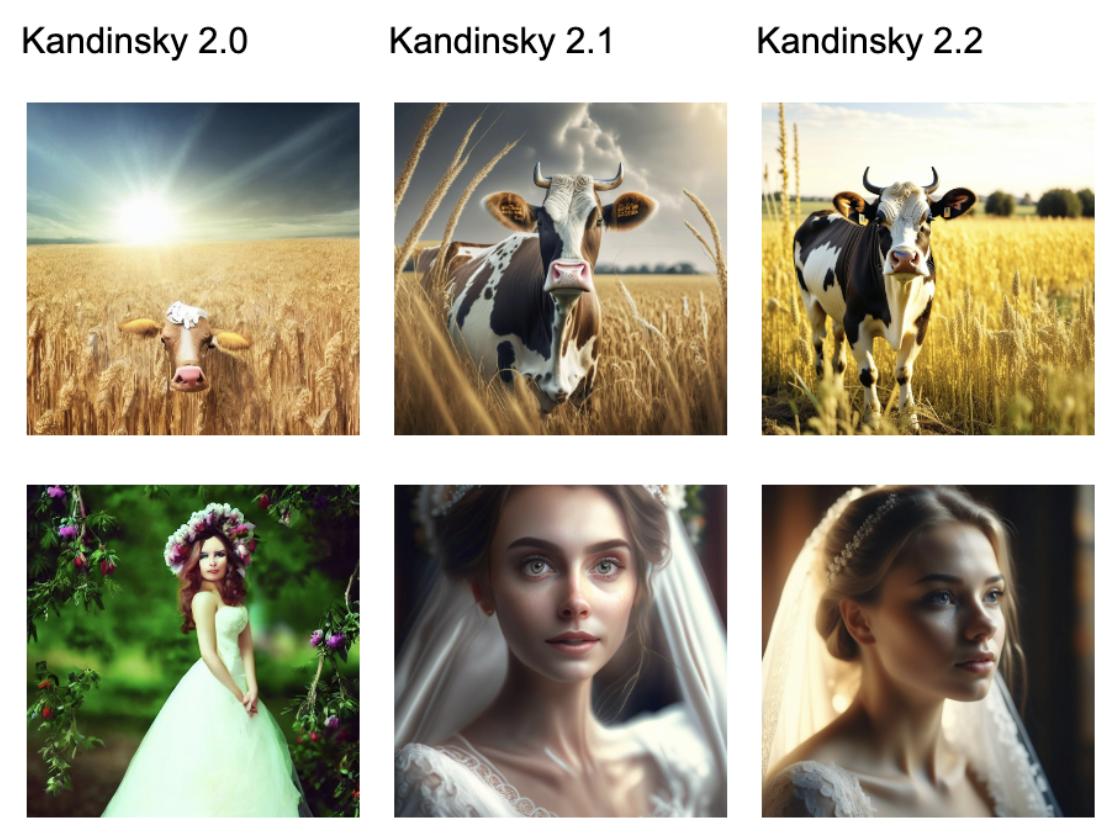
Description:
Kandinsky 2.2 brings substantial improvements upon its predecessor, Kandinsky 2.1, by introducing a new, more powerful image encoder - CLIP-ViT-G and the ControlNet support.
The switch to CLIP-ViT-G as the image encoder significantly increases the model's capability to generate more aesthetic pictures and better understand text, thus enhancing the model's overall performance.
The addition of the ControlNet mechanism allows the model to effectively control the process of generating images. This leads to more accurate and visually appealing outputs and opens new possibilities for text-guided image manipulation.
Architecture details:
+ Text encoder (XLM-Roberta-Large-Vit-L-14) - 560M + Diffusion Image Prior — 1B + CLIP image encoder (ViT-bigG-14-laion2B-39B-b160k) - 1.8B + Latent Diffusion U-Net - 1.22B + MoVQ encoder/decoder - 67M
Сheckpoints:
+ Prior: A prior diffusion model mapping text embeddings to image embeddings + Text-to-Image / Image-to-Image: A decoding diffusion model mapping image embeddings to images + Inpainting: A decoding diffusion model mapping image embeddings and masked images to images + ControlNet-depth: A decoding diffusion model mapping image embedding and additional depth condition to images
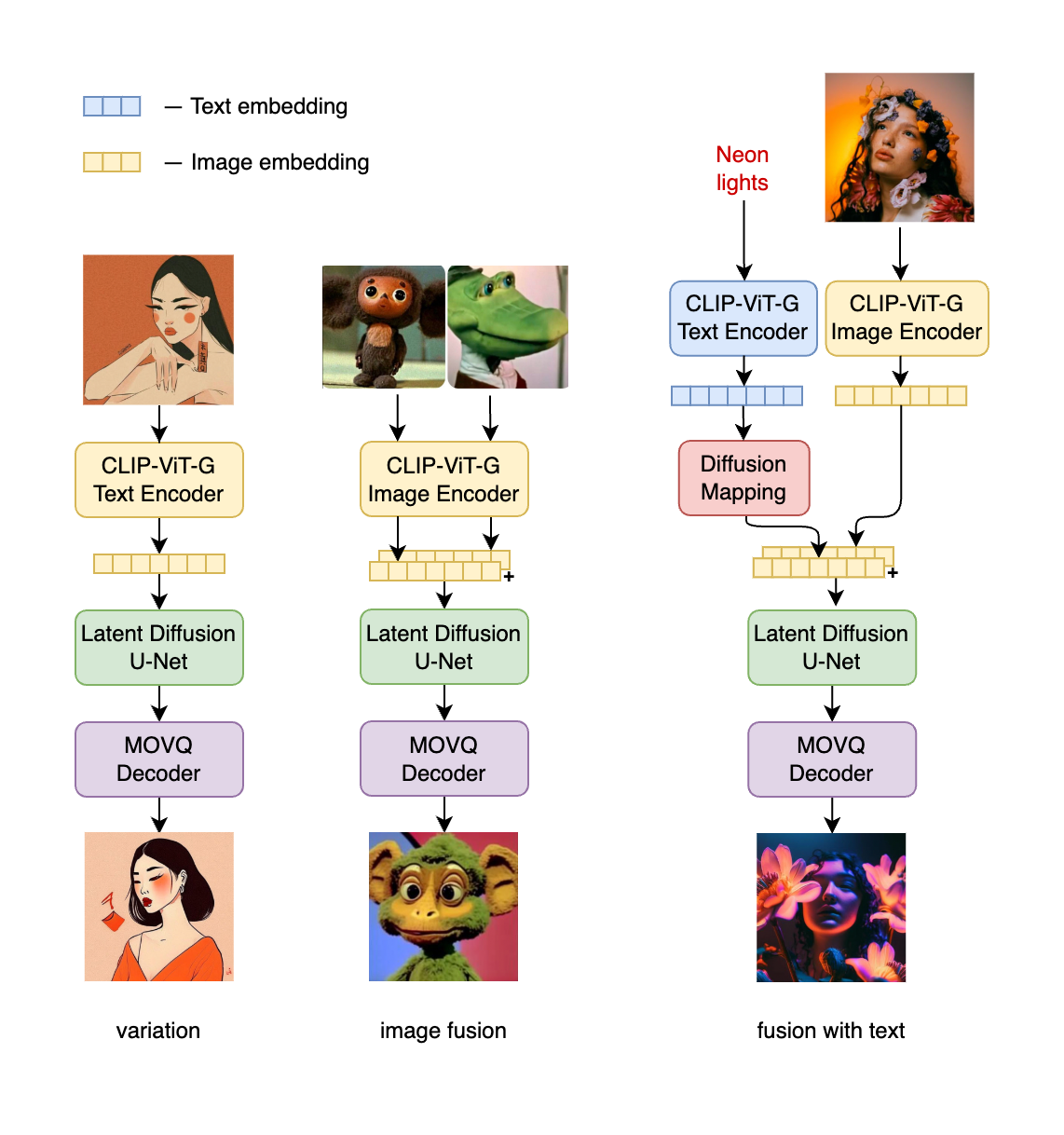
Check our jupyter notebooks with examples in ./notebooks folder
from kandinsky2 import get_kandinsky2
model = get_kandinsky2('cuda', task_type='text2img', model_version='2.2')
images = model.generate_text2img(
    "red cat, 4k photo",
    decoder_steps=50,
    batch_size=1,
    h=1024,
    w=768,
)


pip install "git+https://github.com/ai-forever/Kandinsky-2.git"
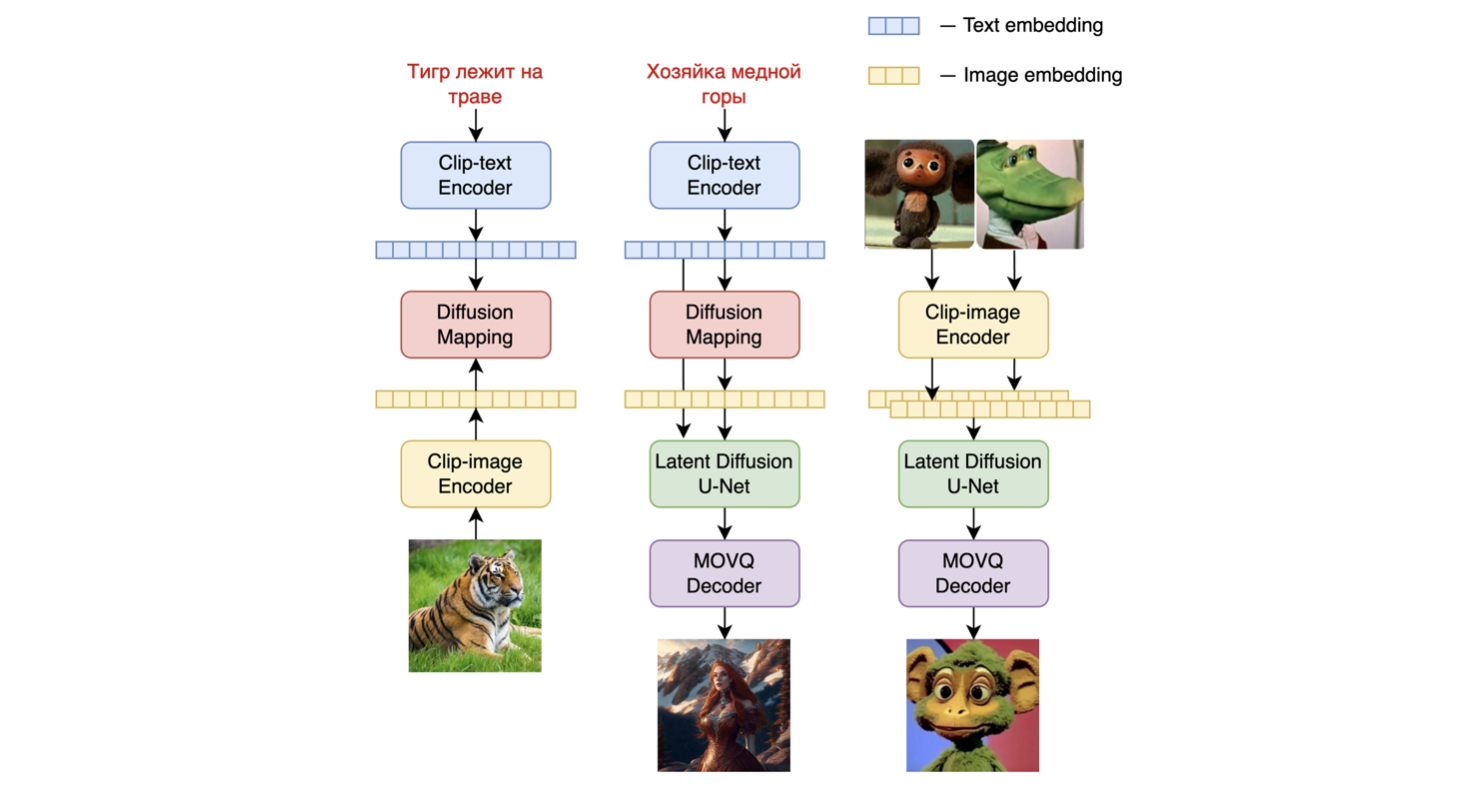
Kandinsky 2.1 inherits best practicies from Dall-E 2 and Latent diffusion, while introducing some new ideas.
As text and image encoder it uses CLIP model and diffusion image prior (mapping) between latent spaces of CLIP modalities. This approach increases the visual performance of the model and unveils new horizons in blending images and text-guided image manipulation.
For diffusion mapping of latent spaces we use transformer with num_layers=20, num_heads=32 and hidden_size=2048.
Other architecture parts:
+ Text encoder (XLM-Roberta-Large-Vit-L-14) - 560M + Diffusion Image Prior — 1B + CLIP image encoder (ViT-L/14) - 427M + Latent Diffusion U-Net - 1.22B + MoVQ encoder/decoder - 67M
Kandinsky 2.1 was trained on a large-scale image-text dataset LAION HighRes and fine-tuned on our internal datasets.
Check our jupyter notebooks with examples in ./notebooks folder
from kandinsky2 import get_kandinsky2
model = get_kandinsky2('cuda', task_type='text2img', model_version='2.1', use_flash_attention=False)
images = model.generate_text2img(
    "red cat, 4k photo",
    num_steps=100,
    batch_size=1,
    guidance_scale=4,
    h=768, w=768,
    sampler='p_sampler',
    prior_cf_scale=4,
    prior_steps="5"
)
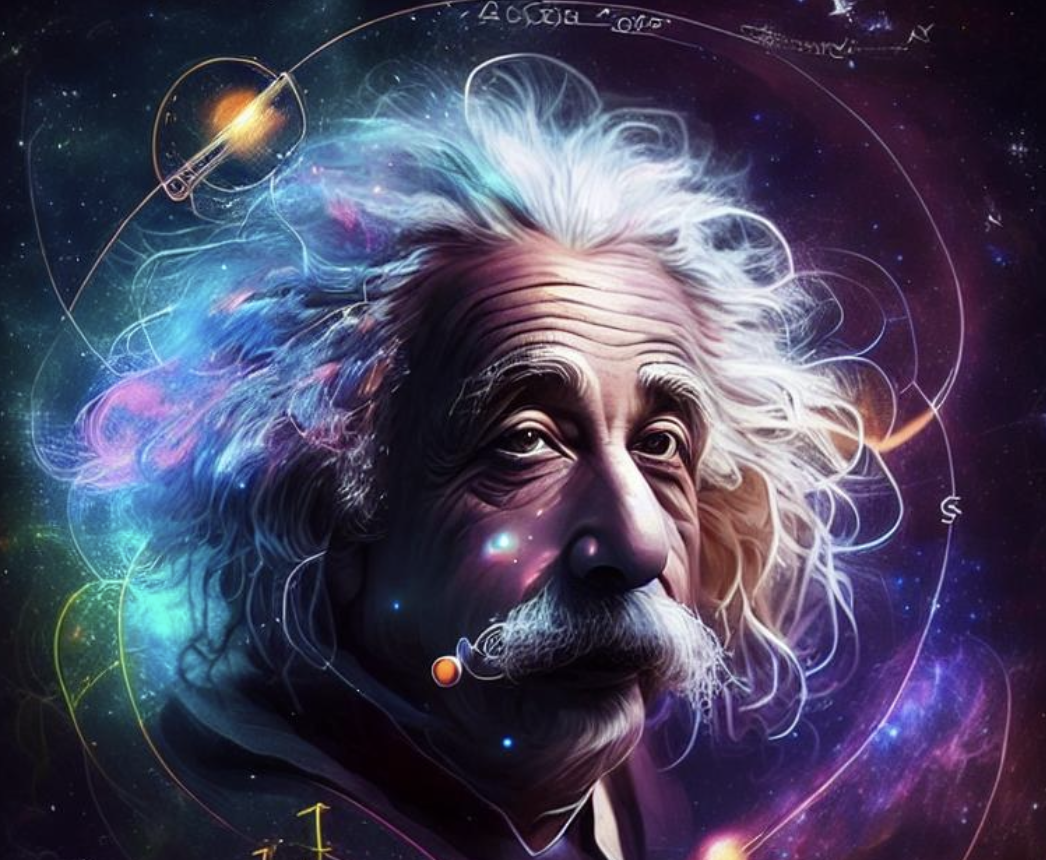
prompt: "Einstein in space around the logarithm scheme"
from kandinsky2 import get_kandinsky2
from PIL import Image
model = get_kandinsky2('cuda', task_type='text2img', model_version='2.1', use_flash_attention=False)
images_texts = ['red cat', Image.open('img1.jpg'), Image.open('img2.jpg'), 'a man']
weights = [0.25, 0.25, 0.25, 0.25]
images = model.mix_images(
    images_texts,
    weights,
    num_steps=150,
    batch_size=1,
    guidance_scale=5,
    h=768, w=768,
    sampler='p_sampler',
    prior_cf_scale=4,
    prior_steps="5"
)
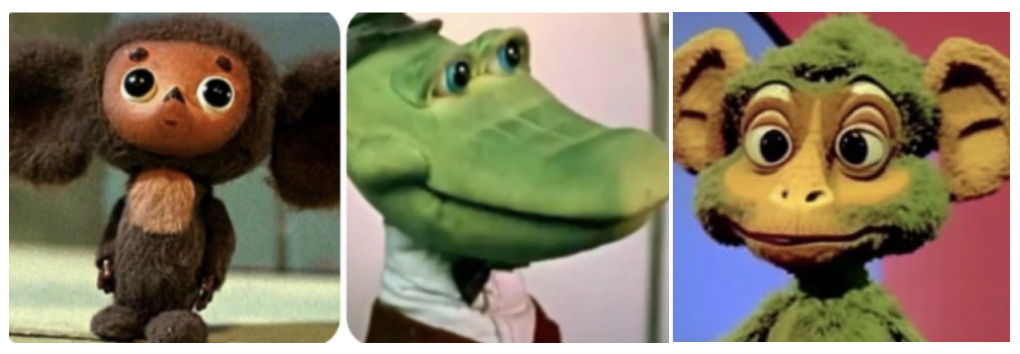
from kandinsky2 import get_kandinsky2
from PIL import Image
import numpy as np
model = get_kandinsky2('cuda', task_type='inpainting', model_version='2.1', use_flash_attention=False)
init_image = Image.open('img.jpg')
mask = np.ones((768, 768), dtype=np.float32)
mask[:,:550] =  0
images = model.generate_inpainting(
    'man 4k photo',
    init_image,
    mask,
    num_steps=150,
    batch_size=1,
    guidance_scale=5,
    h=768, w=768,
    sampler='p_sampler',
    prior_cf_scale=4,
    prior_steps="5"
)
pip install "git+https://github.com/ai-forever/Kandinsky-2.git"
It is a latent diffusion model with two multilingual text encoders:
Kandinsky 2.0 was trained on a large 1B multilingual set, including samples that we used to train Kandinsky.
In terms of diffusion architecture Kandinsky 2.0 implements UNet with 1.2B parameters.
Kandinsky 2.0 architecture overview:
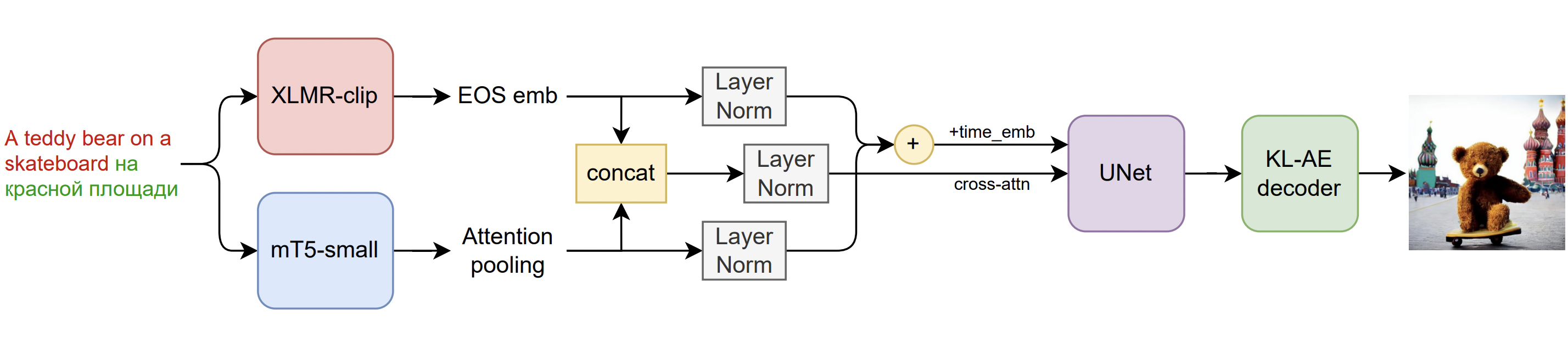
./notebooks folder
from kandinsky2 import get_kandinsky2
model = get_kandinsky2('cuda', task_type='text2img')
images = model.generate_text2img('A teddy bear на красной площади', batch_size=4, h=512, w=512, num_steps=75, denoised_type='dynamic_threshold', dynamic_threshold_v=99.5, sampler='ddim_sampler', ddim_eta=0.05, guidance_scale=10)
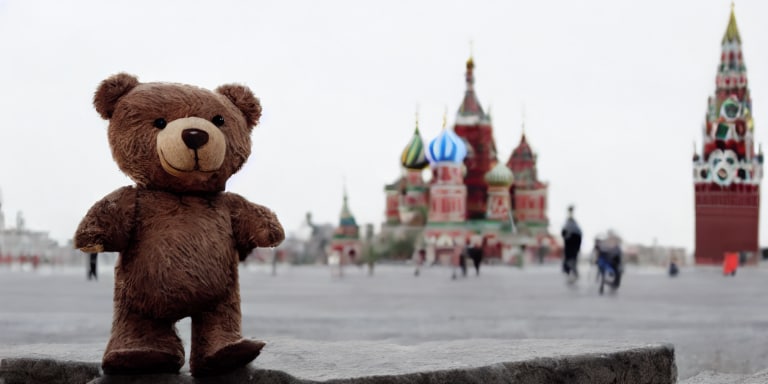
prompt: "A teddy bear на красной площади"
model = get_kandinsky2('cuda', task_type='inpainting') init_image = Image.open('image.jpg') mask = np.ones((512, 512), dtype=np.float32) mask[100:] = 0 images = model.generate_inpainting('Девушка в красном платье', init_image, mask, num_steps=50, denoised_type='dynamic_threshold', dynamic_threshold_v=99.5, sampler='ddim_sampler', ddim_eta=0.05, guidance_scale=10)
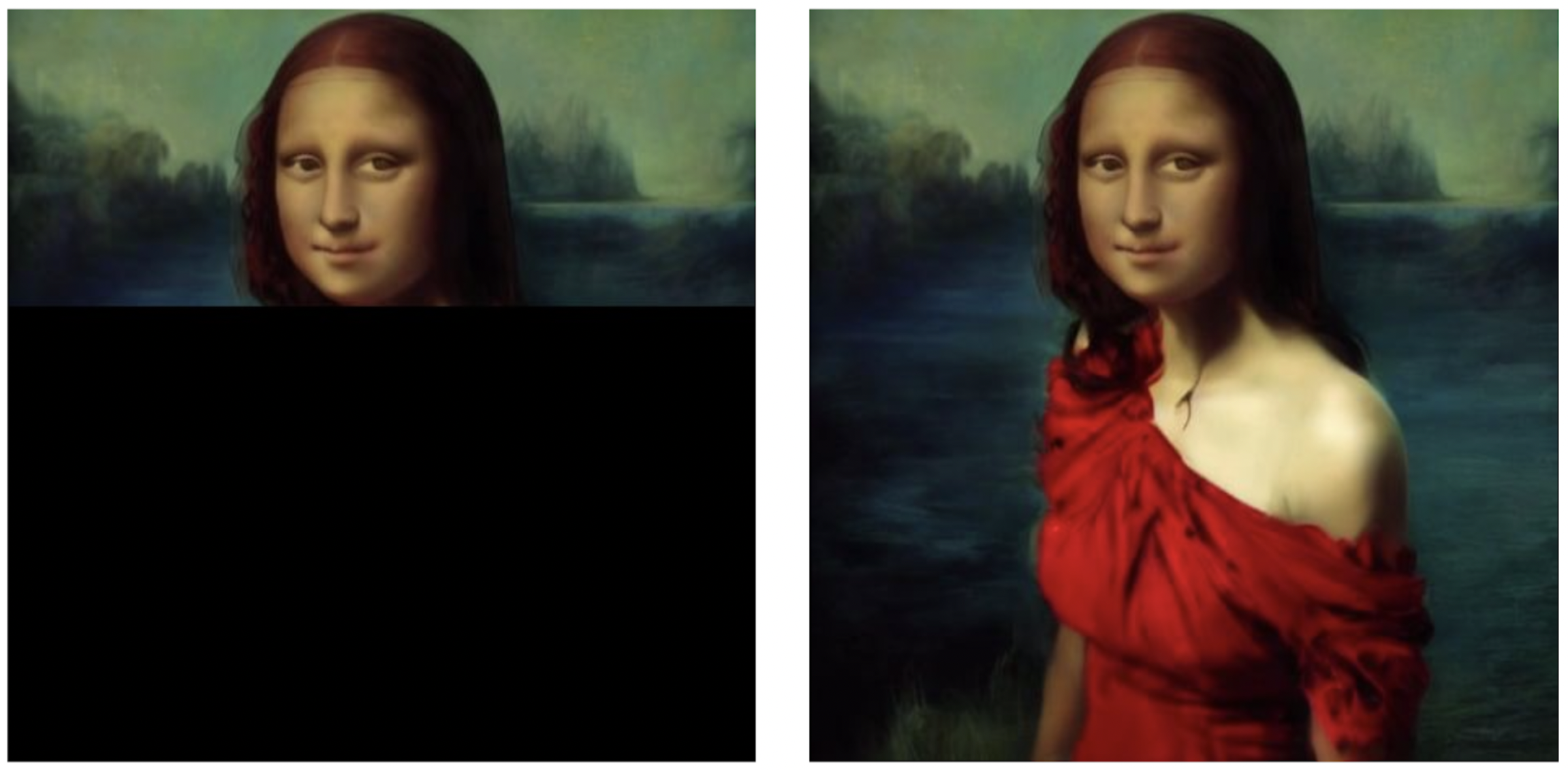
prompt: "Девушка в красном платье"
3. img2img
model = get_kandinsky2('cuda', task_type='img2img') init_image = Image.open('image.jpg') images = model.generate_img2img('кошка', init_image, strength=0.8, num_steps=50, denoised_type='dynamic_threshold', dynamic_threshold_v=99.5, sampler='ddim_sampler', ddim_eta=0.05, guidance_scale=10) ```
+ Arseniy Shakhmatov: Github, Blog + Anton Razzhigaev: Github, Blog + Aleksandr Nikolich: Github, Blog + Vladimir Arkhipkin: Github + Igor Pavlov: Github + Andrey Kuznetsov: Github + Denis Dimitrov: Github
→ →
→ →
→ →
→ →
→ →
→ →→
→→